
Your Cart Is Our Priority
Explore our store to see what our products and resources can do for you.

Not every charger that fits your golf cart is the right charger for it. That’s the mistake thousands of cart owners make every year, and it quietly costs them in reduced battery life, sluggish performance, and expensive replacements. The connector snaps in, the light turns green, and everything looks fine. But underneath, the wrong charging algorithm is either undercharging your pack or stressing it past its limits. This guide breaks down the real differences between golf cart battery chargers, what the specs actually mean, and how to match the right charger to your cart and battery type.
| Point | Details |
|---|---|
| Check charger compatibility | Using the wrong charger type can damage your golf cart battery or limit its capacity. |
| Match voltage and chemistry | Charger voltage and battery chemistry must align for effective and safe charging. |
| Upgrade for performance | Smart and high-amp chargers are best for carts used daily or with lithium batteries. |
| Connector matters | Always verify your golf cart’s connector type to avoid adapter headaches. |
| Routine maintenance saves money | Regular inspections and proper use extend charger and battery life while preventing common failures. |
A charger mismatch isn’t just an inconvenience. Using the wrong charger can cause undercharging, battery damage, or in serious cases, a fire risk. Most owners don’t realize this until they’re replacing a battery pack that should have lasted years longer.
The root issue is that golf cart chargers differ by battery chemistry, charger intelligence, voltage, amperage, and connector type. Each of those variables matters. A charger that’s perfect for a lead-acid 36V Club Car is completely wrong for a lithium 48V EZGO.
Here’s what drives those differences:
Many owners shop by connector fit alone. If it plugs in, it must be right. That logic leads to premature battery failure and voided warranties.
Pro Tip: Before buying any charger, write down your cart’s voltage, battery chemistry, and brand. That three-second step prevents a very expensive mistake.
Once you understand why differences matter, the actual charger categories become much easier to navigate. There are a few core distinctions every cart owner should know.
Lead-acid vs lithium chargers
Lead-acid chargers use a 3-stage process (bulk, absorption, float), while lithium chargers use a 2-stage process (constant current, constant voltage). These protocols are not cross-compatible. Plug a lead-acid charger into a lithium pack and you’ll get incomplete charging at best, battery damage at worst.
Onboard vs offboard chargers
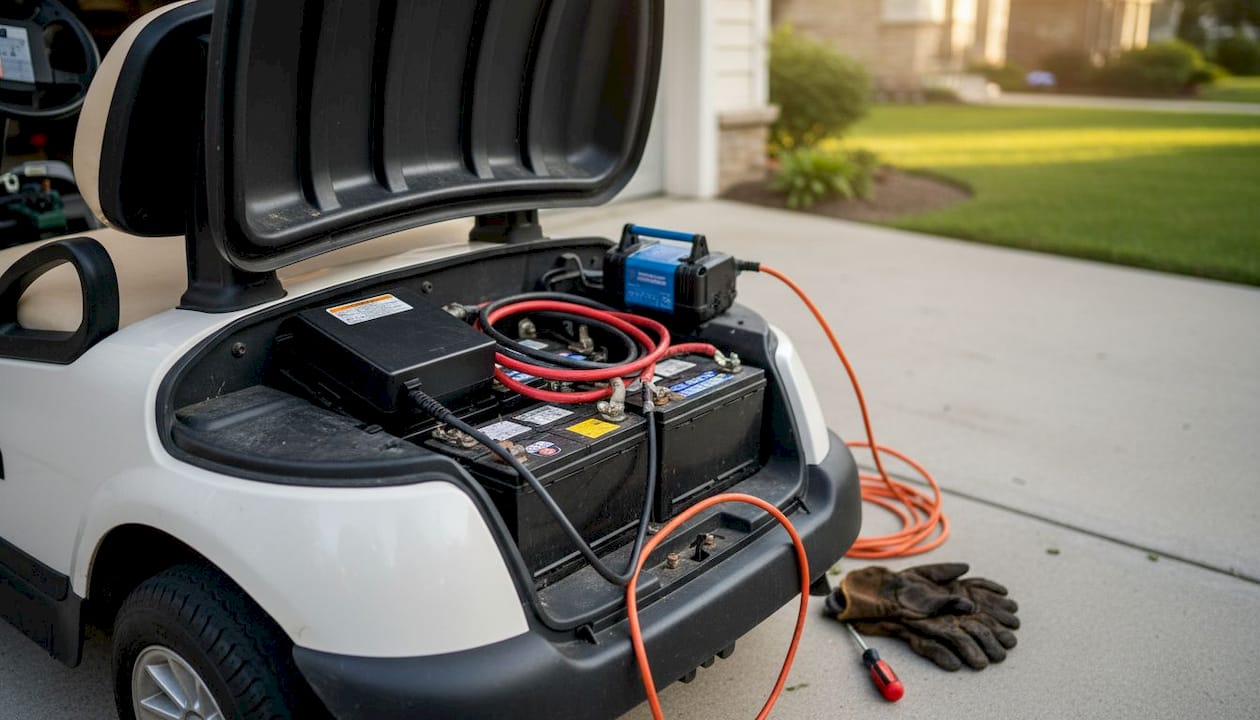
Here’s a quick comparison of the main charger types:
| Charger type | Best for | Key advantage | Key limitation |
|---|---|---|---|
| Lead-acid manual | Occasional use, older carts | Low cost | Requires monitoring |
| Lead-acid smart | Regular lead-acid users | Auto shutoff | Not lithium compatible |
| Lithium smart | Lithium battery packs | Full charge, safe shutoff | Higher upfront cost |
| Onboard | Convenience-focused owners | Built-in, no cables | Harder to replace |
| Offboard/portable | High-use or fleet carts | Higher amps, easy swap | Requires storage |
When choosing a charger, your battery type and how often you ride should drive the decision. A weekend cart and a daily-use fleet vehicle have very different needs.
Key features to look for in any charger:
The numbers on a charger label aren’t just technical filler. They tell you whether that charger will safely and fully charge your battery pack, or quietly damage it over time.
Voltage: The non-negotiable spec
Chargers differ by voltage (36V vs 48V), amperage (15A vs 18A), and connector type. Voltage is the one you cannot compromise on. A 48V charger on a 36V cart will push too much voltage into the system. A 36V charger on a 48V cart won’t fully charge the pack. Both scenarios shorten battery life significantly.
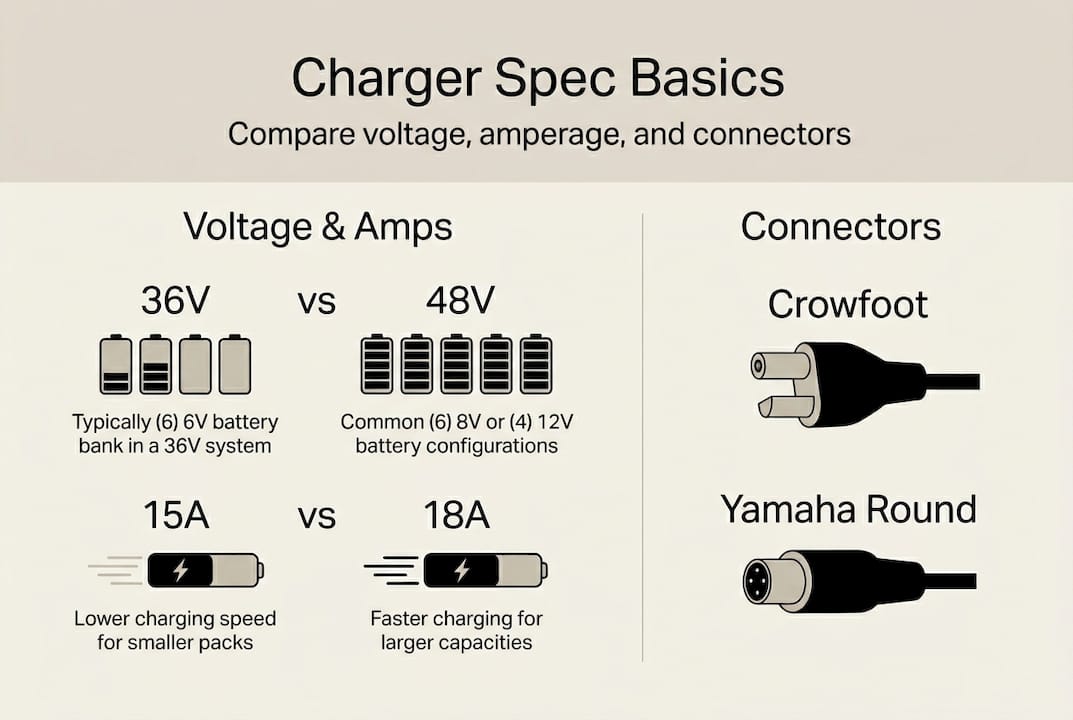
Understanding your golf cart voltage is the first step before buying any replacement charger.
Amperage: Speed vs compatibility
Amperage controls how fast your batteries charge. A 15A charger on a 150Ah battery pack takes roughly 10 hours for a full charge. An 18A charger cuts that down noticeably. But higher amps aren’t always better. Your battery pack needs to be rated to accept that charge rate, or you risk heat buildup and accelerated degradation.
Here’s how common spec combinations compare in practice:
| Voltage | Amperage | Charge time (150Ah pack) | Best use case |
|---|---|---|---|
| 36V | 15A | ~10 hours | Occasional weekend use |
| 36V | 18A | ~8 hours | Regular use, 36V system |
| 48V | 15A | ~10 hours | Standard daily use |
| 48V | 18A | ~8 hours | Heavy use, fleet carts |
| 48V | 25A+ | ~6 hours | Commercial or high-frequency |
Connector types: Brand-specific and non-negotiable
Connectors are brand-specific by design. Here’s what you’ll typically encounter:
Pro Tip: A connector adapter might let you plug in a mismatched charger, but it won’t fix a voltage or chemistry mismatch. Adapters solve physical fit problems only.
This is where most upgrade mistakes happen. When cart owners switch from lead-acid to lithium batteries, they often keep the old charger. It fits. It turns on. But it’s doing real damage.
A lead-acid charger undercharges lithium batteries to only 80% capacity. That’s not a minor inconvenience. Over time, you’re running on a permanently reduced range and accelerating cell degradation in a battery pack that cost you significantly more than lead-acid.
Here’s why the chemistry gap matters so much:
Club Car owners face an additional layer of complexity. Club Car uses an OBC (onboard computer) that communicates with the charger. If the charger isn’t OBC-compatible, the cart may not charge at all, or it may charge incorrectly and affect your warranty.
“Lead-acid and lithium protocols are not cross-compatible. Using a lead-acid charger on lithium batteries limits capacity to around 80% and shortens overall battery life.”
If you’re thinking about upgrading to lithium batteries, budget for a new charger at the same time. It’s not optional. It’s part of the upgrade.
The “intelligence” of your charger has a bigger impact on battery health than most owners realize. This isn’t just a convenience feature. It directly affects how long your batteries last.
Manual chargers require you to monitor the charge and disconnect at the right time. Leave one plugged in too long and you’ll overcharge the pack. Forget to plug it in long enough and you’ll undercharge. Both scenarios degrade battery health over repeated cycles.
Smart (automatic) chargers adjust current throughout the charge cycle and shut off automatically when the pack is full. They’re far more forgiving and far better for battery longevity. For heavy-use carts, upgrading to 18A+ smart chargers is the right move. The lithium market is growing to over $220 million by 2030, driven largely by the weight savings and reduced maintenance that lithium systems offer.
Here’s how to decide which type fits your situation:
Pro Tip: If you ride your cart more than three times a week, a smart charger pays for itself in extended battery life within the first year. Check out our battery performance tips for more ways to protect your investment.
Even the right charger can cause problems if it’s not maintained or used correctly. A few simple habits protect both your charger and your battery pack.
Regular charger care checklist:
For Club Car owners specifically, OBC-compatible chargers are required. Using a non-compatible charger with Club Car’s onboard computer causes charging failures and can create warranty issues.
Common mistakes that shorten charger life:
When to repair vs replace:
If your charger is more than five years old and showing signs of slow charging or heat buildup, replacement is usually more cost-effective than repair. Charger technology has improved significantly, and a new smart charger will likely outperform a repaired older unit. Review our charger maintenance steps for a full inspection routine.
Pro Tip: Never store your charger coiled tightly around itself. Heat builds up in coiled cords during charging and degrades the insulation faster than almost anything else.
You now know more about golf cart chargers than most dealers will tell you at the point of sale. Putting that knowledge to work means finding a charger that matches your voltage, chemistry, amperage needs, and connector type exactly.

At GolfCartStuff.com, we carry chargers for every major cart brand and battery type, from basic lead-acid units to high-output lithium smart chargers. Whether you’re replacing a worn-out unit or upgrading your entire charging setup after a lithium battery swap, our catalog is organized by cart model, voltage, and chemistry so you find the right fit without guesswork. If you’re not sure where to start, our guide on how to choose the right charger walks you through every decision point. Our team is also available to help you match specs to your specific cart and usage pattern.
No. A 48V charger on 36V pushes excess voltage into the battery system, which can cause serious damage to both the batteries and the charger itself.
A lead-acid charger undercharges lithium batteries to roughly 80% capacity, which reduces your range and accelerates long-term battery degradation.
Check your owner’s manual or look at the existing plug shape. Brand-specific connectors like crowfoot, Yamaha round, and EZGO D-style are not interchangeable, so matching the style is essential.
Absolutely. Smart chargers for frequent use automatically shut off when the pack is full, eliminating overcharge risk and extending battery life considerably compared to manual units.
Explore our store to see what our products and resources can do for you.

Leave a comment