




Your Cart Is Our Priority
Explore our store to see what our products and resources can do for you.

TL;DR:
- Golf cart digital meters measure and display battery charge, voltage, and current data in real time to prevent unexpected power loss. Using smart shunt monitors or BMS-integrated displays provides the most accurate readings, especially for lithium batteries, compared to simple voltage meters. Proper installation across the full pack with correct configuration ensures reliable operation and accurate insights into battery health.
Golf cart digital meters are instruments that measure and display your battery pack’s State of Charge (SOC), voltage, and electrical data in real time. Without one, you are riding blind. A sudden power loss mid-round or mid-trip is almost always preventable with a working meter. This guide covers how digital gauges work, how to install them correctly, how to fix common problems, and why upgrading to a smart monitor pays off for any serious cart owner.

A golf cart digital meter reads electrical data from your battery pack and converts it into a readable display. The most common formats are LED bar graphs, numeric LCD panels, and smart shunt-based monitors. Each type serves a different level of accuracy and detail.
Simple voltage meters measure the pack’s resting voltage and estimate charge level from that number. They are affordable and easy to install, but they have a significant weakness. Voltage-based meters are less accurate for LiFePO4 batteries because lithium iron phosphate chemistry has a flat voltage discharge curve. That means voltage barely changes as the battery drains, so a voltage reading tells you very little about actual remaining capacity.
Smart shunt-based monitors solve this problem by measuring actual current flowing in and out of the pack. Smart monitors can achieve accuracy of up to ±1% by tracking coulombs rather than guessing from voltage. That level of precision matters when you are managing a lithium pack worth several hundred dollars. Battery Management System (BMS) integrated meters go one step further by reading data directly from the cells themselves.
Pro Tip: If your cart runs a lithium battery, skip the basic LED bar meter. A numeric LCD or smart shunt monitor is the only way to get readings you can actually trust.
| Meter type | Display format | Best for | Accuracy |
|---|---|---|---|
| LED bar graph | 5–10 LED segments | Casual riders, lead-acid packs | Low to moderate |
| Numeric LCD | Percentage or voltage digits | All chemistries, daily drivers | Moderate |
| Smart shunt monitor | Percentage, amps, volts | Lithium users, performance owners | High (up to ±1%) |
| BMS-integrated display | Full cell data, fault codes | Advanced lithium systems | Very high |
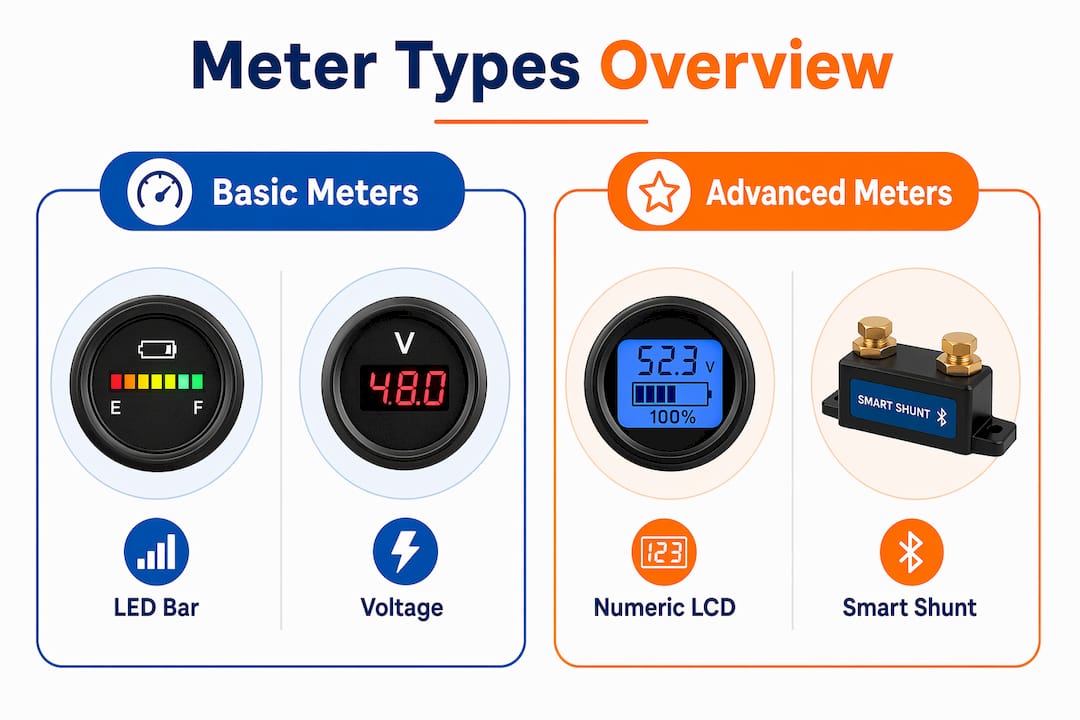
Battery monitoring preferences vary: casual riders favor simple LED bars, while performance enthusiasts and lithium users prefer numeric LCD or smart shunt-based meters for detailed data. Choosing the wrong type for your battery chemistry is the most common mistake cart owners make.
Proper installation determines whether your meter reads accurately or misleads you every time you check it. The single most important rule: wire the meter across the entire battery pack, not across a single battery. Connecting a meter to just one battery produces inaccurate and misleading SOC data. You need total pack voltage to get a meaningful reading.
Here is the standard installation process:
Installation typically takes a few hours with basic tools and is a common DIY upgrade that improves operational reliability. The Golfcartstuff wiring and troubleshooting guide walks through configuration steps for multiple meter types and pack voltages.
Pro Tip: Use a switched power source for the meter’s positive lead so the display powers off with the key. This prevents phantom drain on your battery pack over days of sitting.
Inaccurate readings are the most common complaint from cart owners after installing a new meter. Most problems trace back to one of three causes: wrong wiring, incorrect settings, or misreading voltage sag.
Common symptoms and their causes:
The fastest diagnostic step is cross-referencing your meter against a handheld multimeter. A 48V lead-acid pack rests at around 50.9 volts after charging and settling; a 36V pack rests at about 38.2 volts. If your multimeter matches those numbers but the meter shows something different, the meter settings are wrong. If both readings are off, suspect the battery or charger.
Experienced owners check meter readings only when the cart is at rest, never under load. That single habit eliminates most confusion about low readings. For deeper electrical issues, the Golfcartstuff troubleshooting guide covers common diagnostic steps across multiple cart models.
Smart meters do more than display a number. They give you a complete picture of your battery’s health and behavior over time. That shift from guessing to knowing changes how you maintain your cart.
Key advantages of smart and BMS-integrated meters:
Smart battery monitors with Bluetooth reduce misunderstandings about battery status and improve owner confidence. That transparency also helps when dealing with warranty claims or diagnosing a problem with a dealer. Partial charge cycles, temperature swings, and protection events all affect SOC calibration in lithium batteries. A smart BMS corrects for these variables automatically, which a basic voltage meter cannot do. If you are running lithium golf cart batteries, a smart monitor is not optional. It is the only way to manage the pack correctly.
A smart shunt or BMS-integrated meter is the most accurate way to monitor a golf cart battery pack, especially for lithium chemistry, because it tracks actual current flow rather than estimating from voltage alone.
| Point | Details |
|---|---|
| Wire across the full pack | Connect meter to main pack terminals, not a single battery, for accurate SOC readings. |
| Match meter to battery type | Configure chemistry and voltage settings before trusting any reading on the display. |
| Read at rest, not under load | Voltage sag during acceleration causes false low readings; always check with the cart stopped. |
| Choose smart for lithium | LiFePO4 flat voltage curves make basic voltage meters unreliable; use a shunt or BMS monitor. |
| Fuse the positive lead | A 1A–3A inline fuse on the positive wire protects the meter and wiring from shorts. |
Most cart owners treat the battery meter as an afterthought. They glance at it, see a few bars, and assume everything is fine. That approach costs money.
The real value of a good digital gauge shows up in what it prevents. I have seen owners run lead-acid packs to near-zero repeatedly because their LED bar meter stayed green until the last moment. Lead-acid batteries lose significant capacity when regularly deep-discharged. A numeric LCD or smart monitor would have shown the actual percentage dropping and prompted a charge much earlier.
The other mistake I see constantly is checking the meter while the cart is moving or just after a hard climb. Voltage sag makes the reading look worse than reality. Owners panic, charge unnecessarily, or start suspecting a bad battery when the pack is actually fine. Reading the meter at rest, after a five-minute cool-down, gives you the number that actually means something.
For lithium users specifically, I cannot overstate how much a smart BMS monitor changes the ownership experience. You stop guessing and start managing. The Golfcartstuff battery meter guide is a solid starting point if you want to understand what your specific meter is actually telling you. Waterproof ratings matter too. An outdoor cart in a humid climate will kill an unrated meter within a season. Spend the extra few dollars on an IP65 or better rated unit and it will outlast the cart.
— Roshan
Golfcartstuff carries a full lineup of golf cart battery meters covering 36V, 48V, and 72V systems for both lead-acid and lithium chemistries. Whether you need a simple LED bar for a weekend cruiser or a numeric LCD for a daily driver, the selection covers most common cart models and pack configurations.

Every meter listing includes installation notes and compatibility details so you can order with confidence. The team at Golfcartstuff also stocks the golf cart accessories you need to complete an upgrade, from wiring hardware to mounting hardware. If you own a Club Car or Yamaha, the model-specific parts pages make it easy to find components that fit without guesswork.
A golf cart digital meter is an instrument that displays your battery pack’s State of Charge, voltage, and sometimes current in real time. It helps owners avoid unexpected power loss and manage battery health.
A voltage meter estimates charge level from pack voltage alone, while a smart shunt monitor tracks actual current flow for accuracy up to ±1%. Smart monitors are far more reliable for lithium battery packs.
Voltage sag under load causes the meter to show a temporarily lower reading during hard acceleration or hill climbs. Check the meter only when the cart is at rest for an accurate SOC reading.
Compare the meter reading to a handheld multimeter at the pack terminals with the cart at rest. A healthy 48V lead-acid pack reads around 50.9 volts; a 36V pack reads around 38.2 volts. A mismatch points to a wiring or settings error.
Yes. Installation is a common DIY upgrade that typically takes a few hours with basic tools including a drill, hole saw, and wire crimper. The key steps are wiring across the full pack, fusing the positive lead, and configuring the meter for your battery chemistry and voltage.
Explore our store to see what our products and resources can do for you.

Leave a comment