
Your Cart Is Our Priority
Explore our store to see what our products and resources can do for you.

TL;DR:
- Laws for golf carts vary by federal, state, and local regulations, requiring ongoing compliance.
- Owners must equip carts with headlights, turn signals, mirrors, seat belts, and register for street use.
- Regularly review local rules, maintain equipment, and ensure proper documentation to avoid fines.
Many golf cart owners assume their cart is welcome on any neighborhood street, but that assumption can lead to real fines and headaches in 2026. The rules governing where and how you can drive a golf cart are layered: federal standards set the floor, state laws build on top, and local ordinances often add their own twists. With more cities actively revising their micro-mobility policies this year, what was legal last season may not be legal now. This guide walks you through every layer of the legal framework so you can drive with confidence, avoid surprises, and keep your cart compliant year-round.
| Point | Details |
|---|---|
| Federal safety basics | Golf carts must meet minimum federal equipment and speed standards to qualify as Low-Speed Vehicles. |
| State and local rules differ | Check both state laws and local ordinances, since city rules often add special requirements. |
| Paperwork and insurance needed | Most US states require insurance, registration, and a valid driver’s license for street-legal use. |
| Upgrades and costs | Plan on $300–$1,200 for conversions and factor in ongoing insurance premiums and inspections. |
| Ongoing compliance is key | Stay aware of annual legal changes and inspect your cart often to avoid fines or liability. |
Now that we understand the confusion around legality, let’s start with the federal baseline. Not every golf cart qualifies as a street-legal vehicle under federal law. The key distinction is between a basic golf cart and a Low-Speed Vehicle, commonly called an LSV.
A basic golf cart is designed for golf courses and private property. An LSV is a federally recognized vehicle class that can be registered for public road use. Federal law defines LSVs under FMVSS 500 (49 CFR 571.500) as four-wheeled vehicles with a top speed between 20 and 25 mph and a gross vehicle weight rating under 3,000 lbs. To qualify, the vehicle must have headlamps, turn signals, taillamps, stop lamps, reflectors, mirrors, a windshield, seat belts, a parking brake, a horn, a VIN, rear visibility, and a pedestrian alert sound.
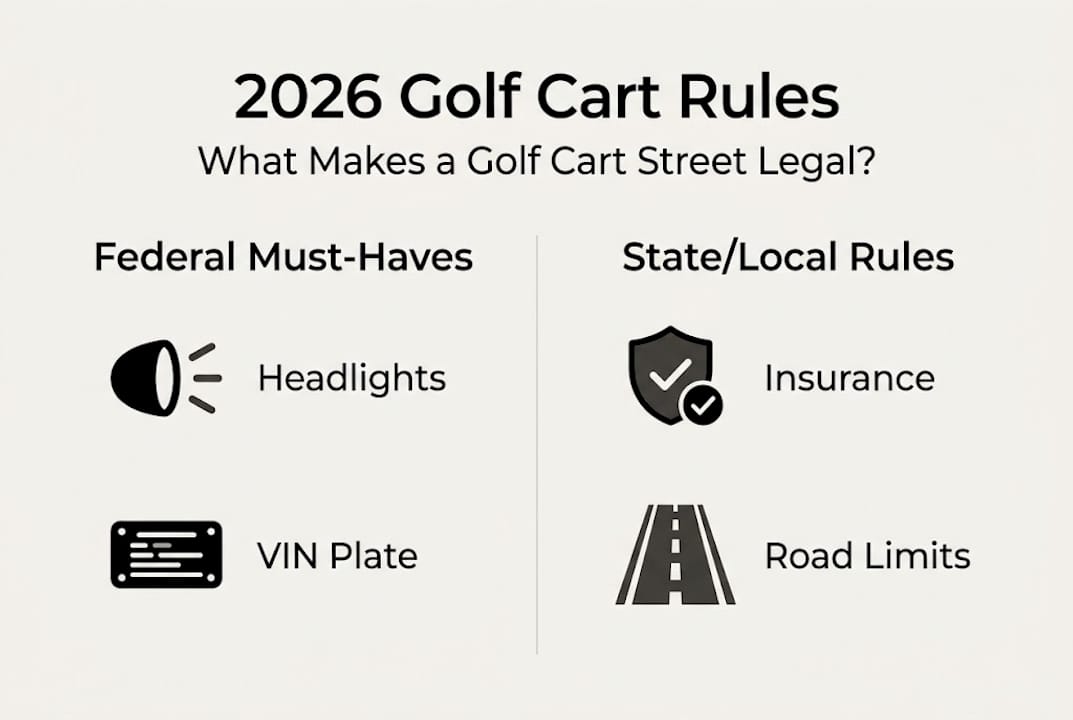
Here’s a quick comparison of the two categories:
| Feature | Basic golf cart | LSV (street legal) |
|---|---|---|
| Top speed | Under 20 mph | 20 to 25 mph |
| VIN required | No | Yes |
| Seat belts | Optional | Required |
| Headlamps | Optional | Required |
| Public road use | No | Yes (where permitted) |
The minimum federal equipment list for an LSV includes:
No major changes to FMVSS 500 took effect in 2026, though federal attention has shifted toward autonomous and micro-mobility vehicles. The street legal requirements for LSVs remain consistent, making this a stable baseline to build from.
Pro Tip: Check your cart’s VIN plate before assuming it qualifies as an LSV. No VIN means no federal street-legal status, regardless of what equipment you add. You can browse mandatory equipment options to close any gaps.
With the federal standards set, understanding how state and local laws apply is critical. Federal law creates the vehicle class, but it doesn’t automatically grant road access. That authority belongs to the states and, in many cases, the cities and counties within them.
Approximately 42 to 48 states have some form of LSV law on the books, but the rules vary widely. Most states allow LSVs on roads with speed limits at or below 35 mph and prohibit them on highways or faster arterials. However, local ordinances can expand or restrict those permissions significantly.
Here’s a snapshot of how states compare:
| State type | Examples | Key rules |
|---|---|---|
| Permissive | FL, AZ, TX, SC | Wide LSV access, local ordinances common |
| Moderate | CA, GA, NC | LSV allowed with registration and insurance |
| Restrictive | NY, MA, VT | Limited or prohibited street use |
Florida is a good example of how layered rules work. State law permits golf carts on certain roads but requires lights for night driving. Individual counties and cities then add their own conditions, such as approved routes, age minimums, or permit requirements.
“More U.S. cities are allowing golf carts on the road even if they aren’t 100% street legal” as micro-mobility trends push local governments to create practical access rules that go beyond strict federal compliance.
The trend is clear: more municipalities are opening streets to golf carts and LSVs, especially in retirement communities, resort towns, and dense suburban neighborhoods. Check the street legal advantages in 2026 to understand why this shift benefits owners who invest in compliance now.
Once you know where you can drive, the next step is making sure you have the right paperwork and insurance. Most states require a valid driver’s license to operate an LSV on public roads, with age 16 being the most common minimum. Registration and titling go through your state DMV or its equivalent, and annual fees typically run between $15 and $40.

Insurance is not optional in most jurisdictions. Liability insurance with a minimum of $10,000 is required in states like Florida, and most policies run between $100 and $300 per year. That’s a small price compared to the liability exposure of driving uninsured.
Here’s a practical cost overview:
| Requirement | Typical cost | Notes |
|---|---|---|
| Registration/title | $15 to $40/year | Varies by state |
| Liability insurance | $100 to $300/year | Minimum coverage |
| Driver’s license | Already owned | Age 16+ in most states |
Your 2026 registration checklist:
The street legal basics guide covers the paperwork process in more detail if you need step-by-step help. You can also review the accessories checklist to make sure your cart is fully equipped before you head to the DMV.
Pro Tip: Keep a copy of your insurance card and registration inside your golf cart at all times. Many officers who stop LSV drivers aren’t familiar with the paperwork, and having it on hand prevents unnecessary delays.
With documents in hand, let’s cover the specific features and upgrades your golf cart needs for full compliance. If your cart started life as a basic golf cart, it almost certainly needs modifications before it can legally hit public roads.
The most common required upgrades include:
Conversion costs typically range from $300 to $1,200 depending on how many upgrades are needed and whether you go DIY or hire a professional. Insurance adds another $100 to $300 per year. The golf cart market is growing at roughly 8% annually through 2034, driven largely by LSV demand, which means dealers who stock conversion kits are sitting on a real growth opportunity.
For DIY owners, a basic light kit with signals and reflectors can run $150 to $400. Adding mirrors and seat belts brings the total closer to $500 to $700. A professional installation with all components typically lands between $800 and $1,200. The investment pays off quickly when you factor in avoided fines, which can run $100 to $500 per violation in many jurisdictions.
Pro Tip: Buy a complete street legal light kit designed for your specific cart model. Generic kits often require extra wiring work and may not meet all local standards.
Knowing the upgrades is key, but practical compliance means staying safe year-round. The rules don’t stay frozen. Cities revise ordinances, states update their LSV laws, and enforcement priorities shift. Owners who treat compliance as a one-time project are the ones who get caught off guard.
Here’s a practical annual compliance routine:
The FMVSS 500 standard saw no changes in 2026, so federal requirements are stable. But local rules are where most surprises happen. A city council vote can change approved routes, speed limits, or permit requirements with 30 days’ notice.
The most common fines come from missing or broken lights, expired registration, and driving on roads that exceed the permitted speed limit. These are all preventable with a seasonal check. Use the inspection checklist to run through every item before your first drive of the year.
Pro Tip: Set a calendar reminder each January to check your local government’s website for any golf cart ordinance updates. Five minutes of research can save you hundreds in fines.
We’ve covered the rules. Here’s what most experienced owners and dealers know that others often overlook.
The biggest legal surprises almost never come from federal law. They come from a local ordinance that changed quietly over the winter, or from crossing into a neighboring county with stricter rules. Owners who focus only on the federal checklist and assume they’re done are the ones who get ticketed.
Compliance is not a one-time project. It’s an ongoing habit. The owners who stay out of trouble are the ones who check local rules annually, keep their equipment in good condition, and don’t cut corners on upgrades just to save $50. Cheap turn signals that fail after one season don’t just create a safety risk. They create a citation.
There’s also a financial argument for doing this right. Dealers who help customers understand the real street legal advantages and invest in quality conversion kits build long-term loyalty. Owners who stay compliant avoid fines, keep their insurance rates stable, and get more use out of their carts. The upfront cost of full compliance is almost always less than the cumulative cost of ignoring it.
Having a trusted source for legal upgrades makes staying compliant simple. Whether you’re converting a basic cart to LSV status or replacing worn safety equipment, sourcing the right parts matters.
At Golf Cart Stuff, we carry a full range of golf cart accessories and mechanical parts for all major brands, including Club Car, EZGO, and Yamaha. Our street legal upgrades section is built specifically for owners and dealers who need to meet 2026 compliance requirements without guesswork. From complete light kits to seat belt sets and mirrors, everything is organized by cart model so you get the right fit the first time. Our team is available to answer compliance questions and help you build the right kit for your cart.
Your cart needs headlamps, turn signals, taillamps, mirrors, seat belts, a windshield, and a VIN per federal FMVSS 500 requirements, but always check local ordinances for additional items like pedestrian alert systems.
Most states allow LSVs on roads up to 35 mph where local law permits, but highways and faster roads remain off-limits regardless of state.
Yes. Liability insurance is required in most states, with minimums like $10,000 common, and most policies cost between $100 and $300 per year.
Conversion costs typically range from $300 to $1,200 for parts and installation, with insurance adding another $100 to $300 annually.
No. FMVSS 500 requirements for LSVs remain unchanged in 2026, so the federal equipment checklist you followed last year still applies.
Explore our store to see what our products and resources can do for you.

Leave a comment