
Your Cart Is Our Priority
Explore our store to see what our products and resources can do for you.

TL;DR:
- Many states require golf carts to have turn signals for street and community use.
- Proper turn signals significantly improve safety and communication on shared paths and roads.
- Installing the right kit can enhance safety, compliance, and community relations for golf cart owners.
Most golf cart owners assume turn signals are optional extras, like a cup holder or a custom seat cover. That assumption can cost you more than you think. In many states and residential communities, operating a cart without turn signals on public paths or roads is not just frowned upon but actually illegal. Beyond the law, the absence of a simple blinking light creates real collision risks every time you approach an intersection, merge onto a path, or share the road with cars. This article breaks down the legal landscape, the safety data, the etiquette benefits, and the practical steps to get your cart properly equipped.
| Point | Details |
|---|---|
| Legal compliance | Turn signals are often required by state and local laws, especially for street-legal golf carts. |
| Accident reduction | Using turn signals can cut golf cart accident risks and improve visibility to other road users. |
| Improved etiquette | Signals replace unreliable hand gestures and reduce confusion in busy golf communities. |
| Easy installation | Most carts can be upgraded with a kit, making this a practical and valuable safety investment. |
If you think turn signals only matter on highways, consider this: turn signals are required for night use and street-legal operation in Florida and communities like The Villages, and many HOAs and local laws mandate them for public paths. Florida is not a special case. Across the country, states and municipalities are tightening the rules on what qualifies as a street legal golf cart, and turn signals are almost always on that checklist.
HOAs in particular have become strict enforcers. Many communities now require carts to meet the same basic equipment standards as low-speed vehicles before allowing them on shared paths. Failing to comply can result in fines, loss of cart privileges, or being required to stop using your cart in common areas entirely.
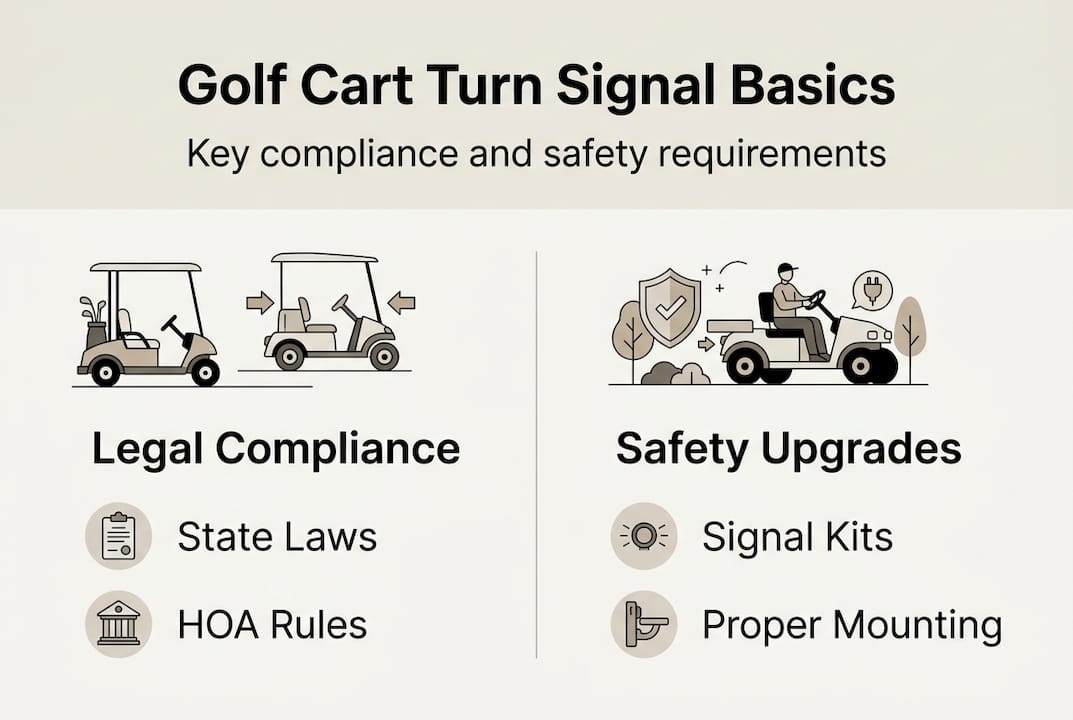
Here is a quick look at how requirements vary by location:
| Location | Turn signal requirement | Applies to |
|---|---|---|
| Florida (general) | Required for street use | Public roads and paths |
| The Villages, FL | Required for night use | All community roads |
| Most HOA communities | Varies, often required | Shared paths and streets |
| Golf courses (private) | Recommended, not always mandated | Cart paths |
| California | Required for street-legal carts | Public roads |
The consequences for ignoring these rules are real. Here is what non-compliance can lead to:
Understanding the golf cart lighting rules in your area is the first step. Laws vary widely, so checking with your HOA or local municipality before hitting the road is always the smart move.
Compliance is one thing. Actual safety is another, and the numbers here are eye-opening. Turn signal use reduced cart-to-car side-swipe accidents by 8% in one study of mixed traffic environments. That may sound modest, but when you consider how many carts operate in dense residential communities alongside cars, that percentage represents a meaningful number of avoided injuries.
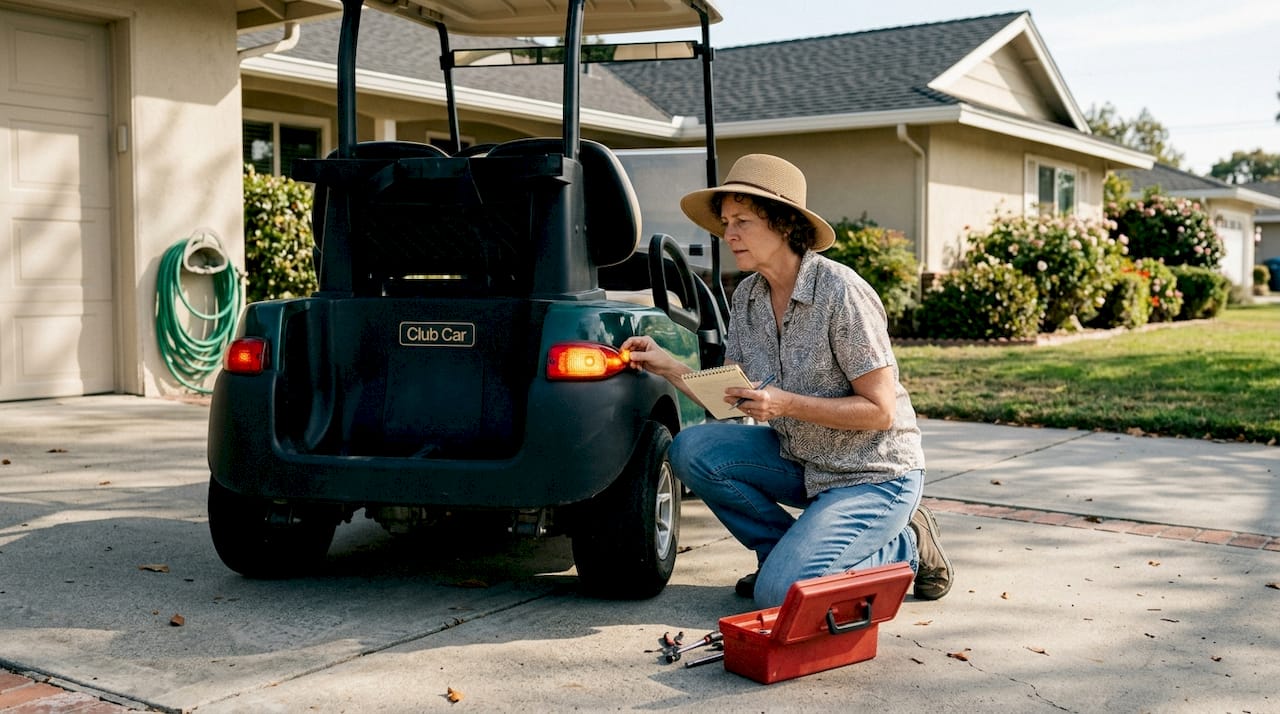
The problem with hand signals is that they fail in the real world more often than drivers expect. Your arm may be obscured by a passenger, blocked by a canopy frame, or simply not visible to a driver approaching from behind. At dusk or in low-light conditions, a hand signal is nearly invisible. A properly mounted turn signal, on the other hand, is designed to be seen from multiple angles and distances.
Here is what typically happens during a cart accident at an intersection without turn signals:
This sequence plays out in parking lots, neighborhood streets, and golf course access roads every year. The fix is simple and inexpensive compared to the consequences.
“Proper signaling in mixed-traffic environments is one of the lowest-cost, highest-impact safety upgrades available to golf cart owners.”
Pro Tip: Mount your turn signal kit at or above eye level for drivers in standard vehicles. A signal buried low on the cart frame is easy to miss. Visibility from behind and from the side is what matters most.
Before you install anything, running through a golf cart safety inspection is a smart starting point. It helps you identify other gaps in your safety setup at the same time.
Safety in traffic is obvious. But what about the slower, more social environments where most carts actually operate? Neighborhoods, retirement communities, and golf courses have their own unwritten rules, and turn signals play a bigger role in keeping the peace than most owners realize.
Hand signals are unreliable in these settings for several reasons. Passengers block the driver’s arm. Glare and sun angles make gestures hard to read. Riders unfamiliar with hand signal conventions may interpret them incorrectly. In a tight community where the same people share the same paths daily, repeated miscommunication builds frustration fast.
Turn signals on non-street-legal carts improve etiquette and prevent close calls on golf courses and in neighborhoods by eliminating the guesswork that comes with hand signals. Here are specific scenarios where a blinking light makes a real difference:
“In communities where carts and pedestrians share space, clear signaling is the difference between a smooth outing and a tense near-miss.”
Pro Tip: Before a group outing, spend two minutes reviewing signal meanings with everyone in your party. A left blink, a right blink, and a hazard flash cover almost every situation you will encounter on a shared path.
Exploring turn signal solutions designed for your specific use case is worth the time. The right setup depends on whether you are primarily on a golf course, in a neighborhood, or on public roads.
Knowing you need turn signals is one thing. Getting the right kit installed correctly is another. Many HOAs and local laws mandate turn signals for public paths, so your kit needs to meet actual standards, not just look the part.
Start by identifying your cart model, year, and whether you need a street-legal setup or a community-use setup. These two categories have different requirements for brightness, mounting position, and wiring.
Follow these steps to choose and install the right kit:
Pro Tip: Cross-reference your kit’s wiring diagram with choosing golf cart lights guidance before you start. Mismatched voltage or incorrect relay sizing is the most common cause of flickering or non-functioning signals.
If you get stuck, detailed support is available through installing turn signals resources that walk you through the process for most major cart models.
Here is something we have noticed after years of helping cart owners upgrade their setups: most people install turn signals to pass an inspection or satisfy an HOA requirement, then move on. They treat it as a checkbox. What they miss is the compounding effect of consistent signaling on their daily experience in the community.
A cart with working turn signals gets treated differently by other drivers and pedestrians. People give you more space. They wait for you. They trust your movements. That trust adds up over time and reduces the low-grade tension that builds in communities where carts and cars share space without clear communication.
We have heard from customers who installed a basic kit expecting nothing beyond compliance and were surprised by how much smoother their daily routes became. One customer in a Florida retirement community told us that after adding signals, a neighbor who had complained about cart traffic near her driveway stopped complaining entirely. Small upgrade, big social return.
The advantages of street-legal golf carts go well beyond legal access. They change how your community perceives and interacts with your cart.
You now know why turn signals matter, what the law requires, and how to install them correctly. The next step is finding the right kit for your cart and your use case.
At GolfCartStuff, we carry a full range of golf cart accessories built for real-world use, including turn signal kits, wiring harnesses, and complete deluxe street legal light kits that bundle everything you need in one package. Whether you are outfitting a single cart for neighborhood use or upgrading a fleet, our street legal accessories page is the right place to start. Browse by cart model, check compatibility, and reach out to our team if you need help selecting the right setup.
Many states and communities, including Florida and The Villages, require turn signals on street-legal golf carts for public roads and night use. Always check your local regulations before driving.
One study found that turn signal use dropped cart-to-car side-swipe accidents by 8% in mixed traffic conditions, making it one of the most cost-effective safety upgrades available.
Even for non-street use, signals are recommended for etiquette and safety. They reduce confusion and close calls among drivers on shared paths and golf courses.
Purchase a model-specific kit and follow the included instructions, or use detailed online guides and FAQs tailored to your cart type for step-by-step support.
Explore our store to see what our products and resources can do for you.

Leave a comment