
Your Cart Is Our Priority
Explore our store to see what our products and resources can do for you.

Finding clear rules for making a golf cart street legal can leave even longtime owners confused. The mix of state laws and local ordinances in the United States means a basic golf course cart and a road-ready vehicle are very different things. Misunderstandings about requirements like local government approval and essential safety features can lead to legal trouble if ignored. Understanding these differences helps owners stay compliant, avoid fines, and enjoy safe trips on public roads.
| Point | Details |
|---|---|
| Street Legal Definition | A street legal golf cart is modified to meet specific regulations for public road use, differing by jurisdiction. |
| Variability of Regulations | Local municipalities have varying rules regarding golf cart usage, often necessitating individual verification for compliance. |
| Safety Modifications Required | Essential modifications include headlights, seat belts, and mirrors to ensure compliance with safety standards. |
| Financial Obligations | Owners must understand registration, insurance, and ongoing costs, which can vary significantly based on location and local laws. |
Understanding what makes a golf cart “street legal” can be complex, as regulations vary significantly across different states and municipalities. A street legal golf cart is not simply a standard golf course vehicle, but a specially modified transportation device that meets specific legal requirements for public road use.
At its core, a street legal golf cart is defined by several key characteristics that distinguish it from traditional golf course vehicles. State driving laws typically outline these requirements, which generally include:
Many golf cart owners mistakenly believe that owning a cart automatically grants them permission to drive on public streets. This misconception can lead to significant legal complications. In reality, local municipalities have extensive authority to regulate golf cart usage, with requirements that can change dramatically between neighboring jurisdictions.
Most states impose strict operational guidelines for street legal golf carts. These often include:
The complexity of these regulations means that what’s permissible in one town might be strictly prohibited just a few miles away. Local government approval is typically required, and cart owners must proactively verify their specific area’s requirements.
Pro tip: Always contact your local department of motor vehicles or municipal government to get precise, current street legal requirements for golf carts in your specific jurisdiction.
Golf carts have evolved far beyond their original purpose of transporting golfers across courses. Today, they represent a diverse category of vehicles with multiple configurations and applications. Golf cart varieties range from basic recreational models to sophisticated street-legal transportation solutions.
The primary types of golf carts can be categorized based on their power source and intended use:
Electric Golf Carts
Gas-Powered Golf Carts
Utility Golf Carts
The distinction between standard golf course vehicles and Low-Speed Vehicles (LSVs) is particularly important. LSVs are specially modified golf carts equipped with additional safety features that allow limited street use. These typically include headlights, turn signals, seat belts, and windshields, enabling operation on roads with speed limits up to 30 miles per hour.
Most states have specific regulations defining different golf cart categories. Michigan law provides an excellent example, clearly distinguishing between recreational golf carts and street-legal variants based on speed, safety equipment, and operational restrictions.
The key differences between golf cart types extend beyond just power source and design. Factors like battery technology, motor efficiency, terrain compatibility, and local legal restrictions play crucial roles in determining the most suitable golf cart for an individual’s needs.
Here’s a side-by-side comparison of golf cart types to help guide your selection:
| Feature | Electric Golf Cart | Gas-Powered Golf Cart | Utility Golf Cart |
|---|---|---|---|
| Environmental Impact | Zero local emissions | Emits exhaust gases | Depends on engine type |
| Range per Refuel/Charge | Short distances | Longer distances | Varies by model |
| Typical Terrain | Flat and smooth | Hilly and rough | All terrains, heavy-duty use |
| Noise Level | Very quiet | Noticeably louder | Varies, often moderate |
| Maintenance Needs | Lower ongoing costs | More frequent maintenance | Higher, due to heavy loads |
Pro tip: Before purchasing a golf cart, carefully assess your specific requirements, local regulations, and intended usage to select the most appropriate model.
Navigating the complex landscape of street legal requirements for golf carts involves understanding both federal guidelines and state-specific regulations. While no universal federal mandate exists, each state develops its own comprehensive framework for determining street legal status. Michigan law serves as an excellent example of the intricate regulatory approach many states employ.
Key federal and state street legality requirements typically encompass several critical areas:
Driver Qualifications
Vehicle Safety Equipment
Operational Restrictions
Some states have particularly nuanced regulations governing golf cart street use. South Carolina regulations demonstrate the complexity, specifying detailed requirements such as mandatory seat belt use for child passengers and precise operational conditions.
The variation in state regulations means that street legal status is not a one-size-fits-all designation. Local municipalities often have additional layers of regulation that can further modify statewide guidelines. Some jurisdictions require specific registration processes, while others mandate additional safety inspections or limit golf cart usage to specific geographic zones.
Understanding these requirements demands careful research and proactive compliance. Cart owners must not only modify their vehicles to meet technical specifications but also remain informed about evolving local ordinances that could impact their vehicle’s street legal status.
Pro tip: Contact your local department of motor vehicles and municipal government to get the most current and precise street legal requirements for golf carts in your specific jurisdiction.
Transforming a standard golf cart into a street legal vehicle requires careful attention to safety features and strategic modifications. Comprehensive safety management goes beyond basic equipment installation, encompassing operational policies and ongoing maintenance.
The essential safety modifications for street legal golf carts include:
Lighting Systems
Structural Safety Additions
Mechanical Safety Requirements
State regulations typically mandate specific safety standards that elevate golf carts from recreational vehicles to street legal transportation. State safety standards often require additional modifications to ensure road compatibility, such as installing low-speed vehicle emblems and implementing strict speed limitations.
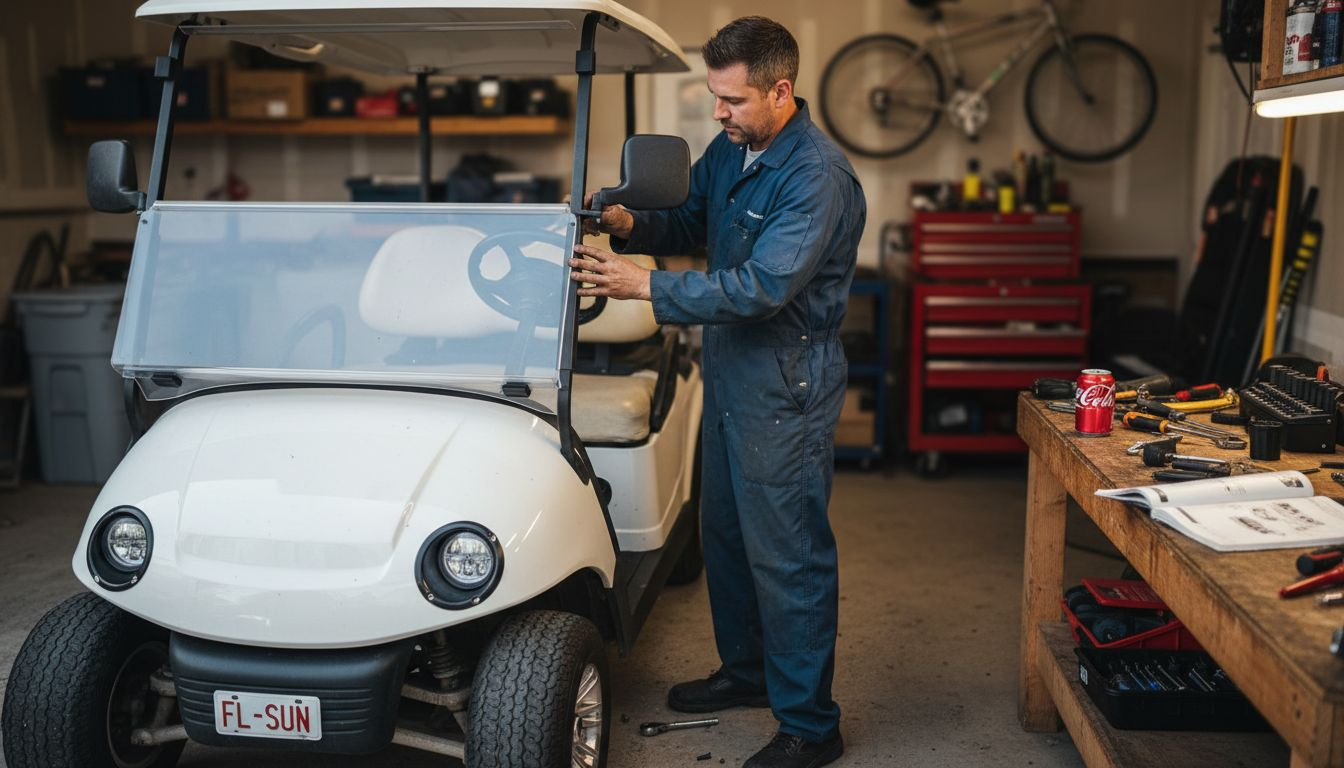
The modification process involves more than just adding equipment. Owners must ensure each component meets local and state regulatory requirements, which can vary significantly between jurisdictions. Proper installation, regular maintenance, and ongoing inspection are crucial to maintaining street legal status and ensuring passenger safety.
Understanding these requirements demands a proactive approach. Cart owners should consult local transportation authorities, review state-specific guidelines, and potentially work with professional golf cart modification specialists to ensure full compliance.
Pro tip: Document every safety modification with photographs and receipts to provide clear evidence of compliance during potential regulatory inspections.
Navigating the financial and legal requirements for street legal golf carts involves understanding complex registration and insurance obligations. South Carolina’s registration process provides an excellent blueprint for the typical regulatory landscape that golf cart owners must navigate.
Key financial and legal obligations typically include:
Registration Requirements
Insurance Specifications
Financial Considerations
Local golf cart regulations demonstrate significant variation across different jurisdictions. Some regions, like Texas, have unique approaches where golf carts might be exempt from vehicle titling but still require local registration and potential insurance coverage.
The financial obligations extend beyond initial registration. Cart owners must budget for ongoing expenses such as periodic re-registration, insurance renewals, and potential safety equipment upgrades to maintain street legal status. These costs can vary dramatically depending on local regulations and the specific classification of the golf cart.
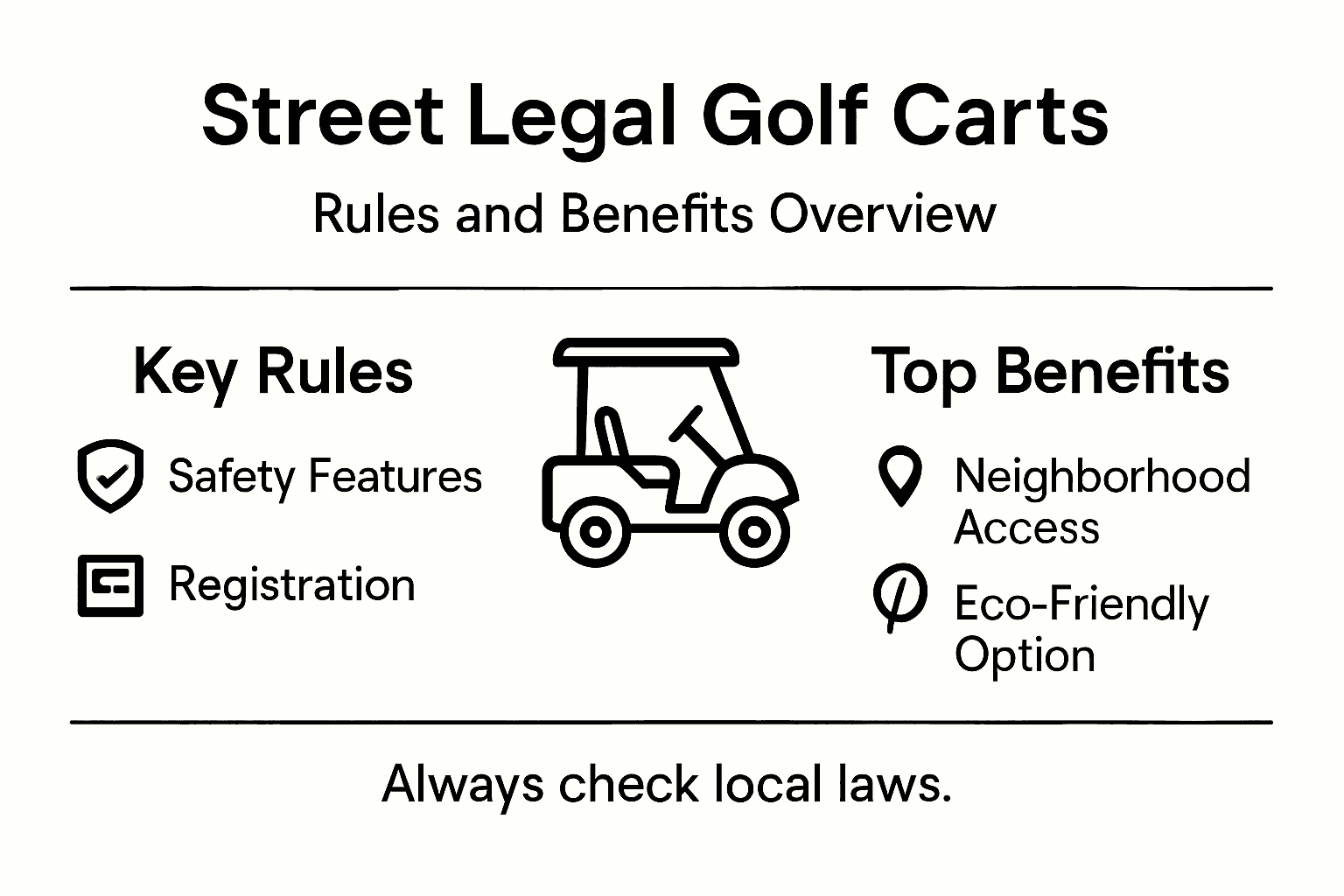
Most jurisdictions require owners to carry documentation at all times when operating their street legal golf cart. This typically includes registration papers, proof of insurance, and any local permits or decals that demonstrate compliance with regional transportation regulations.
The following table summarizes common financial obligations for street legal golf cart owners:
| Obligation Type | Example Requirements | Typical Frequency |
|---|---|---|
| Registration Fees | Initial and renewal payments | Every 1-5 years |
| Insurance Premiums | Liability and accident coverage | Annual or bi-annual |
| Equipment Upgrades | Safety feature installation costs | As regulations change |
| Documentation | Paperwork for compliance checks | At all times while driving |
Pro tip: Create a dedicated folder to organize all golf cart registration, insurance, and compliance documents to streamline potential roadside inspections and annual renewals.
Navigating the complex rules to make your golf cart street legal can feel overwhelming With essential modifications and safety features like headlights seat belts and turn signals required it is critical to have the right parts to stay compliant and safe Whether you need electric or gas cart accessories or legal safety equipment finding the right solutions matters now more than ever
Unlock the full potential of your street legal golf cart today Visit Golf Cart Stuff for a wide selection of parts and accessories designed to meet state and local regulations Shop confidently knowing you have quality components that help transform your cart for road use Act now to upgrade your golf cart and enjoy legal and safe street driving with expert support every step of the way
A street legal golf cart typically needs to meet specific safety and performance requirements, including maximum speed capabilities of 20-25 miles per hour, safety equipment like headlights and turn signals, seat belts, mirrors, and proper registration and insurance documentation.
Yes, but only if it meets street legal requirements set by local laws, such as having necessary safety features, being operated on roads with speed limits of 30 mph or less, and complying with any local regulations.
Essential modifications include adding functional headlights, taillights, turn signals, seat belts, a windshield, mirrors, and ensuring the vehicle adheres to local safety standards and speed restrictions.
Yes, most jurisdictions require operators to be at least 16 years old and to possess a valid driver’s license to legally operate a street legal golf cart.
Explore our store to see what our products and resources can do for you.

Leave a comment