




Your Cart Is Our Priority
Explore our store to see what our products and resources can do for you.

Whether your golf cart needs registration comes down to one question: where do you drive it? Keep it on private property or a gated community, and most states ask for nothing. Take it onto a public road, and you’ll need either a local permit/decal or full title and registration as a Low Speed Vehicle (LSV), which also brings insurance and driver’s license requirements into play. If public streets are the plan, call your city or county before you buy anything.
TL;DR:
- Most states require registration and insurance for golf carts only when they are converted to meet LSV standards and driven on public roads.
- An LSV must have DOT-rated headlights, turn signals, mirrors, seat belts, windshield, slow-moving emblem, and a permanent VIN to pass inspection.
- Fees for permits range from $5 to $10 annually, and full registration involves submitting receipts, photos, and a VIN inspection at the local DMV or tax office.
- Private use of standard golf carts remains unregulated, but crossing into public streets triggers legal registration and insurance requirements.
- Owners should verify local rules in writing and keep thorough documentation to avoid penalties or insurance gaps if operating on public roads.
Every cart falls into one of three legal buckets, and the bucket decides whether you’re filling out DMV paperwork or nothing at all.
A standard golf cart tops out around 20 mph and stays a golf cart in the eyes of the law: no title, no plate, no VIN required for private use. An LSV or NEV (neighborhood electric vehicle) is a federally and state-recognized motor vehicle built or converted to hit 20 to 25 mph, and that speed range is exactly what pulls it into full registration territory. A converted cart starts life as a standard golf cart, then gets lift kits, upgraded motors, and safety add-ons to meet LSV standards, but it doesn’t become road-legal just because the parts are installed.
The distinction matters because a permit and a title are not interchangeable. A permit lets you drive on designated roads within a specific zone. A title makes your cart a recognized motor vehicle with full DMV status, which follows it everywhere state law allows.
State golf cart regulations follow a recognizable pattern, but the details shift enough that assuming your neighbor’s rules apply to you is a mistake.
Florida draws a hard line between golf carts and LSVs. LSVs must carry Personal Injury Protection and Property Damage Liability insurance, and converted carts have to be inspected, titled, and insured before they touch a public road. South Carolina runs one of the cheaper permit systems in the country: a $5 permit valid for five years covers certain local road use, while carts built to LSV spec still need the full title path. Nevada uses a comparable model, with some jurisdictions charging a $10 annual permit that expires December 31 and requires a VIN inspection before the first registration.
Virginia hands the decision to local governments, which can designate specific highways for golf cart travel, typically capping speeds at 25 mph and layering on age or equipment rules of their own. Washington takes a similar zone-based approach, where a golf cart zone ordinance can include decals, posted signage, and time-of-day restrictions that never show up if you only read the state statute.
The recurring pattern: private use is free of paperwork almost everywhere, limited public-road access runs through a cheap local permit, and reliable everyday street driving runs through full LSV registration. That pattern holds across most state-by-state golf cart rules, even when the exact fees differ.
Inspectors aren’t checking whether your cart looks the part. They’re checking whether it satisfies Federal Motor Vehicle Safety Standard 500, the baseline that governs LSV equipment nationwide.
Beyond the hardware, inspectors want a paper trail: photos of the finished cart, receipts for every conversion part, a builder’s affidavit describing the work, and in some counties a certified weight slip. Miami-Dade’s tax collector office spells out this exact document list for converting a golf cart to an LSV, and it’s representative of what most Florida counties expect.
Pro Tip: Keep every receipt from the day you start upgrading, even for parts that seem minor like mirrors or turn signal kits. Inspectors have rejected applications over a missing $40 receipt when everything else checked out.
Bolting on lights and a windshield doesn’t make your cart legal by itself. The administrative step, inspection, VIN assignment, and title filing, is what actually changes its legal status.
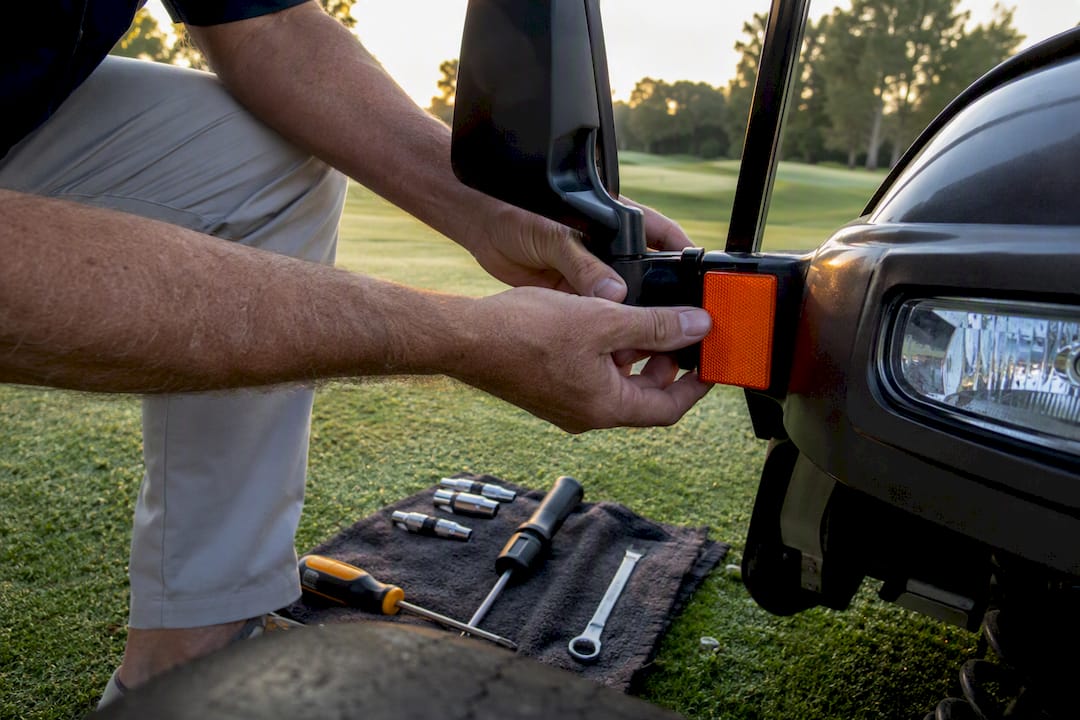
The paperwork stack looks intimidating until you see it laid out in order.
Fees and timelines vary by jurisdiction:
Most owners handle this at the county tax collector’s office rather than a state-level building, and same-day approval is common if every document is in order at the inspection window.
Insurance and licensing requirements kick in the moment your cart crosses from private-property toy to public-road vehicle.
Once a cart is titled as an LSV, most states treat it like any other motor vehicle for insurance purposes. Florida requires PIP and PDL coverage specifically, and insurer guidance confirms that a standard homeowner’s policy typically will not cover a collision that happens on a public street. A valid driver’s license is usually required for public-road operation, and many localities set a minimum age of 16, with additional restrictions for drivers under 18 depending on the ordinance.
The stakes are real if you skip this step:
Florida statute 316.212 spells out equipment requirements and gives local governments authority to set additional rules, with penalties attached for noncompliance.
Start with your state DMV’s LSV page, then move to your county or city ordinance database, since state law sets the floor but local rules almost always add restrictions.
Pro Tip: Get every answer in writing, even a screenshot of an email. Verbal guidance from a city clerk doesn’t hold up if a different officer questions your setup six months later.
Keep every receipt, inspection photo, and insurance document from day one. You’ll need them again the moment you file for title.
The single most common mistake I see is owners assuming their homeowner’s or auto policy automatically extends to a golf cart the moment it hits a public street. It usually doesn’t, and that gap only becomes obvious after a collision, when it’s too late to fix cheaply.
The second mistake is treating parts as proof. Bolting on lights, mirrors, and a windshield feels like a finish line, but no inspector cares what your cart looks like if the paperwork trail is thin. Classify the cart first, buy equipment with receipts second, confirm your local ordinance in writing third, then schedule inspection. Our safety inspection guide walks through what inspectors actually check, and it’s worth reading before you spend a dollar on upgrades.
— Roshan
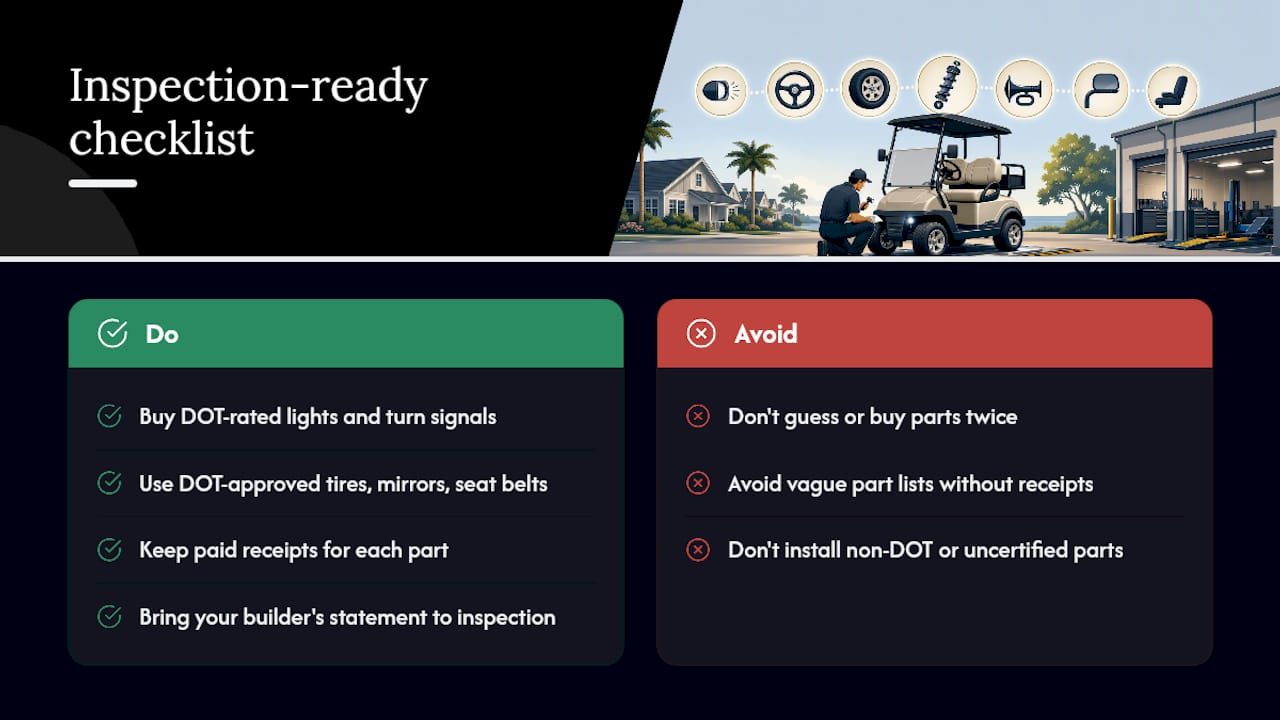
Passing inspection comes down to buying the right parts once, with receipts, instead of guessing twice. Golfcartstuff carries the equipment inspectors actually look for: DOT-rated lights and turn signals, DOT-approved tires, seat belts, mirrors, and lithium batteries that hold up under daily street use.
Every product ships with a documented purchase record you can hand straight to your county tax collector or DMV service center alongside your builder’s statement. That’s the piece most owners underestimate: an inspector wants to see paid receipts for exactly the parts installed, not a vague list. Golfcartstuff doesn’t perform DMV inspections or issue titles, that part stays with your state or county, but the parts and documentation groundwork happens here.
Browse the street-legal accessories collection for kits built around LSV requirements, or check the full accessories lineup for lights, mirrors, and seat belts sold individually. If you’re upgrading the powertrain as part of your conversion, our lithium battery collection is worth a look before your inspection appointment, and pairing that with a lithium conversion guide will help you plan the swap correctly the first time.
Verify every rule mentioned here against the primary source before you file paperwork:
Explore our store to see what our products and resources can do for you.

Leave a comment