
Your Cart Is Our Priority
Explore our store to see what our products and resources can do for you.

TL;DR:
- Golf carts are more dangerous than commonly believed, with most injuries caused by rollovers and high speeds. Speed limits are essential due to the vehicle’s top-heavy design and associated crash risks, and laws vary by location, often requiring registration, lighting, and driver age restrictions. Following safety practices, including proper equipment, safety training, and maintaining speed within engineered limits, significantly reduces injury risk and ensures legal compliance.
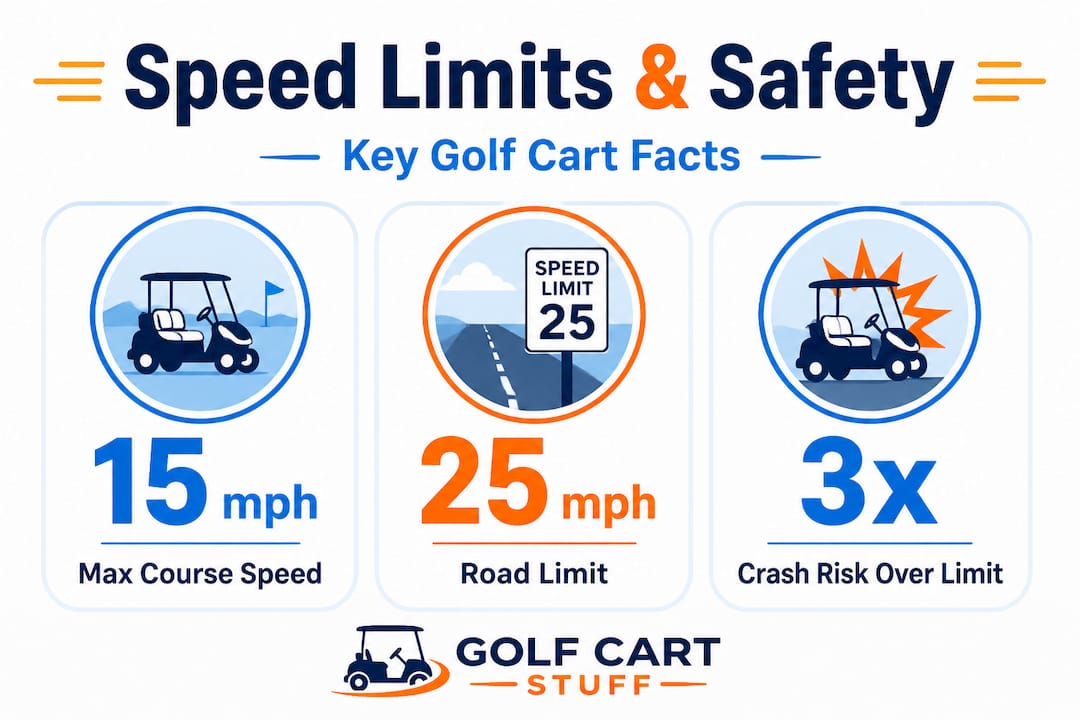
Golf carts have a reputation for being slow, gentle vehicles that couldn’t possibly cause serious harm. That reputation is dangerously wrong. 17,500 emergency room visits were recorded in a single recent year, with rollovers accounting for 72% of serious injuries and speeding involved in nearly half of all crashes. If you own a golf cart, drive one through a neighborhood, or manage a fleet on a course, understanding speed limits isn’t just a legal checkbox — it’s a matter of life and safety. This article walks you through the regulations, real-world scenarios, and proven practices that protect everyone on and around your cart.
| Point | Details |
|---|---|
| Speeding risks are real | Exceeding 15 mph on golf carts greatly increases the risk of crashes and injury. |
| Laws vary by location | State and local rules for cart speed, age limits, and safety features can differ significantly. |
| Safety upgrades matter | Adding seat belts, lights, and governors can reduce rollover risk by half or more. |
| Avoid risky modifications | Non-compliant alterations to speed add legal risk and lead to 25–30% more crashes. |
| Training saves lives | Driver safety training has been proven to slash serious injuries on golf carts. |
With the stakes established, let’s examine why these rules came to be.
Speed limits for golf carts aren’t bureaucratic overreach. They come directly from injury data and engineering reality. Golf carts are top-heavy vehicles with a high center of gravity, minimal structural protection, and no crumple zones. When they tip over — and they do — the consequences can be severe.
The numbers make the case clearly. Speeding over 15 mph is tied to 40% of all golf cart crashes. Carts equipped with 15 mph governors experience 50% fewer rollovers than unregulated carts. And modified carts — those altered to go faster than the manufacturer’s limit — show a 25 to 30% higher crash risk compared to stock vehicles. These aren’t guesses. They’re documented patterns.
Speed isn’t just a fun variable on a golf cart. It’s the single biggest predictor of whether a crash becomes a minor incident or a life-altering emergency.
Here’s what changes as speed increases on a golf cart:
Some owners look into golf cart speed chips as a way to boost performance, which can be done responsibly within the right limits. But many overlook resolving underlying golf cart speed issues — like a cart that runs slower than it should due to mechanical problems — before making any modifications.
The bottom line is simple. Speed governors exist because the physics of golf carts makes them genuinely dangerous at higher speeds. Removing or bypassing them is not a performance upgrade. It’s a risk multiplier.
Now that you know why speed limits matter, it’s important to understand how the rules differ depending on where you drive.
Golf cart law in the United States is a patchwork. There is no single federal standard. Every state sets its own baseline, and many cities and counties layer additional rules on top of that. What’s perfectly legal in one Florida beach town may be completely prohibited one state north.
Here’s a comparison of how common requirements vary by situation:
| Requirement | Golf course use | Private community | Public road use |
|---|---|---|---|
| Speed limit | Varies by course | 15–25 mph typical | 15–25 mph (local law) |
| Minimum driver age | No legal requirement | Often 16+ | 14+ in FL, 16+ elsewhere |
| Lights required | No | Sometimes | Yes, for night use |
| Seat belts required | Rare | Sometimes | Often required |
| Registration needed | No | No | Yes in most states |
Some states take an outright restrictive stance. States like New York and Massachusetts effectively prohibit golf carts from public roads in most circumstances. Others, especially in the Southeast and Southwest, actively accommodate them with designated routes and posted speed limits.
For public road use in permissive states, here are the most common requirements you’ll encounter:
Key stat: Florida allows drivers as young as 14 to operate a golf cart on public roads, while most other states set the minimum at 16. Night use almost universally requires proper lighting, which means your cart needs more than just reflectors.
Checking your specific local ordinances is not optional. The legal requirements for golf carts change frequently as more communities update their rules to reflect the surge in cart ownership. Equally important is making sure your cart has the right golf cart safety equipment installed before you take it onto any public street.
Beyond laws, real-world scenarios highlight how speed limits actually impact your daily drives.
Speed limits for golf carts aren’t one-size-fits-all. They shift based on where you’re driving and how your cart is configured. Understanding these distinctions helps you stay both legal and safe across different environments.
| Location | Typical speed limit | Notes |
|---|---|---|
| Golf course fairways | 8–12 mph (posted by course) | Course rules are enforceable on private property |
| Residential community streets | 15–20 mph | Usually enforced by HOA and local ordinance |
| Public roads (permitted) | 15–25 mph | Must not exceed posted limit for road class |
| Highways and interstates | Prohibited | Golf carts are banned from high-speed roads nationwide |
| Private property/campgrounds | No legal limit | Owner-set rules apply |
One of the most notable recent trends is the rise in restrictions at beach towns and resort communities. As golf cart use has surged in coastal areas, local governments have responded by adding posted limits, restricted zones, and permit requirements. Communities along the Gulf Coast have been particularly active in rolling out new ordinances to manage the explosion in cart traffic.
The risk of modification deserves a separate mention here. Many owners modify their carts for more speed, often without realizing they’ve entered legally murky territory. A modified cart that exceeds the local speed limit can expose you to fines, liability in accidents, and in some cases, the requirement to re-register the vehicle as a Low-Speed Vehicle (LSV). An LSV conversion involves meeting federal safety standards including seat belts, mirrors, lighting, and a Vehicle Identification Number (VIN). Simply bolting on a faster motor doesn’t qualify.
Pro Tip: Before modifying your cart’s speed at all, complete a thorough golf cart safety inspection first. Mechanical issues with brakes, tires, or steering become far more dangerous at higher speeds, and catching them early can prevent a serious accident.
Key risks specific to modified carts in these scenarios:
Best practices consistently point to keeping speeds under 15 to 20 mph, especially on turns, hills, and shared pedestrian paths, and avoiding modifications unless a full LSV conversion is completed properly. For the full picture of what’s needed, the golf cart safety accessories guide is a good resource for understanding what upgrades actually move the needle on compliance and protection.
With regulations and scenarios clear, here’s how to stay compliant and safe every time you drive.
Knowing the rules is step one. Putting them into practice consistently is where most owners either succeed or fall short. The good news is that the most impactful safety measures are not expensive or difficult to implement.
Here are the top practices that make a measurable difference:
Complete a golf cart safety training course. This isn’t just for new drivers. Safety training reduces rollovers by 50%, which is an enormous return for a few hours of education. Many courses and communities offer these programs for free or at low cost.
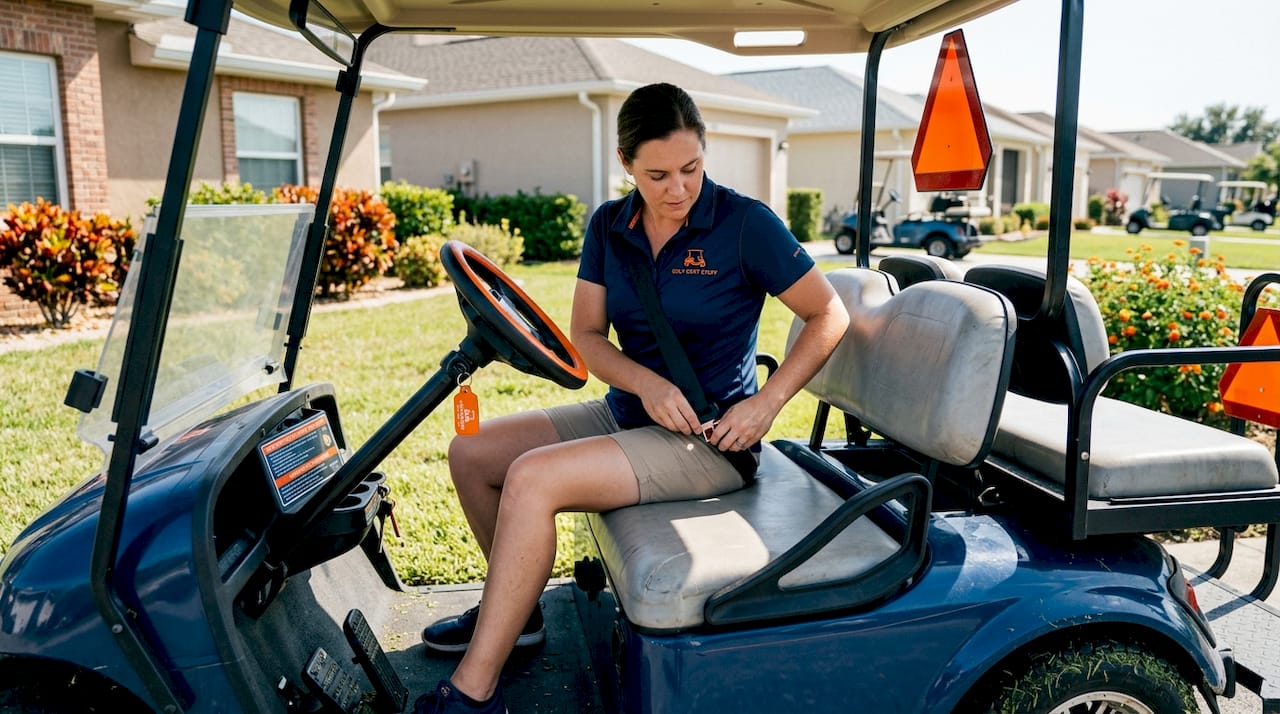
Install and use seat belts. Seat belts are the single most effective piece of passive safety equipment on a cart. Understanding the importance of seat belts goes beyond compliance. They prevent ejection in rollovers and sudden stops — the two most common causes of serious golf cart injuries.
Check your local ordinances before every season. Regulations change. A community that allowed cart use on a particular road last year may have added new restrictions this year. A quick annual review keeps you on the right side of local law.
Keep your speed governor intact and properly calibrated. Don’t remove it. Don’t bypass it. If it’s not working correctly, have it repaired. This single component is responsible for the 50% rollover reduction mentioned in the data.
Add proper lighting for low-visibility conditions. Headlights, taillights, and turn signals aren’t just legal requirements in most public-road jurisdictions. They dramatically reduce your visibility-related collision risk during dawn, dusk, and overcast days.
Maintain your brakes and tires regularly. Golf carts are often stored for months at a time. Brake fade and tire degradation happen during storage too. Check both before extended use, especially if you’ll be driving at or near the legal speed limit.
Follow load and passenger limits. Overloading a golf cart raises its center of gravity and strains the brakes. Most carts are rated for two to four passengers. Exceeding that creates rollover and brake failure risk, especially on hills.
Pro Tip: Think of your cart’s speed governor as your most affordable insurance policy. It costs nothing to keep in place and statistically cuts your rollover risk in half.
Small investments in seat belts, lighting upgrades, and a safety training course will cost less than most single repairs after an accident. And they protect more than your wallet. They protect everyone in and around your cart.
We’ve laid out the evidence and advice — now let’s look at what owners often overlook about speed limits and safety.
Here’s a pattern we see constantly in the golf cart owner community. People spend real money and real time chasing speed. Faster motors, bypassed governors, aftermarket modifications — all in pursuit of a few extra miles per hour. And yet the same owners often have no seat belts, no working headlights, and zero safety training.
That’s the wrong trade-off by a wide margin.
The irony is that the upgrades that actually save lives are cheap and easy. Automotive-oriented safety training cuts accident rates dramatically. A proper seat belt installation costs less than most speed upgrades. And yet these basics get skipped while owners pour resources into going faster on a vehicle that was never designed for speed.
Speed modifications also carry hidden costs that most owners don’t calculate upfront. Insurance complications. Potential re-registration requirements. Increased wear on brakes and tires not rated for higher speeds. Greater exposure to fines in jurisdictions with strict speed enforcement. And, most seriously, a meaningfully higher probability of a crash that causes real injury to you, your passengers, or a pedestrian.
We’re not anti-performance. We understand the appeal of a cart that moves well and handles confidently. But performance and safety aren’t opposites. They work best together. The owners who truly get the most out of their carts are the ones who invest in why seat belts matter, keep their mechanical systems in top shape, and stay within the speed ranges that their carts were engineered to handle safely.
Regulations exist because the data demanded them. Every rule in this space traces back to a real pattern of preventable injuries. When you follow those rules, you’re not losing anything. You’re protecting the people you drive with and keeping yourself out of situations that no one wants to deal with.
Taking your cart from barely compliant to genuinely safe doesn’t require a complete overhaul. It requires the right parts, installed correctly.
At Golf Cart Stuff, we stock everything you need to bring your cart up to code and beyond. Whether you’re looking for street legal accessories like lighting kits, mirrors, and turn signals, or browsing a full range of golf cart accessories to improve comfort and safety, you’ll find options that fit your specific cart and local requirements. Club Car DS owners can also explore our full catalog of Club Car DS parts to keep a well-maintained, regulation-ready cart on the road. Every product we carry is selected with real cart owners in mind, because safe driving starts with having the right equipment.
Most areas set golf cart speed limits between 15 and 25 mph on public roads, but some states and cities ban public road use entirely, so always verify your local ordinances before driving on any street.
Modifying your cart beyond the legal speed limit significantly raises your crash risk and may be illegal unless you complete a full LSV conversion, since modified carts carry a 25 to 30% higher crash risk and standard modifications do not meet the federal safety standards required for higher-speed vehicles.
In most jurisdictions where golf carts are permitted on public roads, a functioning speed governor is required to keep the cart within the legal limit, and the data backs this up since carts with 15 mph governors experience 50% fewer rollovers than ungoverned vehicles.
Yes, age requirements vary by state. Florida permits drivers as young as 14 to operate a golf cart on public roads, while most other states require drivers to be at least 16.
Seat belts, proper lighting, and driver safety training are the three most impactful measures, with safety training and restraints shown to reduce rollovers and serious injuries by approximately 50% when consistently used together.
Explore our store to see what our products and resources can do for you.

Leave a comment