
Your Cart Is Our Priority
Explore our store to see what our products and resources can do for you.

TL;DR:
- Start your golf cart upgrades with essential safety features such as mirrors, seat belts, and compliant lighting to ensure legality and safety. Progress to comfort, weather protection, powertrain enhancements, and aesthetic modifications, prioritizing proper sequencing and quality parts for optimal results. Following a structured checklist prevents costly mistakes and maximizes the longevity and performance of your customized golf cart.
Most golf cart owners hit the same wall: you know you want to upgrade, but you’re not sure whether to start with a new battery pack, better lighting, or a lift kit. Skip the wrong step and you waste money, or worse, end up with a cart that’s unsafe or illegal to drive on public paths. This golf cart upgrade checklist gives you a proven sequence, from safety essentials to aesthetic finishes, so every dollar you spend builds on solid groundwork rather than creating problems you’ll fix later.
| Point | Details |
|---|---|
| Prioritize safety | Upgrade mirrors, seat belts, and full LED lighting kits first for legal and safe operation. |
| Battery upgrades first | Convert to lithium batteries before motor or controller mods for maximum performance gains. |
| Integrate wiring properly | Ensure lighting wiring connects correctly with brake and turn signals to avoid malfunctions. |
| Weather protection extends use | Enclosures, windshields, and heaters let you ride comfortably in varied weather conditions. |
| Test drives validate upgrades | Always perform real-world test drives after major mods to confirm all systems work correctly. |
No other upgrade matters if your cart isn’t safe to operate. This is where every good golf cart improvement guide starts, and for good reason. Safety equipment protects passengers, keeps you on the right side of local regulations, and forms the electrical and structural foundation that later mods depend on.
Before anything else, confirm you have these basics covered:
Lighting is the upgrade most owners underestimate. A proper LED lighting kit for street-legal use isn’t just headlights and taillights. You need front and rear turn signals, brake lights, and a horn in most jurisdictions. Wiring each of these into your cart’s existing brake switch and turn signal circuit is what separates a compliant cart from one that looks compliant.
If you live in California or plan to drive on public roads, California’s street-legal requirements mandate seat belts, a windshield, mirrors, turn signals, and a parking brake under FMVSS 500. Other states have similar codes. Research your local rules before buying parts so you don’t install equipment that doesn’t meet your area’s specifications.
Pro Tip: Add your horn early and wire it to a dedicated fused circuit. It’s one of the cheapest parts on this list and one of the most commonly required for street-legal certification.
For a broader look at what the golf cart customization guide recommends, the priority order is consistent: safety first, then comfort, weather, performance, and aesthetics.
Now that you understand why safety is paramount, let’s explore how to enhance daily comfort and convenience on your golf cart.
Once safety equipment is sorted, the upgrades that improve how your cart feels to use every day are next. These aren’t glamorous, but they’re the reason you’ll actually use your cart more.
Daily comfort upgrades like phone mounts, windshields, and seat covers increase how often you actually use your cart, which is the real return on investment for any modification.
Pro Tip: Prioritize upgrades that solve a specific frustration you have right now. If your phone falls off the dash every ride, fix that first. If the seat hurts your back after 20 minutes, fix that next. Comfort mods are personal, and the best ones are the ones that remove friction from your daily routine.
Staying on top of your golf cart battery care is just as important as adding accessories. A well-maintained battery system ensures all your new comfort electronics have consistent power.
With safety equipment and comfort in place, let’s look at how weather protection mods keep you riding year-round.
A golf cart that only works in perfect weather is a seasonal toy. The right weather protection upgrades turn it into a vehicle you can use 10 to 12 months a year, which dramatically changes the value equation.
Enclosures paired with windshields and heaters can extend your usable riding season by several months, especially in climates where fall and spring bring wet or cold conditions.
Proper weather sealing also protects your wiring, battery terminals, and seat materials from moisture damage, extending the life of the upgrades you’ve already installed. Think of it as insurance for everything else on this checklist. Your golf cart maintenance routine should include checking enclosure seals and floor mat condition seasonally.
Once protected from the elements, upgrading your golf cart’s powertrain can significantly improve performance.
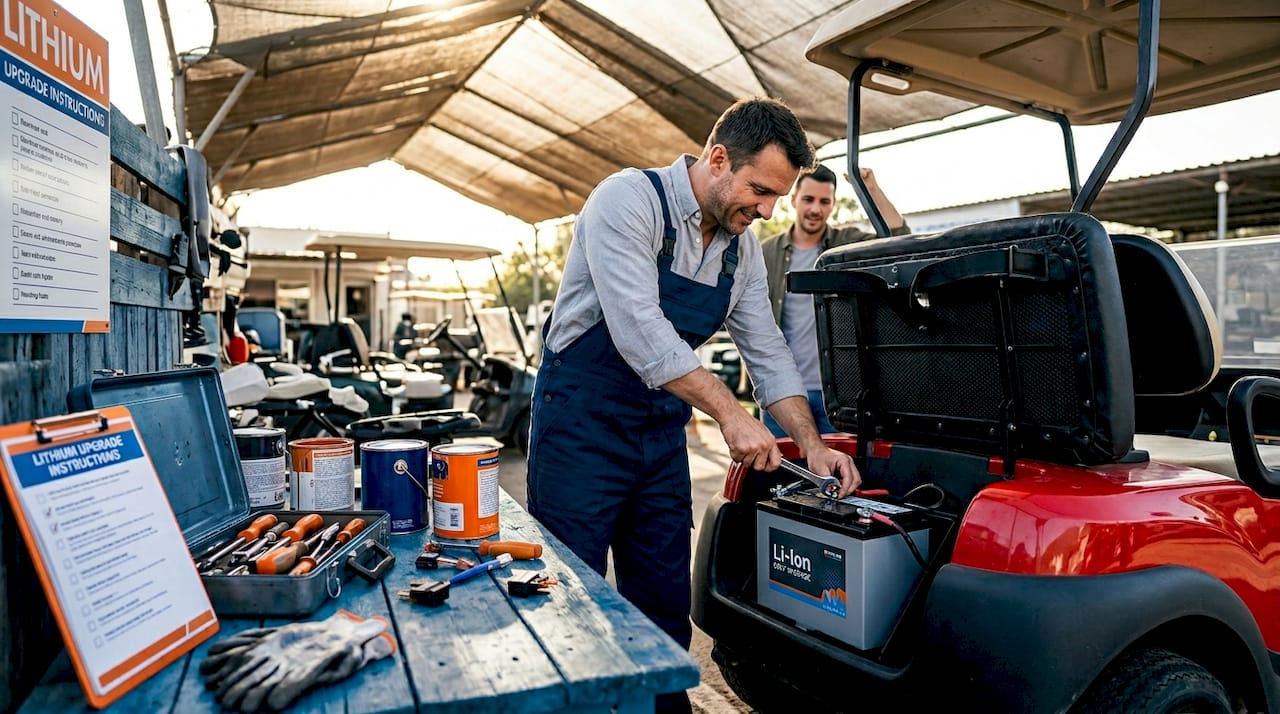
This is where upgrading electric golf carts gets serious. Powertrain upgrades deliver the most dramatic performance changes, but they also require the most planning. The order matters more here than anywhere else on this checklist.
Battery capacity limits power delivery, which means installing a faster motor before upgrading your battery is like adding a turbocharger to an engine running on bad fuel. Start with the battery pack.
Lithium batteries deliver longer lifespan, less maintenance, reduced weight, and measurable improvements in speed, range, and braking compared to standard lead-acid packs. A 48V lithium setup on a cart previously running flooded lead-acid batteries can feel like a completely different vehicle. Review the golf cart battery setup guide to understand whether a 36V or 48V configuration fits your goals.
Once your battery can deliver the current, a higher-amperage controller and upgraded motor unlock the speed and torque your new battery can supply. The golf cart controller is essentially the brain of your electric drivetrain. Upgrading the controller without the motor (or vice versa) leaves performance on the table. Do them together.
For carts running lighting and accessories on 12V while the main pack is 36V or 48V, a voltage reducer is essential. Without one, you’re pulling 12V loads directly from cells that aren’t designed for that drain pattern, which shortens pack life.
| Upgrade | Estimated cost | DIY difficulty | Performance impact |
|---|---|---|---|
| Lithium battery conversion | $900 to $2,500 | Moderate | Very high |
| Compatible lithium charger | $150 to $400 | Easy | High (protects battery) |
| Controller upgrade | $200 to $600 | Moderate | High |
| Motor upgrade | $300 to $900 | Moderate to hard | High |
| Voltage reducer | $30 to $80 | Easy | Medium (protects system) |
Pro Tip: After each powertrain phase, do a full test ride before the next upgrade. You’ll notice real performance differences, and it helps you identify any issues early before layers of new parts make troubleshooting harder.
Now let’s explore how to enhance your golf cart’s style and personalization to stand out on the course or neighborhood.
Aesthetics upgrades are earned. They go last because they look best on a cart that already performs well and runs clean. The good news: LED lighting and underglow kits do double duty by improving nighttime visibility while adding serious visual appeal.
Lift kits and oversized tires are popular golf cart modifications, but they affect handling. A taller, heavier cart corners differently. Test your handling at low speed before taking it on roads or slopes. Check out the complete golf cart customization guide for a full breakdown of what each mod affects beyond looks.
Having covered style upgrades, let’s share a fresh perspective on modern golf cart modding strategies and common pitfalls.
Here’s the honest truth about how to upgrade golf cart modifications effectively: most people who end up frustrated didn’t make bad choices, they made good choices in the wrong order. Wiring in underglow lights before you’ve sorted the brake switch integration is a classic mistake. You end up with lights that don’t respond correctly, or worse, wiring that creates shorts when the brake engages. Proper wiring integration with the brake switch and turn signals isn’t optional. It’s the difference between a cart that passes inspection and one that doesn’t.
The battery-before-controller rule is equally overlooked. Owners buy a high-amperage controller expecting a big speed boost, then wonder why the improvement is marginal. The battery was the bottleneck the whole time. This is wasted money that a proper sequenced approach avoids entirely.
Dedicated test drives after upgrades verify performance under real conditions, not just in your driveway. A new motor might feel fine at low speed but behave unexpectedly under load on an incline. You want to discover that in a controlled test, not on a public path.
Skipping routine maintenance between upgrades is the other silent killer of mod projects. A new lithium battery in a cart with corroded terminals and worn brake pads performs below its potential.
Pro Tip: Keep a simple log, even a notes app on your phone, recording every upgrade, every part number, and every service date. When something goes wrong months later, that log cuts troubleshooting time in half. It also adds tangible value if you ever sell the cart.
Ready to put this checklist into action? Having the right parts from a reliable source is what separates a smooth upgrade project from a frustrating one full of returns and compatibility headaches.
Browse the full range of golf cart accessories covering every phase of this checklist: LED light kits, seat belts, mirrors, enclosures, windshields, lift kits, lithium batteries, chargers, controllers, and accent lighting. If you drive a specific model, the Club Car DS parts and Yamaha G1-G22 parts collections offer model-specific fitment so you’re not guessing on compatibility. Every product includes specifications that match the upgrade stages covered above, making it straightforward to shop by phase rather than by guesswork.
Start with safety mods including mirrors, seat belts, and compliant lighting before moving to comfort or performance upgrades. Following the priority order of safety, comfort, weather, performance, and aesthetics ensures each upgrade builds on a solid foundation.
Install a full LED kit with headlights, brake-integrated taillights, front and rear turn signals, and a horn, then wire everything into the brake switch and signal circuits. California’s street-legal requirements outline exactly what a compliant setup must include, and most states follow similar standards.
Yes. Lithium batteries last 5 to 10 years, charge faster, weigh significantly less than lead-acid packs, and improve overall cart performance including speed, range, and braking response.
After every major upgrade phase, conduct a dedicated test drive under real operating conditions including inclines and braking at speed to verify that all systems work as expected before moving on.
Many upgrades like phone mounts, seat covers, and basic LED lighting are straightforward DIY projects. However, about 60% of common mods are DIY-friendly, while motor and controller swaps along with full wiring integration work are better handled by someone with electrical experience.
Explore our store to see what our products and resources can do for you.

Leave a comment