



Your Cart Is Our Priority
Explore our store to see what our products and resources can do for you.

For most power applications, lithium iron phosphate (LiFePO4) is the better battery. It lasts longer, wastes less energy, weighs less, and costs less over a full lifecycle. Lead-acid still makes sense when upfront budget is the hard constraint, when you need ballast weight, or when the battery sits on float for months at a time with almost no cycling.
Here is the short version before you read further:
Use-case recommendations at a glance:
| Point | Details |
|---|---|
| Choose LiFePO4 for daily cycling | Solar, RV, marine, and golf-cart applications that cycle daily recover the premium cost within a few years. |
| Keep lead-acid for low-cycle or ballast use | Rarely-cycled backups, float service, and applications where weight is needed stay cost-effective with lead-acid. |
| Verify charger compatibility before swapping | A mismatched charge profile damages both chemistries; confirm LiFePO4-specific settings before retrofitting. |
| Run TCO math on your actual cycle count | Cycles per year is the single biggest variable; fewer than 100 cycles/year narrows the lithium cost advantage significantly. |
| Golfcartstuff for golf-cart fitment | Golfcartstuff verifies cart model, voltage, and charger compatibility for lithium retrofits on EZGO, Club Car, and Yamaha carts. |
Both chemistries store energy electrochemically, but the underlying reactions impose very different constraints on how you charge, discharge, and manage them.
Lead-acid uses lead dioxide (PbO₂) at the positive plate and sponge lead (Pb) at the negative plate, with a sulfuric acid electrolyte. During discharge, both plates convert to lead sulfate (PbSO₄) and the acid dilutes. Recharging reverses that reaction. The problem is that the conversion is never perfectly reversible: sulfate crystals accumulate on the plates over time, reducing active surface area. That process, sulfation, is one of the three principal aging mechanisms identified in peer-reviewed literature, alongside grid corrosion and positive active-material (PAM) degradation.
Lead-acid comes in several variants:
Lithium iron phosphate (LiFePO4) moves lithium ions between a graphite anode and an iron-phosphate cathode through a liquid electrolyte. The iron-phosphate crystal structure is thermally stable, which is why LiFePO4 is the chemistry of choice for stationary and mobile power rather than the older NMC or NCA lithium chemistries. Its voltage curve is nearly flat across most of the discharge range, which means usable capacity is predictable and the battery does not sag badly under load.
The BMS (battery management system) is non-negotiable for lithium. It monitors individual cell voltages, temperature, and current; it balances cells during charging; and it cuts power if any parameter goes out of range. Lead-acid banks rely on periodic equalization charges and manual maintenance instead. A lithium pack without a BMS is a fire risk. A lead-acid bank without periodic equalization slowly loses capacity to sulfation.
As EnergySage notes, lithium-ion batteries typically outperform lead-acid on efficiency, cycle life, and maintenance, while lead-acid retains its upfront cost advantage and remains viable for low-cycle float applications.
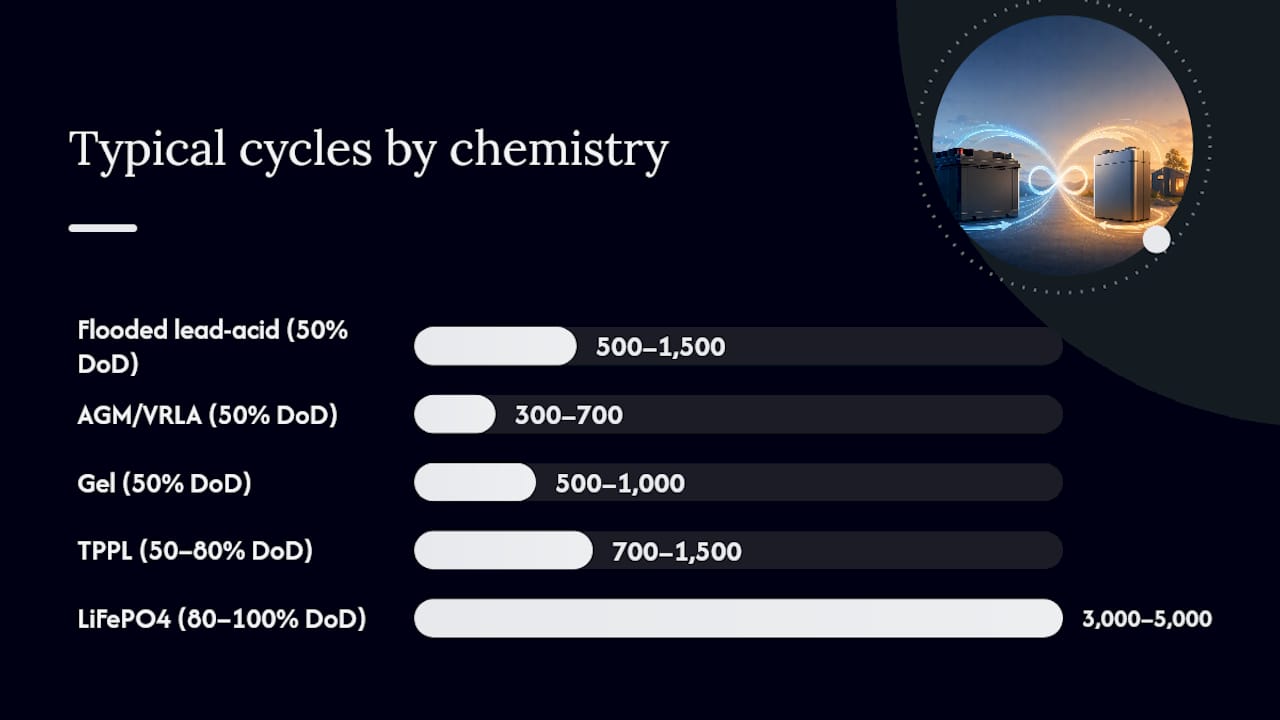
Cycle life is the most misread spec in battery purchasing. The number printed on a datasheet is meaningless without knowing the DoD and temperature at which it was measured.
Typical cycle-life ranges:
| Chemistry | Typical Cycles | DoD Assumed | Notes |
|---|---|---|---|
| Flooded lead-acid | 500–1,500 | 50% | Requires regular watering and equalization |
| AGM/VRLA | 300–700 | 50% | Sealed; no maintenance but shorter life |
| Gel | 500–1,000 | 50% | Sensitive to overcharge; lower charge rates |
| TPPL | 700–1,500 | 50–80% | Better partial-state-of-charge tolerance |
| LiFePO4 | 3,000–5,000 | 80–100% | Per Power Station Picker; BMS required |
DoD and usable capacity are what you actually spend. To match the usable capacity of one 100Ah LiFePO4, you need two 100Ah lead-acid batteries wired in parallel.
Worked lifetime-energy example:
Assume a 100Ah 12V system (1.2 kWh rated):
That is more than 13 times the energy from a battery that weighs roughly half as much. Over a 10-year horizon with daily cycling, you replace the AGM bank roughly every 18 months; the LiFePO4 bank likely outlasts the decade.
The DOE’s Technology Strategy Assessment puts lead-acid volumetric energy density at roughly 25–100 kWh/m³ versus 150–500 kWh/m³ for lithium-ion. In gravimetric terms, lead-acid typically runs 30–50 Wh/kg while LiFePO4 runs 90–160 Wh/kg. That gap has direct physical consequences.
For a 100Ah 12V bank:
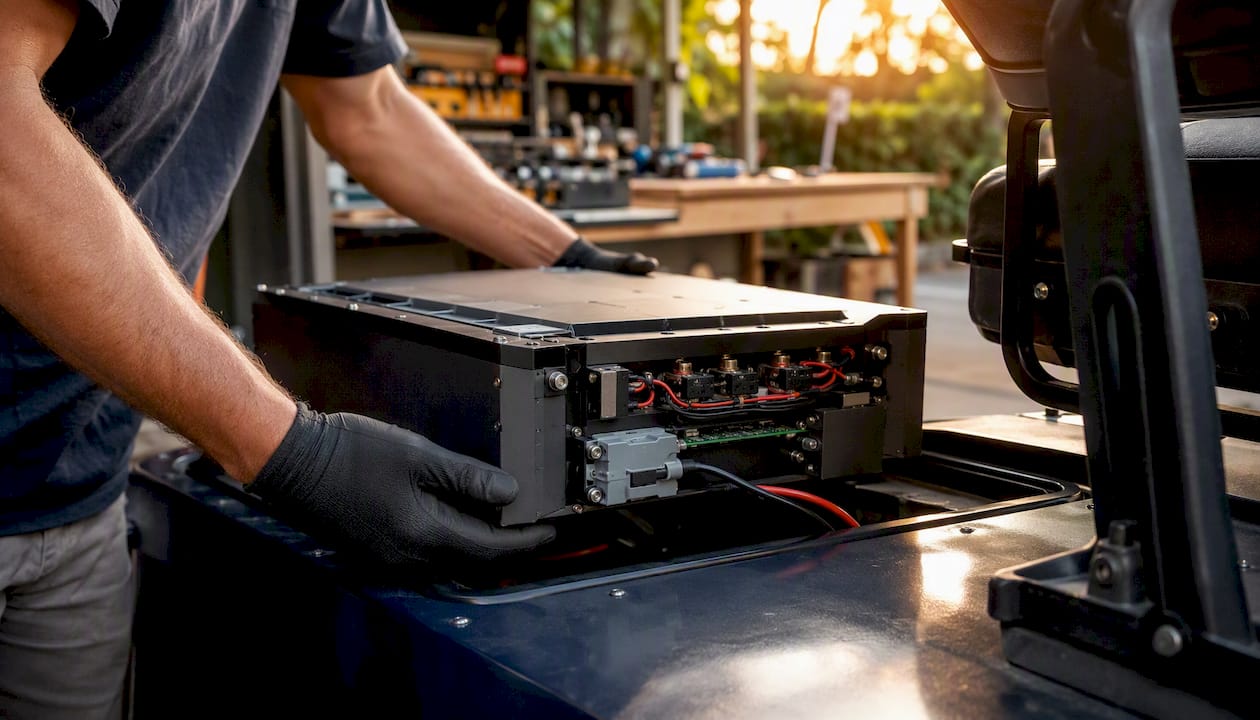
In an RV, boat, or golf cart, that weight difference compounds fast. Replacing four 6V flooded lead-acid batteries in a golf cart (combined ~240 lbs) with a single LiFePO4 pack of equivalent usable energy can cut battery weight by more than half.
Discharge rate and Peukert-type losses:
Lead-acid and LiFePO4 charge differently enough that using the wrong charger on either chemistry can shorten battery life or cause a safety event.
Typical charge times:
Charger compatibility checklist before any swap:
For golf-cart-specific charger guidance, this high-output charger guide covers speed, safety, and battery-life tradeoffs in detail. The LiFePO4 chemistry and its charger requirements are also explained clearly in Banshee Battery’s LiFePO4 explainer, which covers BMS implications for light-vehicle applications.
Round-trip efficiency (RTE) is the percentage of energy you get back out of a battery for every unit you put in. The gap between lead-acid and LiFePO4 here is real money, especially in solar systems where every watt-hour of loss is a watt-hour you had to generate.
PNNL’s analysis puts lead-acid RTE at roughly 75–84% depending on discharge duration.
Worked efficiency example:
Assume a solar system that cycles 5 kWh of usable energy per day, 365 days per year:
That is 361 kWh per year in extra solar generation (or grid draw) just to cover the efficiency gap. At $0.13/kWh average U.S. residential electricity, that is roughly $47/year in wasted energy, compounding over the battery’s lifetime.
What drives the losses:
Temperature is where the chemistry differences become most practically important, especially for outdoor installs, RVs in winter, and golf carts stored in unheated garages.
Lead-acid temperature behavior:
LiFePO4 temperature behavior:
Practical mitigation steps:
For LiFePO4 storage in seasonal applications (golf carts stored over winter, for example), proper storage guidance recommends storing at 50–60% state of charge in a temperature-controlled space, not at full charge.
The physical difference between lead-acid and LiFePO4 is not subtle. For a 48V golf cart battery bank with 5 kWh of usable energy:
That is a weight reduction of more than 300 lbs on a vehicle where every pound affects range, suspension wear, and tire life.
Installation checklist:
For a detailed breakdown of 36V versus 48V system choices for golf carts, the 36V vs 48V battery setup guide covers voltage selection and wiring implications.
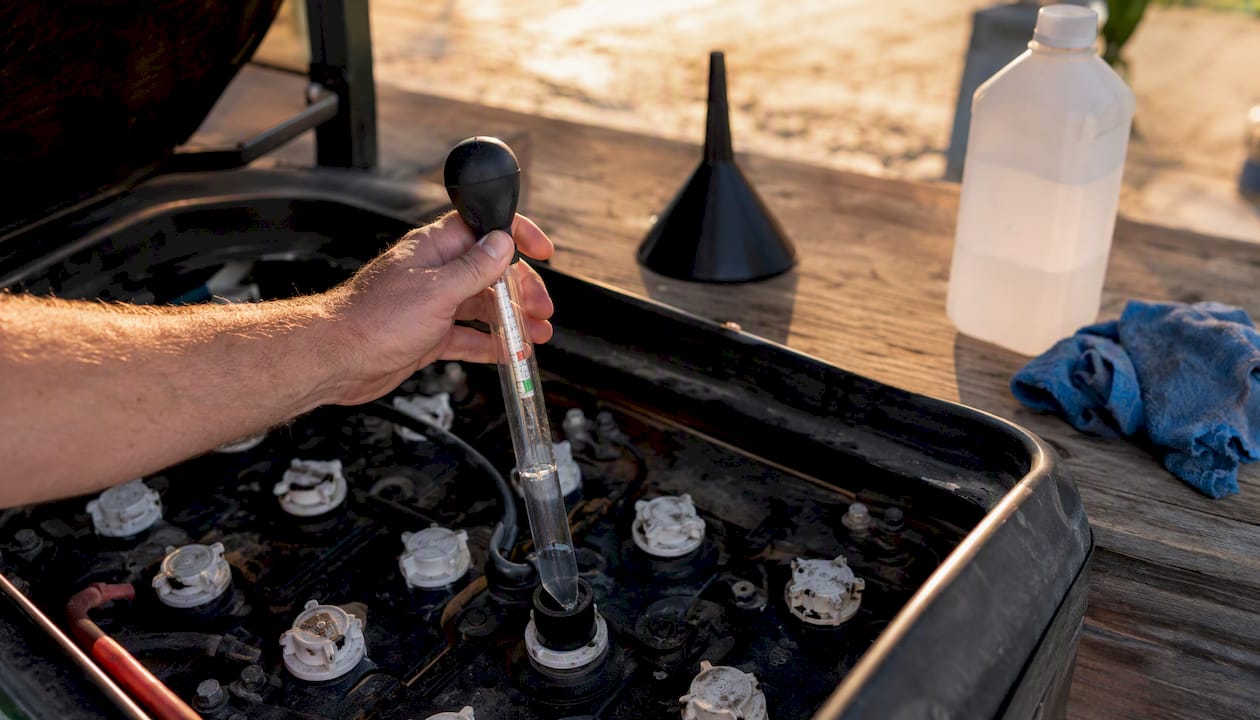
The maintenance gap between lead-acid and LiFePO4 is one of the most underappreciated cost differences. It is not just time; it is the failure modes that catch owners off guard.
Recommended storage state of charge by chemistry:
Maintenance checklist:
Flooded lead-acid:
LiFePO4:
For practical golf-cart-specific maintenance routines, these battery care tips cover both chemistries.
Common failure modes:
Lead-acid: Sulfation (from chronic undercharge or deep discharge), grid corrosion (from overcharge or heat), and PAM shedding (plates crumble after many cycles). The Frontiers review identifies these three mechanisms as the principal aging pathways and notes that operation-based interventions (proper charging, temperature management) can meaningfully extend life.
LiFePO4: Cell imbalance (one cell drifts from the group, causing premature BMS cutoff), BMS failure (rare but catastrophic if the pack has no protection), and electrolyte degradation from chronic overcharge or extreme temperatures. Thermal runaway is possible but far less likely with LiFePO4 than with NMC or NCA chemistries because of the stable iron-phosphate crystal structure.
Sticker price is where lead-acid wins. Lifecycle cost is where it loses, in almost every daily-cycle application.
TCO inputs that matter:
Worked 10-year TCO example for a 5 kWh usable system:
The upfront cost advantage of lead-acid evaporates after the first replacement cycle. PNNL’s cost analysis places lead-acid capital costs at roughly $200–$236/kWh of rated energy, which looks cheap until you account for the 50% DoD constraint doubling the required rated capacity and the replacement frequency.
Pro Tip: TCO is highly sensitive to cycles per year. If your system cycles once a day, lithium wins decisively. If it cycles once a week (a seasonal cabin, a rarely-used backup), the lead-acid replacement frequency drops sharply and the TCO gap narrows. Run the math for your actual cycle count before committing.
A cradle-to-grave lifecycle assessment found that lithium-ion batteries generally have lower climate-change impacts per kWh delivered than lead-acid, primarily because of higher energy density and longer lifetime, though some lithium chemistries show higher impacts in acidification and particulate-matter categories.
Certifications to look for:
Safety differences in practice:
Recycling and end-of-life:
Lead-acid has one of the most mature recycling infrastructures of any industrial product. The Frontiers review records lead-acid recycling rates approaching 99% in the U.S., driven by the economic value of recovered lead and a well-established collection network. Drop-off at any auto parts retailer is standard.
Lithium recycling infrastructure in the U.S. is growing but not yet at the same scale. LiFePO4 is less economically attractive to recycle than NMC because it contains no cobalt or nickel, so collection programs are less developed. The lifecycle assessment notes that lithium-ion generally outperforms lead-acid on climate-change impact per kWh delivered, but the recycling gap is a real environmental consideration. Check with your battery manufacturer for a take-back or recycling program before disposal; never landfill either chemistry.
The DOE’s assessment specifically highlights lead-acid’s low raw-material cost and high recycling rate as strategic advantages worth preserving in applications where those factors dominate.
| Application | Recommended Chemistry | Key Reason |
|---|---|---|
| Solar daily-cycle (residential/off-grid) | LiFePO4 | Higher RTE and cycle life; lower 10-year TCO |
| RV / mobile power | LiFePO4 | Weight savings and usable capacity per cubic foot |
| Marine (trolling, house bank) | LiFePO4 | Vibration tolerance, weight, no off-gassing in cabin |
| UPS / standby backup (low-cycle) | Lead-acid VRLA or LiFePO4 | VRLA for budget/low-cycle; LiFePO4 for 15–20 year design life |
| Golf carts (daily use) | LiFePO4 | Weight, range, and cycle life advantages are decisive |
| Rarely-cycled cabin / emergency backup | Lead-acid AGM | Low cycle count means lead-acid TCO is competitive |
| Industrial ballast | Lead-acid | Weight is a feature, not a bug |
| Sub-freezing charge environment (no heater) | Lead-acid | LiFePO4 requires low-temp charge cutoff or heater |
Where lead-acid still makes sense: A cabin generator backup that fires four times a year, a boat bilge pump float battery that rarely deep-cycles, or any application where the battery doubles as structural ballast. For UPS applications, industry guidance notes that lithium solutions typically enable 15–20 year design life versus 3–5 years for VRLA in high-cycle environments, but VRLA remains cost-effective for low-cycle standby.
Use this checklist whether you are buying new or retrofitting an existing system.
Questions to ask any seller:
Red flags:
Sizing formula:
Required usable kWh = Daily energy need (kWh) × Desired autonomy days Required rated kWh = Required usable kWh ÷ DoD (as a decimal) Required Ah at system voltage = Required rated kWh × 1,000 ÷ System voltage
Example: A golf cart that uses 1.5 kWh per round, runs two rounds per day, and needs one day of autonomy: 3 kWh usable ÷ 0.95 DoD = 3.16 kWh rated. At 48V: 3,160 Wh ÷ 48V = 65.8Ah minimum. A 48V 75Ah LiFePO4 pack covers it with margin.
Golf carts are where the lead-acid vs lithium batteries decision is most concrete. The weight reduction alone changes how a cart handles, and the cycle-life difference means you stop buying batteries every two to three years.
Key retrofit considerations:
The top benefits of lithium golf cart batteries covers the performance and maintenance advantages in detail. For model-specific fitment questions on EZGO, Club Car, or Yamaha carts, contact Golfcartstuff directly for compatibility and warranty guidance before ordering.
LiFePO4 has become the practical default for anyone who cycles a battery regularly, and the adoption curve in golf carts reflects that. At Golfcartstuff, the shift in customer inquiries toward lithium has been consistent over the past several years. Buyers who run their carts daily, or who are tired of watering batteries and replacing banks every two seasons, almost always land on LiFePO4 once they run the numbers.
That said, lead-acid still has a real customer base. Seasonal users who store their carts for five months a year, buyers on strict upfront budgets who plan to sell the cart within two years, and customers in very cold climates without heated storage all have legitimate reasons to stick with flooded or AGM. The chemistry is proven, the recycling infrastructure is unmatched, and the parts are available everywhere.
The honest retail perspective: LiFePO4 inventory and warranty support have matured to the point where the risk of early adoption is largely gone. The remaining question is not whether lithium is better, but whether your specific use case cycles enough to justify the upfront premium. For most daily-use golf cart owners, it does.
Golfcartstuff stocks lithium golf-cart battery packs sized for EZGO, Club Car, and Yamaha carts, with fitment support built into the purchase process. You are not guessing at compatibility; the team confirms your cart model, voltage system, and charger before the order ships.

The practical difference from buying generic: charger compatibility is checked, BMS specs are verified against your controller, and warranty support is handled by people who know golf-cart electrical systems, not a general-purpose battery retailer.
Browse the lithium golf cart battery collection to find packs for your specific cart. Club Car DS owners can also check Club Car DS parts for compatible accessories and installation hardware. Yamaha owners will find fitment-specific options in the Yamaha parts catalog.
Services available through Golfcartstuff:
Explore our store to see what our products and resources can do for you.

Leave a comment