
Your Cart Is Our Priority
Explore our store to see what our products and resources can do for you.

TL;DR:
- Proper maintenance and charging habits can significantly extend golf cart battery lifespan.
- Regular inspection, cleaning terminals, and correct storage prevent early battery failure.
- Knowing your battery type and following tailored care routines is essential for optimal performance.
Battery failure is the number one reason golf cart owners find themselves stranded mid-round or staring at a cart that simply won’t move. Most of those failures don’t happen overnight. They build slowly from small, avoidable mistakes: skipped water checks, the wrong charger, or batteries left in a cold garage all winter without any preparation. Replacing a full battery pack can cost anywhere from $600 to well over $2,000, depending on your cart’s system. The good news is that with the right habits, you can squeeze years of extra life out of your current batteries and keep your cart running at its best every single season.
| Point | Details |
|---|---|
| Know your battery | Identify your battery type for specific care routines and best results. |
| Smart charging matters | Use the right charger and always complete charging cycles to extend battery life. |
| Clean and inspect regularly | A little cleaning and timely inspection prevent most battery performance issues. |
| Prepare for storage | Off-season storage done right prevents loss of capacity and unnecessary damage. |
Before you can care for your batteries properly, you need to know what’s actually powering your cart. Not all golf cart batteries are the same, and the maintenance routines that keep one type healthy can actually damage another.
Flooded lead-acid (FLA) batteries are the most common type in gas-to-electric conversions and older electric carts. They’re affordable and reliable, but they require the most hands-on maintenance. These batteries have removable caps so you can add distilled water to maintain proper electrolyte levels. Ignore the water, and your plates will dry out and fail prematurely.
AGM (Absorbed Glass Mat) batteries are sealed, which means no water topping off required. The electrolyte is suspended in a glass mat, making them spill-proof and more vibration-resistant than flooded batteries. They’re more expensive upfront but need less routine attention. However, as noted in golf cart battery maintenance guides, different battery types require specific maintenance approaches, so you can’t treat an AGM battery the same way you’d treat a flooded one.
Lithium batteries are the newest option, and they’re gaining popularity fast. They charge faster, weigh significantly less (often 70% lighter than lead-acid), and have a much longer cycle life, sometimes over 2,000 charge cycles compared to 500 to 1,000 for lead-acid. The tradeoff is cost: lithium battery packs are considerably more expensive. But they require the least maintenance of all three types.
Here’s a quick comparison of the three battery types:
| Battery type | Water maintenance | Average cycle life | Relative cost | Key care priority |
|---|---|---|---|---|
| Flooded lead-acid | Yes, every 2-4 weeks | 500 to 1,000 cycles | Low | Water levels and terminal cleaning |
| AGM | No | 600 to 1,200 cycles | Medium | Proper charge voltage and storage |
| Lithium | No | 2,000+ cycles | High | Compatible charger and temperature |
Key things to keep in mind for each type:
Knowing your battery type isn’t just trivia. It determines every maintenance decision you make, from how often you inspect them to what charger you should be using.
With a clear understanding of battery types, it’s time to focus on a crucial factor for battery health: charging routines. How you charge your batteries is directly tied to how long they last. Most premature battery failures are caused by charging mistakes, not manufacturing defects.
Regular, complete charging cycles significantly extend battery lifespan. This means letting your charger run until it completes the full cycle rather than pulling the plug after a few hours. Partial charges leave sulfation deposits on the battery plates over time, which reduces capacity and eventually makes the battery unable to hold a full charge.
Equally damaging is leaving batteries completely drained. Deeply discharging lead-acid batteries (below 20% capacity) stresses the plates and shortens the overall lifespan. A good rule of thumb: plug in your cart after every use, even if you only drove it for 20 minutes.
Overcharging is just as dangerous. Excess heat builds up inside the battery, warping plates and accelerating water loss in flooded types. This is why choosing the right golf cart charger matters enormously. Using a charger that doesn’t match your battery type or voltage can cause chronic overcharging without you ever realizing it.
Understanding charger differences for performance can help you decide whether an automatic, smart charger is worth the investment. Smart chargers detect the battery’s state of charge and shut off automatically at 100%, preventing overcharging entirely.
Charging dos and don’ts:
“A battery that’s charged consistently and correctly will outlast a higher-quality battery that’s charged carelessly. The charger is as important as the battery itself.”
Pro Tip: If you’re storing your cart for the off-season, invest in a maintenance charger (sometimes called a trickle charger) that keeps batteries at an optimal charge level without overcharging. This small investment protects a much larger one.
Charging smart is just part of the equation. Hands-on, regular maintenance makes the difference between batteries that last and those that don’t. The good news is that basic battery maintenance doesn’t require special tools or technical expertise. It just requires consistency.
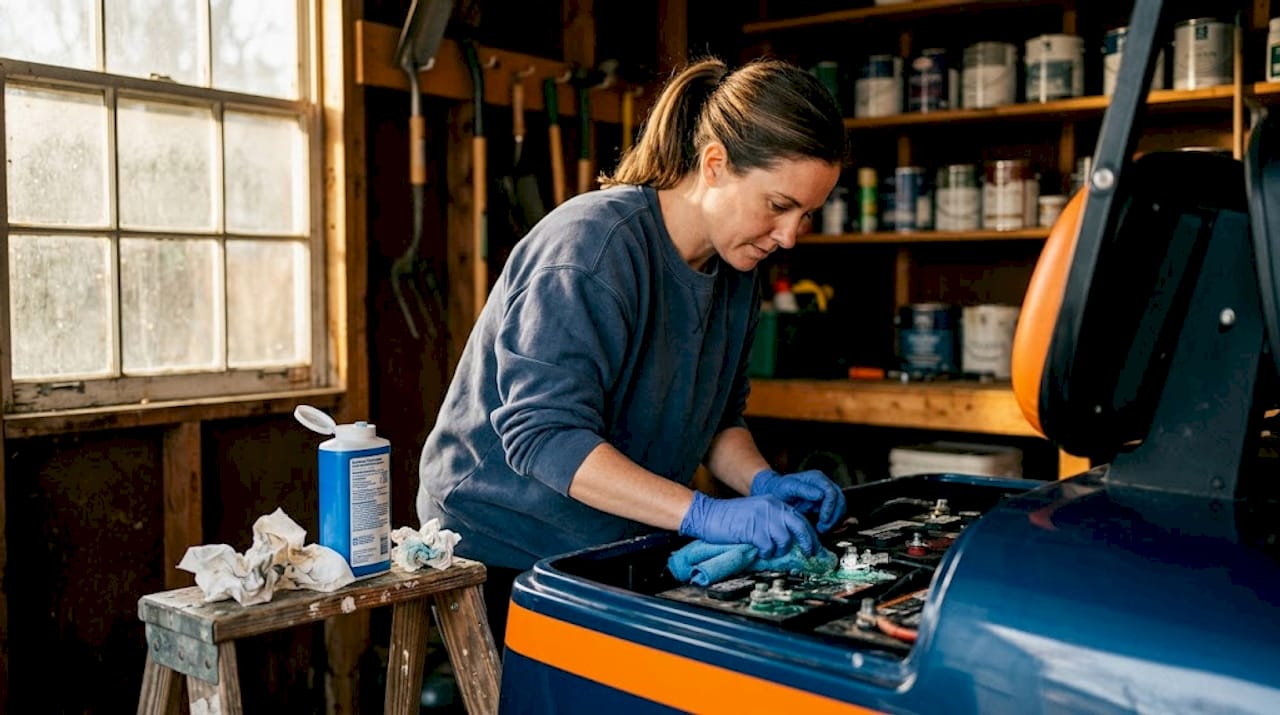
Corroded terminals and loose connections are top contributors to power loss and battery failure. Corrosion looks like a white or bluish powder forming around the battery terminals and cable connections. It acts as a resistor, meaning your cart draws more power to overcome the resistance, which drains batteries faster and can cause uneven charging across your battery pack.
Here’s how to handle cleaning and inspection the right way:
For flooded lead-acid batteries specifically, water level inspection is non-negotiable. You need to check step-by-step battery maintenance regularly to make sure electrolyte levels stay above the battery plates. When the plates are exposed to air, they oxidize rapidly and lose capacity permanently. Always use distilled water, never tap water, which contains minerals that contaminate the electrolyte and accelerate plate damage.
Statistic callout: Following a consistent cleaning and inspection routine can extend the usable life of your battery pack by up to 25%, according to maintenance data from golf cart service professionals. That’s potentially years of additional use from batteries you already own.
Pro Tip: Set a calendar reminder for every two weeks to do a quick battery check. It takes less than 10 minutes and is the single most impactful thing most cart owners can do to protect their investment. A small amount of time now prevents a very expensive replacement later.
When you spot minor issues, like a slightly loose terminal or early-stage corrosion, fix them immediately. Problems that seem minor at first compound quickly in a battery system. A loose cable that causes inconsistent charging will shorten the life of every battery in your pack, not just the one it’s connected to.
After daily use, how you store your golf cart batteries can make or break their lifespan, especially over the winter or during extended periods without use. This is where many cart owners lose years of battery life without ever realizing it.
Incorrect storage is a major reason for reduced battery capacity after winter. Batteries left in a discharged state during cold months develop a process called sulfation, where lead sulfate crystals harden on the plates. Once severe sulfation sets in, a battery can’t recover. What was a perfectly functional battery in October becomes a dead weight by spring.
Understanding battery storage by voltage can also inform how you approach seasonal prep, since 36V and 48V systems have different total capacities and discharge behaviors during idle periods.
Storage preparation checklist:
Here’s a side-by-side look at what good storage looks like for different timeframes:
| Storage duration | Charge level at start | Cable disconnect | Recharge interval | Temperature concern |
|---|---|---|---|---|
| Short-term (1 to 4 weeks) | Full charge | Optional | Not required | Low |
| Medium-term (1 to 3 months) | Full charge | Recommended | Every 4 to 6 weeks | Moderate |
| Long-term (3+ months, winter) | Full charge | Required | Every 4 to 6 weeks | High, keep above freezing |
Temperature matters more than most owners realize. Cold slows the chemical reactions inside a battery, reducing its effective capacity. A lead-acid battery stored at 20 degrees Fahrenheit loses capacity significantly faster than one stored at 50 to 60 degrees. If you live in a region with harsh winters, even moving your cart from an unheated outdoor space to an insulated garage can add years to your battery pack’s life.
Don’t neglect batteries during storage. A set-it-and-forget-it approach is one of the most common and costly mistakes golf cart owners make. Four weeks of inattention in January can undo years of careful maintenance.
Here’s something we’ve noticed after working with thousands of golf cart owners: the people who get the most out of their batteries aren’t the ones who buy the most expensive packs or the fanciest chargers. They’re the ones who do small things consistently.
Wiping down terminals takes two minutes. Checking water levels takes five. Plugging in after every ride takes seconds. None of these habits require specialized knowledge or expensive tools. But they stack up in a way that no single upgrade can match.
Most battery failures we see trace back to simple neglect: a couple of months of forgetting to water the batteries, a winter of storage without recharging, or running a cart daily on a charger that doesn’t match the battery chemistry. These aren’t dramatic failures. They’re slow declines that become irreversible before most owners notice.
The importance of regular maintenance really can’t be overstated for battery longevity. You don’t need to be a mechanic. You just need to be consistent. A $5 bottle of terminal protector spray and a bi-weekly 10-minute check can outperform a $300 battery upgrade on a neglected cart every single time.
Putting these battery care habits into practice is a lot easier when you have the right tools within reach.

At Golf Cart Stuff, we carry everything you need to support a solid battery maintenance routine, from high-quality golf cart battery chargers that match your voltage and battery chemistry, to cables, terminal protectors, and other essential golf cart accessories. Whether you’re setting up a first-time maintenance kit or replacing aging components, you’ll find trusted products built for real golf cart use. Browse our full selection to find exactly what your cart needs to keep those batteries performing season after season.
Check water levels every 2-4 weeks and always after a full charge for flooded lead-acid batteries, since water inspection is a core recommended maintenance task that prevents plate damage.
Key signs include slow charging, noticeably shorter run time per charge, and physical changes like visible corrosion, swelling, or cracked battery cases.
No. You must use a charger that matches both your battery type and your system’s voltage, because choosing the right charger is what prevents both undercharging and overcharging that shortens battery life.
Store batteries at a full charge, disconnect the negative cable, keep them in a space that stays above freezing, and recharge every 4 to 6 weeks, since incorrect storage is a leading cause of reduced battery capacity after winter.
Explore our store to see what our products and resources can do for you.

Leave a comment