

Your Cart Is Our Priority
Explore our store to see what our products and resources can do for you.

TL;DR:
- Using a high-output charger can reduce charging time and support longer battery life when properly matched to the battery chemistry and system specifications. However, oversizing or mismatching the charger risks overheating, BMS shutdowns, and potential damage to the battery pack. Correct compatibility, smart multi-stage algorithms, and proper wiring are essential for safe, effective high-output charging.
Charging your golf cart faster sounds like a straightforward win, but the truth is more interesting. Done right, a properly matched high-output charger can reduce downtime, protect your battery pack, and actually support longer battery life. Done wrong, it can cook your cells, trip your BMS, and leave you with a shortened investment. The difference isn’t the charger’s amp rating on the box. It’s whether that charger is matched to your specific battery system, chemistry, and wiring. This article breaks down exactly how high-output chargers work, who benefits most, and what you need to know before you upgrade.
| Point | Details |
|---|---|
| Faster charging requires the right match | Only use high-output chargers that are compatible with your battery’s specs to avoid damage. |
| Smart chargers extend battery life | Chargers with multi-stage profiles help prevent common battery problems like overcharging. |
| Operational needs drive real benefit | High-output charging saves time for fleets or frequent users, but casual owners may not need the investment. |
| Lithium batteries pair well | High-output chargers offer the strongest upside with lithium batteries that support fast charging and smart profiles. |
The term “high-output” simply means the charger delivers more amps or watts than a standard unit. A typical golf cart charger might push 10 to 15 amps. A high-output model can deliver 25, 30, or even 40+ amps depending on the design. More current means the battery fills up faster, at least during the early part of the charging cycle.
Here’s where it gets important. High-output chargers reduce charging time by delivering more current during the bulk phase, but only when your battery system can safely accept that current. The battery isn’t a passive bucket you fill. It has a maximum acceptance rate, and pushing beyond that rate creates heat, stress, and damage.
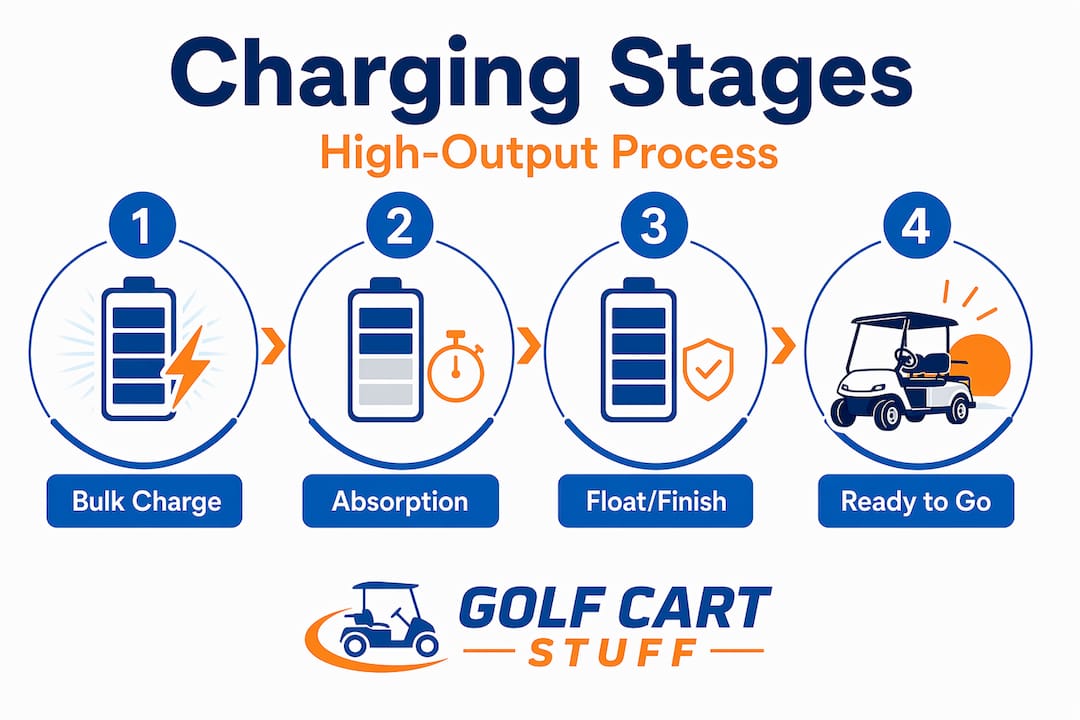
Most modern chargers use a multi-stage algorithm. The bulk phase pushes high current into a mostly depleted battery. As the pack fills, the charger transitions to absorption, then to float. The actual speed advantage of a high-output charger is concentrated in that bulk phase. Understanding charger differences helps you see why two chargers with different amp ratings can produce very different results on the same battery pack.
| Charger type | Typical output | Best for | Charge time (48V, 150Ah pack) |
|---|---|---|---|
| Standard | 10-15A | Overnight use, light duty | 10-15 hours |
| Mid-output | 18-22A | Daily use, single cart | 7-10 hours |
| High-output | 25-40A | Fleets, frequent cycling | 4-7 hours |
| Ultra-high | 40A+ | Commercial operations | 2-4 hours |
Key things to understand before going high-output:
“A charger’s output rating means nothing if the battery can’t accept the current safely. The bottleneck is almost always the battery, not the charger.” This is the concept that separates smart buyers from frustrated ones.
Reviewing charger performance essentials before purchasing any high-output unit gives you a solid baseline for making the right call.
Not every golf cart owner needs a high-output charger. But for certain situations, it’s one of the most practical upgrades you can make. Let’s look at who benefits most and when the investment actually pays off.
Fleets and golf course operations are the clearest use case. When you have 20 carts that need to be ready by 7 AM and the last round finishes at 8 PM, you have roughly 11 hours to charge. A standard 10A charger may not fully restore a heavily depleted pack in that window. Fleet operations with faster chargers maintain better uptime and avoid the costly problem of sending out a cart with 40% charge at noon.
Frequent recreational users who ride daily or multiple times per week also benefit. If you’re charging every evening and riding hard the next morning, trimming charge time from 12 hours to 6 hours makes your schedule more flexible without stressing the battery when the charger is spec-matched.
Lithium battery owners often see the biggest gain. Lithium iron phosphate (LiFePO4) cells accept higher charge rates far more tolerantly than flooded lead-acid. More on that in section 5, but the short version is that lithium’s chemistry pairs naturally with high-output charging when the algorithm is correct.
Here’s a quick comparison of typical use cases:
| User type | Benefit level | Notes |
|---|---|---|
| Golf course fleet | Very high | Fast turnaround, high daily cycles |
| Daily recreational rider | Moderate to high | Convenience and uptime |
| Weekend-only user | Low | Standard charger usually sufficient |
| Lithium battery owner | High | Tolerates higher currents with right charger |
| Lead-acid, occasional use | Low to moderate | Risk increases without smart algorithm |
Follow these steps before upgrading to a high-output charger:
Pro Tip: If your battery pack’s max charge rate is 0.2C and you have a 150Ah pack, your safe maximum charge current is 30 amps. Buying a 50A charger won’t speed things up. It will trigger the BMS cutoff or stress the cells. Know your C-rate before you shop.
Speed without control is where high-output charging causes real damage. This section covers the actual risks and how smart features protect your investment.
The most common mistake is assuming that a voltage-compatible charger is automatically safe. Voltage match is necessary, but it’s not sufficient. You also need the right chemistry profile, the right current ceiling, and the right multi-stage algorithm. Using the correct high-output charger with the right voltage and chemistry, along with smart multi-stage charging that includes taper and cutoff stages, is what actually protects battery lifespan.
What happens when the output is too high? Several things can go wrong:
Smart charger features to look for:
“The smarter the charger, the safer the speed. A dumb high-output charger is worse than a smart standard charger. The algorithm matters as much as the amp rating.”
Pro Tip: Before plugging in any new high-output charger, check your garage or storage outlet’s breaker rating. A 25A charger on a 15A circuit is a fire hazard. Consult an electrician about adding a dedicated 30A or 50A circuit if you’re running commercial-grade equipment.
Regular maintenance on your charging setup is just as important as the initial spec match. Review charger maintenance tips and follow through with charger maintenance steps to keep connectors clean, cables inspected, and cooling vents clear on the charger unit itself.
The battery chemistry in your cart changes everything about how high-output charging works. These two battery types behave very differently under high current, and the charger algorithm must reflect that.
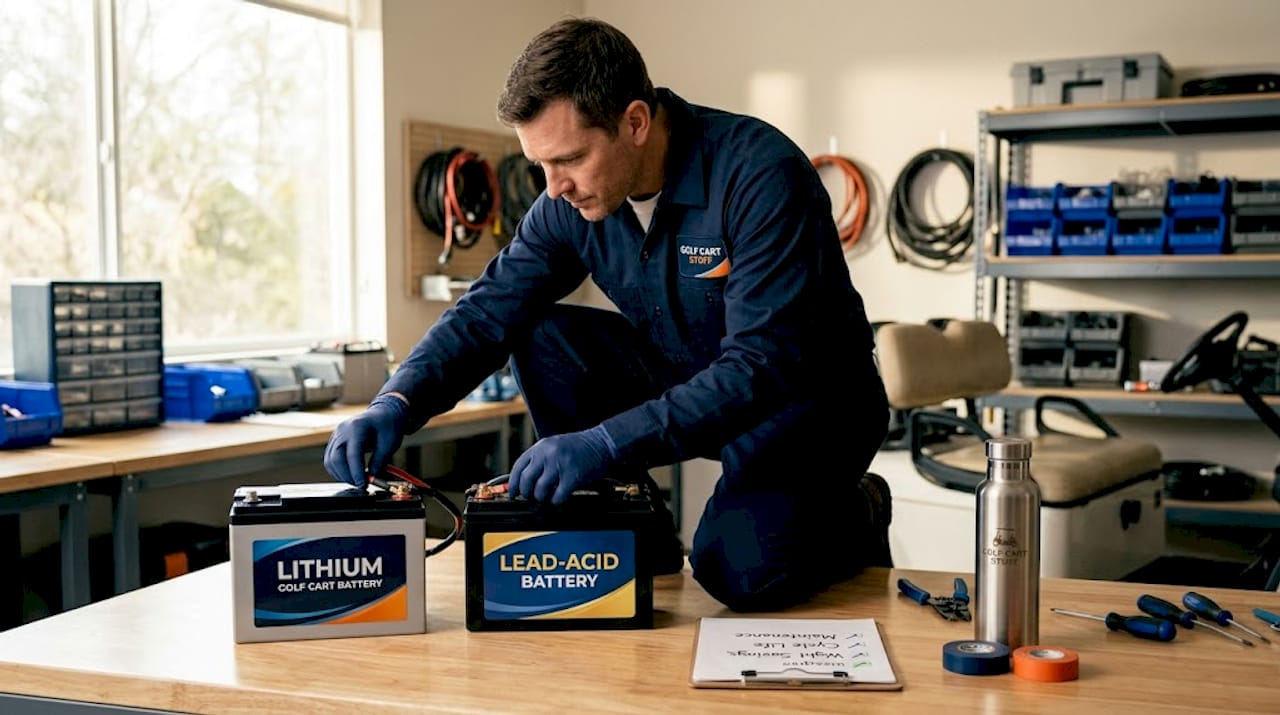
High-output chargers paired with lithium batteries and BMS-compatible charging deliver clear advantages because lithium charges faster and has fundamentally different algorithm expectations than lead-acid. This isn’t a minor detail. Using a lead-acid charger on a lithium pack is one of the most damaging mistakes a cart owner can make.
| Feature | Lithium (LiFePO4) | Flooded lead-acid | AGM lead-acid |
|---|---|---|---|
| Max charge rate (C-rate) | 0.5C to 1C typical | 0.1C to 0.2C typical | 0.2C to 0.3C |
| Accepts high-output charging | Yes, with correct profile | Limited | Limited |
| Requires float stage | No | Yes | Yes |
| BMS required | Yes | No | No |
| Charge time at optimal rate | 1-3 hours (varies) | 8-14 hours | 6-10 hours |
| Charger compatibility | Chemistry-specific | Standard golf cart | AGM-specific |
Key differences to understand:
Upgrading to lithium is one of the best decisions a serious cart owner can make, and understanding lithium battery benefits shows why high-output charging is one of the biggest advantages that comes with the switch. Faster recharge, longer cycle life, and lighter weight all add up to a better cart experience overall.
Here’s the perspective most charger marketing skips entirely. When a product promises “50% faster charging,” the implied message is that faster equals better. But in the real world of golf cart battery systems, faster only equals better when it’s appropriate for your specific setup.
We’ve seen cart owners buy the highest-amp charger they could find because it “sounded more powerful,” only to end up with bloated battery cases, shortened pack life, or a BMS that trips every single charge cycle. The charger wasn’t defective. It was simply the wrong tool for that battery.
The real insight is this: oversizing a charger even with voltage compatibility can stress batteries through heat or lead to repeated protective cutoffs, meaning output must be matched to battery capacity and manufacturer guidance. This is a nuance that almost no product listing explains clearly.
The most successful golf cart owners we’ve worked with ask three questions before buying a charger. First, what is my battery’s maximum safe charge rate? Second, does this charger have the right algorithm for my battery chemistry? Third, can my wiring and outlets handle this load? These three questions do more to protect battery life than any single spec number on a charger label.
Think of high-output charging the way you’d think of a performance tire on your cart. A wider, grippier tire is a genuine upgrade on certain surfaces. Put it on the wrong cart or terrain, and it’s a liability. The tool is only as good as the match. Reviewing your voltage guide is a smart first step in confirming that your cart’s system can actually benefit from a higher-output upgrade.
Long-term battery health comes from accuracy, not aggression. The right high-output charger for your exact battery pack will charge faster, protect cells, and extend the overall lifespan of your investment. The wrong one, even if it’s technically “faster,” will cost you more in replacement batteries than you ever saved in charge time.
Making the move to a high-output charger is just one part of a smarter charging setup. The wiring, connectors, battery terminals, and accessories around your charger all need to support the increased current load for the system to work safely and efficiently.

At Golf Cart Stuff, we carry a wide range of Club Car parts and golf cart accessories specifically selected to complement charging upgrades. Whether you’re building out a fleet charging station or upgrading a single personal cart, our product selection covers the components that make high-output charging work reliably. From battery cables rated for higher current to connectors, terminals, and storage accessories, you’ll find what you need to support a complete system upgrade backed by practical product knowledge.
Yes, if the charger’s output exceeds your battery’s safe charging rate, you risk overheating and reduced battery lifespan; always match charger specs to battery recommendations, since exceeding max charge current creates heat and cell degradation.
No, real-world charging speed depends on whether the battery chemistry and BMS can accept higher currents efficiently; battery acceptance rate is always the limiting factor, and built-in protections will slow or stop charging if the current is too high.
Some chargers support multiple battery types, but lithium requires chemistry-specific profiles and BMS compatibility that lead-acid setups do not need, so never assume a charger is universally compatible just because the voltage matches.
Check your battery spec sheet for maximum charge current, verify your wiring and outlet capacity, and confirm algorithm compatibility; charger output must match battery capacity and manufacturer guidance to avoid stress damage.
Frequent charging within manufacturer specs using smart multi-stage charging does not necessarily reduce lifespan, but mismatched or unsmart charging at high output significantly increases the risk of shortened battery life.
Explore our store to see what our products and resources can do for you.

Leave a comment