
Your Cart Is Our Priority
Explore our store to see what our products and resources can do for you.

A golf cart wholesale pricing tier is a structured discount level that manufacturers and distributors assign based on the volume of units you purchase in a single order or contract. The higher your order quantity, the lower your per-unit cost. Dealers, fleet operators, resorts, and large commercial buyers all use these tiers to secure pricing well below standard retail. Brands like E-Z-GO and Cushman build their dealer programs around exactly this structure, rewarding volume commitment with progressively deeper discounts.
Here is what wholesale pricing tiers typically cover:
True wholesale pricing typically begins at a minimum order quantity of several units, with significant cost advantages occurring at larger order sizes that align with container loads. At this level, logistics efficiencies enhance per-unit discounts, making bulk buying economically beneficial.
| Volume Tier | Typical Order Size | Pricing Implication |
|---|---|---|
| Entry wholesale | 5–10 units | Basic discount over retail; qualifies for wholesale terms |
| Mid-tier bulk | 11–20 units | Moderate per-unit savings; partial logistics benefits |
| Container load | 20–26 units | Deepest per-unit discount; full logistics cost efficiency |
| Fleet/commercial | 27+ units | Custom pricing negotiated directly with manufacturer |
For dealers just starting out, the 5–10 unit threshold is the door. For established operations buying at container-load volumes, the per-unit savings can be substantial enough to fund the next order cycle from margin alone.
Key minimum purchase quantities to keep in mind:
Pro Tip: If you are close to a container-load threshold, adding one or two units to reach it often costs less than the per-unit savings you gain across the full order.
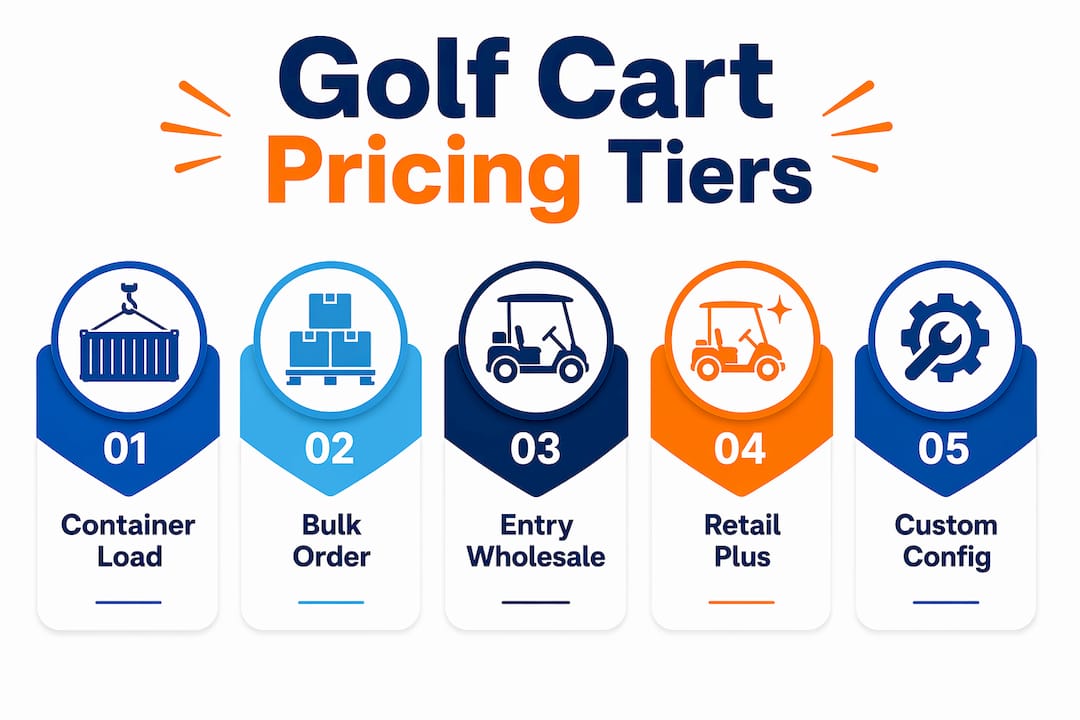
Volume gets you in the door, but configuration determines where you land within a tier. Battery type alone is one of the biggest variables: lead-acid batteries represent the baseline, while lithium-ion (LiFePO4) packs add $1,000–$2,500 to the wholesale cost per unit. For commercial buyers, that premium pays back through faster charging, lower maintenance, and fewer warranty claims.

Regulatory compliance adds another layer. Upgrading a cart to meet Department of Transportation standards for Low-Speed Vehicles (LSVs) requires AS1-certified glass windshields, three-point seatbelts, turn signal arrays, and backup cameras, adding roughly $800–$1,500 to the wholesale acquisition cost. Off-road builds with lifted suspensions and high-torque AC motors sit at the top of the pricing range for the same reason.
Factors that move your tier pricing:
Large resorts and commercial campuses that require high-capacity vehicles with premium features consistently land at the upper wholesale tiers, regardless of order volume.
Being an authorized dealer is not just a title. Formal multi-year dealer contracts unlock pricing tiers that one-time bulk buyers never see, along with priority shipping, co-op marketing support, and direct access to manufacturer reps. A resort buying 30 carts once gets volume pricing. An authorized dealer buying 30 carts per quarter gets dealer-tier pricing, which is a different number entirely.
The authorization process typically involves a business license review, a territory agreement, a minimum annual purchase commitment, and sometimes a facility inspection. Once approved, dealers operate under a contract that defines their pricing tier, territory exclusivity, and resale obligations. That contract is the asset. Dealers who maintain their annual volume commitments tend to move up tiers over time, while those who fall short risk losing their tier status.
Partnership benefits that authorized dealers access:
For dealers looking to sharpen their approach, a solid dealer pricing strategy covers how to position tier access as a competitive advantage in your local market.
Wholesale agreements are not just about price. Payment terms, lead times, resale restrictions, and warranty conditions all shape the real cost of a bulk purchase. Most manufacturers require a deposit of 30%–50% at order confirmation, with the balance due before shipment. Net-30 or Net-60 terms are available to established dealers with strong credit histories, but first-time buyers typically pay upfront.
Lead times for new units generally run 8–16 weeks from order confirmation, depending on the manufacturer and configuration complexity. Container-load orders from overseas manufacturers can extend that timeline. Resale restrictions are common: many wholesale agreements prohibit selling outside your designated territory or below a minimum advertised price (MAP). Violating MAP policies can cost you your dealer tier.
Key purchase terms to review before signing:
Understanding golf cart resale value before you commit to a wholesale tier helps you model the margin on each unit across its full lifecycle, not just at the point of purchase.
Start with authorization status. A supplier who can offer you a formal dealer agreement gives you access to better pricing tiers and more consistent support than a one-time wholesale transaction. Verify that the supplier is an authorized distributor for the brands you want to carry, and ask specifically which tier your projected annual volume qualifies for.
Pricing transparency matters more than the headline number. A supplier who shows you a clear tier schedule, with defined volume thresholds and per-unit prices at each level, is easier to plan around than one who negotiates case by case. Total cost of ownership, including freight, warranty, and after-sales support, often matters more than the per-unit wholesale price.
Practical criteria for evaluating suppliers and tiers:
For buyers who plan to customize their fleet after purchase, reviewing buying and modifying tips before finalizing a wholesale order helps avoid spec mismatches that add cost later.
The dealers who get the best pricing in 2026 are not necessarily the ones buying the most units. They are the ones with the strongest supplier relationships. Formal partnerships yield access to exclusive pricing tiers, marketing support, and preferential shipping that volume alone cannot buy. Treating your supplier as a long-term partner rather than a transaction source is the single most consistent differentiator between dealers who hold their margins and those who compete purely on price.

Seasonality is a real pricing lever that most buyers underuse. Off-season periods, particularly late autumn and winter, are when manufacturers push deeper discounts to clear aging inventory. Placing a large order in november or december can effectively lower your tier entry cost without requiring a higher volume commitment. That timing advantage compounds when you combine it with a container-load order.
Expert tips for 2026 wholesale buyers:
Once your wholesale order lands, the real work starts: keeping those carts running and generating revenue. Golfcartstuff carries a full range of golf cart accessories and replacement parts for the most popular models on the market, including Club Car and Yamaha. Whether you are outfitting a new fleet or maintaining an existing one, having reliable parts on hand keeps downtime short and customer satisfaction high.
Browse Club Car DS parts and Yamaha components at Golfcartstuff to keep your wholesale fleet running at full capacity.
Wholesale pricing tiers reward volume and formal dealer partnerships, with the deepest discounts reserved for container-load orders and authorized dealers who commit to annual purchase minimums.
| Point | Details |
|---|---|
| Entry threshold | Wholesale pricing starts at 5–10 units; full savings unlock at 20–26 units (container load). |
| Configuration drives cost | Lithium battery upgrades add $1,000–$2,500 per unit; LSV compliance upgrades add $800–$1,500 to the wholesale cost per unit. |
| Dealer authorization matters | Formal multi-year contracts unlock dealer-only pricing, priority shipping, and marketing support. |
| Seasonality lowers entry cost | Off-season orders in late autumn and winter access deeper discounts without higher volume. |
| Total cost of ownership | Warranty terms, freight, and after-sales support shape real cost beyond the per-unit wholesale price. |
Explore our store to see what our products and resources can do for you.

Leave a comment