
Your Cart Is Our Priority
Explore our store to see what our products and resources can do for you.

TL;DR:
- AC motors use brushless design and regenerative braking for higher efficiency and better hill climbing.
- DC motors rely on brushes that wear over time and experience performance drops on inclines.
The primary difference between AC and DC golf cart motors is that AC motors use alternating current with a brushless design and regenerative braking, while DC motors rely on direct current with carbon brushes that wear over time. Understanding this distinction matters because it shapes everything from how your cart climbs a hill to how much you spend on maintenance over a decade. This guide covers the difference between AC and DC golf cart motors in full, with real performance data and practical upgrade advice for owners who want to make the right call.
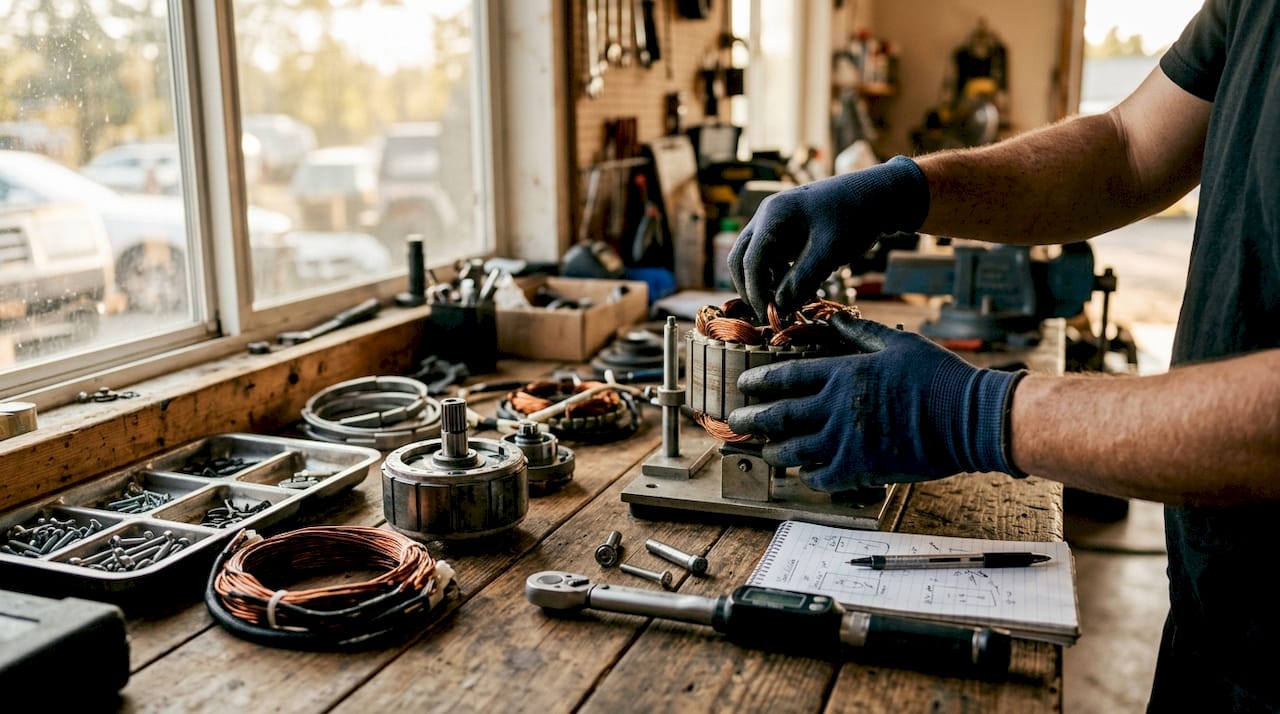
AC motors and DC motors are the two main golf cart motor types, and their core difference comes down to how they generate and manage electrical current. A DC motor runs on direct current flowing in one direction, using carbon brushes pressed against a spinning commutator to transfer power. An AC motor runs on alternating current that reverses direction many times per second, eliminating the need for brushes entirely.
AC motors operate at 90–95% efficiency compared to 70–85% for DC motors. That gap means AC motors convert more battery energy into motion, which directly extends your range on a single charge. The efficiency advantage comes from the brushless design, which eliminates friction losses and heat buildup that drag down DC motor performance.
Regenerative braking is another defining feature of AC systems. When you lift off the accelerator, the AC motor acts as a generator and feeds energy back into the battery. Regenerative braking can extend battery range by 10–15% in hilly terrain. DC motors lack this capability entirely.
DC motors use a series-wound design where the field coil and armature coil connect in series. Carbon brushes press against a segmented copper commutator ring, delivering current to the spinning armature. The commutator reverses the current direction mechanically, which is what keeps the motor spinning. This mechanical switching is effective but creates friction, heat, and carbon dust with every rotation.
AC motors work on induction principles. The stator generates a rotating magnetic field, and the rotor follows that field without any physical contact. No brushes, no commutator, no mechanical switching. The motor requires an inverter and a controller to convert the battery’s DC power into the alternating current the motor needs. That controller also manages torque delivery, acceleration curves, and regenerative braking.
The controller in an AC system is significantly more sophisticated than a standard DC controller. It monitors motor temperature, current draw, and rotor position in real time. This active management is what gives AC motors their consistent performance under load.
Pro Tip: If you hear a faint high-pitched whine from an AC motor, that sound comes from the inverter’s switching frequency. It is completely normal and not a sign of a problem.
AC motors deliver smoother acceleration and better hill climbing through active current management. The controller adjusts torque output continuously, so the cart maintains speed on an incline without the driver noticing a drop. DC motors experience power loss and torque degradation on hills due to heat buildup and voltage sag. On a steep course, that difference is immediately noticeable.
| Performance Metric | AC Motor | DC Motor |
|---|---|---|
| Efficiency | 90–95% | 70–85% |
| Torque consistency on hills | Maintained under load | Degrades with heat |
| Regenerative braking | Yes, 10–15% range gain | No |
| Brake wear reduction | 30–50% less wear | Standard wear rate |
| Acceleration feel | Smooth, linear | Adequate, rougher |
| Noise profile | Faint inverter whine | Brush noise |
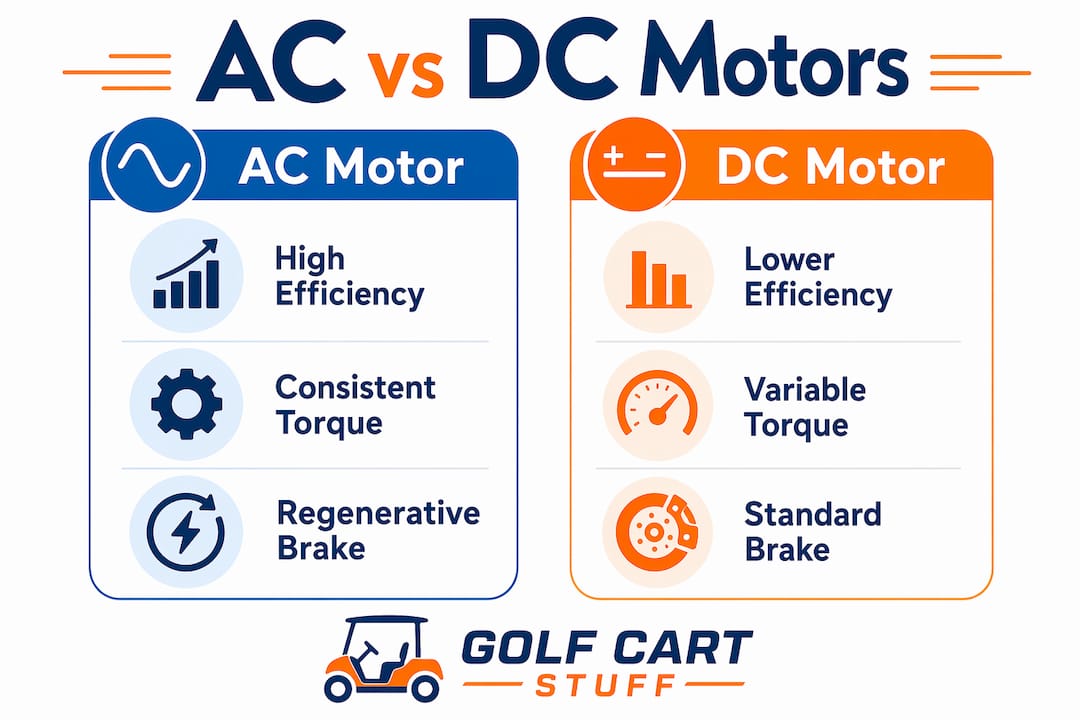
Regenerative braking on AC motors reduces brake wear by 30–50%. That means less frequent brake service on top of the motor maintenance savings. For owners who use their cart on hilly courses or communities, this adds up to real money over time.
Electric golf cart motors deliver instant torque from a standstill, which is one reason they feel more responsive than gas carts. AC motors improve torque consistency under stress, so that instant-torque feel stays consistent whether you are on flat ground or climbing a grade. DC motors can feel punchy at low speeds but lose that edge as the motor heats up under sustained load.
Sound is a smaller but real difference. AC motors produce a faint high-pitched whine from the inverter switching frequency. DC motors produce a rougher brush noise. Neither is loud, but owners who prioritize a quiet ride will find AC systems noticeably smoother.
DC motors require carbon brush replacement every 3–5 years. Each brush service costs $100–$200, and skipping it causes problems beyond just worn brushes. Carbon dust builds up inside the motor housing and can cause electrical shorts if the maintenance is neglected. That is a failure mode most DC motor owners do not anticipate until it happens.
AC motors eliminate brush service entirely. There are no brushes to wear, no commutator to inspect, and no carbon dust to clean out. The main service items for an AC motor are the controller and the wiring connections, both of which require far less frequent attention.
Owners save $200–$400 over 10 years on brush maintenance alone by choosing AC systems. Add the efficiency gains and regenerative braking benefits, and the total cost of ownership often favors AC motors despite a higher purchase price upfront.
Pro Tip: If you own a DC motor cart, check your brushes every two years rather than waiting for the three-year mark. Catching worn brushes early prevents the carbon dust buildup that leads to costly electrical repairs.
Battery range also ties into maintenance costs. An AC motor’s higher efficiency means the battery works less hard to cover the same distance. That reduces the number of full charge cycles over the battery’s life, which can extend battery pack longevity. For owners running 48-volt or 72-volt lithium packs, that is a meaningful long-term benefit.
Choosing between AC and DC comes down to four factors: terrain, budget, cart age, and how you use the cart. Neither motor type is universally better. Suitability depends on terrain, load, budget, and intended usage. A flat retirement community with light loads is a very different application than a hilly golf course with four passengers and a full cooler.
For owners who use their cart for golf cart torque-heavy applications like towing, off-road use, or steep terrain, AC motors deliver a clear performance advantage. For budget-conscious owners with flat-terrain use cases and older carts, a DC motor replacement is a practical, cost-effective solution.
AC motors outperform DC motors in efficiency, hill climbing, and long-term ownership costs, but DC motors remain a practical choice for flat terrain, older carts, and budget-focused owners.
| Point | Details |
|---|---|
| Efficiency gap | AC motors run at 90–95% efficiency; DC motors run at 70–85%, reducing range. |
| Maintenance savings | AC motors eliminate brush service, saving $200–$400 over 10 years. |
| Hill performance | AC motors maintain consistent torque on inclines; DC motors lose power with heat. |
| Upgrade complexity | DC-to-AC conversions require motor, controller, and often wiring replacement. |
| Regenerative braking | AC systems recover energy during deceleration, extending range by 10–15% on hills. |
People fixate on horsepower numbers when shopping for a motor upgrade. That is the wrong metric. The real question is how the motor behaves under load, and that is where AC and DC motors diverge most sharply.
I have seen owners drop money on a high-horsepower DC motor for a hilly course and still feel disappointed. The motor feels strong off the line, but once it heats up on the third or fourth climb, the torque drops and the cart slows down noticeably. That is not a power problem. It is a thermal management problem, and it is baked into the DC motor’s brush-and-commutator design.
AC motors handle that situation differently because the controller actively manages current and heat. The cart does not slow down on the fourth hill the way it does on the first. That consistency is what owners actually want, even if they describe it as “more power.”
That said, I would not tell every DC motor owner to convert to AC. If you have a 2005 Club Car DS running a 36-volt DC system on a flat course, a DC motor replacement from Golfcartstuff makes far more sense than a full AC conversion. The compatibility headaches and upfront cost of a conversion do not pay off in that application.
The honest answer is that AC motors are the better technology for most performance applications. DC motors are the right tool for budget rebuilds and flat-terrain carts where the efficiency gap does not translate into a real-world difference you will notice.
— Roshan
Whether you are maintaining a DC motor or planning a performance upgrade, having the right parts on hand saves time and money.
Golfcartstuff carries motor components, controllers, and accessories for both AC and DC systems across the most popular cart platforms. If you run a Club Car DS, the Club Car DS parts collection covers motor-related components and maintenance parts. Yamaha owners can find compatible parts in the Yamaha G1-G22 parts catalog. Not sure where to start with a motor issue? The motor troubleshooting guide walks through the most common AC and DC problems and their fixes.
AC motors use alternating current with a brushless design and regenerative braking, while DC motors use direct current with carbon brushes that require periodic replacement. AC motors run at 90–95% efficiency compared to 70–85% for DC motors.
AC motors save $200–$400 over 10 years on brush maintenance and deliver better efficiency and hill performance. For hilly terrain or heavy-use applications, the long-term savings and performance gains justify the higher upfront cost.
A complete DC-to-AC conversion requires replacing the motor, controller, and often the wiring harness. This makes the upgrade costly and complex, and it is often not practical for older or budget DC-platform carts.
AC motors eliminate brush replacement entirely, which is the most frequent maintenance task for DC motors. Annual AC motor service focuses on wiring connections and controller checks rather than mechanical brush inspection.
AC motors are the clear choice for hilly terrain. They maintain consistent torque under load and use regenerative braking to recover energy on descents, extending battery range by 10–15% compared to DC systems.
Explore our store to see what our products and resources can do for you.

Leave a comment