
Your Cart Is Our Priority
Explore our store to see what our products and resources can do for you.

Golf cart owners often find themselves frustrated when tackling steep hills or hauling extra cargo, only to realize their stock motors fall short of expectations. For North American enthusiasts and small business owners, the secret to unlocking true performance lies in understanding what sets different golf cart motor types apart. This guide dispels persistent myths, explains real differences between AC and DC motors, and offers clear strategies to match your cart’s motor to your actual driving needs.
| Point | Details |
|---|---|
| Understanding Motor Types | Golf carts primarily use either DC or AC motors, each with distinct advantages that cater to different performance needs. |
| Addressing Common Myths | Stock motors are limited for varied terrains, and misconceptions about motor technology often lead to poor upgrade decisions. |
| Importance of Maintenance | Regular inspection and maintenance of golf cart motors are essential to avoid costly failures and ensure optimal performance. |
| Upgrade Strategy | Assess your terrain and load requirements before upgrading to ensure the selected motor matches your actual needs and prevents wasted investment. |
A golf cart motor is the core component that transforms electrical energy stored in your batteries into the mechanical power that moves your vehicle. Think of it as the heart of your cart’s performance, pumping life into everything from leisurely cruise speeds to aggressive hill climbs. Most golf carts operate on electric power, though some older models or specialty builds use gas engines. Understanding how these motors work and what separates fact from fiction is the foundation for making smart upgrades that actually deliver results.
Golf cart motors convert battery energy into rotational motion through electromagnetic principles. The motor sits between your batteries and wheels, receiving electrical signals and translating them into torque and speed. Two main types dominate the market: DC motors and AC motors. DC motors have been the traditional choice for decades and remain surprisingly effective despite outdated perceptions. AC motors, the newer technology, offer efficiency advantages and features like regenerative braking capability that improve overall performance and extend range.
Your motor’s condition directly affects how your cart performs on different terrains and load situations. A stock motor performs adequately on flat golf courses with light passenger loads. But take that same motor off-road, add cargo, or attempt steep inclines, and you’ll quickly discover its limitations.
Plenty of misconceptions circulate among golf cart owners, and they often lead to poor buying decisions. Here are the most damaging myths and what reality actually shows:
“Stock motors work fine for everything” — Stock motors are engineered specifically for golf courses: flat terrain, moderate speeds, and light loads. Real-world use differs dramatically. If you’re hauling supplies around a property, navigating hilly terrain, or pulling a trailer, stock motors struggle.
“DC motors are outdated and weak” — Completely false. DC motors still deliver substantial torque and remain reliable workhorses. The issue isn’t technology age—it’s that many people compare undersized stock DC motors to upgraded options. Apples to apples, modern DC motors perform impressively.
“AC motors are always better” — Not automatically. AC motors excel at efficiency and regenerative braking, which helps recover energy when you brake. But for raw power delivery and simplicity, many applications still favor DC. The best choice depends on your specific use case.
“More power means faster speeds only” — Speed matters, but torque—the twisting force that moves your cart—matters more for real-world performance. A motor with strong torque climbs hills effortlessly, accelerates smoothly with cargo, and handles rough terrain. Upgrading motors significantly enhances speed, torque, and overall cart performance, transforming your cart from a fair-weather recreational vehicle into a capable neighborhood transport.
Maintenance requirements vary significantly between motor types, and understanding these differences prevents costly failures. DC motors rely on brushes and commutators that require periodic inspection and occasional replacement—typically every few years depending on use. AC motors shift maintenance focus to electronic control sophistication and software calibration. Neither requires constant attention, but both demand you understand what actually needs checking.
Many owners believe motors are sealed black boxes that never need attention. Reality: regular inspection catches wear early and prevents catastrophic failure. Check brush wear on DC motors annually if you use your cart heavily. Monitor electronic controllers on AC systems for corrosion or loose connections.
Your motor’s longevity depends on matching its capacity to your actual use, not just leaving it completely untouched.
Pro tip: Before upgrading your motor, honestly assess your actual terrain and load demands rather than buying based on horsepower alone—matching the right motor to your real needs prevents wasted money and ensures reliable performance.
Golf carts typically use one of two motor technologies, and your choice between them shapes everything about how your cart performs. The DC motor (direct current) and the AC motor (alternating current) represent fundamentally different approaches to converting battery power into motion. Neither is universally “better”—each excels in different situations and comes with distinct advantages and tradeoffs. Understanding how they differ helps you match the right motor to your actual needs instead of chasing the shiniest option.
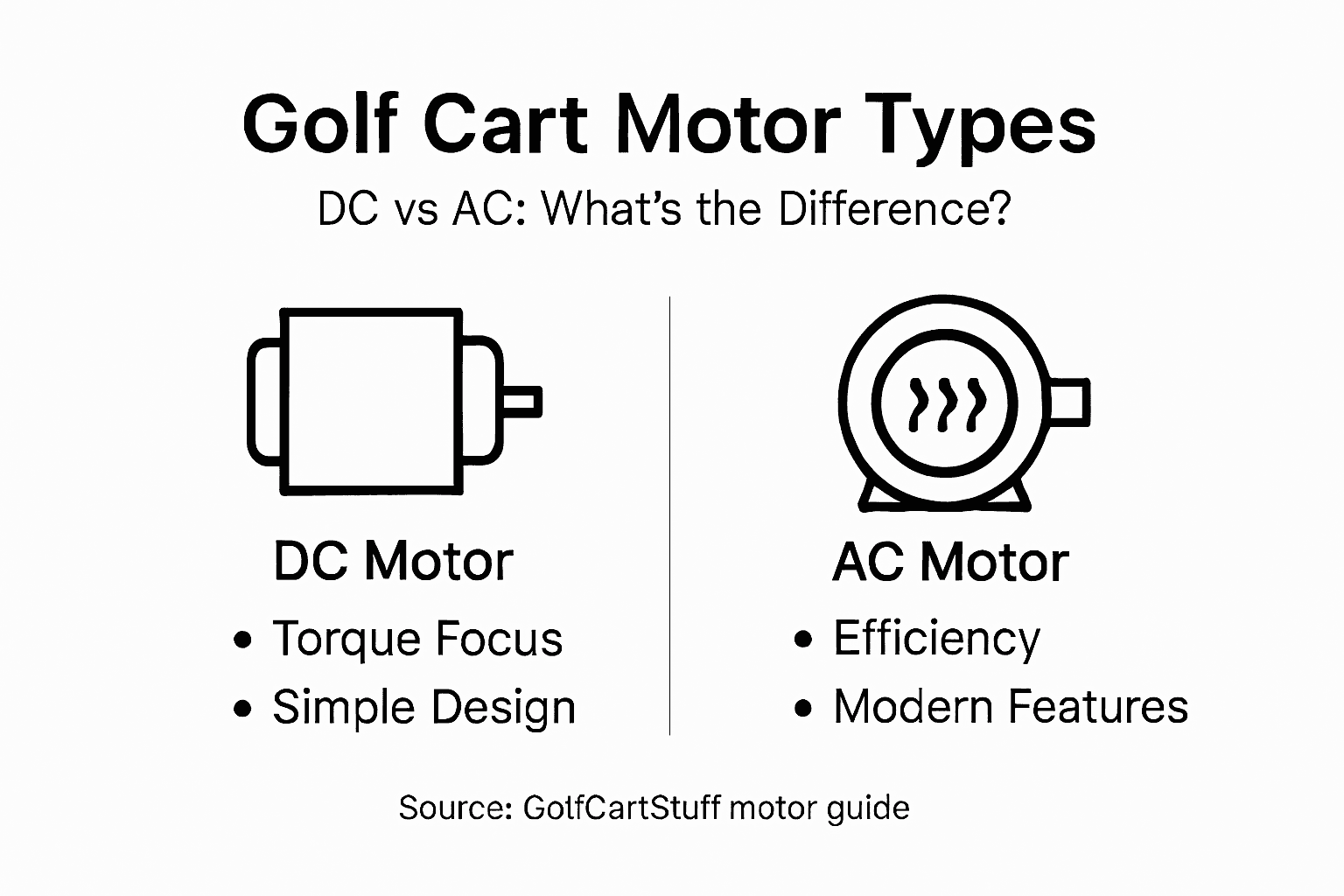
DC motors have powered golf carts for decades and remain the most common choice, especially for standard carts and budget upgrades. They’re straightforward mechanically: electricity flows directly into the motor, creating a magnetic field that spins the shaft. DC motors deliver immediate torque, meaning they respond instantly when you press the accelerator. You feel this responsiveness when climbing hills or accelerating from a standstill—the cart moves now, not after a moment’s lag.
DC motors come in different voltage configurations, most commonly 36-volt or 48-volt systems. Higher voltage means more power and speed, though it also requires more batteries and increases cost. The main characteristics of DC motors include:
DC motors excel when you need raw power for hauling cargo, navigating rough terrain, or climbing steep grades. They’re predictable and honest—you get what you pay for without surprises.

AC motors represent newer technology and are gaining traction in high-performance builds and luxury carts. Rather than direct current, AC motors use alternating electrical pulses that create rotating magnetic fields. This approach allows for more sophisticated electronic control, regenerative braking, and efficiency gains that reduce battery drain.
When you brake an AC-equipped cart, the motor reverses its function and feeds energy back into the battery pack—a feature called regenerative braking. This recovered energy extends your range and reduces the number of times you need to recharge. AC motors also generate less heat during operation, allowing for lighter cooling requirements and potentially longer motor life.
Key advantages of AC motor systems:
Choosing between DC and AC comes down to your priorities and budget. Here’s how they stack up:
| Feature | DC Motors | AC Motors |
|---|---|---|
| Torque Response | Immediate and strong | Smooth and adjustable |
| Cost | Lower upfront price | Higher initial investment |
| Maintenance | Brush/commutator replacement | Minimal maintenance |
| Efficiency | Good on flat terrain | Superior overall |
| Range | Standard | Extended with regen braking |
| Terrain Capability | Excellent for hills | Good with smart electronics |
| Customization | Simple upgrades | Advanced tuning options |
When deciding between electric or gas golf carts, remember that both DC and AC options are electric—gas is an entirely different category. Most North American golf cart owners choose electric because it’s quieter, cheaper to operate, and requires less maintenance than combustion engines.
The best motor isn’t the most powerful one available—it’s the one that matches your actual terrain, load demands, and how you’ll use your cart daily.
DC motors work perfectly for owners who prioritize reliability and immediate power delivery. AC motors suit those willing to invest more upfront for efficiency gains and advanced features. Your terrain matters too: steep hillside properties benefit from DC’s instant torque, while flat acreage where efficiency matters more favors AC systems.
Here’s a quick guide to matching golf cart motors to real-world usage scenarios:
| Usage Scenario | Motor Choice | Key Performance Benefit |
|---|---|---|
| Steep hills | DC motor (high torque) | Immediate climbing power |
| Flat, long-distance | AC motor (high efficiency) | Extended battery range |
| Heavy cargo hauling | High-voltage DC or AC | Strong torque and safe acceleration |
| Recreational cruising | Standard DC or AC | Quiet, smooth operation |
Pro tip: Test drive carts equipped with both motor types before buying, paying attention to how quickly the cart accelerates off the line and how smoothly it handles the terrain you actually use most often.
When you press the accelerator pedal on a golf cart, you’re not directly controlling the motor—you’re triggering a sophisticated chain of events that happens in milliseconds. The motor is just one component in an integrated system where batteries, electrical relays, controllers, and the motor itself work in harmony to convert stored energy into smooth, controlled movement. Understanding how these pieces interact reveals why proper maintenance and smart upgrades make such a difference in real-world performance.
Your golf cart’s electrical system begins with batteries that store direct current (DC) power. When you turn the key or press the accelerator, that power doesn’t flow directly to the motor—it first passes through a solenoid, which acts as an electrical relay or gatekeeper. The solenoid opens and closes the circuit, controlling whether power reaches the rest of the system. Think of it as a security checkpoint that prevents accidental motor engagement and protects your electrical components.
Once the solenoid activates, power flows to the speed controller, the brain of your motor system. This device sits between the battery and motor, monitoring your throttle input and regulating how much electrical current actually reaches the motor. It’s why your cart accelerates smoothly instead of lurching violently—the controller gradually increases current flow as you push the pedal further down. The controller also prevents excessive current draw that could damage batteries or the motor.
Here’s the basic power flow in your cart:
The actual motor conversion happens through electromagnetism. Inside your motor casing, electrical current passes through coils of wire, creating magnetic fields. These magnetic fields interact with permanent magnets in the motor, producing rotational force called torque. The amount of torque depends on how much current flows through the coils—more current creates stronger magnetic fields and more rotational force.
DC motors work through direct current, creating continuous rotation as long as power flows. AC motors work differently, using alternating pulses to create rotating magnetic fields, but the end result is the same: shaft rotation that ultimately spins your wheels. The motor, either AC or DC, converts regulated electrical energy into rotational force, turning the wheels and enabling movement.
Your speed depends on voltage and motor design. A 48-volt system provides roughly double the power of a 36-volt system, translating to higher speeds and better hill-climbing ability. The voltage remains relatively constant—the speed controller modulates the electrical current instead, which is why your accelerator feels responsive rather than on-off.
What separates a well-functioning cart from one that feels sluggish or unpredictable is how these components work together. A quality speed controller smoothly adjusts current flow, preventing voltage spikes that damage batteries or create jerky acceleration. The solenoid must engage cleanly without chattering or stalling. The motor brushes (on DC systems) must maintain good electrical contact as they rotate.
Battery condition directly affects this entire system. Weak or aging batteries can’t maintain voltage under load, causing the controller to struggle. The motor then receives insufficient current, reducing torque and top speed. This is why maintaining your golf cart battery is foundational to overall performance—it’s not just about range, it’s about keeping the entire system functioning optimally.
The interconnected nature of golf cart electrical systems means upgrades rarely work in isolation. Installing a higher-output motor without upgrading batteries often disappoints because the batteries can’t supply sufficient current. Upgrading batteries without checking your controller’s capacity limits doesn’t help if the controller throttles current flow.
Every component in your cart’s electrical system must be sized and maintained for the power you’re demanding, or the weakest link becomes your bottleneck.
Temperature also matters in practice. Controllers and motors generate heat during operation. In hot climates or during aggressive use, this heat can degrade performance if cooling is insufficient. Dust and debris inside motor vents restrict airflow and trap heat. Regular cleaning and attention to ventilation keeps everything running at peak efficiency.
Pro tip: Monitor your cart’s acceleration feel and top speed regularly—any noticeable decline indicates battery degradation or component issues, allowing you to address problems before they become expensive repairs.
A stock golf cart motor works fine for gentle rounds on manicured courses, but step outside that narrow use case and you quickly discover its limitations. Upgrading your motor transforms your cart from a one-trick vehicle into a capable machine that handles real-world demands. Whether you’re tackling hilly terrain, hauling cargo, or simply want snappier acceleration, motor upgrades deliver measurable improvements that justify the investment.
Stock motors are engineered for a specific purpose: moving two passengers on flat ground at moderate speeds. They’re undersized intentionally to keep manufacturing costs low. When you demand more—steeper hills, heavier loads, rougher terrain—the stock motor can’t keep up. It strains under load, generates excessive heat, and leaves you crawling uphill at disappointing speeds.
Upgrading your motor addresses these limitations directly. A higher-output motor delivers more torque, the rotational force that actually moves your cart. More torque means:
The relationship between motor size and performance isn’t theoretical—it’s mechanical reality. A 15-horsepower motor will outperform a 10-horsepower motor on every terrain metric. The question isn’t whether upgrading works, but whether the upgrade matches your actual needs and budget.
Motor upgrades fall into several categories, each suited to different goals. Direct replacements swap your existing motor for a higher-output version of the same type. This is the simplest upgrade path: remove the old motor, install the new one, and you’re done. Direct replacements work with your existing electrical system without requiring controller or solenoid changes.
Higher voltage system upgrades require more substantial work. Upgrading from 36 volts to 48 volts means adding batteries, upgrading controllers, and potentially replacing the motor itself. This approach delivers better performance across the board but involves more complexity and cost. The voltage difference is significant—a 48-volt system provides roughly 33 percent more power than 36 volts.
Motor type conversions swap DC for AC or vice versa. Switching to an AC motor gains you regenerative braking and efficiency improvements, but requires a compatible controller and often substantial electrical rewiring. This is the most involved upgrade path and typically appeals to owners seeking advanced features rather than simple power gains.
Common motor upgrade categories:
Don’t approach motor upgrading in isolation. Your motor is just one part of an interconnected system, and weak links elsewhere will undermine even excellent motor upgrades. Before buying a new motor, honestly assess your entire cart’s capacity and limitations.
Battery condition matters enormously. Aging batteries can’t deliver the current a powerful motor demands, essentially limiting your motor’s effectiveness. An 18-horsepower motor paired with weak batteries won’t perform like an 18-horsepower motor should. Fix battery issues before or alongside motor upgrades.
Your speed controller must match your motor’s output specifications. An undersized controller throttles current flow to the motor, preventing it from reaching full power. When considering top ways to upgrade your golf cart, ensure every component in the electrical chain can handle the power you’re installing.
Mechanical components also matter. Stock brakes designed for modest speeds and weights may prove inadequate when your cart suddenly accelerates harder or weighs more (due to added batteries from a voltage upgrade). Stock suspension and tires work fine for leisurely cruising but may need reinforcement for aggressive use.
Use this table to quickly check which component upgrades are essential for a successful motor upgrade:
| Component | When to Upgrade | Impact on Performance |
|---|---|---|
| Batteries | If motor output increases | Prevents power drop and short range |
| Speed controller | For higher-current motors | Enables full motor power |
| Brakes | If speed or weight rises | Ensures safe stopping |
| Suspension/Tires | With heavy loads | Maintains stability and traction |
The most expensive upgrade mistake is installing a powerful motor without addressing supporting systems—you’ll feel like the upgrade failed because the motor can’t fully express its potential.
Consider your actual terrain and use case. Steep hills demand raw torque, favoring larger DC motors or upgraded AC systems. Flat property where efficiency matters more suits AC motors with regenerative braking. Frequent cargo hauling justifies higher voltage systems and robust braking. Recreational cruising might need only a modest direct replacement motor.
Motor installation complexity depends on your upgrade path. Direct replacements typically take 2-4 hours if you have mechanical experience, or a few hundred dollars if you hire a technician. Voltage upgrades demand more time and expertise due to battery bank expansion and electrical reconfiguration. Motor type conversions are specialty work best handled by shops with relevant experience.
After installation, your motor maintenance evolves. DC motors still need periodic brush inspection and potential replacement every few years. AC motors shift focus to electronic controller monitoring and software calibration. Either way, understand what actually needs checking to keep your upgraded system running at peak performance.
Pro tip: Test your upgraded cart thoroughly on the terrain where you’ll use it most before considering the project complete, and budget for potential supporting upgrades like brakes or controllers that may need attention.
Choosing the right motor feels overwhelming when you’re staring at spec sheets and price tags. Every vendor claims their option is the best, and marketing language obscures the real differences that matter for your situation. The key is cutting through the noise by understanding what specifications actually translate to real-world performance and recognizing the common mistakes that leave owners disappointed with their purchases.
Motor specifications can be confusing, but a few metrics tell you what you actually need to know. Horsepower gets the most attention, but it’s misleading in isolation. Horsepower measures power output, yet two motors with identical horsepower can feel completely different depending on how that power is delivered. A motor that hits peak horsepower at high RPMs won’t feel as responsive off the line as one with strong low-end torque.
Torque is where the real story lives. Torque is the rotational force that actually moves your cart, and peak torque at low RPMs determines how quickly your cart accelerates and climbs hills. A motor rated for 75 foot-pounds of torque at 1,500 RPM will outperform one with 75 foot-pounds at 3,000 RPM, despite identical peak torque numbers. Examine torque curves, not just peak figures.
Voltage directly correlates with performance. A 48-volt motor outperforms a 36-volt motor in virtually every way. Higher voltage means stronger magnetic fields, more torque, and faster speeds. The tradeoff is cost and battery bank size—48-volt systems require more batteries and command higher prices.
Key specifications worth examining:
Ignoring these details leads to poor matches. Buying based on horsepower alone is like choosing a vehicle based solely on top speed—it misses what actually matters for daily driving.
Golf cart owners fall into predictable traps when upgrading motors. The biggest mistake is oversizing the motor without upgrading supporting systems. Installing a 20-horsepower motor on a cart with 36-volt batteries and a stock controller is like putting racing fuel in an economy car with a standard engine—the system can’t utilize the potential you’ve paid for.
Battery weakness is the silent killer of motor upgrades. Even a phenomenal motor can’t perform with weak batteries limiting current flow. Owners often upgrade motors, feel disappointed with results, then blame the motor when the real issue was aging batteries that couldn’t deliver sufficient amperage. Always assess battery condition before upgrading.
Electrical system mismatch happens frequently. Your speed controller must match your motor’s output specifications. A controller rated for 150 amps won’t fully unleash a motor demanding 200 amps under load. Solenoids must handle the current without chattering or failing. Each component in the chain must be sized appropriately.
Another common pitfall: ignoring mechanical limitations. Upgrading a motor without upgrading brakes is dangerous when your cart suddenly accelerates harder. Weak suspension might struggle with the added battery weight from a voltage upgrade. Tires rated for moderate speeds might not handle the new performance envelope safely.
Common upgrade mistakes:
When evaluating motor options, stop thinking about which motor is “best” and start thinking about which matches your needs. Create a simple comparison framework. First, identify your actual use case: What terrain do you navigate? How much weight do you typically carry? How often do you use the cart? How much are you willing to invest?
Next, identify performance requirements. Steep hills demand strong low-end torque—DC motors or high-output AC systems. Flat property where efficiency matters suits AC motors with regenerative braking. Frequent cargo hauling justifies higher voltage and robust braking. Recreational cruising needs less aggressive specs.
Then assess system readiness. Can your batteries handle a more powerful motor? Do you need a controller upgrade? Will your brakes handle increased speed and weight? Are mechanical upgrades necessary? Understanding these dependencies prevents expensive mistakes where you upgrade the motor but the rest of the system can’t support it.
Finally, calculate total cost of ownership. A cheaper motor paired with necessary supporting upgrades might cost more than a higher-priced motor that’s more efficient and requires fewer ancillary changes. The lowest motor price rarely delivers the best value.
The motor that feels best and performs longest is the one matched to your actual needs and properly supported by every other system in your cart.
Reading reviews from owners with similar use cases reveals real-world performance. Someone in Texas with hilly property using their cart daily tells you something genuine. Marketing claims from the manufacturer tell you what they hope you believe. Prioritize user experience over spec sheets.
One final consideration: warranty and support. Premium motors from established suppliers often cost more upfront but include better warranties and technical support. If something fails, you want recourse. Budget brands might save money initially but leave you stranded if problems emerge.
Pro tip: Before committing to any motor upgrade, contact other owners with similar carts and use cases to learn what actually performed well and what disappointed them in practice.
Choosing the perfect golf cart motor means balancing torque, voltage, and efficiency to tackle your unique terrain and hauling needs. If you’ve felt your stock motor lag on hills or struggle with heavy loads, it’s time to explore proven upgrades that match your performance goals. Understanding concepts like torque response and voltage system is vital, but finding quality parts to bring your cart up to speed is the next step.
Don’t settle for disappointing speed or unreliable performance. Visit GolfCartStuff today to find premium golf cart motors, reliable controllers, and battery solutions that ensure your electric system works in harmony. Whether you want a simple bolt-in replacement or a high-voltage upgrade, our carefully selected parts help you avoid common pitfalls and unlock faster acceleration, better hill climbing, and longer battery life. Take control now and power your performance with confidence at GolfCartStuff.
DC motors offer immediate torque and are simpler to maintain, making them reliable for standard use. AC motors are more efficient, support regenerative braking, and produce smoother acceleration, but they tend to have a higher upfront cost.
Upgrading your golf cart motor increases torque and power, allowing for faster acceleration, better hill climbing, and smoother operation, especially under heavier loads or rough terrain.
Consider your typical usage scenario, such as terrain type, load capacity, and desired speed. Assess whether you need a motor that excels in torque for steep hills or one focused on efficiency for flat areas.
Signs that your motor may need maintenance include decreased acceleration, unusual noises, overheating, or inconsistent performance. Regularly check for worn brushes in DC motors and monitor the electronic controller in AC systems for issues.
Explore our store to see what our products and resources can do for you.

Leave a comment