
Your Cart Is Our Priority
Explore our store to see what our products and resources can do for you.

TL;DR:
- Golf cart alignment primarily involves adjusting front toe-in to ensure tires are slightly inward, promoting straight tracking and even tire wear.
- Owners can measure and set toe-in at home using a tape measure and basic tools, aiming for approximately 1/8 inch difference between front and rear tire markings.
- Proper maintenance also requires checking tire pressure and inspecting mechanical components, as worn parts can mimic alignment issues and require professional service.
Golf cart alignment is defined as the process of adjusting your front tires to a slight inward angle, called toe-in, so your cart tracks straight and wears tires evenly. Unlike a full automotive alignment, golf cart alignment is mostly about one measurement: front toe-in. Get that right, and you eliminate pulling, uneven tire wear, and a crooked steering wheel. Most owners can handle this at home with a tape measure and a couple of wrenches.
Golf cart alignment is primarily a front toe adjustment, not the multi-angle process you’d find at an automotive shop. Toe-in means the front edges of your front tires sit slightly closer together than the rear edges. This inward angle stabilizes the cart during forward motion and keeps it tracking in a straight line without driver correction.
The front toe setting works because tires naturally want to splay outward under load. A small amount of toe-in counteracts that tendency, so the cart rolls forward predictably. Without it, you get a cart that drifts, wears the outer edges of its tires faster than the center, and demands constant steering input to stay on course.
Camber and caster, the other two angles in a full automotive alignment, are generally fixed on golf carts. Most Club Car, EZGO, and Yamaha models do not offer adjustments for those angles at the owner level. That makes toe-in the only variable you actually control, which simplifies the whole process considerably.
Measuring toe-in correctly takes about ten minutes and requires only a tape measure. Follow these steps on a flat, level surface for accurate results.
The ideal toe-in distance is approximately 1/8 inch, meaning the front measurement should be about 1/8 inch shorter than the rear measurement. A reading of zero means your tires are parallel, which is acceptable but not optimal. A negative number means toe-out, which causes instability and should be corrected immediately.
Pro Tip: Before you measure anything, check your tire pressure. Inflate both front tires to the manufacturer-recommended PSI. Uneven pressure changes the effective diameter of each tire and throws off your measurement before you even start.
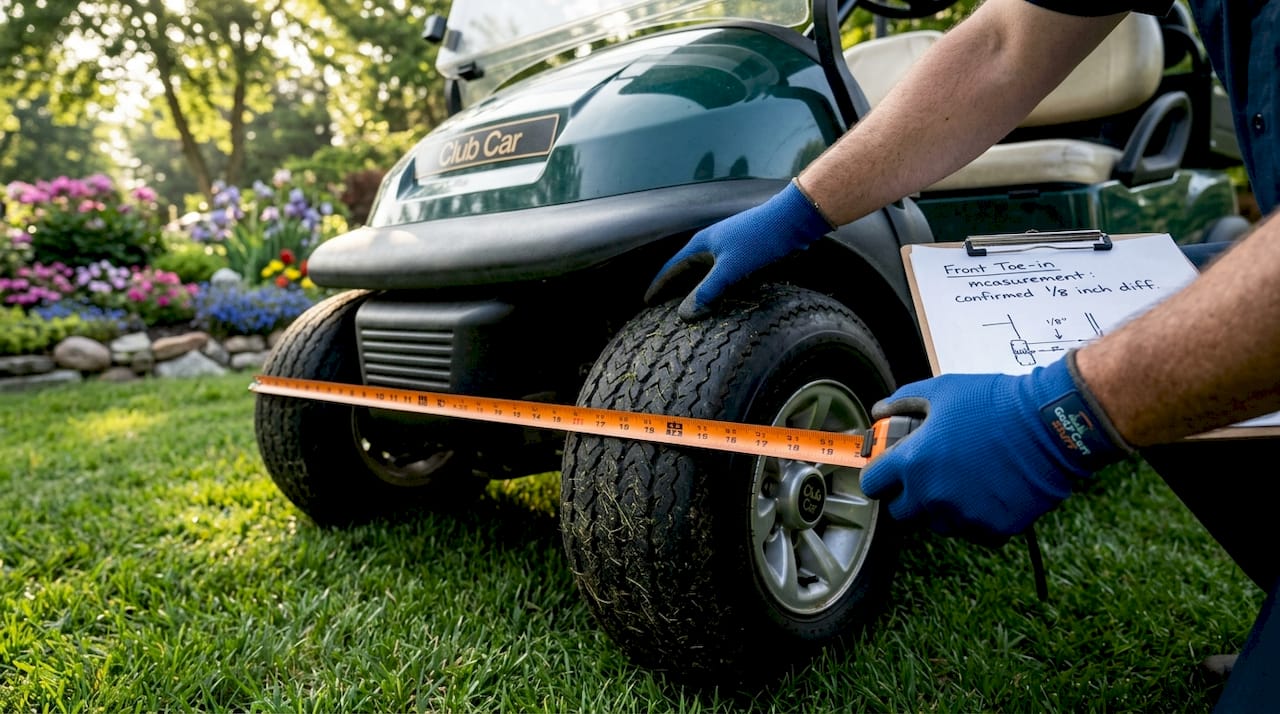
Repeat the measurement two or three times to confirm consistency. Small errors in marking tire centers are common, and averaging multiple readings gives you a more reliable baseline.
Once you have your baseline measurement, adjusting toe-in is a straightforward process. The adjustment happens at the tie rods, the metal rods connecting your steering rack to each front wheel hub.
Symmetric tie rod adjustments are the most critical part of this process. If you turn the left tie rod two full turns but only one turn on the right, your toe-in number might look correct while your steering wheel sits noticeably off-center. Equal adjustments on both sides keep everything balanced.
Pro Tip: If the jam nuts are seized from rust or age, apply penetrating oil like PB Blaster and wait 15 minutes before attempting to loosen them. Forcing a seized nut strips the tie rod threads and turns a simple adjustment into a parts replacement job.
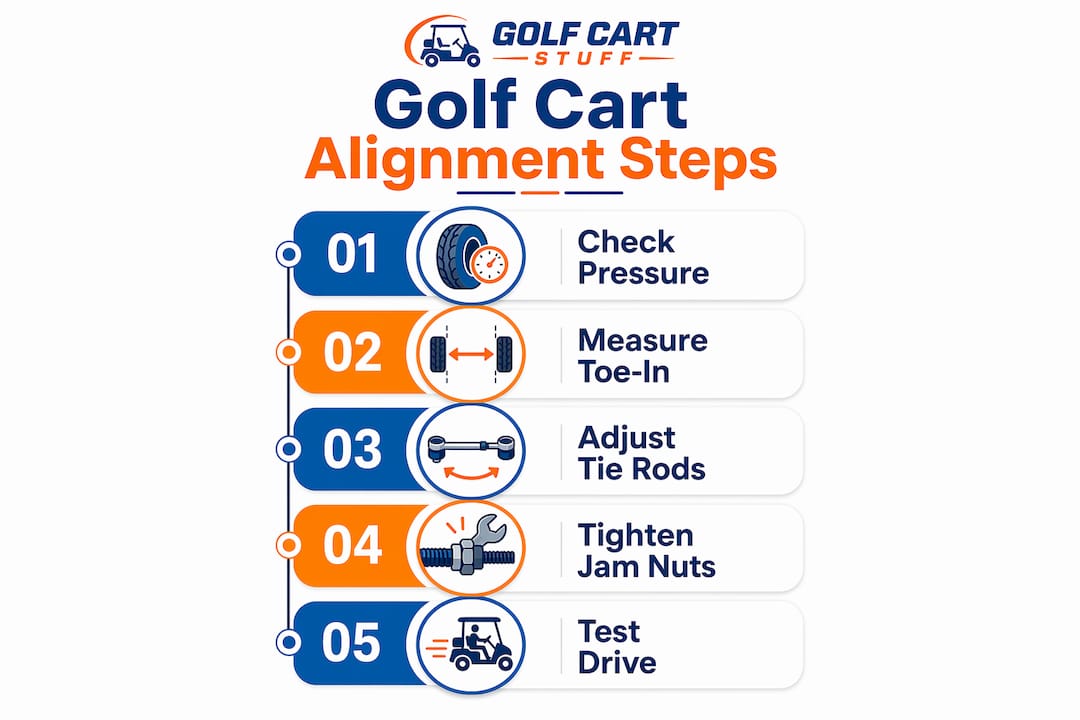
If the cart still pulls after you’ve achieved correct toe-in, stop adjusting. Continuing to chase the problem with more toe changes will not fix a mechanical issue. The next step is diagnosis, not more adjustment.
Many owners spend hours adjusting toe-in when the real problem has nothing to do with alignment. Knowing what else causes pulling or unstable steering saves significant time and frustration.
Chasing alignment fixes on a cart with worn mechanical components is like adjusting the sails on a boat with a broken rudder. Fix the broken parts first, then set the alignment.
Learning to spot suspension problems early prevents you from misdiagnosing a mechanical failure as an alignment issue and wasting time on adjustments that cannot solve the real problem.
The right tools make the job faster and safer. You do not need specialized equipment for basic toe adjustment.
Pro Tip: After tightening the jam nuts, grab each tie rod and try to rotate it by hand. If it moves, the jam nut is not tight enough. A loose jam nut will let the toe setting drift within a few miles of driving, and you will be back to square one.
Proper tire installation and inflation before any alignment work also reduces the chance of measurement errors caused by improperly seated tires.
DIY alignment handles most toe-in corrections effectively. Several situations, however, call for professional service.
Professional alignment also makes sense after any collision, even a minor one. A curb strike at low speed can bend a spindle or shift a steering component enough to throw off alignment without any visible damage. The cost of a professional check is far lower than the cost of replacing tires worn out by undetected misalignment.
Proper golf cart alignment requires setting front toe-in to approximately 1/8 inch, making symmetric tie rod adjustments, and ruling out tire pressure and worn parts before any adjustment begins.
| Point | Details |
|---|---|
| Toe-in is the core adjustment | Set front tires approximately 1/8 inch closer at the front than the rear for stable tracking. |
| Symmetric adjustments are required | Turn both tie rods equally to keep the steering wheel centered and the cart tracking straight. |
| Check tire pressure first | Equalize front tire PSI before measuring or adjusting alignment to avoid false readings. |
| Worn parts mimic misalignment | Inspect tie rod ends, brakes, and spindles before assuming toe-in is the problem. |
| Professional service has a clear role | Seek a shop after part replacements, collisions, or when pulling persists after correct DIY adjustment. |
Most alignment problems I see come down to one thing: owners skipping the tire pressure check and going straight to the tie rods. It is the single most common mistake in golf cart maintenance, and it wastes hours of work. A cart with 18 PSI on the left front and 12 PSI on the right will pull hard to the right no matter how perfectly you set the toe-in. Fix the pressure first, and the problem often disappears entirely.
The other lesson I keep coming back to is the value of small, equal adjustments. A quarter turn on each tie rod, then re-measure. Another quarter turn, then re-measure again. Owners who make three full turns and then check are almost always overcorrected and chasing the problem in the opposite direction. Patience here is not optional.
If you have done everything right and the cart still pulls or the steering wheel stays crooked, stop. Put down the wrenches and inspect the mechanical components. Worn tie rod ends, a dragging brake, or a bent spindle will defeat any alignment adjustment you make. The alignment and safety connection is real, but alignment cannot compensate for broken parts. Fix what is broken, then set the toe.
— Roshan
Golfcartstuff stocks genuine tie rods, steering components, and maintenance tools for Club Car, EZGO, and Yamaha golf carts. Whether you are replacing a worn tie rod end on an EZGO or sourcing a new steering component for a Club Car DS, you will find the correct part without guessing. Browse Club Car DS parts for steering and suspension components, or check the EZGO parts collection for model-specific tie rod ends and related hardware. For Yamaha owners, the Yamaha G1-G22 parts catalog covers the most common alignment-related components. Quality parts hold their settings longer and reduce the frequency of re-adjustment.
Toe-in means the front edges of the front tires are set slightly closer together than the rear edges. The target measurement is approximately 1/8 inch difference between the front and rear tire spacing.
Check alignment at least once per season or any time you notice pulling, uneven tire wear, or a crooked steering wheel. Also check after replacing tie rod ends or any front suspension component.
Yes. A tape measure, two adjustable wrenches, and a flat surface are all you need for basic toe-in adjustment. Jack stands are required any time you lift the cart off the ground for safety.
Persistent pulling after correct toe-in adjustment usually points to uneven tire pressure, a dragging brake, or worn tie rod ends. Worn components cause handling problems that toe adjustment cannot fix.
Yes. Replacing tie rod ends requires a post-installation alignment check because thread counting alone does not guarantee the correct toe-in setting has been restored.
Explore our store to see what our products and resources can do for you.

Leave a comment