
Your Cart Is Our Priority
Explore our store to see what our products and resources can do for you.

TL;DR:
- High-precision GPS (RTK) offers centimeter-level accuracy, essential for safety zones and fleet management.
- Standard GNSS GPS provides 5 to 15 meters of error, often leading to boundary and drift issues.
- Choosing the right GPS depends on your specific needs, budget, and cart compatibility for reliable operation.
Not all GPS systems are created equal, and if you’ve ever trusted a cheap unit to keep your cart on the fairway or within a geofenced zone, you may have already learned this the hard way. The gap between a standard GPS receiver and a high-precision solution isn’t just a matter of price; it’s a matter of reliability, safety, and whether your technology actually does the job you bought it for. This guide breaks down how golf cart GPS systems work, what accuracy really means in practice, which features matter most, and how to install the right system confidently on your specific cart model.
| Point | Details |
|---|---|
| GPS accuracy matters | The precision of your golf cart’s GPS directly impacts navigation, boundaries, and user trust. |
| RTK beats standard GPS | RTK systems provide centimeter-level accuracy—much better than typical 5-15 meter errors. |
| Right features, better results | Choosing a GPS with real-time updates, geofencing, and weather resistance ensures reliable performance. |
| Practical installation tips | Check compatibility and follow a step-by-step process to avoid headaches and ensure safe setup. |
A golf cart GPS system is a device that uses satellite signals to determine your cart’s real-time location, then uses that data to serve up navigation, course mapping, boundaries, and fleet tracking. Simple enough, right? But the devil is in the details, specifically in how accurately that location data reflects where you actually are.
Here’s what these systems typically handle:
For recreational players, a GPS that puts you in the right general area might seem fine. But for course operators, fleet managers, or anyone relying on geofencing for safety, even a 10-foot error is enough to cause real problems. A cart that the system thinks is on the path may actually be creeping onto the green. An alert that should trigger at a boundary fires 30 feet late, or not at all.
There’s also the issue of GPS drift, which is a gradual, unpredictable shift in reported position even when the cart is standing still. Most cart owners never think about drift until a geofence stops working reliably or their tracking data looks like the cart wandered all over the green overnight. Understanding golf cart IQ systems can help you see how integrated technology manages these kinds of accuracy challenges at the hardware level.
“Standard GNSS positioning requires 15-50 foot safety buffers to account for drift, which steadily erodes trust in automated alerts and boundary systems.” — GPS drift analysis for golf carts
Pro Tip: If your GPS-equipped cart ever shows a location that seems “off” even while parked, that’s drift in action. Many owners mistake this for a software glitch when it’s actually a fundamental hardware limitation of standard GPS receivers.
To make a smart buying decision, you need to know what you’re actually comparing. There are two primary GPS technologies used in golf cart systems today: standard GNSS and RTK.
Standard GNSS (Global Navigation Satellite System) is what most consumer devices use, including budget golf cart GPS units. It pulls signals from satellites like GPS (U.S.), GLONASS (Russia), or Galileo (EU), and calculates position based on signal timing. Under ideal open-sky conditions, you’re looking at roughly 5 to 15 meters of horizontal error. Under heavy tree canopy, that error range expands to as much as 30 meters. That’s nearly 100 feet of uncertainty on a golf course where boundaries can be only 20 feet from a sensitive area.
RTK (Real-Time Kinematic) GPS is a different animal entirely. It uses a fixed reference station to send correction data to the receiver, allowing it to achieve horizontal accuracy of 1 to 2 centimeters. That’s essentially the width of your finger, rather than the width of a green. RTK systems process carrier-phase signals rather than just timing data, which is what gives them that extraordinary precision.
Here’s how the two stack up side by side:
| Feature | Standard GNSS | RTK GPS |
|---|---|---|
| Accuracy (open sky) | 5 to 15 meters | 1 to 2 centimeters |
| Accuracy (under canopy) | Up to 30 meters | 2 to 5 centimeters |
| Geofencing buffer needed | 15 to 50 feet | Near zero |
| Typical cost (unit) | $100 to $500 | $800 to $3,000+ |
| Best for | Casual navigation | Fleet management, safety zones |
| Setup complexity | Simple plug-and-play | Requires base station or correction service |
The cost difference is real, but so is the performance gap. For a recreational golfer who just wants yardage to the pin, standard GNSS may be perfectly adequate. But for a course with 80 carts, a safety boundary around a maintenance road, or a resort property managing utility vehicles across a large campus, RTK pays for itself quickly by eliminating the errors that cause liability and operational headaches.
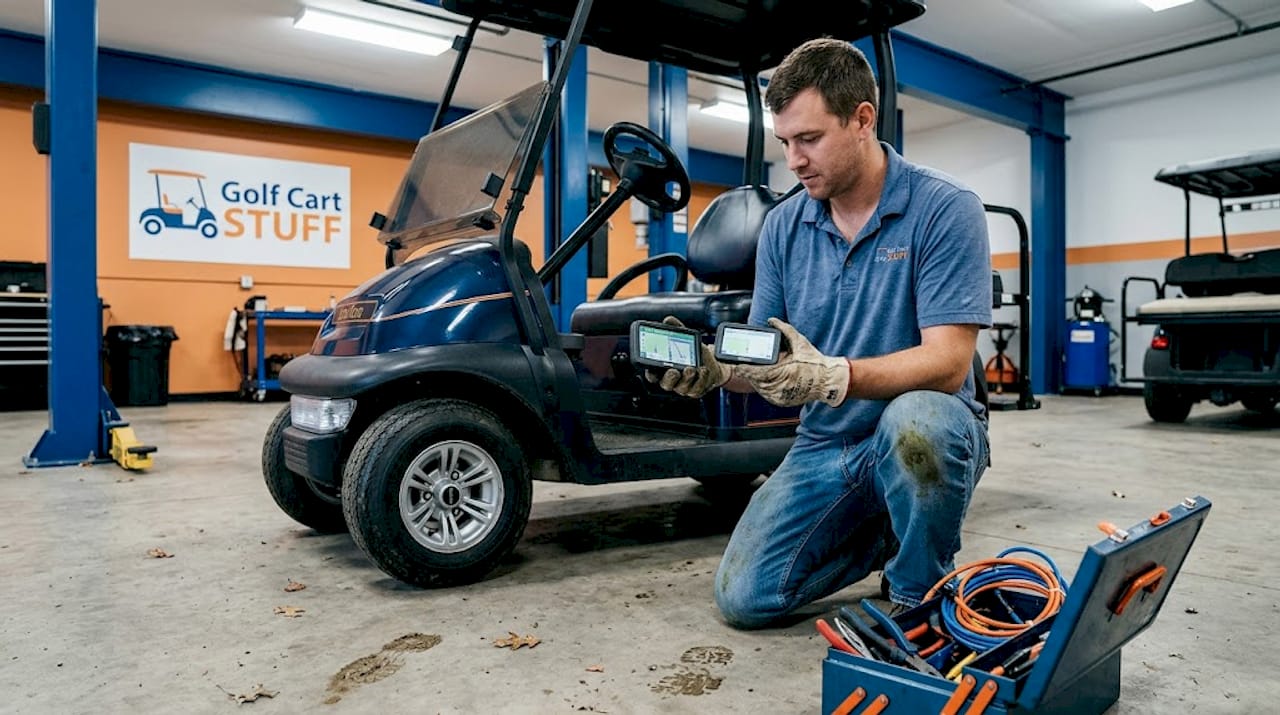
If you’re also evaluating your cart’s overall platform before adding GPS, it’s worth understanding the fundamental tradeoffs between gas vs electric golf carts, since power source affects available mounting locations, wiring options, and battery draw for electronics.
Once you understand accuracy tiers, the next step is evaluating specific features. Not every GPS unit lists its error range prominently on the box, so knowing what to ask about puts you in a much stronger position.
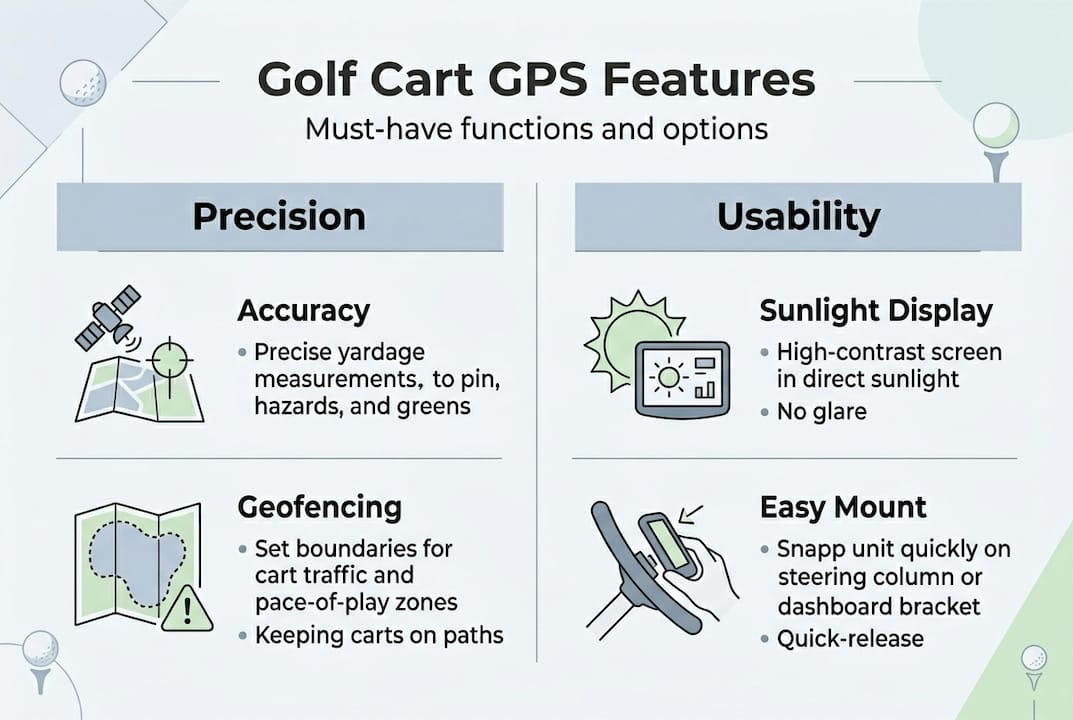
Here are the features that genuinely matter:
One often-overlooked consideration is geofencing buffer size. A standard GPS unit might need a 30 to 50-foot virtual buffer around a hazard to reliably trigger an alert, which means the “boundary” on the screen doesn’t reflect the real boundary on the ground. On a tight course, that gap can put carts in genuinely unsafe areas before the alert fires. For course operators, this isn’t just annoying. It’s a liability risk.
Checking out top-rated golf cart add-ons can also help you identify mounting accessories, display brackets, and wiring harnesses that make GPS installation cleaner and more durable.
Pro Tip: The single feature most golf cart owners wish they had prioritized after their first GPS install is a sunlight-readable display with adjustable brightness. Many buyers focus on software features and forget that if you can’t read the screen in direct sunlight, none of the other features matter.
Picking the right system is only half the job. Installing it correctly determines whether you get reliable performance or a unit that rattles loose, drains your battery, or loses signal at the worst moments. Here’s a practical step-by-step approach:
Here’s a look at typical installation parameters by common cart type:
| Cart type | Avg. install time | Typical cost (DIY) | Common pitfalls |
|---|---|---|---|
| Electric (48V) | 1 to 2 hours | $50 to $150 | Voltage mismatch, incorrect fuse rating |
| Electric (36V) | 1 to 2 hours | $50 to $150 | Limited accessory power circuits |
| Gas (Yamaha, E-Z-GO) | 2 to 3 hours | $75 to $200 | Vibration damage, heat exposure near engine |
| Lifted/custom | 2 to 4 hours | $100 to $250 | Non-standard wiring, antenna placement issues |
Understanding your golf cart electrical system before you start ensures you connect the GPS to the right circuit without overloading existing components. Similarly, if you’re unsure whether your battery setup can handle the continuous draw of a GPS unit plus other accessories, reviewing 36V vs 48V battery configurations will help you plan correctly.
One more number worth knowing: courses and operations that upgrade from standard GPS to precision RTK systems report an average improvement of 21 minutes in pace of play in documented testing. That’s a meaningful operational gain for any busy course, and it translates to happier players and better cart utilization.
Here’s the perspective most GPS vendors won’t give you directly: the true cost of a budget GPS system isn’t the purchase price. It’s everything that happens after the inaccurate alerts start firing, the geofence boundaries stop being trusted, and players or staff begin ignoring the system because it’s unreliable too often.
We see this pattern regularly. An operator buys 20 standard GPS units because the per-unit price is lower. Within a season, the geofences require constant adjustment to compensate for drift. Staff override the alerts because they’ve learned the system is wrong as often as it’s right. That investment doesn’t just fail to deliver, it actively trains everyone on the course to distrust the technology. Rebuilding that trust after a bad experience costs more than upgrading upfront would have.
The math is especially uncomfortable for clubs and resorts. When a cart system’s 5-15 meter error range causes repeated boundary failures, the liability exposure from a cart entering a restricted area or a dangerous slope can be significant. One incident can cost more than the price difference between a standard and precision system across an entire fleet.
The counterintuitive truth is that precision GPS is often the more economical long-term choice, not the premium one. For individual owners who genuinely only need basic yardage data and don’t rely on geofencing, standard systems are fine. But too many buyers assume they fall into that category until they discover they needed more. Understanding IQ systems and integrated cart technology before buying helps you recognize whether your use case actually demands higher precision.
Buy once with the right accuracy tier for your actual needs. The savings from getting it right the first time are real.
Making the most of your GPS upgrade is easier when the rest of your cart is set up for it.
At Golf Cart Stuff, we carry a wide selection of accessories and replacement parts designed to support seamless GPS installation and overall cart performance. From mounting hardware and wiring accessories to battery components that handle the added draw of electronics, you’ll find what you need to make your GPS system perform at its best from day one. Browse our golf cart accessories catalog to find GPS-ready upgrades, compatibility-tested parts, and the add-ons that experienced cart owners keep coming back for. Whether you’re outfitting a single cart or a full fleet, we make it straightforward to get the right parts with confidence.
Standard GPS offers 5-15 meter accuracy, while RTK achieves 1-2 centimeters, dramatically reducing errors for navigation and geofencing on the course.
Most modern GPS units work with a wide range of cart models, but always verify your cart’s battery voltage and electrical system requirements before purchasing to avoid compatibility issues.
Precise GPS can improve pace by an average of 21 minutes per round in documented cases by keeping carts accurately on designated paths and reducing confusion at boundaries.
Geofencing keeps carts within safe or designated zones, but standard GPS systems require 15-50 foot safety buffers to compensate for drift, which significantly reduces how precise and trustworthy those boundaries actually are in practice.
Explore our store to see what our products and resources can do for you.

Leave a comment