
Your Cart Is Our Priority
Explore our store to see what our products and resources can do for you.

TL;DR:
- Golf cart load capacity depends on factors like battery type, frame, tires, and accessories, not just passenger count. Exceeding the safe weight limit causes mechanical damage, tire failure, and safety hazards such as tip-overs. Always calculate your operating weight with all accessories and cargo to prevent safety risks and costly repairs.
Most golf cart owners assume they know their cart’s limits. You bought a 4-seater, you put four people in it, and you’re good. Except that’s not how golf cart load capacity explained in any owner’s manual actually works. Your cart’s true weight limit depends on a web of factors: battery type, frame material, tire ratings, accessories, and cargo. Get it wrong and you’re not just risking a slow ride. You’re risking mechanical damage, blown tires, and in some cases, a tip-over. This guide breaks down every layer of that complexity so you can operate your cart safely and intelligently.
| Point | Details |
|---|---|
| Curb weight vs. operating weight | Operating weight includes all accessories and cargo, which can add 200-400 lbs over base curb weight. |
| Payload limits vary widely | A 4-seater golf cart typically holds 800 to 1,000 lbs of combined passengers and cargo. |
| Tires are the first weak link | Golf cart tires rated 500 to 800 lbs per tire fail before the frame does when overloaded. |
| Modifications don’t increase safe limits | You cannot safely raise a cart’s capacity through aftermarket changes; the integrated design sets hard limits. |
| Base decisions on operating weight | Always calculate load against operating weight, not just the manufacturer’s curb weight spec. |
Before you can manage your cart’s weight limits, you need to speak the language. The specs on a manufacturer’s website can look confusing because multiple weight terms get used without clear explanation.
Dry weight is the weight of the cart with no fluids, no batteries, and often no standard accessories installed. It’s essentially the stripped frame and body. This number is nearly useless for real-world load planning because dry weight excludes batteries and fluids, which are heavy components every operating cart carries.
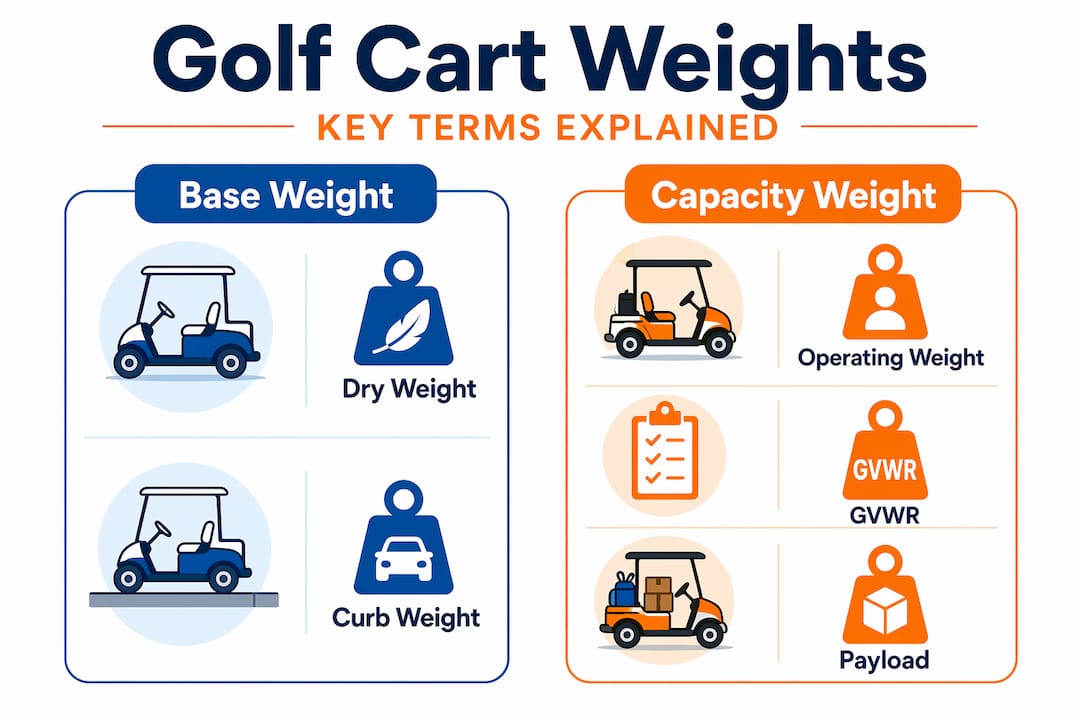
Curb weight is more useful. It refers to the cart as it sits ready to operate, with batteries and standard equipment included. For 2-seat models, curb weights range from 650 to 1,100 lbs in 2026, and larger utility models can exceed 2,000 lbs. This is your starting point, not your endpoint.
Operating weight is the number that actually matters for capacity planning. It includes the curb weight plus every accessory you’ve bolted on, every bag in the cargo bed, and every person in the seat. Accessories and modifications add 200 to 400 lbs over the base curb weight in many real-world setups. If you’re doing load calculations off the manufacturer sticker without accounting for your roof, lifted suspension, custom wheels, and rear cargo box, you’re already working with bad math.
Gross Vehicle Weight Rating (GVWR) is the maximum total weight the cart is designed to handle safely. This includes the cart itself and everything on or in it.
Payload capacity is simply GVWR minus curb weight. That’s the actual number of pounds you have left for passengers, cargo, and accessories combined.
Here’s a quick comparison to keep those terms straight:
| Term | What it includes | Use it for |
|---|---|---|
| Dry weight | Frame and body only | Manufacturer comparison shopping |
| Curb weight | Cart ready to drive | Baseline load calculations |
| Operating weight | Curb weight plus all real-world additions | Accurate payload planning |
| GVWR | Maximum allowable total weight | Legal and safety ceiling |
| Payload capacity | GVWR minus curb weight | How much you can actually load |
Not all golf carts are built equal, and understanding golf cart capacity means knowing what variables push those numbers up or down.
Your battery pack is one of the heaviest components on the cart and it directly affects how much else you can carry. Lithium-ion batteries reduce weight by 100 to 300 lbs compared to lead-acid packs. In practical terms, that weight savings translates directly into more available payload. However, switching to lithium isn’t a pure win on paper. Lithium setups require reinforced frames in some configurations, and the net weight reduction is closer to 60 to 90 lbs after factoring in all components. Still, that’s meaningful headroom. You can read more about why this matters in our breakdown of lithium battery benefits.
Steel frames are heavier but generally more forgiving under stress. Aluminum frames save weight but can have lower tolerance for sustained overloading. Either way, the suspension system sets a hard ceiling on how much weight the cart can handle before handling degrades. A cart with a worn or undersized suspension will show signs of overload well before you hit the rated GVWR.
This is the factor most owners never check. Golf cart tires have load ratings between 500 and 800 lbs per tire, and they are often the first component to fail under excess weight. Even if the frame and suspension could theoretically handle more, the tires give out first. Blowouts and tread separation are the direct result of consistently exceeding tire load ratings. Overloaded tires risk catastrophic failure without warning, which is a dangerous situation at any speed.
More seats mean a higher rated payload in most cases, but that’s because the GVWR was designed to accommodate more passengers, not because the cart is structurally stronger per seat. A 6-seater with six average adults on board may already be at or near its payload limit before you add a single bag of gear.
Pro Tip: Before adding any aftermarket accessories, calculate their combined weight and subtract that from your payload budget first. Roof canopies, cargo boxes, and light kits add up faster than most owners realize.
The consequences of exceeding your golf cart weight limit aren’t just theoretical. They show up in your maintenance bills and your safety record.

Overloading is a leading cause of premature motor and battery failure. When a cart carries more than it was designed to, the motor draws higher current to maintain speed, especially on inclines. That excess current discharge generates heat, which degrades battery cells faster. You’ll notice it first as reduced range per charge, then as battery packs that need replacing ahead of schedule.
The mechanical strain doesn’t stop there. Excess weight puts suspension components, brake systems, and wheel bearings under stress that exceeds their design specs. The result is accelerated wear that costs real money over time. Some signs your cart may be overloaded include:
Safety risks compound quickly. Reduced braking performance, compromised steering response, and the real risk of tip-overs on any incline make overloading a genuine hazard. A 4-seater golf cart payload limit of 800 to 1,000 lbs sounds generous until you factor in four adults, a cooler, a cargo box, and a dog.
“Overloading not only shortens component lifespan but also drastically reduces battery range and increases maintenance costs.” Golf Cart Safety Tips
One tempting but dangerous response is modifying the cart to carry more. You cannot safely increase a golf cart’s weight capacity through modifications. The integrated design of the frame, suspension, motor, and braking system sets limits that aftermarket parts don’t override. A stronger axle doesn’t fix an undersized motor. New springs don’t upgrade your tire ratings. If you want to read more about what modifications can and can’t do, check out this guide on golf cart modifications.
Knowing the theory is only useful if you can apply it. Here’s how to actually manage your golf cart carrying capacity in the real world.
Pro Tip: If you regularly haul cargo, consider a cart with a factory-rated utility bed and a higher GVWR rather than retrofitting a standard cart. Factory engineering accounts for load distribution in ways bolt-on solutions can’t match.
If you’re evaluating suspension health as part of your load management plan, this resource on golf cart suspension problems is worth reading before you find out the hard way something is worn.
I’ve watched a lot of golf cart owners focus almost entirely on passenger count when thinking about weight limits. Four seats mean four people, and they stop there. But in my experience, cargo and accessories are where owners actually get into trouble.
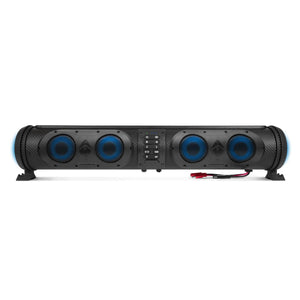
A custom build with a roof, rear seat flip kit, cargo box, upgraded wheels, and a sound system can easily add 350 lbs to the base curb weight before a single person sits down. That leaves very little payload margin for actual use. The owners who run into chronic suspension wear, short battery life, and unpredictable handling almost never trace it back to cumulative accessory weight. They blame the brand or the model.
What I’ve found genuinely useful is the fleet management mindset: treat operating weight as a living number you recalculate whenever you add something to the cart. That approach forces you to be intentional about every addition instead of stacking weight until something breaks.
My honest take on modifications versus upgrades: if the goal is carrying more, buy a cart rated for more. The money spent on aftermarket reinforcement usually exceeds the cost difference between a standard and a utility-rated cart, and it never actually gets you to the same safety baseline.
— Roshan

If this article made you rethink how you’re loading your cart, the next step is making sure your current setup is actually built for the job. At Golfcartstuff, you’ll find golf cart accessories designed to work within your cart’s rated capacity, not against it, including cargo solutions, suspension components, and maintenance parts. If battery weight is part of your load equation, browse the selection of lithium golf cart batteries to see how switching packs can free up meaningful payload. And for Club Car DS owners looking to maintain structural and mechanical integrity under regular loads, the Club Car DS parts catalog covers everything from suspension to drivetrain components that keep your cart performing safely.
Most standard 2-seat golf carts have a payload capacity between 400 and 600 lbs, while 4-seat models typically allow 800 to 1,000 lbs of combined passenger and cargo weight. Always check your specific GVWR rather than relying on general ranges.
Switching to lithium-ion batteries reduces the cart’s curb weight by approximately 60 to 90 lbs net, which directly increases your available payload by that amount. It’s one of the few modifications that genuinely and safely frees up capacity.
Signs of overloading include sluggish performance on flat ground, visibly bulging or underinflated tires, noticeably longer braking distances, and reduced battery range. If you’re seeing two or more of these at once, weigh your operating setup against your GVWR.
No. The integrated design of the frame, suspension, motor, and braking system sets hard limits that aftermarket parts cannot safely override. Attempting to exceed rated capacity through modification compromises structural integrity and increases accident risk.
Everything added to the cart after its curb weight counts toward payload: passengers, cargo, installed accessories, and any equipment in the bed or on the frame. Accessories alone can add 200 to 400 lbs, so factor them in before loading passengers and gear.
Explore our store to see what our products and resources can do for you.

Leave a comment