
Your Cart Is Our Priority
Explore our store to see what our products and resources can do for you.

TL;DR:
- Speed chips increase golf cart speeds by modifying controller programming to allow higher current flow.
- Proper compatibility, safety, and legal considerations are essential before installing a speed chip.
- Upgrading other components like tires and brakes alongside a speed chip leads to safer, more balanced performance.
Many golf cart owners assume that slapping in a speed chip is like flipping a switch that transforms their cart into a race vehicle. That belief leads to wasted money, mechanical headaches, and sometimes legal trouble. The reality is that speed chips interact with your cart’s controller in specific ways that depend on your model, year, and electrical system. This guide walks you through what speed chips actually do, how they compare to other upgrades, what the law says, and how to pick and install the right one without compromising your cart’s reliability or safety.
| Point | Details |
|---|---|
| Speed chips explained | Speed chips alter your golf cart controller to raise maximum speed within safe, designed limits. |
| Consider benefits and risks | Speed chips can add 2-5 mph but may void warranties and add wear if misused. |
| Know upgrade alternatives | Other upgrades like motor and controller swaps offer more speed but with higher cost and complexity. |
| Follow legal and safety rules | Always check local laws and golf cart association policies before installing speed-enhancing parts. |
| Get the right fit | Ensure any speed chip you choose fits your cart’s brand, year, and controller type precisely. |
A golf cart speed chip is a small electronic component that plugs into your cart’s speed controller. Its job is simple in concept: it tells the controller to allow a higher maximum current, which lets the motor reach greater speeds than the factory setting allows. Think of it like adjusting the rev limiter on a car’s engine management system. The chip doesn’t add power from thin air; it removes a programmed ceiling.
Speed chips modify the speed controller programming to adjust a cart’s maximum speed limit. This is an important distinction. The chip works within your existing motor’s capability. If the motor, battery, or wiring is already worn, a speed chip won’t fix those problems and may actually stress them further.
Here’s what a speed chip typically does and doesn’t do:
Most speed chips are designed for specific brands and controller generations. Club Car, EZGO, and Yamaha all use different controllers, and a chip made for one won’t work correctly in another. Golf cart owners who buy generic chips without checking compatibility are usually disappointed.
Pro Tip: Before you install any speed chip, document your cart’s current top speed and battery voltage at full charge. This baseline helps you measure real gains and spot any unusual drain caused by the modification.
Now that you know what a speed chip is, understanding its real-world benefits and the potential downsides is essential before making changes.

The most obvious appeal is speed. A well-matched speed chip can realistically push your cart 2 to 5 miles per hour faster than stock. On a cart that originally tops out at 14 mph, that’s a meaningful jump. Speed chips can provide up to a 5 mph increase in some models, but they also risk voiding warranties and increasing wear. That combination of promise and risk is exactly why dealers and owners need to weigh both sides carefully.
Key benefits:
Key risks:
| Feature | With a speed chip | Without modification |
|---|---|---|
| Top speed gain | Up to 5 mph | None |
| Installation cost | Low ($20-$80 typical) | N/A |
| Warranty impact | Often voided | Unchanged |
| Motor wear rate | Increased | Normal |
| Battery range | Reduced slightly | Normal |
| Reversibility | Easy if chip is saved | N/A |
When is a speed chip worth it? If your cart is out of warranty, you use it primarily on private property, and your motor and batteries are in solid condition, a speed chip is a practical and affordable upgrade. When isn’t it worth it? If you’re still under warranty, operate in a regulated community or golf course, or your battery pack is aging, the risks outweigh the gains.
“Before purchasing any performance modification, talk to a local dealer who knows your specific cart model. A five-minute conversation can save you from a costly mistake.”
Pro Tip: Dealers should always ask customers about their primary use case before recommending a speed chip. A cart used on a private ranch has very different needs and risk tolerances than one used in a planned retirement community.
Exploring golf cart upgrades comparison resources helps both owners and dealers put the chip decision in broader context.
With strengths and risks in mind, comparing speed chips to other performance mods gives a clearer upgrade strategy.
Speed chips aren’t the only route to a faster cart. Motor and controller swaps can provide more dramatic speed increases but at higher cost and complexity. Understanding where each upgrade fits helps you spend wisely and avoid over-engineering your setup.
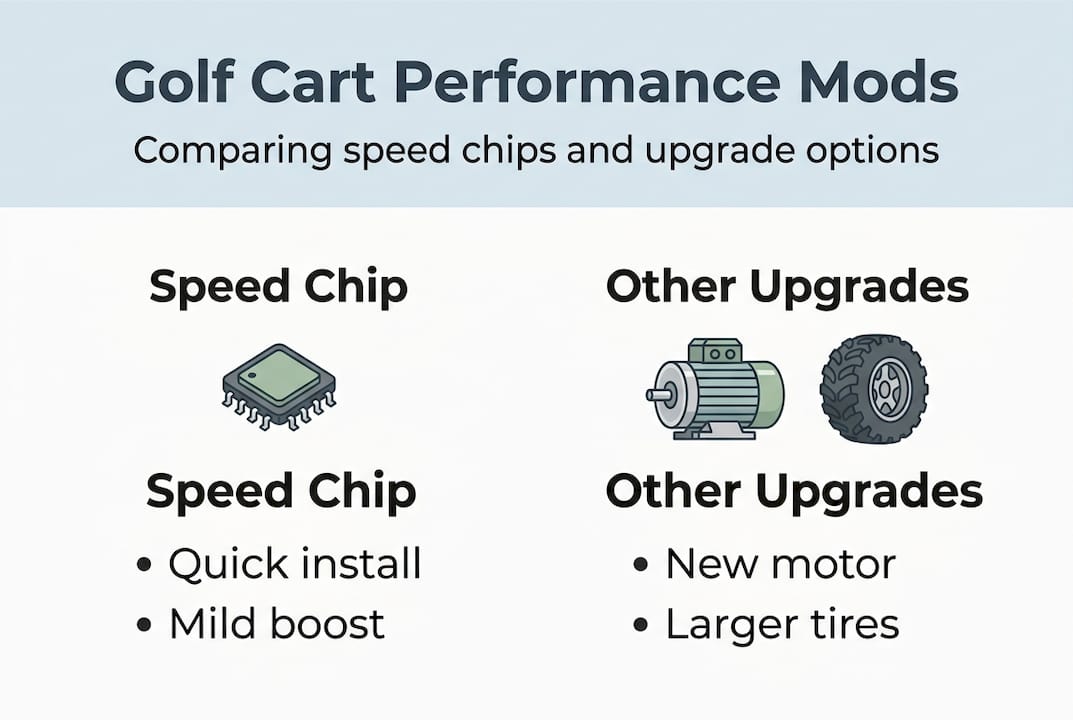
Here’s how common upgrades stack up:
| Upgrade type | Speed gain | Avg. cost | Installation complexity | Reversible? |
|---|---|---|---|---|
| Speed chip | 2-5 mph | $20-$80 | Low | Yes |
| High-speed motor | 5-15 mph | $300-$800 | Medium-High | Yes |
| Controller swap | 4-12 mph | $200-$600 | Medium | Yes |
| High-speed gear set | 3-8 mph | $100-$250 | Medium | Yes |
| Larger tires | 1-4 mph | $150-$400 | Low-Medium | Yes |
Best scenarios for speed chips:
Best scenarios for mechanical upgrades:
Some upgrades pair exceptionally well with a speed chip. Larger tires increase your effective rolling diameter, which compounds the speed chip’s effect. A brushless motor upgrade combined with a chip can push a cart well beyond stock limits. For deeper insight into related modifications, the upgrade ideas guide covers practical combinations worth considering.
If your cart uses an advanced electronic management system, the IQ systems guide explains how intelligent controllers handle speed adjustments differently and what that means for chip compatibility.
Before finalizing any modifications, it’s important to review legality and safety to prevent issues down the road.
Golf carts that travel on public roads or in managed communities operate under rules that many owners underestimate. Some local laws restrict max golf cart speed, and exceeding those limits can result in fines or loss of street-legal status. That’s not a theoretical risk. Owners have had their carts flagged during routine checks in retirement communities and on shared-use paths.
Here are the most important compliance and safety steps to follow before installing a speed chip:
“Safety modifications should always keep pace with speed modifications. A faster cart with stock brakes and old tires is not an upgrade. It’s a liability.”
Reviewing the street legal requirements for your specific use case is one of the smartest moves you can make before touching your speed settings. Street-legal certification depends on more than just speed; lighting, mirrors, and seatbelts all factor in, but speed compliance is often the first thing inspectors check.
With the context, benefits, risks, and practicalities in mind, let’s break down the steps to actually choose and install a chip.
Compatibility varies not only by brand but by year and specific controller type, so always verify your cart’s exact system before purchasing. A chip that lists “Club Car” on the package could be designed for one of six different controller generations. Getting this wrong means buying something that either does nothing or causes errors.
Follow this sequence to select and install correctly:
For DIY owners, basic chip installations are manageable with average mechanical aptitude. However, if your cart has an advanced electronic system, an integrated management computer, or is still under warranty, professional installation is the smarter call. A shop familiar with your brand will also spot related issues before they become failures.
The motor choices guide is a useful reference when your speed chip selection depends on knowing whether your current motor can handle increased current load.
Pro Tip: Always save your original factory speed chip. Store it in a labeled bag in a dry location. If you ever need to return the cart to stock settings for a warranty claim, a trade-in, or a course requirement, having the original chip makes the process simple and free.
Here’s a perspective that doesn’t get enough airtime in speed chip discussions: chasing top speed alone often creates a cart that’s faster but worse in almost every other way.
We’ve seen it happen repeatedly. An owner installs a speed chip, gains a few mph, and immediately notices the cart feels loose in turns, takes longer to stop, and drains batteries faster than before. The fix wasn’t wrong. The approach was incomplete. Speed changes the physics of your cart. Braking distance increases with the square of speed, not linearly. Stability under load shifts. Tire wear patterns change. A cart that was balanced and comfortable at 14 mph may feel genuinely unsafe at 19 mph if nothing else was upgraded.
The owners who end up happiest with their modified carts are not the ones who maxed out their speed chips. They’re the ones who treated the speed chip as one piece of a larger system upgrade. They added better tires, upgraded their brake pads or shoes, improved suspension, and sometimes added a windshield or lighting kit to match their new use pattern. Their carts are faster, yes, but also safer, more comfortable, and worth more at resale.
Dealers who sell speed chips without asking about the rest of the cart’s condition are doing their customers a disservice. The best dealers use speed chip purchases as a conversation opener: “Great choice. Now let’s make sure your brakes and tires can handle the extra speed.” That approach builds trust and often leads to additional sales that genuinely benefit the customer.
Modification strategies that combine speed with comfort and safety aren’t just smarter, they’re more satisfying long-term. The goal isn’t the fastest cart on the path. It’s the best cart for how you actually use it.
When you’re ready to put these insights into action, having access to proven parts and trusted support makes all the difference.
At GolfCartStuff.com, we carry model-specific speed chips, performance accessories, and everything you need to build a faster and safer cart. Whether you drive a Club Car, EZGO, or Yamaha, compatibility matters, and our team can help you confirm the right chip for your controller before you buy. Browse our full range of golf cart accessories for performance and comfort upgrades that complement your speed modifications. Club Car owners will find dedicated options in our Club Car DS parts collection, and EZGO riders can explore compatible upgrades through our EZGO cart accessories catalog. Have a compatibility question? Reach out before you order. Getting it right the first time saves time, money, and frustration.
No, speed chips are model and controller specific. Always verify compatibility with your cart’s exact make, model year, and controller type before purchasing.
Many speed chips deliver a 2 to 5 mph increase, depending on the model, motor condition, and current battery health at the time of installation.
Yes. Some local laws cap golf cart speeds and exceeding those limits after modification may result in fines or loss of permission to operate on public roads.
Most owners can handle basic chip installations on standard controllers, but professional help ensures correct compatibility and protects warranty coverage on more complex or newer systems.
Explore our store to see what our products and resources can do for you.

Leave a comment