
Your Cart Is Our Priority
Explore our store to see what our products and resources can do for you.

Golf cart tire rubbing on the inside almost always traces back to wheel offset, spacer choice, or worn suspension parts, and a conservative spacer or corrected offset usually clears it. Rubbing at the top or fender points to a tire that’s too tall or too wide, which means downsizing the tire or adding a lift kit for vertical room. Skip either fix without diagnosing first, and you risk trading one rub for a worse one, plus extra strain on your wheel bearings. Run the checklist below before you order anything.
TL;DR:
- Proper diagnosis of the contact point is essential before selecting a fix, as different rub locations require different solutions.
- Wheel spacers correct inner clearance issues but can cause fender or frame rubs if not carefully measured and matched to the specific contact point.
- Lift kits increase vertical space and alter steering geometry, making them the ideal fix for top-of-tire or fender contact problems, not spacers.
- Underinflated tires and worn suspension components can mimic fitment issues, so regular maintenance checks help prevent recurring rubbing.
- Owners should measure and test fit with load and steering movement before purchasing parts, to avoid unnecessary or counterproductive modifications.
You can’t fix what you haven’t located. Rubbing at the inner sidewall points to a different problem than rubbing against a fender lip, and guessing wrong means buying the wrong part twice.
Work through this sequence before touching any parts:
Forum owners troubleshooting a Yamaha G22 after a lift kit install found the same pattern repeatedly: the fix only worked once someone pinned down the exact contact point instead of swapping parts on a hunch.
Most golf cart wheel rubbing comes down to one of six mechanical culprits, and they don’t all call for the same repair.
Common spacer sizes for golf carts run 1 inch for a mild stance correction and 2 inches for carts that are already lifted, according to Golf Cart Search’s spacer breakdown. Neither size is a universal answer. The right one depends entirely on where your rub is happening.
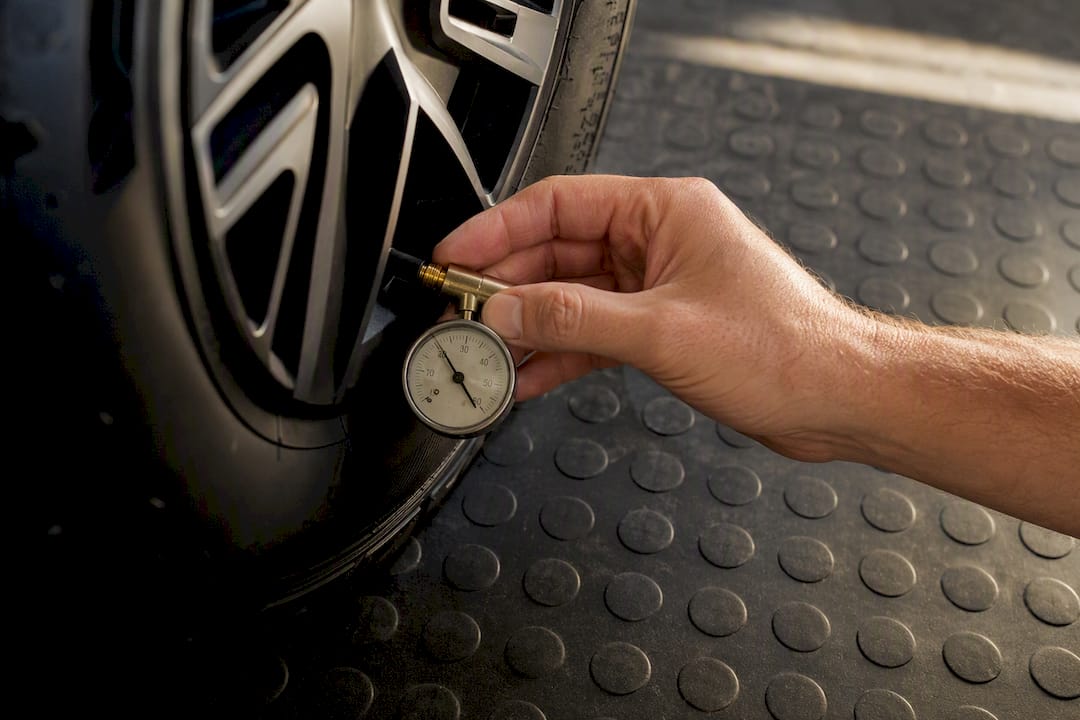
Pro Tip: Before you blame the tire or wheel, check tire pressure first. A soft tire bulges at the sidewall and can mimic a fitment problem that doesn’t actually exist.
Match your fix to your contact point. Applying a fender fix to an inner rub, or vice versa, wastes money and sometimes makes clearance worse.
A wheel spacer pushes the tire outward from the hub, which is exactly why it solves inner rubbing but can create a fender rub if the tire was already close to the outer wheel arch. That’s the trade-off in a nutshell: you’re never eliminating clearance problems, just relocating them, so measure before and after every change.
Spacers and lift kits solve different problems, and mixing them up is the single most common mistake owners make when chasing a rub.
Spacers trade inner clearance for outer clearance. They work well when your rub happens on the suspension side, since pushing the wheel outward puts distance between the tire and the control arm or leaf spring. A 1 inch spacer handles a mild correction; a 2 inch spacer is more common on carts already running a lift kit, per Golf Cart Search. Bigger isn’t automatically better. Every extra inch of spacer adds leverage on the wheel bearing, which accelerates wear over time.
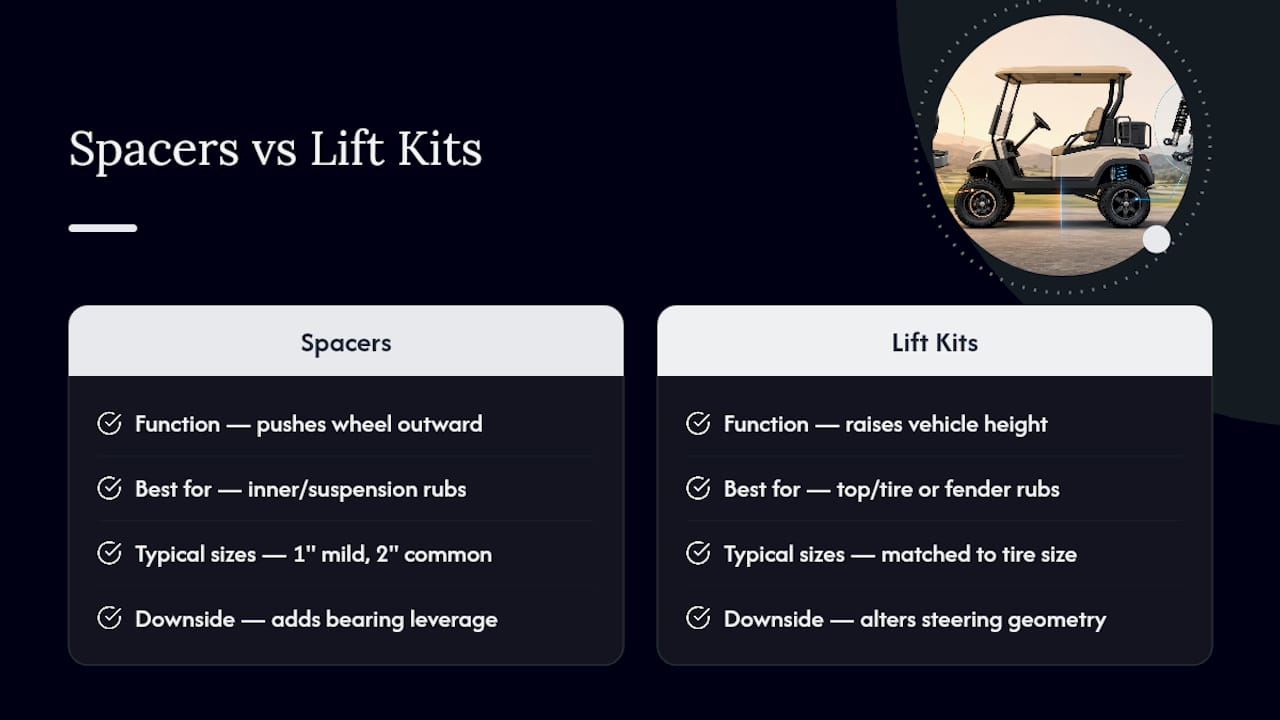
Lift kits solve a different problem entirely: they add vertical clearance and change your steering geometry in the process. If your rub is a top-of-tire or fender contact rather than an inner-sidewall issue, a spacer won’t touch it. You need height, not width, and that usually means a correctly matched lift kit rather than a spacer stacked on top of a problem it wasn’t designed to fix.
Pro Tip: If you’re on the fence, ask whether a smaller tire solves the problem without adding any parts at all. Less hardware means less added stress on bearings and steering components.
Measure four things before committing to any fix: the inner clearance to the control arm or leaf spring, the outer clearance to the fender lip, your tire’s overall diameter, and your current wheel offset plus any spacer thickness you’re considering.
Stop driving immediately if you see metal-on-rubber contact, a rub that shifts depending on load, or any sign of hardware interference. None of those resolve themselves with more miles.
A fix that holds for six months and then reappears usually means a maintenance gap, not a bad repair.
Golf Cart Stuff’s wheel and tire guide and spacer stability guide cover the offset, sizing, and hardware details that owners need before ordering parts. This piece draws on that product-level fitment knowledge alongside community troubleshooting patterns from forums like Cartaholics, where owners document exactly what worked and what didn’t after lift kit and spacer installs. For deeper reading on tire sizing specifically, the tire size guide walks through how diameter and width changes affect clearance on common models.
Most rubbing advice online starts with the fix instead of the diagnosis. Someone posts “add a 2 inch spacer” without ever asking where the tire is actually making contact, and that’s backwards. A spacer solves an inner clearance problem. It does nothing for a fender rub, and on a cart that’s already borderline on outer clearance, it can turn a minor inner rub into a much worse fender strike.
The forum troubleshooting culture around golf carts gets one thing right that a lot of retail guidance skips: owners measure before they buy. That habit is worth keeping regardless of whether you end up ordering a spacer, a smaller tire, or a lift kit. What conventional advice underrates is the bearing math. Every spacer, no matter how small, adds leverage to a wheel bearing that wasn’t designed with that leverage in mind. A 1 inch spacer is a minor tax on bearing life. A 2 inch spacer stacked onto an already-lifted cart is a bigger one, and it deserves more scrutiny than it usually gets in casual advice threads.
If you take one thing from this, take the order of operations: locate the rub, measure clearance, then pick the smallest, least invasive fix that solves that specific location.
— Roshan
Some retailers skip the guesswork that comes with generic auto parts stores by focusing on wheels, spacers, and lift kits built around actual golf cart bolt patterns, hub bores, and thread pitch instead of a one-size-fits-most assumption.
Once you’ve pinned down whether your rub is an inner clearance issue or a fender/top contact problem, match it to the right category. Browse Yamaha parts or Club Car DS parts for wheels, spacers, and lift components sized to your model, and double check bolt pattern, hub bore, and thread pitch against your current setup before you check out. If you’re still deciding between a spacer and a smaller tire, the wheel and tire guide walks through sizing side by side so you order the right part the first time.
Explore our store to see what our products and resources can do for you.

Leave a comment