
Your Cart Is Our Priority
Explore our store to see what our products and resources can do for you.

TL;DR:
- Most golf cart owners learn the purpose of a voltage converter through trial and error, often damaging their batteries. A DC-DC converter safely steps down high pack voltage to stable 12V for accessories, preventing costly battery replacements. Choosing the correct, high-efficiency switching converter and proper wiring ensures system reliability and prolongs battery life.
Most golf cart owners discover what a golf cart voltage converter does the hard way. They need 12V power for a radio or some LED lights, they tap a single 12V battery in their 48V pack, and a few months later they are buying a whole new set of batteries. The voltage converter, properly called a DC-DC converter or voltage reducer, exists specifically to prevent that expensive mistake. This article covers what the device is, how it works, which type to buy, how to install it correctly, and when you actually need one.
| Point | Details |
|---|---|
| Converter vs. single battery tap | Always draw 12V power through a proper converter, not by tapping one battery in your pack. |
| DC-DC converters beat resistor reducers | Switching converters run at 85 to 95% efficiency and protect sensitive electronics from voltage spikes. |
| Size above your actual load | Choose a converter rated higher than your total accessory amperage to prevent overheating and early failure. |
| Check your cart before buying | Factory-equipped carts often already have a built-in voltage reducer, so inspect first. |
| Fuse every output circuit | Protect each 12V accessory line with its own fuse using a dedicated fuse block. |
A golf cart voltage converter is a DC-DC device that takes the high voltage from your battery pack, typically 36V, 48V, or 72V, and steps it down to a stable 12V DC output for running accessories. You will also hear it called a voltage reducer or golf cart power converter. All three terms point to the same category of product.
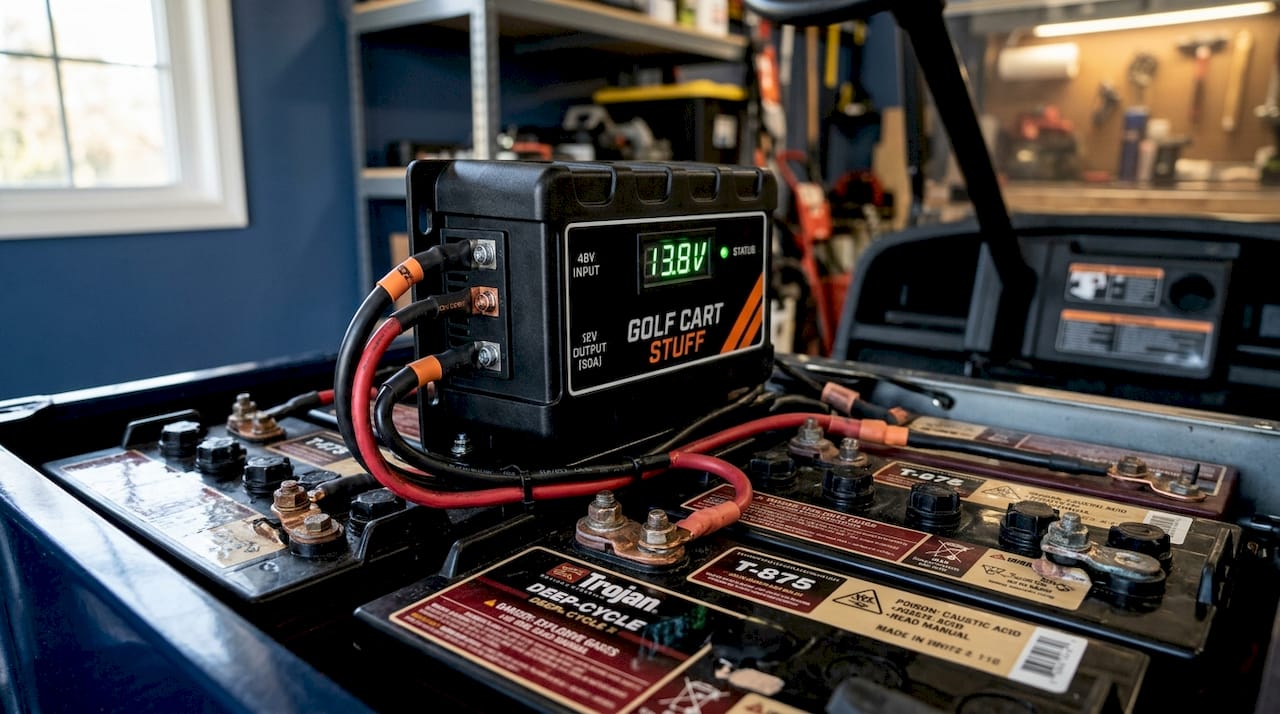
The term “golf cart voltage regulator” sometimes gets mixed in here, but that refers to something different. A voltage regulator controls charging output. A DC-DC converter controls accessory supply voltage. Knowing that distinction saves you from buying the wrong part.
Here is what the converter is not: it is not an inverter. Voltage reducers convert DC to lower-voltage DC, while inverters convert DC to AC. If you need to run a standard wall-plug device like a laptop charger, you need an inverter. For everything else on your cart, LED strips, USB ports, radios, horns, and fans, a DC-DC converter is the right call. Inverters waste energy and introduce unnecessary complexity for devices that already want DC power.
The key function is regulation. Your battery pack voltage sags as the pack discharges, but your accessories need a steady 12V to function correctly. A quality converter maintains stable 12 to 13.8V output regardless of what the pack voltage is doing, which protects electronics from damage caused by over-voltage or voltage fluctuation.
Pro Tip: A voltage converter does not touch your drive system at all. It only feeds the 12V accessory rail, so installing one has zero effect on how fast or far your cart travels.
Not all voltage converters for golf carts are built the same, and choosing the wrong type is one of the most common mistakes DIY owners make.
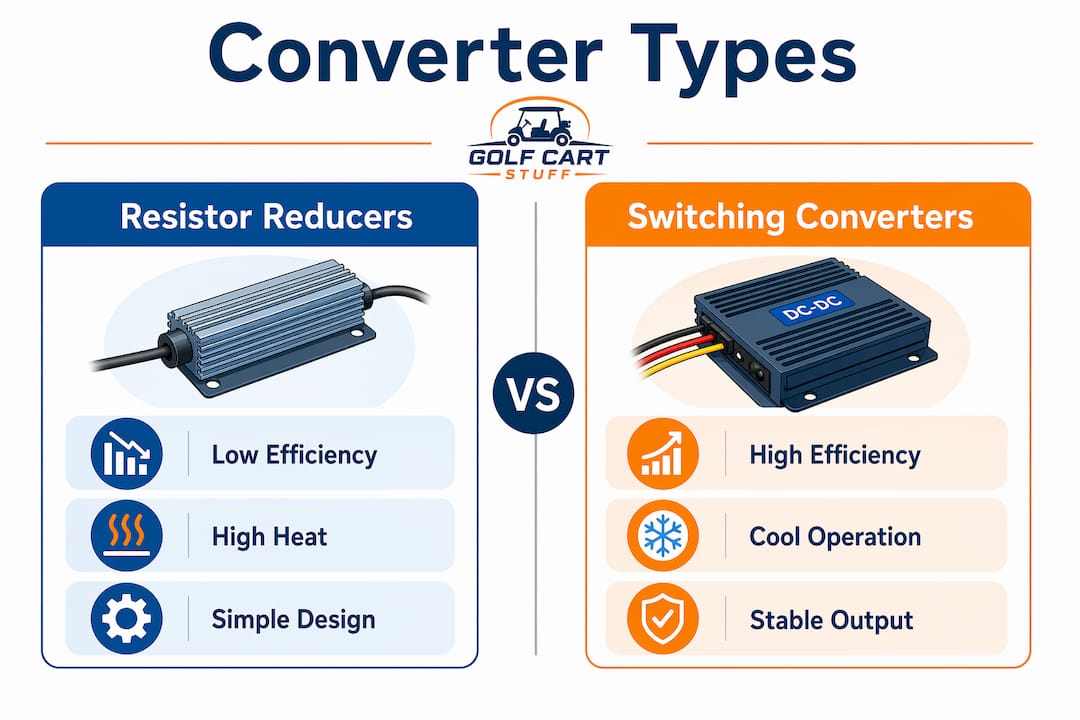
The older style of golf cart voltage reducer uses resistors or linear regulation to drop voltage. The unwanted voltage is simply burned off as heat. These units run at roughly 25 to 33% efficiency, which means for every watt your accessories actually use, you are wasting two to three watts as heat. On a battery-powered vehicle, that is a real hit to your range. They also run hot enough to cause problems in enclosed spaces, and the output voltage is not tightly regulated, which stresses sensitive electronics over time.
Modern switching converters, sometimes called buck converters, use a completely different method. They switch power on and off at high frequency and filter the result, which means almost no energy is wasted as heat. Switching converters reach 85 to 95% efficiency and produce cleaner, ripple-free output. They also include built-in protections like over-current, short-circuit, and thermal shutdown that older resistor units simply do not have.
Here is a direct comparison:
| Feature | Resistor-based reducer | Switching DC-DC converter |
|---|---|---|
| Efficiency | 25 to 33% | 85 to 95% |
| Heat output | High | Low |
| Output stability | Poor | Tight regulation |
| Electronics protection | Minimal | Over-current, thermal, short-circuit |
| Cost | Lower upfront | Moderate, but better long-term value |
| Reliability | Lower | Higher |
Many owners with older carts are still running resistor-style reducers without realizing it. Upgrading old reducers to switching converters is one of the best low-cost electrical improvements you can make.
Proper DC-DC converter sizing depends on your total 12V accessory load, not just your biggest single device. Add up the amperage draw of every accessory you plan to run at the same time. Then buy a converter rated at least 20 to 25% above that number. This gives you a safety margin so the unit runs cool and lasts longer.
Pro Tip: If you plan to add accessories in the future, buy a converter sized for what you expect to have, not just what you have today. Upgrading converters later means rewiring work you could have avoided.
Getting the installation right is just as important as picking the right converter. A few common wiring mistakes can shorten your battery life or damage your accessories.
Never tap a single battery for 12V power. This is the most important rule. Tapping a single 12V battery in a series string causes that battery to discharge faster than the rest. The batteries stop aging together, capacity drops unevenly, and you end up replacing the entire pack early. A properly wired converter draws from the whole pack, spreading the accessory load evenly across all batteries.
Connect converter input leads to the main pack terminals. Run the positive lead to the full pack positive and the negative lead to the full pack negative. This is how the converter draws equally from every battery in the string.
Fuse the input lead close to the battery. If the input wire shorts, you want the fuse to blow, not the wiring to burn. Use a fuse rated just above the converter’s maximum input current.
Use a fuse block on the output side. A fuse block for multiple accessories is safer and neater than running individual wires back to the converter. Each accessory circuit gets its own fuse, which protects devices independently and makes troubleshooting much simpler.
Mount the converter in a ventilated location. Switching converters run cool, but they still need airflow. Avoid mounting them inside sealed enclosures or pressed against foam. A few inches of clearance on all sides is enough.
Check your existing system before you buy anything. Factory carts with 12V accessories usually already have a voltage reducer built in. If your cart came with lights or a horn from the factory, there is a good chance a converter is already present. Locate it, check its amperage rating, and decide whether it can handle any new loads you plan to add.
For a full walkthrough of golf cart wiring connections, the golf cart wiring troubleshooting guide at Golfcartstuff covers the process step by step.
Pro Tip: Label every wire you run with electrical tape and a marker before you close everything up. When something acts up six months later, you will be glad you did.
Understanding how to use a voltage converter becomes much clearer when you look at what golf cart owners are actually running.
If you are running a Club Car DS or a Yamaha model and planning a lithium swap alongside accessory upgrades, it is worth verifying that your converter’s input voltage range covers the lithium pack’s maximum charge voltage, not just its nominal voltage.
Troubleshooting tip: if your LED lights flicker or your radio resets randomly, the converter is almost always the culprit. Either the unit is undersized and sagging under load, or the output voltage is not stable. Check the output with a multimeter while accessories are running. A good switching converter holds steady within a fraction of a volt even at full rated load. If you are seeing swings of more than half a volt, replace the converter.
Understanding your golf cart voltage system before starting any upgrade project makes every installation decision cleaner and faster.
I have seen dozens of golf carts come through with the same story. The owner wanted to run a radio, grabbed a cheap resistor reducer or tapped a battery directly, and six months later the pack was failing unevenly. The frustrating part is that a quality switching DC-DC converter costs anywhere from $20 to $60 depending on the amperage rating. That is a tiny fraction of what a replacement battery set costs.
In my experience, most DIY mistakes with voltage converters fall into two categories. The first is buying the wrong type, usually a resistor reducer that wastes energy and runs hot. The second is undersizing the unit and running it near its maximum rated current constantly. Both lead to early failure and often take accessories down with them when they go.
What I have found actually works is this: spend a few extra dollars on a name-brand switching converter rated well above your current load, fuse everything properly, and mount it where air can move around it. That combination almost never fails. Carts I have seen with that setup installed five or more years ago are still running the original converter without issues.
If you are converting to lithium or adding a significant accessory load, treat the converter selection as seriously as you treat the battery selection. The two components work together. A weak link in either direction affects the whole system.
— Roshan

Whether you are adding LED lights, a radio, or planning a full lithium conversion, getting the right parts makes every difference. Golfcartstuff carries a wide selection of voltage reducers and converters along with fuse blocks, wiring supplies, and everything else you need for a clean, reliable installation. Browse the full range of golf cart accessories to find products matched to your cart model, whether you are driving a Club Car DS, a Yamaha G1 through G22, or something else entirely. The site also covers popular brand-specific part catalogs for Club Car DS and Yamaha models, so you can shop with confidence that parts will fit your cart.
A golf cart voltage converter steps down the battery pack voltage (36V, 48V, or 72V) to a regulated 12V DC output for powering accessories like lights, radios, and USB chargers. It draws from the full battery pack to distribute the load evenly across all batteries.
They are the same device referred to by different names. Both convert high-voltage DC from the battery pack to 12V DC for accessories. The term “reducer” is older and more common on forums; “converter” is more technically precise.
Not necessarily. Factory carts with built-in 12V accessories usually already have a converter installed. Check the amperage rating of the existing unit before adding new accessories to confirm it can handle the extra load.
Switching converters operate at 85 to 95% efficiency, run much cooler, and provide stable regulated output. Resistor reducers waste most of their input energy as heat and do not regulate output voltage tightly enough for sensitive electronics.
No. Tapping one battery in a series string causes that battery to discharge faster than the others, which leads to uneven wear and early pack failure. A proper converter draws from the entire battery pack and keeps all batteries balanced.
Explore our store to see what our products and resources can do for you.

Leave a comment