
Your Cart Is Our Priority
Explore our store to see what our products and resources can do for you.

TL;DR:
- Using demo carts, service workflows, and lifestyle bundles boosts accessory attach rates by shifting the sales focus to personalized configurations. Manufacturing engaging displays, targeted bundles, and timely online suggestions encourages customers to see accessories as essential for their specific needs. Training staff and tracking key performance indicators ensure consistent growth of accessory revenue across all sales channels.
The fastest way dealers raise accessory attach rates: combine showroom demo units, service-driven recommendations, and value bundles at the point of sale. When all three work together, the conversation shifts from “do you want to add anything?” to “which configuration fits your needs?” That’s a fundamentally different sale.
Three things to do this week:
Quick close checklist for sales reps:
The single biggest shift a dealer can make is turning accessories from a catalog conversation into a visual, touchable experience. Customers who see a fully outfitted demo cart don’t ask whether they need accessories. They ask which ones.
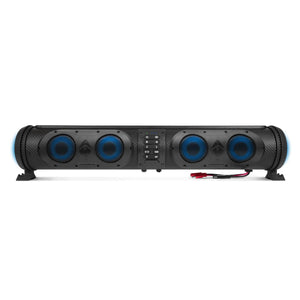
Start with the accessories that have the highest visual impact and the widest buyer appeal. LED underbody lighting and headlight kits catch attention from across the showroom. A full windshield signals weather protection without a word of explanation. Upgraded seats, especially two-tone or custom-stitched options, communicate quality immediately. A mounted soundbar and a rear utility box round out a cart that looks ready for real life, not just the fairway.

Lift kits deserve their own demo unit if your floor space allows. Customers who are on the fence about a lift rarely commit from a brochure. Seeing the ride height in person closes that gap fast. Pair the lifted demo with aggressive tires and a light bar, and you’ve built a cart that sells itself to the off-road and neighborhood crowd simultaneously.
Slatwall panels with mounted accessory samples work better than shelf displays because customers can touch and compare. Position them near the demo carts, not across the room. Lifestyle signage matters: a photo of a family loading a cooler onto a cart with a rear seat kit speaks to a completely different buyer than a photo of a golfer reaching for a club. Label each display by use case (“Golf Day Setup,” “Neighborhood Cruiser,” “Work & Haul”) so customers self-select before a rep even approaches.
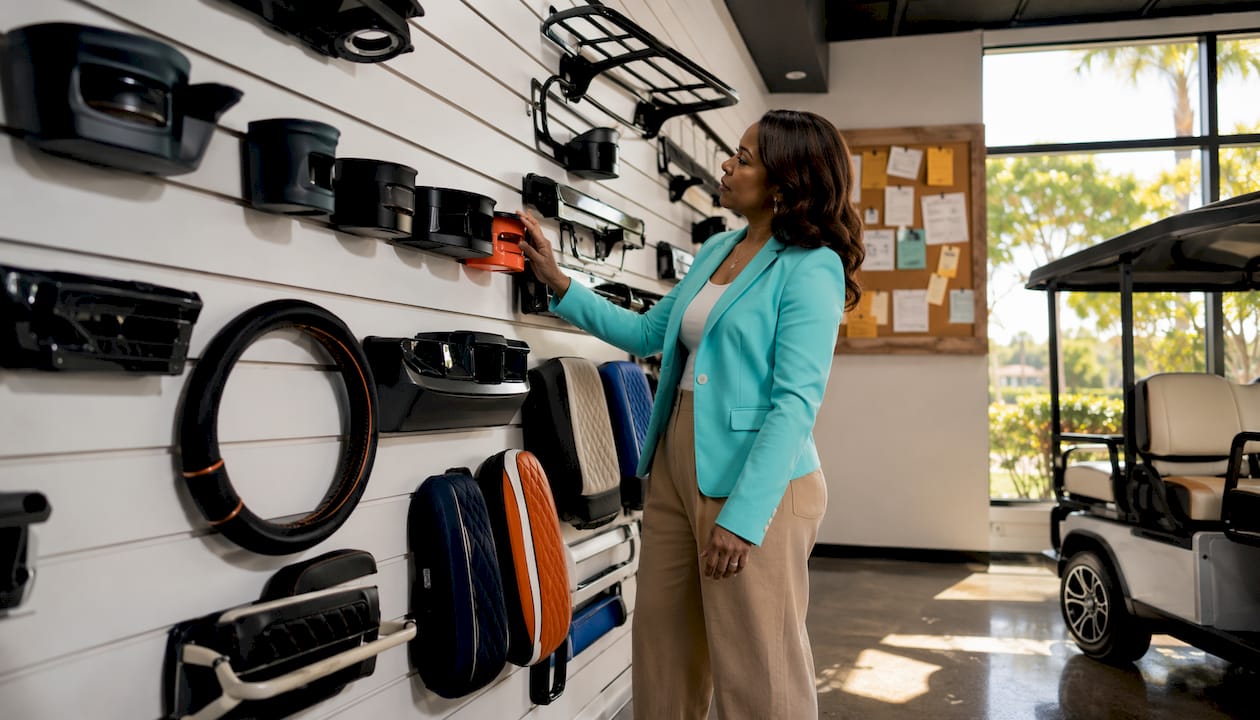
Professional install photos outperform product-only shots in every context, from showroom signage to online listings. A seat shown installed on a Club Car Precedent tells a buyer far more than the same seat on a white background. Short 30-second video demos of accessories in action, shared via text during follow-up, consistently outperform static images for closing hesitant buyers.
Pro Tip: Rotate your demo cart accessories quarterly. A fresh configuration gives repeat visitors a reason to look again, and it creates a natural “new arrival” conversation starter for your sales team. Schedule a demo day around each rotation to generate social proof and urgency.
Pricing strategy is where most dealers leave money on the table. The fix isn’t discounting more aggressively. It’s packaging accessories so the value is obvious and the decision is easy. Bundling by customer lifestyle increases transaction value without requiring a rep to pitch every item individually.
| Bundle Name | Core Accessories | Anchor Price Approach | Target Buyer |
|---|---|---|---|
| Golf Day Package | GPS holder, club washer, beverage holder, windshield | Cart price + bundle at 10% off individual items | Golfer, course member |
| Utility Work Pack | Rear utility box, tow hitch, heavy-duty seat, cargo net | Flat bundle add-on, install included | Property owner, contractor |
| Family Safety Pack | Rear seat kit, seatbelts, LED lights, horn | Safety framing, no discount needed | Family buyer, HOA community |
| Premium Experience | Soundbar, custom seat, lift kit, LED lighting | Anchor against individual retail total | Enthusiast, gift buyer |
The anchor pricing principle here is straightforward: show the combined retail price of individual accessories, then show the bundle price. Offering a retail total discounted by a bundle price feels like a win even if your margin on the bundle is identical to selling each piece separately. The customer perceives savings; you move more units.
When to discount versus when to value-add: discount only when you have a margin cushion and a specific reason (end-of-season, demo unit clearance). Otherwise, add value through free installation or an extended warranty. A customer who gets free installation on a $300 accessory package perceives more value than one who gets $30 off, and your labor cost is often lower than the discount would have been.
Pro Tip: Offer a “limited-time install special” tied to the sale day. “We can install this today while you’re here” creates urgency without a price cut. Same-day installs close at a noticeably higher rate than installs scheduled for a return visit.
Your product pages and checkout flow are a 24/7 sales rep. Most dealer sites leave them set to “display only.” A few targeted changes can turn them into consistent accessory revenue.
Set up three automated touchpoints after every cart sale. A 30-day message checks in on the customer’s experience and surfaces one accessory relevant to their use case. A 90-day message ties to a seasonal hook (spring prep, summer riding, fall storage). A 6-month message is a service reminder that naturally leads to an inspection and an accessory recommendation. Dealer marketing tactics that pair persona-targeted messaging with seasonal timing consistently outperform generic broadcast emails.
Timing is the part most sales training skips. Asking too early feels pushy. Asking at the wrong moment, after the customer has mentally closed the sale, gets a reflexive “no.” The 90-rule is simple: spend the first 90% of the conversation understanding the customer’s use case, then make your accessory recommendation in the final 10%, framed as a solution to what they just told you.
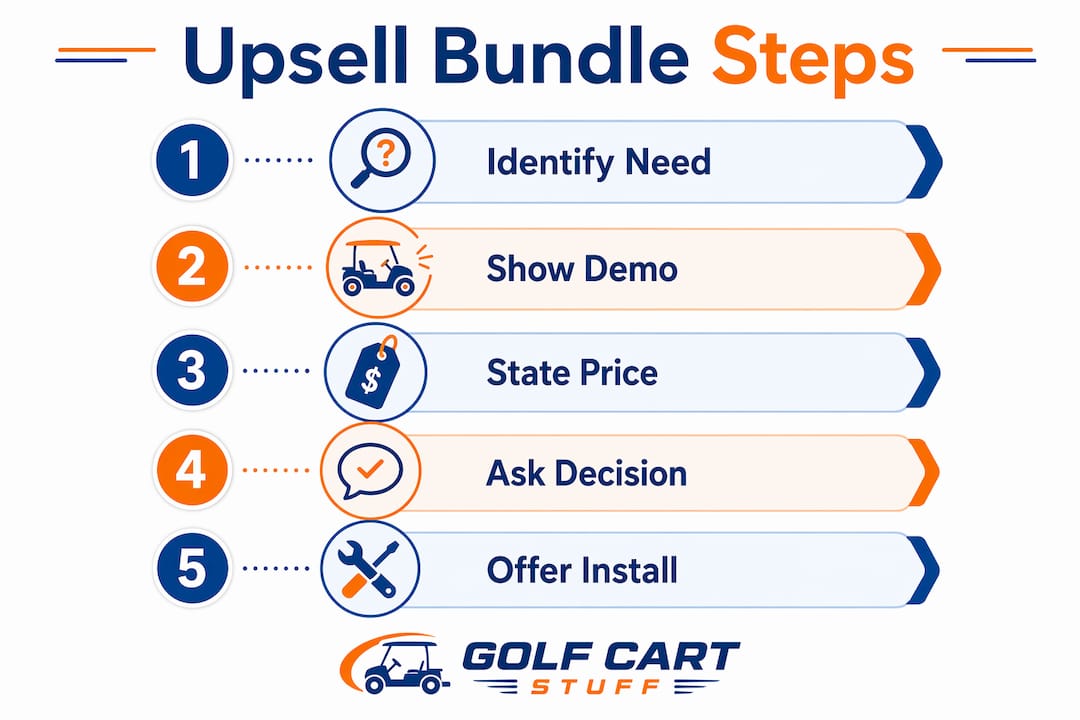
Identify the need → Show the installed demo → State the price and benefit → Ask for the decision.
That’s it. Four steps, in that order, every time.
Golf buyer: “You mentioned you play early mornings. A lot of our golfers add the LED headlight kit for exactly that reason. It’s installed on that cart over there — want to take a look? It runs $149 installed today.”
Family buyer: “With kids in the cart, the rear seat kit with integrated seatbelts is the one thing most parents wish they’d added from the start. We can put it on before you drive home.”
Utility buyer: “If you’re hauling tools or gear, the rear utility box and tow hitch package is going to save you a lot of trips. It’s $285 installed, and we can have it done in about an hour.”
“I’ll think about it and come back.” Acknowledge it, then offer the install incentive: “Totally fair. Just so you know, we’re running same-day installs this week, so if you decide today, you leave with it done.”
“That seems expensive.” Reframe to daily cost or comparison: “Spread over a couple of years, it’s less than a dollar a day, and it’s already on the cart, so there’s nothing to install later.”
Pro Tip: Run a 15-minute role-play at the start of each weekly team meeting. Rotate the buyer persona. The rep who plays the customer learns as much as the one pitching. Track which scripts generate the fewest objections and update your standard language monthly.
Service bays are the most underused upsell channel in most dealerships. A customer who brings their cart in for maintenance is already engaged, already trusting you, and already on-site. Structured service workflows turn that visit into a reliable revenue moment.
After-sales service programs increase customer retention and create ongoing accessory revenue opportunities, which is exactly why the service workflow deserves the same attention as your showroom floor.
Checklist for service techs:
Training without incentives produces inconsistent results. Incentives without training produce discounting. You need both, and they need to reinforce the same behavior: recommending the right accessory at the right moment, at a price that protects margin.
Avoid rewarding units sold without a margin floor. A rep who discounts every bundle to close the add-on is costing you money while hitting their number. Build the margin floor into the incentive structure from day one.
Pro Tip: Offer short micro-certifications for both sales reps and techs. A “Lighting Specialist” or “Lift Kit Certified” badge takes 30 minutes to earn and gives staff a genuine reason to talk confidently about installation. Customers respond to specificity: “Our tech is certified on lift kit installs” closes faster than “we can install it.”
You don’t need a complex dashboard. You need four numbers, tracked weekly, with a clear baseline.
| KPI | How to Calculate | Target Benchmark |
|---|---|---|
| Accessory attach rate | Accessory transactions ÷ total cart sales | a majority attach rate for established programs |
| Avg. accessory revenue per sale | Total accessory revenue ÷ total cart sales | Track trend, not a fixed number |
| Install attach rate | Installs sold ÷ accessories sold | 40%+ signals strong service integration |
| Margin per accessory bundle | Bundle revenue minus COGS and labor | Should exceed single-item margin |
Don’t test two variables at once. You won’t know which one moved the number. One change, one measurement period, one decision. That discipline is what separates dealers who improve consistently from those who try everything and learn nothing.
The evidence for accessory upselling isn’t theoretical. At customization-focused dealerships, the large majority of buyers add accessories at the point of purchase, according to dealer reporting in industry publications. The demand is already there. The question is whether your process captures it.
Bundling by customer lifestyle, a tactic supported by dealer institute guidance, increases transaction value without requiring aggressive discounting. The Golfcartstuff seller’s guide reinforces this with practical steps: demonstration cars and image-first listings are among the highest-leverage tactics available to dealers today.
Days 1–30: Build one demo cart. Enable one checkout cross-sell. Train staff on one script per buyer persona. Establish your attach-rate baseline.
Days 31–60: Launch two lifestyle bundles. Implement the service workflow. Begin tracking the four core KPIs weekly.
Days 61–90: Refine bundles by margin data. Roll out the incentive plan. Expand demo rotations and launch your first CRM-triggered post-sale campaign.
One implementation risk worth naming: if you launch bundles before training staff on how to present them, the bundle becomes a discount tool rather than a value tool. Train first, then launch.
Accessory upselling works when demo merchandising, service workflows, and value bundles operate together, not as isolated tactics.
| Point | Details |
|---|---|
| Demo carts close faster | A fully outfitted demo unit shifts the conversation from “should I?” to “which configuration?” |
| Bundle by lifestyle, not by product | Golf, utility, and family bundles increase transaction value without requiring aggressive discounting. |
| Service visits are upsell opportunities | A five-step Check-In to Install workflow turns every service bay visit into a reliable accessory revenue moment. |
| Track four KPIs weekly | Attach rate, average accessory revenue per sale, install attach rate, and margin per bundle are the only numbers you need. |
| Golfcartstuff stocks the categories that matter | Lights, seats, lift kits, windshields, and batteries are all available to help dealers build demo carts and fulfill bundles quickly. |
The conventional wisdom says to offer accessories at the end of the sale, almost as an afterthought. That’s exactly backwards. By the time a customer has mentally committed to the cart purchase, their decision-making energy is spent. They’re ready to leave, not to evaluate new options.
The dealers who consistently hit 60% or higher attach rates do something different: they build the accessory conversation into the cart conversation from the first walkaround. The demo cart isn’t a separate stop on the showroom tour. It’s the first stop. Accessories aren’t presented as extras. They’re presented as the difference between a cart that works and a cart that works for your specific life.
The other mistake is treating service techs as mechanics and nothing else. A tech who notices a cracked seat cushion and says nothing just cost you an $89 sale. Train your service team the same way you train your sales team, with product knowledge, a script, and an incentive. The service bay is often where your most loyal customers spend time, and loyalty is the easiest upsell environment there is.
One more thing: don’t discount your way to attach rate. A 60% attach rate built on heavy discounting is a margin problem wearing a success metric. Build the value into the bundle, the demo, and the install offer. When customers feel they’re getting more, not paying less, you protect your margin and your reputation simultaneously.
Building demo carts and launching lifestyle bundles only works if you can actually stock the accessories your customers want. Golfcartstuff carries the full range of categories dealers need to execute the tactics in this guide: LED lighting kits, custom seats, lift kits, windshields, batteries, and more, all compatible with EZGO, Club Car, and Yamaha carts.
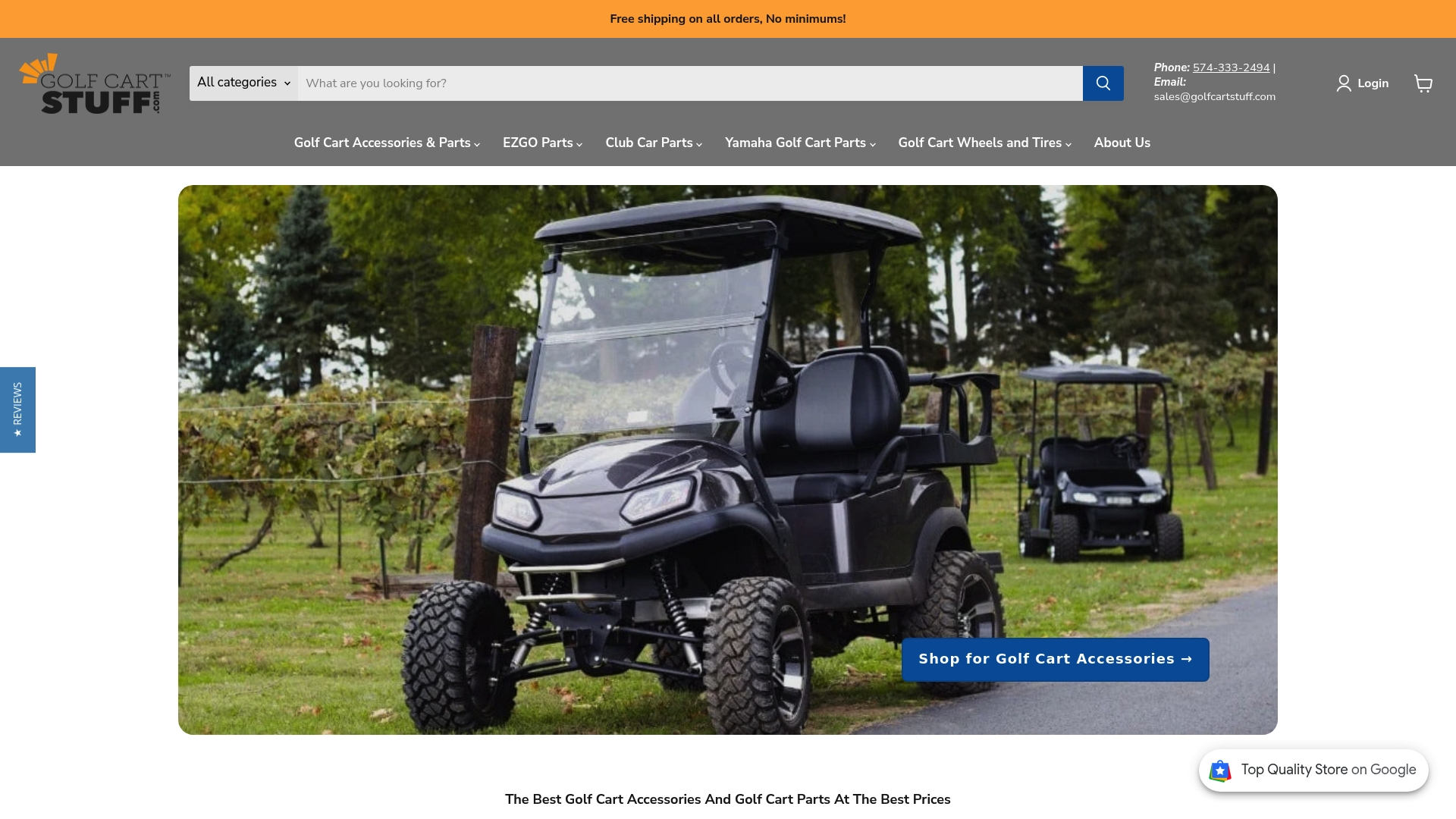
Whether you’re setting up your first demo unit or fulfilling a family safety bundle, the golf cart accessories collection covers the categories with the highest attach rates. Dealers looking to stock Club Car-specific parts can browse the Club Car DS parts collection for OEM-fit options that simplify bundle fulfillment. Bulk orders and dealer support are available. Browse the collections and place your first demo-build order today.
Explore our store to see what our products and resources can do for you.

Leave a comment