
Your Cart Is Our Priority
Explore our store to see what our products and resources can do for you.

The role of leaf spring bushings is simple: they sit inside the spring eye and shackle as a flexible buffer, keeping metal parts from grinding against each other while letting the spring flex and travel the way it’s designed to. When a bushing wears out, the effect shows up fast: harsher rides, clunking over bumps, axle misalignment, and stress that spreads to shocks and mounting hardware. Golfcartstuff sees this pattern constantly on golf carts with sagging, noisy rear ends, and it almost always traces back to the same worn rubber sleeve.
Leaf spring bushings work by cushioning the spring eye and shackle joints, and ignoring early wear signs turns a small, cheap fix into a suspension and alignment problem.
| Point | Details |
|---|---|
| Core function | Bushings isolate metal-to-metal contact at the spring eye, absorbing shock and allowing controlled movement. |
| Watch for early symptoms | Clunking, harsher rides, and uneven tire wear all point to bushing wear before failure gets worse. |
| Material choice matters | Rubber favors quiet comfort; polyurethane favors durability and tighter handling. |
| Replace early, not late | Acting at the first crack or soft spot avoids damage to shocks, sleeves, and alignment. |
| Where to source parts | Golfcartstuff stocks model-specific bushings and leaf spring kits for Club Car, Yamaha, and EZGO carts. |
A leaf spring bushing is a rubber or polyurethane sleeve pressed into the spring eye, the looped end of the leaf spring. It separates the spring’s metal eye from the metal pin or bolt running through it, turning what would be a rigid, squeaky connection into a cushioned one. You’ll find bushings in two spots on most leaf spring setups: the front eye, which is usually a fixed mount to the frame, and the rear eye, which connects to a shackle that allows the spring to lengthen and shorten as it flexes.
Here’s a quick way to spot one during an inspection:
A leaf spring bushing does more than fill space. It’s the flexible element inside the spring eye or shackle that separates rigid metal parts, absorbing shocks while letting the spring move without binding. Every bump the wheel hits sends a vertical load up through the spring, and that load has to travel somewhere before it reaches your seat or the golf cart’s frame.
The bushing accommodates three kinds of motion:
That flexibility is what keeps the ride from feeling like a wagon wheel on a cobblestone road. Rubber bushings, in particular, absorb vibration and isolate noise, which is the technical definition of NVH control, before it ever reaches the chassis. Inside the bushing, a metal sleeve keeps the bolt aligned and prevents the rubber from tearing under torque. When that sleeve corrodes or the surrounding rubber degrades, the alignment it was maintaining starts to drift.
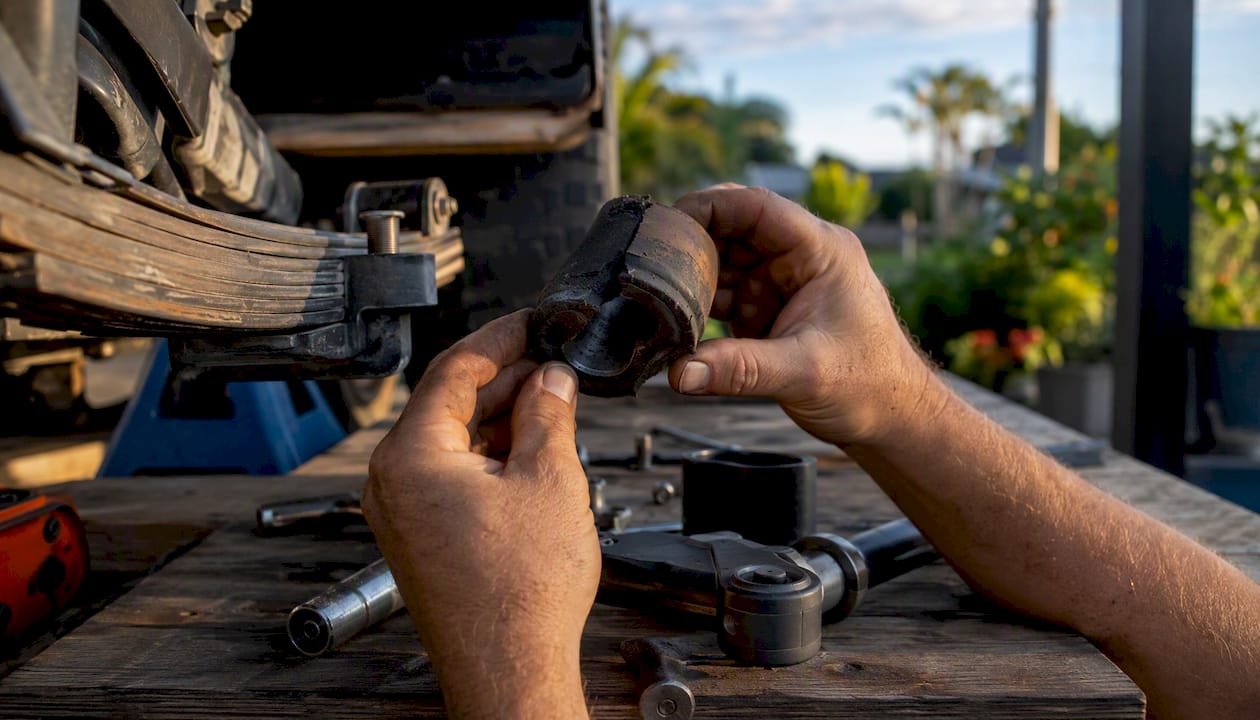
Worn bushings rarely fail silently. The most common signs include increased ride harshness, a clunking or rattling noise over bumps, excessive body roll in turns, and uneven tire wear from an axle that’s no longer tracking straight. Left alone, this can progress into real handling instability.
Split your inspection into what you can see and what you can hear or feel:
Pro Tip: Don’t wait for the clunk. A hairline crack or slightly mushy bushing today is a cheap fix; a seized, corroded one six months from now often means cutting it out and dealing with a damaged spring eye.
Worn bushings don’t stay a one-part problem for long. Once the rubber degrades, the axle can shift slightly under torque, which throws off alignment and accelerates wear on shocks, control links, and even the tires. Ride comfort drops, steering gets vaguer, and on a golf cart carrying passengers over uneven terrain, that vagueness translates directly into reduced control.
Some consequences to watch for:
Technicians who inspect failed bushings regularly trace subtle alignment drift back to uneven bushing wear far more often than to a cracked spring leaf itself. If your cart wanders or clunks under braking, treat that as a safety issue, not just a comfort complaint.
Give your bushings a visual check every few months, and inspect immediately after heavy use, rough terrain, or the first sign of a new noise. Waiting for a loud clunk usually means the bushing has already lost its structural integrity, and technicians generally recommend acting at the first hairline crack or soft spot rather than pushing it further.
Replacement follows a fairly consistent sequence:
A few things determine whether this is a weekend DIY job or a trip to a pro shop:
For golf cart owners working on a Club Car, our complete guide to golf cart leaf springs walks through model-specific fitment in more detail.
Material choice comes down to a trade-off between comfort and durability. Rubber bushings are the better pick for vibration and noise isolation, which is why most factory setups use them. Polyurethane trades a slightly firmer ride for better resistance to oil, grime, and road contaminants, plus tighter, more predictable handling over time.
Here’s how they stack up:
If your golf cart spends most of its life on smooth cart paths, rubber keeps the ride quiet and comfortable. If it’s hauling loads across gravel or uneven ground regularly, polyurethane’s added stiffness holds up better, though it will transmit slightly more road noise into the frame.
Short answer: you might be able to, but you shouldn’t. Driving on badly worn bushings is strongly discouraged because it compromises suspension safety and tends to accelerate damage to shocks, control arms, and chassis alignment the longer it continues.
If you absolutely need to move the vehicle before repairs:
On golf carts, we see rear shackle bushings fail first, almost always from sun-cracked rubber. Match the bushing to your cart’s model, and always check the inner sleeve, not just the outer rubber, before you call it good.
Golfcartstuff carries the leaf spring and suspension parts that make this repair straightforward instead of a guessing game, with fitment sorted by brand so you’re not stuck decoding generic part numbers. Whether you’re swapping a single bushing or the whole spring, checking your model against our parts pages first saves you a return shipment.

If you’re working on a Club Car, browse our Club Car DS golf cart parts collection for shackles, bushings, and full leaf spring sets built for that platform. Yamaha owners can check the Yamaha G1-G22 parts collection for compatible hardware, and if you’re dealing with a seized or corroded sleeve that won’t budge, that’s a job worth handing to a shop with a press rather than fighting it in your garage. Confirm your model and year before ordering. Bushings are cheap; the wrong-fit return shipping isn’t.
What is the main role of leaf spring bushings in a suspension system? Their main role is separating metal parts at the spring eye and shackle so the spring can flex without binding, while absorbing vibration before it reaches the frame.
How do I know if my leaf spring bushings are worn out? Listen for clunking over bumps, watch for uneven tire wear, and check visually for cracked or flattened rubber around the spring eye.
Can worn bushings damage other suspension parts? Yes. Worn bushings let the axle shift slightly under load, which accelerates wear on shocks, control links, and alignment over time.
Is polyurethane better than rubber for leaf spring bushings? It depends on your priority. Polyurethane lasts longer and resists grime better, but rubber gives a quieter, more comfortable ride.
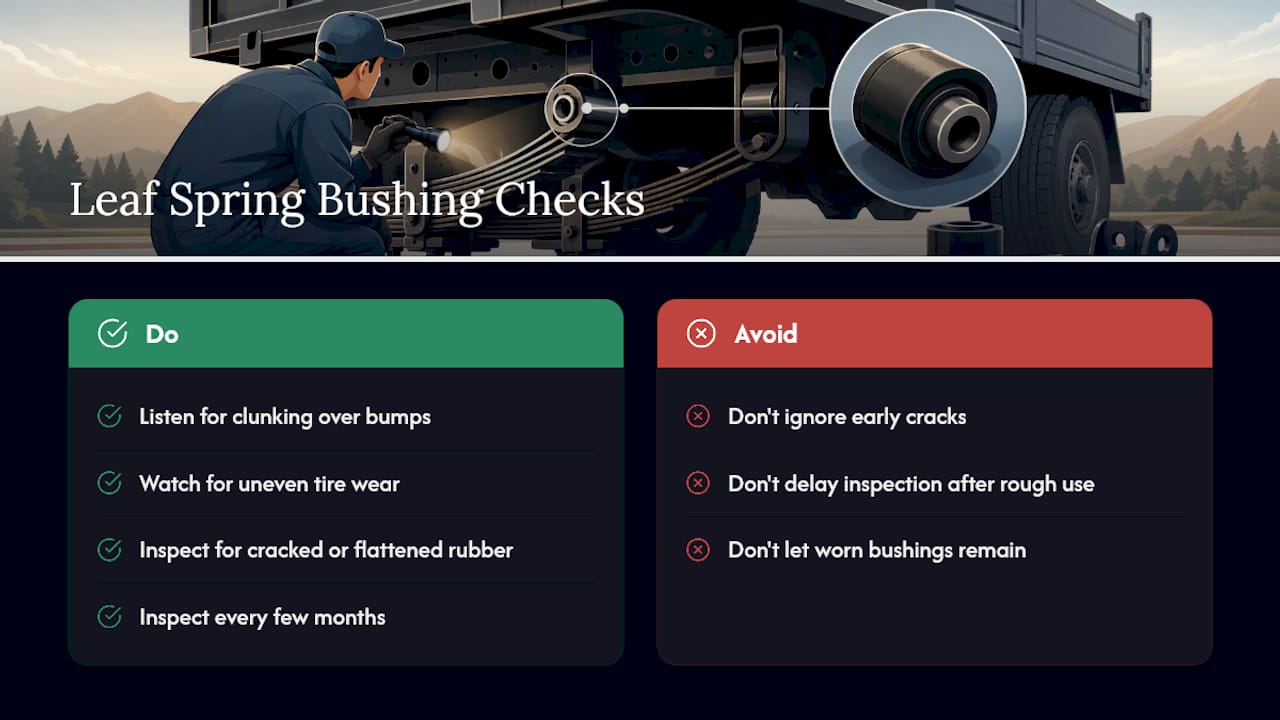
How often should I inspect leaf spring bushings? Check them every few months and immediately after any rough or heavy use, since early cracks are far cheaper to fix than a seized bushing later.
Explore our store to see what our products and resources can do for you.

Leave a comment