

Your Cart Is Our Priority
Explore our store to see what our products and resources can do for you.

Many golf cart owners view mirrors as optional accessories, but this misconception overlooks a critical safety reality. With golf cart injuries averaging 23,000 emergency visits annually, proper visibility equipment is essential for preventing accidents. This guide explores why mirrors matter for legal compliance and safety, examines the different mirror types available, explains installation and maintenance best practices, and provides expert insights to help you make informed decisions about upgrading your golf cart’s visibility systems.
| Point | Details |
|---|---|
| Legal requirement | Street-legal golf carts federally require at least one side mirror and one rearview mirror, with state-specific variations. |
| Mirror types matter | Planar mirrors offer accuracy, convex mirrors provide wider views with distortion, and panoramic options maximize rear visibility. |
| Installation options | Clamp-on mounts offer easy, no-drill installation while drill/screw mounts provide enhanced stability for rough terrain. |
| Maintenance prevents failure | Regular inspection and proper tightening prevent vibration-related loosening that compromises mirror effectiveness. |
| Safety enhancement | Mirrors significantly reduce collision risks during backing maneuvers and turning, addressing common accident scenarios. |
Federal regulations mandate that street-legal golf carts include at least one side mirror and one rearview mirror. State requirements add specific variations, with Florida requiring rearview mirrors for all street-legal carts. These legal standards exist for good reason, as mirrors are fundamental to safe navigation on public roads.
Beyond legal compliance, mirrors address a growing safety concern. Golf cart injuries generate approximately 23,000 emergency department visits annually, with this number rising steadily over recent decades. While rollovers and ejections cause the most severe injuries, collision accidents during backing and turning maneuvers represent preventable incidents that proper mirror systems can eliminate.
Understanding street legal golf cart basics helps contextualize why visibility equipment matters so much. Despite operating at relatively low speeds, golf carts share road space with pedestrians, cyclists, and motor vehicles. The compact design and open structure of golf carts create blind spots that mirrors directly address.
Key safety benefits mirrors provide include:
Pro Tip: Even if you only operate your golf cart on private property, mirrors dramatically improve safety by helping you spot children, pets, and obstacles that might otherwise remain invisible until too late.
The rising injury statistics underscore an important reality. As golf cart usage expands beyond traditional golf courses into neighborhoods, retirement communities, and commercial campuses, the need for proper safety equipment intensifies. Mirrors represent one of the most cost-effective safety upgrades available, offering protection that far exceeds their modest investment.
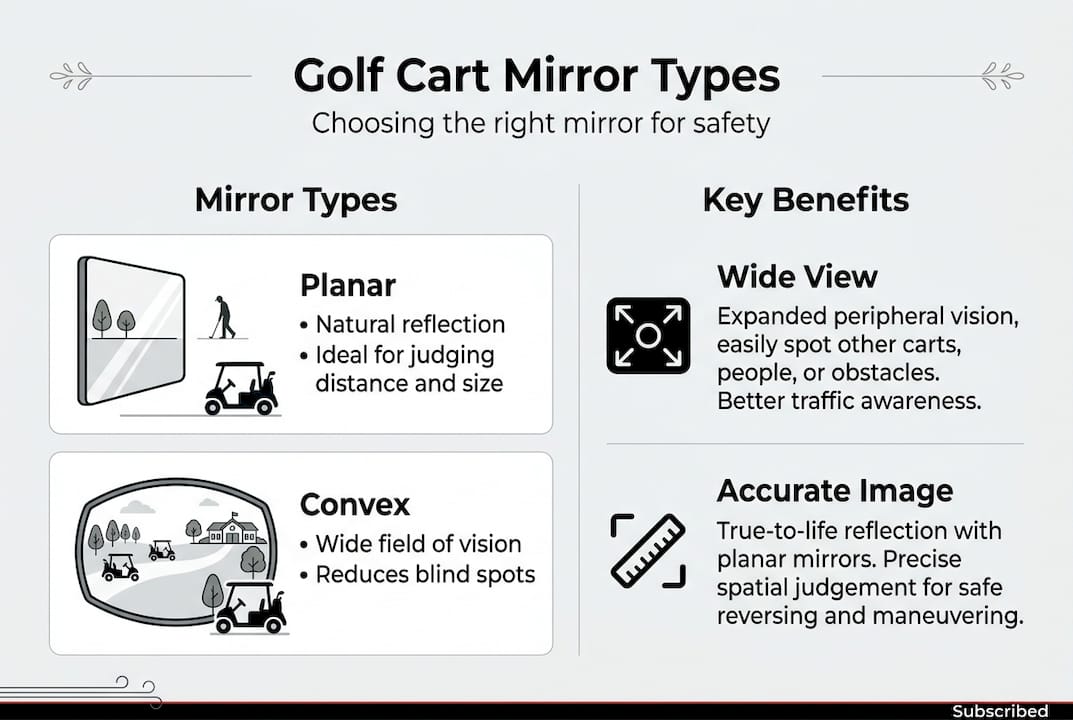
Selecting the right mirror type requires understanding how different designs balance accuracy against field of view. Planar mirrors provide accurate size and distance representation but offer limited viewing angles, while convex mirrors expand visibility at the cost of distance distortion. Each design serves specific purposes based on your golf cart’s primary usage.
Planar (flat) mirrors function like standard bathroom mirrors, reflecting objects at their true size and distance. This accuracy helps drivers judge gaps precisely when backing or merging. However, the narrow field of view means you see less of what’s happening behind and beside your cart. Planar mirrors work best as driver-side mirrors where accurate distance judgment matters most.
Convex mirrors curve outward, creating a fish-eye effect that dramatically expands the viewing area. You can monitor a much wider zone behind your cart, catching vehicles and pedestrians that planar mirrors would miss. The trade-off involves distance distortion, making objects appear smaller and farther away than reality. Drivers need practice adjusting their spatial judgment when using convex mirrors.

Aspheric mirrors blend both technologies, featuring a gradually changing curve that balances accuracy in the center with wider peripheral views. These mirrors cost more but reduce the adaptation period compared to fully convex designs. Many golf cart owners find aspheric mirrors offer the best compromise for varied driving conditions.
Panoramic and multi-panel mirrors provide ultra-wide rear visibility by combining multiple viewing angles in one unit. These designs excel at eliminating blind spots completely, making them ideal for street-legal carts operating in busy areas. The expanded view helps monitor multiple lanes of traffic and detect approaching vehicles from greater distances.
| Mirror Type | Field of View | Distance Accuracy | Best Application | | — | — | — | | Planar (Flat) | Narrow | Excellent | Driver-side, precise maneuvering | | Convex | Wide | Distorted | Passenger-side, blind spot coverage | | Aspheric | Moderate-Wide | Good | All-purpose, balanced performance | | Panoramic | Ultra-Wide | Moderate | Rear-mounted, street-legal compliance |
Many experienced golf cart owners adopt the automotive standard of pairing mirror types. Install a planar mirror on the driver’s side for accurate distance judgment during parking and merging. Mount a convex mirror on the passenger side to maximize blind spot coverage. This combination delivers both precision and comprehensive visibility.
Pro Tip: When choosing between mirror types, consider your primary operating environment. Tight community streets with frequent pedestrian traffic benefit from panoramic rear mirrors, while open campus driving works well with paired side mirrors.
Understanding the purpose of golf cart mirrors helps guide your selection process. Match mirror characteristics to your specific needs rather than defaulting to the cheapest option. The right mirror type transforms from a legal requirement into a genuine safety asset that prevents accidents before they happen. Explore best golf cart add-ons 2026 for complementary upgrades that enhance overall cart functionality.
Proper installation determines whether your mirrors deliver reliable performance or become loose, vibrating distractions. Clamp-on mounts offer no-drill versatility for roll bars sized 1.25 to 1.75 inches, while drill/screw mounts provide enhanced stability for rough terrain operation. Understanding both methods helps you choose the right approach for your golf cart’s construction and usage patterns.
Clamp-on mirror installation follows these straightforward steps:
Drill/screw mounting requires more preparation but delivers superior vibration resistance. You’ll need a power drill, appropriate drill bits for your cart’s material (metal or fiberglass), mounting screws with washers, and safety glasses. Mark your mounting points carefully, ensuring they align with structural supports rather than thin panels that could crack under stress.
Key installation considerations include:
Pro Tip: Before drilling permanent mounting holes, temporarily attach mirrors with strong double-sided tape for a test drive. This trial period reveals whether your planned positions provide optimal visibility or need adjustment.
Maintenance prevents the gradual degradation that renders mirrors useless. Regular inspection counters vibration loosening that occurs naturally on rough terrain. Check clamp tightness weekly if you frequently drive on unpaved surfaces, monthly for smooth pavement operation. Avoid over-tightening screws, which strips threads and actually reduces long-term stability.
Vibration effects accumulate over time, particularly with clamp-on designs. The constant jarring from bumps, curbs, and uneven surfaces gradually works fasteners loose even when initially installed correctly. Incorporating mirror checks into your routine maintenance schedule catches problems before mirrors shift out of alignment or detach completely.
Folding mirror designs offer practical benefits beyond space saving. When navigating narrow paths, storage areas, or tight turns, the ability to temporarily fold mirrors inward prevents accidental damage. Quality folding mechanisms maintain adjustment settings, so you don’t need to re-aim mirrors after unfolding.
Complementary safety upgrades work synergistically with mirrors to maximize visibility. Installing golf cart light kits improves your ability to see and be seen during dawn, dusk, and evening operation. Adding turn signal solutions communicates your intentions to other road users, reducing the collision risks that mirrors help you monitor.
Experienced golf cart operators recognize that mirror selection involves subtle trade-offs beyond basic visibility considerations. Convex mirrors distort distance perception, which can lead to misjudging gaps during merging or backing maneuvers. New users often either underestimate how close objects actually are, resulting in overly cautious driving, or overestimate distances and cut margins too thin. This adaptation period typically requires two to three weeks of regular driving before spatial judgment recalibrates.
Vibration management represents an ongoing challenge that separates effective mirror systems from frustrating ones. Even properly installed mirrors face constant stress from terrain irregularities. The repetitive jarring loosens fasteners gradually, creating the annoying mirror shake that blurs your view and defeats the safety purpose. Addressing this requires proactive maintenance rather than reactive tightening after problems become obvious.
Experts recommend clamp-on panoramic mirrors of 16.5 inches or larger with integrated LED turn signals for street-legal applications. This size provides sufficient viewing area to eliminate blind spots while the turn signal integration reduces wiring complexity. The clamp-on design allows adjustment without permanent modifications, preserving your golf cart’s resale value.
Advanced mirror strategies include:
Pro Tip: Apply a thin coat of anti-fog treatment to mirror surfaces before winter months. Morning condensation and light rain can render mirrors useless precisely when visibility matters most.
The over-tightening trap catches many golf cart owners during installation and maintenance. Excessive torque strips threads in both metal and plastic components, creating loose connections that vibrate even worse than properly tightened fasteners. Use hand tools rather than power drivers for final tightening, stopping when you feel firm resistance rather than cranking until nothing moves.
“Regular mirror maintenance isn’t optional for golf carts operating on varied terrain. The constant vibration from unpaved paths, speed bumps, and rough pavement works fasteners loose faster than most owners expect. Weekly quick checks prevent the gradual misalignment that compromises safety without obvious warning signs.”
Mirror positioning affects more than just visibility. Improperly angled mirrors force drivers into awkward head positions that cause neck strain during extended operation. Your mirrors should allow natural glances with minimal head movement, keeping your primary attention forward while peripheral vision monitors reflected views. If you find yourself turning your head significantly to check mirrors, readjust their angles.
Understanding street legal golf cart requirements helps contextualize why mirror specifications matter for legal compliance. Different jurisdictions enforce varying standards for mirror size, positioning, and quantity. Verify your local regulations before purchasing mirrors to ensure your selection meets legal minimums.
Common installation mistakes include mounting mirrors too low (requiring excessive downward glances), too far outboard (creating excessive blind spots near the cart), or without adequate structural support (leading to rapid loosening). Review golf cart installation FAQs for guidance on avoiding these pitfalls across various accessory types.
The mirror maintenance cycle should align with your golf cart’s overall service schedule. When checking tire pressure, battery water levels, and brake function, add a quick mirror inspection. Tighten any loose fasteners, clean mirror surfaces, and verify adjustment stability. This integrated approach ensures mirrors remain effective rather than degrading into useless decorations.
Upgrading your golf cart’s visibility systems transforms safety from abstract concern into concrete protection. Whether you need mirrors for legal street compliance or simply want to prevent backing accidents on private property, selecting quality components makes the difference between effective safety equipment and frustrating accessories that loosen and misalign.
Explore comprehensive mirror options designed specifically for golf cart applications at GolfCartStuff, where you’ll find clamp-on and permanent mount designs in planar, convex, and panoramic configurations. Pair your mirror upgrade with complementary safety accessories like lighting systems and turn signals to create a complete visibility solution. Understanding the purpose of golf cart mirrors helps guide your selection toward options that match your specific operating conditions. Browse best golf cart add-ons 2026 for additional enhancements that maximize your cart’s functionality and safety profile.
Mirrors are federally required only for street-legal golf carts operating on public roads, mandating at least one side mirror and one rearview mirror. Private property golf carts face no federal mirror requirements, though individual facilities may enforce their own safety standards. State regulations add specific requirements, with some jurisdictions like Florida mandating rearview mirrors for all street-legal carts regardless of federal minimums.
Planar mirrors provide accurate distance and size representation with limited field of view, while convex mirrors offer wider visibility with distance distortion that makes objects appear farther away. Most experts recommend pairing both types, using planar mirrors on the driver’s side for precise maneuvering and convex mirrors on the passenger side for blind spot coverage. This combination delivers both accuracy and comprehensive visibility.
Regular maintenance checks every one to two weeks catch vibration-related loosening before mirrors shift out of alignment. Avoid over-tightening fasteners, which strips threads and actually reduces stability. Use thread-locking compound on screw-mount installations and verify clamp-on designs include rubber or nylon inserts that dampen vibration. Quality mirrors with robust mounting hardware resist loosening better than budget options.
Clamp-on mirror mounts attach to standard roll bars sized 1.25 to 1.75 inches without requiring drilling or permanent modifications. These designs use adjustable clamps with rubber padding that grips the roll bar securely while protecting the finish. Clamp-on installation takes minutes and allows easy repositioning or removal, making them ideal for golf cart owners who want flexibility or lease their vehicles.
Most jurisdictions don’t specify exact mirror dimensions, instead requiring mirrors that provide adequate rear visibility. However, experts recommend panoramic rear mirrors of at least 16.5 inches width for street-legal applications, as this size eliminates blind spots effectively. Side mirrors should extend far enough outboard to see past passengers while remaining within your cart’s overall width. Check your specific state and local regulations for any minimum size requirements that may apply.
Clean mirror surfaces weekly or after dusty conditions to maintain clear visibility, using microfiber cloths and glass cleaner to avoid scratching. Check and adjust mirror angles monthly or whenever you notice difficulty seeing behind your cart. Incorporate mirror inspection into your regular maintenance routine, tightening loose fasteners and verifying stable adjustment mechanisms. Proactive maintenance prevents the gradual degradation that compromises safety without obvious warning signs.
Explore our store to see what our products and resources can do for you.

Leave a comment