



Your Cart Is Our Priority
Explore our store to see what our products and resources can do for you.

TL;DR:
- Minimum advertised price (MAP) restricts what dealers can publicly promote, not their final sale prices. Violating MAP policies results in commercial sanctions like supply restrictions, not legal action. Dealers should use tactics like “add to cart” pricing and bundling to stay MAP-compliant while remaining competitive.
A golf cart minimum advertised price (MAP) is the lowest price a dealer may publicly display for a part or accessory — but it is not a floor on what you can actually charge at checkout. You can sell below MAP; you just cannot advertise that lower price on a product page, marketplace listing, email, or printed flyer. Violate that line and the brand can cut off your supply, no lawsuit required.
Here is the short version for dealers and owners:
MAP restricts advertised price, not the final sale price. A dealer who lists a lift kit at $299 on their website but sells it for $275 after a buyer adds it to the cart has not violated MAP. A dealer who lists it at $275 on the product page has.
That distinction matters because it separates MAP from two things people often confuse it with:
The legal foundation is United States v. Colgate & Co. (1919), which established that a manufacturer may unilaterally refuse to sell to dealers who do not follow its pricing policies — provided no agreement on price is negotiated. The moment a brand and dealer sign a contract specifying a minimum sale price, the policy stops being MAP and starts looking like RPM.
MAP policies are lawful in the United States when they remain strictly unilateral and are enforced by a manufacturer’s choice of trading partners rather than by price-fixing agreements. The Colgate doctrine gives manufacturers the right to refuse to deal with resellers who advertise below MAP.
Channels typically covered by MAP: product pages, Google Shopping feeds, Amazon and eBay listings, promotional emails, social media ads, and printed catalogs.
The short answer: without MAP, automated repricers race each other to the bottom and destroy dealer margins within weeks.
MAP is the primary tool manufacturers use to prevent that collapse. A specialty dealer that stocks Club Car, EZGO, and Yamaha parts, trains staff on installation, and offers local tech support cannot compete on advertised price alone against a warehouse-only seller running a repricing algorithm. MAP levels that playing field by removing advertised price as the only competitive variable.
MAP is a channel-governance tool. It does not guarantee any specific price to the end consumer; it protects the economics of the dealer network that serves them.
Pro Tip: If a brand offers seasonal “amnesty” windows — short periods when dealers may advertise below MAP — those windows are usually communicated by email. Watch for them; they are legitimate opportunities to run advertised promotions without risking your authorized status.

Brands monitor advertised prices continuously, often using third-party services that scan marketplace feeds, Google Shopping, and retailer product pages. A violation surfaces fast.
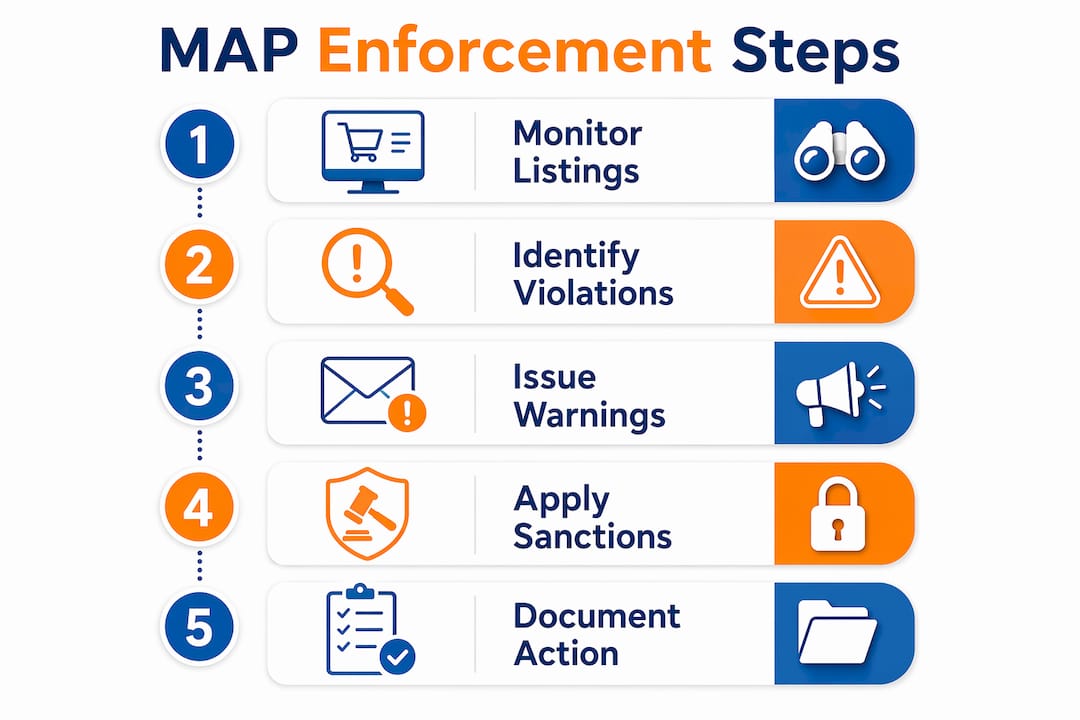
Typical enforcement sequence:
Advertised violations typically trigger commercial sanctions, not lawsuits. No criminal liability, no civil damages in most cases. The real risk is losing access to brand catalogs and support programs — which, for a dealer whose business depends on a specific brand’s parts, is a serious operational threat.
Pro Tip: Screenshot every listing the moment you correct it. Timestamped documentation of the fix is your best defense if a brand disputes whether you acted promptly.
The goal is to offer competitive prices without putting them on a public listing. Several standard tactics accomplish this:
What to avoid:
Operationally, best-practice compliance means SKU-level MAP flags in your storefront, a regular monitoring cadence, and a written internal policy documenting your compliance process. Check the Golfcartstuff dealer pricing strategy guide for channel-specific tactics built around the golf cart parts market.
Marketplace listings are public by definition, which makes them high-risk for MAP violations. A price change on Amazon reflects instantly in brand monitoring feeds.
Common marketplace approaches for MAP-compliant dealers:
For buyers: the price on a marketplace listing may be higher than what you actually pay at checkout. Ask the seller directly about final price and, more importantly, confirm warranty coverage. Unauthorized third-party sellers are not bound by MAP in the same way authorized dealers are, and buying from them can void manufacturer warranties on parts.
Pro Tip: On Amazon specifically, “Sold by [Authorized Dealer]” in the listing details is a meaningful signal. It tells you the seller has a direct brand relationship and is accountable for MAP compliance.
A solid MAP policy covers these elements:
For manufacturers: keep the policy strictly unilateral, apply it uniformly to all dealers, and never negotiate a price floor directly with any reseller. Uniform enforcement is what preserves Colgate protection.
Pro Tip: Review your vendor’s MAP policy annually. Brands update covered SKUs and channel definitions, and an outdated internal checklist is a common source of accidental violations.
Act fast. The cure window is usually short, and prompt response is the clearest signal of good faith.
Branded, proprietary, and performance-oriented parts are the most common MAP candidates. In the golf cart parts channel, that includes:
Generic or commodity parts (unbranded hardware, standard fasteners, basic cables) rarely carry MAP policies because there is no brand equity to protect.
The golf cart parts market is smaller and more relationship-driven than the broader automotive aftermarket, and that changes how MAP works in practice.
In mainstream automotive aftermarket (think brake pads or oil filters), brands deal with thousands of SKUs across massive distribution networks. Enforcement is largely automated and impersonal. In the golf cart channel, the dealer network is tighter. Brands know their authorized dealers personally, which means violations get noticed faster and consequences feel more immediate. A relationship that took years to build can be damaged by a single week of below-MAP advertising.
Golf cart parts also see sharper seasonal demand swings. Seasonal peaks in spring and summer can push demand significantly, which means MAP windows and promotional timing matter more here than in year-round automotive categories. Brands in this channel are more likely to offer structured amnesty periods around off-season clearance rather than allowing open-ended discounting.
If you are buying parts for your EZGO, Club Car, or Yamaha, MAP shapes your experience in a few concrete ways.
Prices on product pages and marketplace listings reflect MAP floors, not necessarily the lowest price available. Adding items to your cart, calling the dealer, or asking about bundle pricing can unlock lower actual prices without the dealer violating any policy. That “add to cart to see price” button is not a gimmick; it is a MAP compliance mechanism working in your favor.
MAP also protects you indirectly. Dealers who maintain authorized status under MAP policies are accountable to the brand for warranty support, genuine parts, and installation quality. A seller advertising suspiciously low prices on a marketplace may be unauthorized, which can mean gray-market parts and no warranty coverage. For buying and modifying a golf cart, sticking with authorized dealers is the cleaner path.
MAP limits what dealers can advertise publicly, not what they can charge at checkout — and understanding that distinction protects both your supply relationships and your margins.
| Point | Details |
|---|---|
| MAP vs. sale price | MAP restricts public advertising; dealers can often sell below MAP at checkout without violating policy. |
| Legal basis | Unilateral MAP policies are lawful under the Colgate doctrine (1919); negotiated price agreements cross into RPM territory. |
| Enforcement reality | Violations trigger commercial consequences (supply loss, delisting), not criminal penalties. |
| Dealer compliance | Use add-to-cart pricing, bundle structures, and SKU-level MAP flags to stay compliant while staying competitive. |
| Golfcartstuff resources | Golfcartstuff’s dealer pricing guide and wholesale tier explainer offer channel-specific MAP and margin guidance for golf cart parts dealers. |
Most MAP confusion I see comes from dealers treating MAP as either a legal threat or a meaningless formality. Neither framing serves you well.
It is not a legal threat. A MAP violation notice is a commercial warning from a business partner, not a lawsuit. Responding promptly, correcting the listing, and documenting the fix is almost always enough to preserve the relationship. The dealers who lose authorized status are usually the ones who ignore notices or argue about them instead of fixing the problem.
But it is also not meaningless. The brands that enforce MAP consistently are usually the ones worth carrying. Uniform enforcement means your competitors cannot undercut your advertised price on the same branded lift kit or battery system. That protection is worth something, especially in a market where a single aggressive repricing algorithm can wipe out margin on an entire product category overnight.
The deeper issue is that MAP is a signal about the brand’s commitment to its dealer network. A brand that enforces MAP uniformly is a brand that wants its authorized dealers to succeed. That is the relationship worth protecting.
Dealers and owners sourcing parts for Club Car, EZGO, and Yamaha carts can browse Golfcartstuff’s full catalog of genuine and aftermarket components, from lift kits and LED lighting to batteries, wheels, and custom accessories.
Golfcartstuff stocks the branded parts most likely to carry MAP policies, which means you get the real product with the warranty coverage that matters to your customers. Whether you are stocking a service bay or building out a custom cart, the catalog covers the SKUs your buyers are searching for. Dealers can also reference the dealer pricing strategy guide for margin and compliance guidance specific to the golf cart parts channel.
Browse golf cart accessories or go straight to Club Car DS parts to find what you need.
Explore our store to see what our products and resources can do for you.

Leave a comment