
Your Cart Is Our Priority
Explore our store to see what our products and resources can do for you.

Many golf cart owners think upgrading their cart is just about swapping batteries or adding a bigger motor. The truth is, your controller is the brain behind every bit of performance your cart delivers. Without understanding how controllers manage power flow, speed, and acceleration, you’re missing the foundation of any meaningful upgrade. This guide breaks down controller types, lithium battery compatibility, and customization options so you can make informed decisions that actually improve your ride.
| Point | Details |
|---|---|
| Controllers regulate electrical flow | They optimize performance and efficiency by managing current to the motor |
| Lithium battery upgrades are often compatible | Match voltage and current limits to avoid controller damage |
| Controller types offer different features | Series, Regen, and AC controllers provide varying levels of control and programmability |
| Upgrading improves speed and efficiency | Controller customization enhances acceleration, battery use, and overall performance |
Your golf cart controller acts as the brain controlling electrical current flow to the motor. It determines how fast you accelerate, how smoothly you brake, and how efficiently your battery power gets used. Instead of wasting energy through resistors like older systems, modern golf cart controllers manage power using Pulse Width Modulation, which rapidly switches current on and off to regulate voltage. This method dramatically improves efficiency and extends battery life.
PWM works by chopping the electrical signal into pulses. When you press the accelerator pedal, the controller increases the pulse width, delivering more power to the motor. Release the pedal, and the pulse width narrows, reducing power. This precise control gives you smooth acceleration and responsive braking without the heat and energy waste of resistor-based systems.
Controllers also manage critical safety features. They monitor motor temperature, prevent over-current situations, and coordinate braking systems. Different motor types require compatible controllers because a golf cart motor designed for DC series operation won’t work properly with an AC controller, and vice versa.
Here’s what your controller manages:
Pro Tip: If your cart feels sluggish or accelerates unevenly, the controller might be failing. Check for error codes or unusual heat buildup on the controller housing before assuming you need a motor replacement.
Understanding controller function helps you diagnose problems faster. A cart that suddenly loses power might have a controller thermal cutoff protecting the system, not a dead battery. Similarly, jerky acceleration often points to controller issues rather than motor problems. Knowing these distinctions saves you time and money on repairs.
Golf cart controllers fall into three main categories, each offering distinct advantages for different performance needs and budgets. Series controllers represent the traditional technology, while Regen and AC controllers bring modern features and efficiency gains.
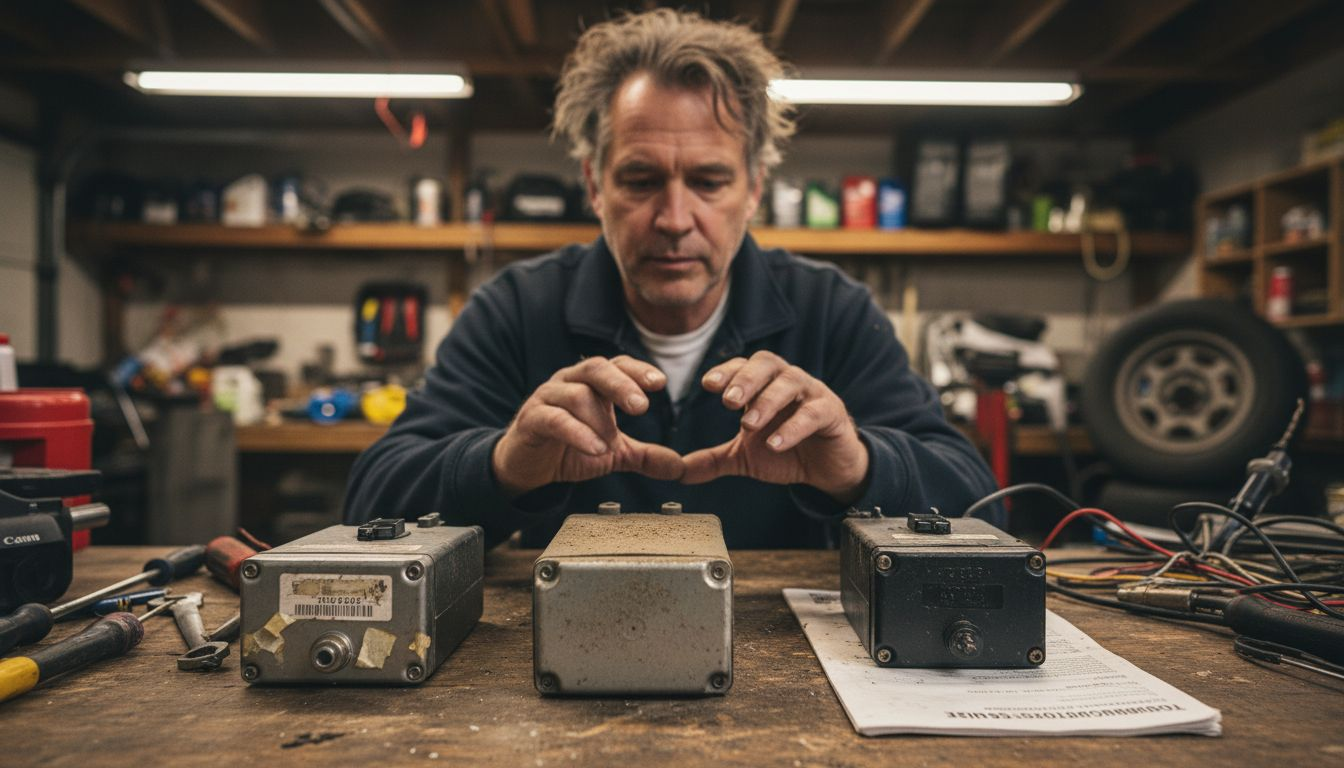
Series controllers are the simplest design. They manage both field and armature windings in the motor, controlling speed through basic voltage regulation. These controllers work well for standard golf carts used on flat terrain at moderate speeds. They’re affordable, reliable, and easy to replace, making them popular for basic transportation needs.
Regen controllers add regenerative braking capability. When you release the accelerator or press the brake, these controllers convert the motor into a generator, feeding energy back into the batteries. This feature extends range and reduces brake wear. Regen controllers typically include speed sensors and additional safety features like automatic rollback prevention on hills.
AC controllers represent the latest technology, offering programmability, superior efficiency, and precise torque control. They use vector control algorithms to manage motor speed and power delivery with exceptional accuracy. AC systems run cooler, require less maintenance, and provide smooth, quiet operation. The tradeoff is higher upfront cost and more complex installation.
Here’s how to identify your controller type:
Choosing the right controller affects everything from hill climbing ability to battery efficiency. Series controllers work fine for flat courses and light use. Regen controllers make sense if you frequently drive hilly terrain or want extended range. AC controllers suit owners who demand maximum performance, programmability, and the smoothest possible ride.
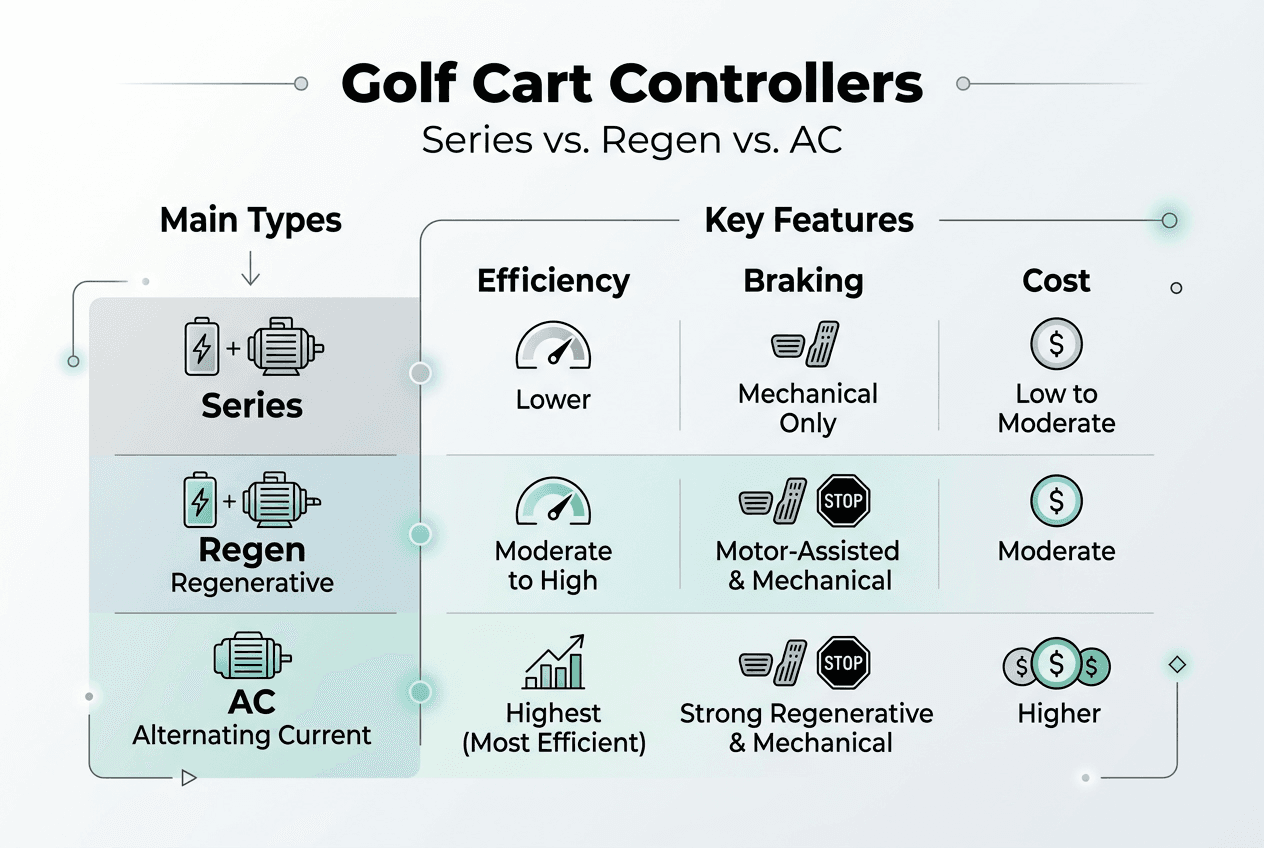
| Controller Type | Efficiency | Programmability | Cost | Best For |
|---|---|---|---|---|
| Series | Moderate | None | Low | Basic transportation, flat terrain |
| Regen | High | Limited | Medium | Hilly terrain, range extension |
| AC | Highest | Extensive | High | Performance, customization, efficiency |
Pro Tip: If you’re unsure which controller you have, count the large terminals. Series controllers typically have four or five main terminals, while AC controllers have three motor phase connections plus battery terminals.
Controller selection impacts your cart’s personality. A Series controller delivers straightforward, predictable performance. Regen adds sophistication with energy recovery. AC transforms your cart into a highly refined machine with customization options that let you dial in exactly the driving experience you want.
Upgrading to lithium batteries doesn’t automatically require a new controller, but you must respect voltage and current specifications to avoid expensive damage. The good news is that matching system voltage and current limits typically allows your stock controller to work perfectly with lithium technology.
Voltage matching is non-negotiable. A 48-volt controller needs a 48-volt lithium pack. Installing a 36-volt pack in a 48-volt system causes weak performance and potential controller confusion. The controller expects a certain voltage range and won’t function properly outside those parameters. Similarly, current limits matter because lithium batteries can deliver massive current that might overwhelm an undersized controller.
Lithium batteries provide a nearly flat voltage output throughout their discharge cycle. Unlike lead-acid batteries that experience voltage sag as they deplete, lithium maintains consistent power delivery. Your cart runs at full speed longer, and acceleration stays crisp even when the battery drops to 30% capacity. This stable voltage profile actually reduces stress on your controller.
The lifespan advantage of lithium is substantial. LiFePO4 batteries deliver 2,000 to 5,000 charge cycles compared to 500 to 1,000 for lead-acid. This longevity means fewer replacements and lower total ownership costs, even though lithium batteries cost more upfront. Your controller benefits too, experiencing fewer voltage fluctuations over the battery’s extended life.
Common upgrade mistakes to avoid:
Pro Tip: Before upgrading to lithium, verify your controller’s maximum current rating. High-performance lithium packs can deliver 200+ amps, which might exceed your controller’s safe operating range and trigger thermal shutdowns.
Upgrade benefits extend beyond just battery life. Lithium’s lighter weight improves handling and reduces tire wear. The consistent voltage delivery means your controller operates in its optimal range more often, potentially extending controller lifespan. You’ll notice improved acceleration, especially on hills, because lithium doesn’t sag under load like lead-acid batteries.
Wiring upgrades often accompany lithium conversions. Lithium batteries can push more current through existing cables, and undersized wires create resistance, heat, and voltage drops. Upgrading to proper gauge cables ensures your controller receives clean power and operates efficiently. This investment protects your controller and maximizes the performance gains from your battery upgrade.
Charger compatibility deserves attention. Lead-acid chargers use different charging profiles than lithium batteries require. Using the wrong charger can damage your lithium pack or create safety hazards. Most lithium upgrades include a compatible charger, but verify this before completing your purchase. Your controller doesn’t directly interact with the charger, but proper charging maintains the battery health that keeps your controller happy.
Understanding your battery setup helps you make informed decisions. A 36-volt system uses six 6-volt batteries or three 12-volt batteries in series. A 48-volt system typically uses six 8-volt or four 12-volt batteries. When converting to lithium, you’ll use fewer cells because lithium chemistry operates at different voltages, but the total pack voltage must match your controller’s requirements.
Advanced controllers like the Curtis 1205M-5601 transform your golf cart from basic transportation into a customizable performance machine. These controllers don’t just manage power; they let you program acceleration curves, speed limits, and regenerative braking to match your exact preferences and terrain.
Curtis controllers enhance performance through precision power management and seamless technology integration. The 1205M-5601 model fits EZGO and Club Car DS models from 1996 forward, offering plug-and-play compatibility with many popular carts. The aluminum construction resists corrosion and impact damage, ensuring reliable operation in harsh conditions.
Programmability sets advanced controllers apart. You can adjust how aggressively your cart accelerates from a stop, set maximum speed limits for different drivers or uses, and fine-tune regenerative braking strength. A cart used for hauling supplies might benefit from gentle acceleration to prevent load shifting, while a performance cart could use aggressive acceleration curves for maximum fun.
Customization options include:
Pro Tip: Start with conservative programming settings and gradually increase performance parameters. Aggressive acceleration settings can stress drivetrain components, while excessive top speed might exceed your tire or suspension capabilities.
Different terrains demand different controller setups. Hilly courses benefit from stronger regenerative braking and higher current limits for climbing. Flat, paved paths allow higher top speeds and gentler acceleration. Beach use requires careful current management to prevent overheating in soft sand. Advanced controllers let you create multiple profiles and switch between them based on conditions.
| Feature | Stock Controller | Curtis 1205M-5601 | Benefit |
|---|---|---|---|
| Acceleration Control | Fixed | Programmable | Customized power delivery |
| Speed Limiting | Basic | Multi-level | Safety and efficiency |
| Regen Braking | None/Basic | Adjustable | Extended range |
| Thermal Protection | Standard | Advanced | Prevents damage |
| Compatibility | Model-specific | Wide range | Easier upgrades |
Driver preference plays a huge role in controller programming. Some owners want maximum performance and don’t mind aggressive acceleration. Others prefer smooth, comfortable operation that won’t jostle passengers. Advanced controllers accommodate both preferences through simple programming changes, letting multiple family members enjoy the cart their way.
Efficiency gains from proper controller tuning can be significant. Optimized acceleration curves reduce current spikes that waste energy. Appropriate regenerative braking captures energy that would otherwise turn into brake heat. Speed limiting prevents unnecessary high-speed operation where aerodynamic drag kills efficiency. These adjustments can extend your range by 10% to 20% without sacrificing usability.
Safety features in advanced controllers include automatic rollback prevention, thermal shutdown protection, and fault code diagnostics. If something goes wrong, the controller stores error codes that help technicians diagnose problems quickly. This diagnostic capability reduces troubleshooting time and prevents misdiagnosis that leads to replacing good components.
Combining an advanced controller with quality accessories and upgrades creates a complete performance package. Better tires improve traction to use the controller’s power effectively. Upgraded suspension handles the improved acceleration without bottoming out. A lift kit provides ground clearance for the higher speeds your programmed controller enables. Each component works together to deliver a superior driving experience.
Understanding controller technology is just the first step toward optimizing your golf cart’s performance. Whether you’re planning a lithium battery upgrade, considering an advanced programmable controller, or simply want to refresh worn components, having access to quality parts makes all the difference. From aluminum wheels and tires that complement your controller’s improved performance to complete upgrade packages that transform your ride, you’ll find everything needed to bring your vision to life.
Explore trusted golf cart parts and accessories that match the controller technologies discussed in this guide. Whether you’re upgrading a vintage cart or fine-tuning a modern machine, quality components ensure your investment delivers the performance, reliability, and enjoyment you expect from your golf cart.
Series controllers regulate speed through traditional voltage control without energy recovery features. They’re simple, reliable, and affordable for basic golf cart applications. Regen controllers add regenerative braking that converts motion into electrical energy, feeding power back to the batteries. They typically include speed sensors and enhanced safety features like automatic rollback prevention, making them ideal for hilly terrain and extended range needs.
Yes, your stock controller typically works with lithium batteries if you match voltage and current limits correctly. A 48-volt controller needs a 48-volt lithium pack, and the battery’s maximum discharge current must stay within your controller’s rating. Mismatched setups cause poor performance, controller overheating, or complete failure. Always verify specifications before purchasing lithium batteries, and consider why upgrading batteries makes sense for your specific cart and usage patterns.
Programming enables precise tuning of acceleration curves, top speed limits, and regenerative braking intensity to match your preferences and terrain. You can create gentle acceleration for passenger comfort or aggressive power delivery for performance use. Adjustable parameters let you optimize efficiency, extend range, and customize the driving experience. Different profiles suit different conditions, like softer settings for beach sand versus aggressive tuning for paved roads.
Sluggish acceleration, inconsistent speed control, and controller overheating suggest it’s time for an upgrade. If your cart struggles on hills it used to climb easily, or if you’ve upgraded to lithium batteries and want to unlock their full potential, a new controller makes sense. Incompatibility with modern battery technology, lack of programmability, or simply wanting better performance are all valid reasons. Upgrading often improves reliability, efficiency, and overall driving enjoyment beyond what repairs to an old controller can achieve.
Explore our store to see what our products and resources can do for you.

Leave a comment