
Your Cart Is Our Priority
Explore our store to see what our products and resources can do for you.

Every time you steer your golf cart across a meticulously groomed fairway or a rugged trail, a smooth and safe ride depends on more than just the cart itself—it hinges on proper tire balancing. Uneven wheels create vibrations that raise safety risks and shorten component life, especially at higher speeds. By grasping how weight distribution affects ride comfort and stability, American golf cart owners can prevent costly repairs and enjoy more reliable performance mile after mile.
| Point | Details |
|---|---|
| Tire Balancing is Essential | Proper tire balancing improves ride comfort, safety, and prevents premature tire wear. |
| Professional Maintenance Recommended | Have golf cart tires professionally balanced every 5,000 miles or annually for optimal performance. |
| Different Tire Types Have Unique Balancing Needs | Select appropriate tires and balancing techniques based on the terrain to minimize damage and maximize efficiency. |
| Signs of Unbalanced Tires Should Not Be Ignored | Look for vibrations, uneven wear, and noise; these can lead to costly repairs if left unaddressed. |
Understanding tire balancing is critical for golf cart owners seeking smooth rides and optimal performance. Tire balance describes the distribution of mass within a wheel assembly, which directly impacts driving comfort and safety. When wheel mass is unevenly distributed, periodic forces and vibrations can emerge, causing potentially dangerous steering oscillations.
Tire balancing involves two primary techniques:
The goal of tire balancing is straightforward: create a uniformly weighted wheel that rotates smoothly at various speeds. Wheel balancing machines detect unbalanced mass and indicate exactly where counterweights should be placed to minimize vibrations.
Golf cart owners should understand that tire balancing differs from wheel alignment. While alignment focuses on tire angles and suspension geometry, balancing addresses weight distribution. Unbalanced tires can cause:
Pro tip: Have your golf cart tires professionally balanced every 5,000 miles or annually to maintain optimal performance and prevent unnecessary wear.
Golf cart tires are not one-size-fits-all, with different designs tailored to specific terrains and usage requirements. Airless tires represent an emerging technology for golf carts, offering unique performance characteristics that impact balance and ride quality.
Three primary tire types dominate the golf cart market:
Terrain considerations play a critical role in tire selection. Golf course management guidelines highlight the importance of tire selection for minimizing turf damage while maintaining cart performance. Each tire type requires specific balancing techniques to ensure optimal performance and safety.
Balancing needs vary significantly across tire types. Turf tires demand precise weight distribution to prevent ground compaction, while street tires require meticulous balancing to reduce vibrations during high-speed operation. All-terrain tires present the most complex balancing challenge due to their varied tread designs and potential uneven wear patterns.
This table summarizes the differences between golf cart tire types and their specific balancing considerations:
| Tire Type | Main Terrain | Balancing Focus | Typical Challenge |
|---|---|---|---|
| Street | Paved surfaces | Reduce vibration | High-speed precision needed |
| Turf | Grass/turf | Prevent ground compaction | Gentle weight distribution |
| All-terrain | Mixed/rough | Handle uneven wear | Complex tread balancing |
Pro tip: Rotate your golf cart tires every 1,000-1,500 miles and have them professionally balanced to extend tire life and maintain smooth performance.
Tire balance significantly impacts vehicle dynamics, creating a direct relationship between wheel equilibrium and overall driving experience. Unbalanced tires generate periodic forces that translate into noticeable vibrations, compromising both comfort and safety for golf cart operators.
The primary effects of unbalanced tires include:
Vibration transmission becomes particularly pronounced at higher speeds. Vehicle dynamics research demonstrates that imbalanced tires create lateral and vertical oscillations that compromise driver control and comfort. These microscopic movements might seem insignificant, but they accumulate substantial stress on your golf cart’s mechanical systems.
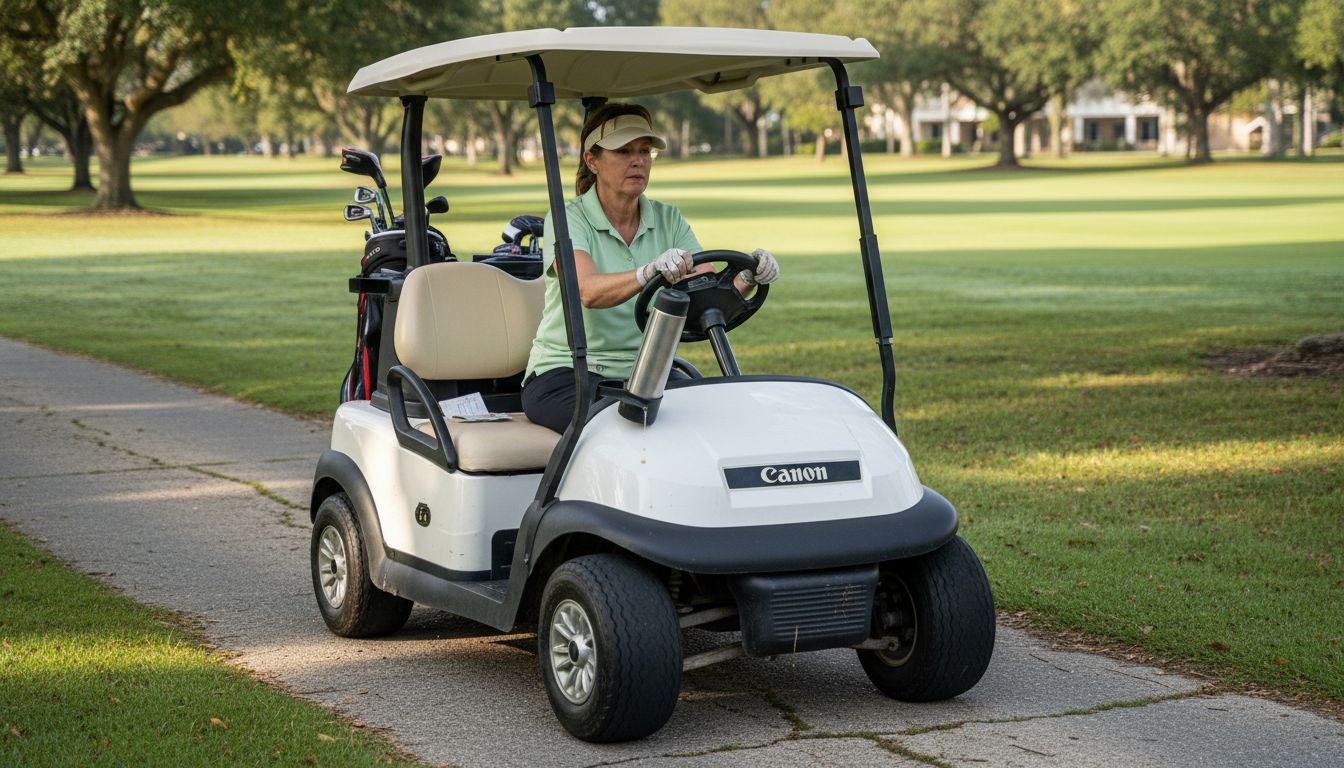
Technical implications extend beyond immediate ride quality. Persistent tire imbalance can lead to long-term mechanical complications, including accelerated wear on wheel bearings, shock absorbers, and steering components. The cumulative effect transforms what initially appears to be a minor alignment issue into a potential expensive maintenance concern.
Here is a quick reference table highlighting impacts of properly balanced vs. unbalanced golf cart tires:
| Status | Ride Quality | Component Lifespan | Safety Impact |
|---|---|---|---|
| Balanced tires | Smooth operation | Extended durability | Reduced accident risk |
| Unbalanced tires | Noticeable shakes | Accelerated wear | Increased hazard risk |
Pro tip: Invest in professional tire balancing at least twice annually or every 3,000-5,000 miles to maintain optimal golf cart performance and prevent costly mechanical wear.
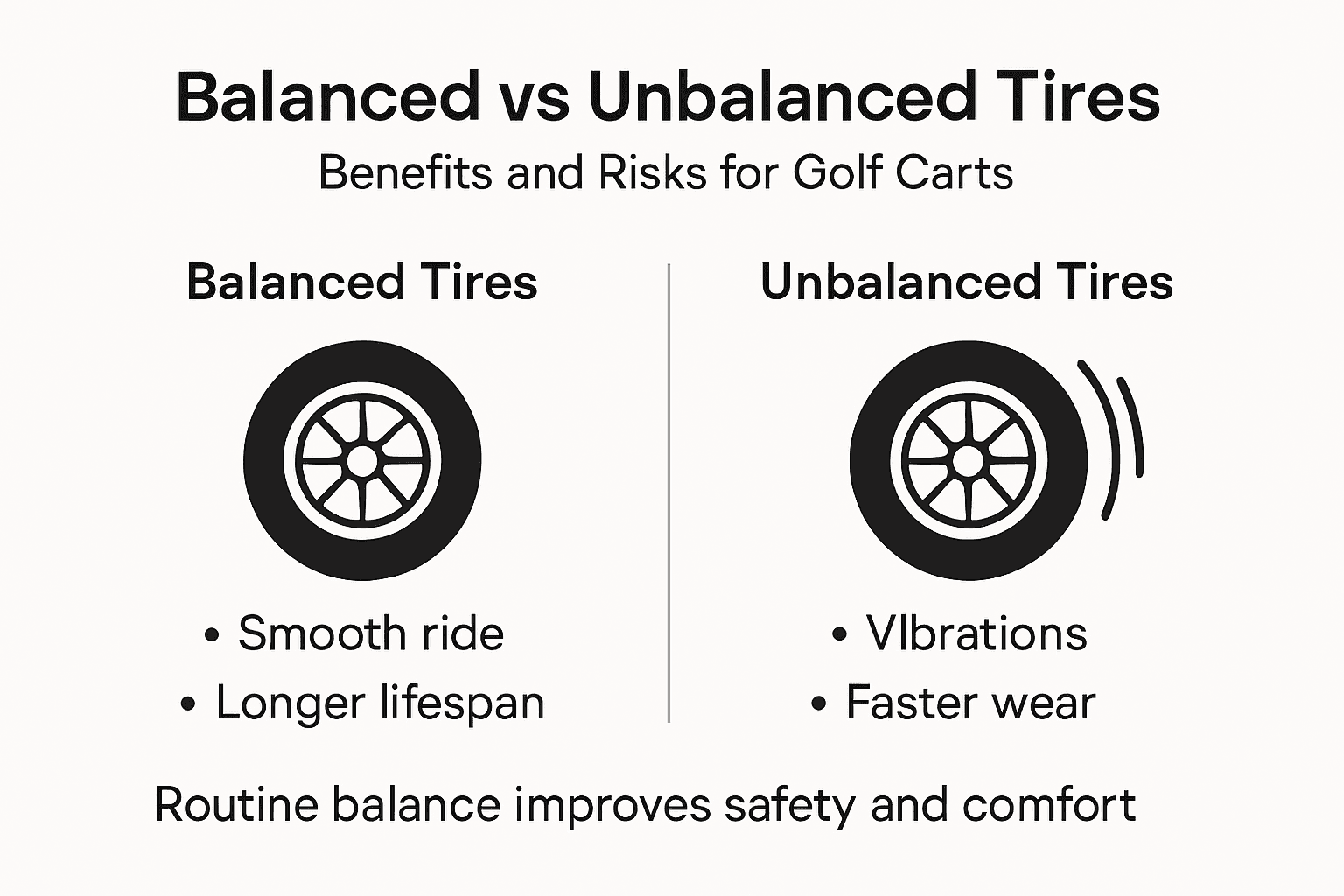
Unbalanced tires present multiple warning signs that golf cart owners should recognize to prevent potential safety hazards and costly repairs. Early detection can mean the difference between routine maintenance and extensive mechanical damage.
Critical signs of tire imbalance include:
Economic implications extend far beyond simple maintenance. Societal costs of vehicle-related accidents can reach astronomical levels, with unbalanced tires contributing significantly to potential mechanical failures and safety risks. The financial impact encompasses not just repair costs, but potential medical expenses, productivity loss, and vehicle damage.
The long-term consequences of neglecting tire balance can be substantial. Persistent imbalance accelerates wear on suspension components, wheel bearings, and drivetrain systems. What might seem like a minor vibration can translate into hundreds or even thousands of dollars in preventable repairs over your golf cart’s lifetime.
Pro tip: Schedule a professional tire balance inspection every 5,000 miles or annually, whichever comes first, to catch potential issues before they become expensive problems.
Tire balancing techniques involve precise scientific approaches to ensure smooth wheel rotation and optimal performance. Golf cart owners have two primary methods for addressing potential wheel imbalances: static and dynamic balancing techniques that target different mechanical aspects of wheel equilibrium.
Two primary balancing methods include:
Technical precision is crucial in tire balancing. Wheel balancing machines utilize advanced sensor technologies including accelerometers and ultrasonic sensors to detect microscopic vibration patterns. These sophisticated instruments can pinpoint exact locations where counterweights should be strategically placed to minimize wheel rotation irregularities.
Professional technicians approach tire balancing as a systematic process, measuring and correcting imbalances with millimeter-level precision. The goal is to align the tire’s principal moment of inertia with its rotation axis, ensuring smooth wheel performance and extending the lifespan of both tires and suspension components.
Pro tip: Invest in professional balancing services that use digital balancing machines, which provide more accurate measurements than traditional manual techniques.
Understanding how unbalanced golf cart tires cause vibrations and premature wear highlights the importance of regular maintenance for your ride. If you want to avoid steering wheel shakes, protect suspension components, and enjoy a longer-lasting tire life, it is essential to address tire balance correctly. Terms like static balancing and dynamic balancing are more than jargon—they are key factors in ensuring your golf cart offers safety and reliable performance every time you hit the course.

Explore our wide selection of high-quality golf cart parts and accessories designed to optimize your tire maintenance routine at Golf Cart Stuff. Whether you need balancing weights, replacement tires tailored for street, turf, or all-terrain use, or professional advice on how to extend your cart’s lifespan, we have everything you need in one place. Don’t let uneven tire wear or unexpected handling issues slow you down. Visit our landing page now and take the first step toward a smoother, safer ride. Make your golf cart maintenance smarter today by shopping at Golf Cart Stuff.
Balancing golf cart tires evenly distributes mass in the wheel assembly, which prevents vibrations that can lead to steering issues, premature tire wear, and ultimately enhances safety during operation.
It is recommended to have your golf cart tires professionally balanced every 5,000 miles or at least once a year to maintain optimal performance and minimize wear on components.
Common signs of unbalanced tires include noticeable steering wheel vibrations, uneven tire wear patterns, increased road noise, and reduced handling responsiveness during driving.
Golf cart tires can be categorized into street tires, turf tires, and all-terrain tires, each requiring specific balancing techniques due to their unique designs and intended terrains. Street tires focus on vibration reduction, turf tires on preventing ground compaction, and all-terrain tires handle varied tread patterns for balance.
Explore our store to see what our products and resources can do for you.

Leave a comment