
Your Cart Is Our Priority
Explore our store to see what our products and resources can do for you.

TL;DR:
- LED golf cart lights significantly improve energy efficiency, safety, and durability compared to halogen bulbs. They deliver brighter illumination, longer lifespan, and customizable styles, making them a worthwhile upgrade for night driving and aesthetic enhancement. Despite higher upfront costs, their lower maintenance and energy savings offer substantial long-term value.
LED golf cart lights are defined as solid-state lighting systems that replace traditional halogen or incandescent bulbs with light-emitting diodes, delivering superior brightness, energy efficiency, and durability in a compact form. The benefits of LED golf cart lights go far beyond aesthetics. Owners who switch report longer battery range, dramatically reduced maintenance, and measurably safer nighttime driving. Whether you run a Club Car DS, a Yamaha G-series, or a custom off-road build, LED lighting for golf carts is one of the highest-return upgrades you can make. This article breaks down exactly why, with real numbers and practical guidance.
The single most compelling reason to switch is power consumption. A standard halogen headlight setup draws roughly 110 watts. A comparable LED setup draws about 6 watts, making the energy difference between the two technologies staggering. That gap matters enormously on an electric golf cart where every watt-hour counts.
Here is what that looks like in practice:
This efficiency advantage compounds when you add accessories. Running LED underglow strips, interior lighting, and a light bar simultaneously still draws far less power than a single halogen headlight. Owners who have upgraded to lithium battery packs get the most out of this pairing, since lithium’s flat discharge curve keeps voltage stable across the full range of LED accessories.
Pro Tip: If you plan to add underglow or accent lighting, do the LED headlight upgrade first. The power savings from the headlights alone will offset the draw from your new accessories, keeping your total electrical load well within safe limits.
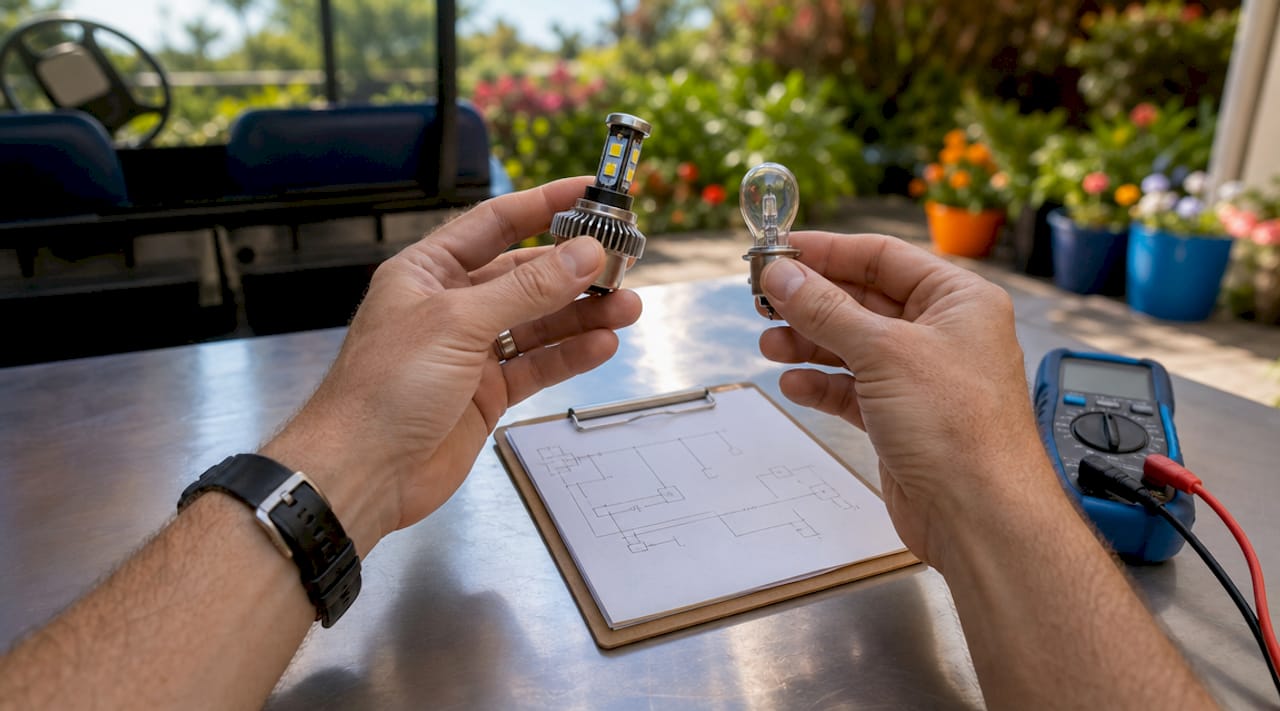
Brightness is measured in lumens, and the gap between LED and halogen is significant. LED headlights produce 1,000 to 2,500+ lumens, compared to 700 to 1,200 lumens for halogen. That extra output is not just a number on a spec sheet. It directly affects your ability to see and react to obstacles at night.
Research on driver response thresholds shows that recognizing a dark-clad pedestrian or object requires approximately 15 to 20 lux of illumination at the object’s surface. Halogen setups on golf carts frequently fall short of that threshold at distances beyond 30 feet. Quality LED systems reach it consistently at greater distances, giving you more reaction time.
Color temperature also matters. Most quality LED golf cart headlights operate at around 6000K, producing a bright white light that renders road surfaces and obstacles with high contrast. Halogen outputs a warmer yellow-orange tone that reduces contrast in low-light conditions.
Beam pattern control is equally critical. Compliant LED headlights meet FMVSS 108 and UNECE R112 standards for photometric performance, meaning they deliver a precise cut-off line that illuminates the road without blinding oncoming drivers or pedestrians. Not every cheap LED kit on the market meets these standards, so sourcing from reputable suppliers matters.
Pro Tip: Choose a kit that integrates headlights, taillights, and turn signals as a matched system. Integrated LED systems with instant-on response times communicate your braking and turning intent far more effectively than incandescent setups, which have a measurable lag before reaching full brightness.
A well-designed LED golf cart lighting system balances lumen output, glare control, and durability to avoid causing excessive glare while maximizing driver visibility and safety.
Halogen bulbs on golf carts typically last 1,000 to 2,000 hours before burning out. LED lights last 30,000 to 50,000 hours under comparable conditions. That is not a minor improvement. It is a fundamental change in how often you ever think about your lighting at all.
| Feature | Halogen | LED |
|---|---|---|
| Lifespan | 1,000 to 2,000 hours | 30,000 to 50,000 hours |
| Filament | Yes (fragile) | No (solid-state) |
| Heat output | High | Low |
| Vibration resistance | Poor | Excellent |
| Replacement frequency | Frequent | Rare |
The reason LEDs outlast halogens goes beyond just the absence of a filament. LEDs operate cooler and resist vibration because they use epoxy lenses instead of fragile glass, and they have no moving or heat-stressed components. Golf carts regularly travel over rough terrain, cart paths with bumps, and uneven ground. That vibration kills halogen filaments. LEDs handle it without issue.
Thermal management is the one factor that separates a quality LED from a cheap one. Good LED systems use copper heat conduction and robust heat sinks to keep junction temperatures low. Poor thermal design shortens LED life significantly, sometimes down to halogen-level hours. This is why high-quality thermal management is the most important spec to evaluate when choosing a kit.
Pro Tip: Look for OEM-grade or quality aftermarket LED kits that specify their thermal management design. A kit with a proper aluminum heat sink and copper thermal path will outlast a cheaper unit by years, even if both are labeled “LED.”
Safety on a golf cart at night depends on two things: seeing clearly and being seen clearly. LED lighting for golf carts addresses both. The brightness advantage covered above handles the first. The second comes from how LEDs behave as signal lights.
Instant-on LED brake lights reach full brightness in microseconds. Incandescent bulbs take 200 to 300 milliseconds to warm up to full output. At 15 mph, that delay translates to several feet of additional stopping distance for anyone following you. LED brake lights close that gap and give trailing drivers more time to react.
Glare management is the flip side of brightness. SAE research confirms that improperly aimed or non-compliant LED headlights can cause more discomfort to oncoming drivers than halogens. The solution is choosing kits with proper beam pattern optics and ensuring correct vertical aim during installation. A well-aimed LED headlight is safer for everyone. A poorly aimed one creates new hazards.
You can review the regulatory requirements for LED headlight installation to understand what compliance looks like in practice before you buy.
LED technology enables lighting designs that are simply impossible with halogen. The solid-state nature of LEDs allows for compact form factors, multi-color output, and dynamic effects that transform a golf cart’s appearance.
Popular LED customization options for golf carts include:
The practical benefits of these options extend beyond looks. Underglow improves ground-level visibility around the cart at night, helping passengers step on and off safely. Interior lighting makes it easier to find items in the cart after dark. Light bars add genuine forward illumination for off-road or trail use where standard headlights fall short.
Pro Tip: Build your LED lighting system in stages. Start with headlights and taillights for the safety and efficiency gains, then add underglow or accent lighting as a second phase. This approach spreads the cost and lets you evaluate power draw at each stage before adding more.
LED kits cost more upfront than halogen replacements. A quality LED headlight and taillight kit for a Club Car or Yamaha typically runs higher than a basic halogen set. That initial price difference is real, and it is worth acknowledging directly.
What changes the math is total cost of ownership. A 5-year TCO analysis of LED versus halogen consistently shows LED kits delivering net savings through reduced replacement frequency and lower energy draw. Halogen bulbs that burn out every season add up fast in both parts cost and labor time.
Consider the full picture:
Upfront costs for LED kits are higher than halogen, but longer lifespan and lower energy use result in lower total cost of ownership over time.
The upgrade makes the most financial sense for owners who drive at night regularly, cover significant daily distances, or plan to keep their cart for several years. Occasional daytime-only users will see smaller returns, though the durability and safety benefits still apply.
LED golf cart lights outperform halogen on every practical metric: power consumption, brightness, lifespan, safety, and long-term cost, making them the clear choice for any owner who drives after dark.
| Point | Details |
|---|---|
| Energy efficiency | LED headlights draw ~6W versus ~110W for halogen, preserving battery range. |
| Superior brightness | LEDs deliver 1,000 to 2,500+ lumens versus 700 to 1,200 for halogen, improving night visibility. |
| Lifespan advantage | LED lights last 30,000 to 50,000 hours, far exceeding halogen’s 1,000 to 2,000 hours. |
| Safety features | Instant-on LED brake lights and compliant beam patterns reduce accident risk. |
| Long-term value | Higher upfront cost is offset by fewer replacements and lower energy draw over time. |
I have seen a lot of golf cart owners treat LED lighting as a cosmetic upgrade, something you do when you want the cart to look cool at a neighborhood event. That framing undersells what is actually happening when you make the switch.
The visibility improvement at night is not subtle. The first time you drive a cart with a quality 2,000-lumen LED setup on a dark cart path, the difference from halogen is immediately obvious. You see further, you see more clearly, and you feel more confident making decisions at speed. That confidence is not just comfort. It is a genuine safety margin.
What I have also noticed is that owners who buy cheap LED kits and have a poor experience often conclude that “LED is overhyped.” The real issue is thermal management and beam quality, not the technology itself. A kit without proper heat sinking will dim and fail within a year. A kit with poor optics will blind oncoming carts and create glare complaints. Choosing quality matters more with LEDs than it ever did with halogens, because the performance ceiling is higher and so is the floor when you get it wrong.
My advice: read the specs, look for kits that reference their thermal design, and buy from suppliers who stand behind their products. The best LED kits for golf carts are the ones that treat lighting as a safety system, not just an accessory.
— Roshan
Golfcartstuff carries a full selection of LED headlight kits, taillight assemblies, underglow systems, and complete street-legal light kits compatible with Club Car, Yamaha, EZ-GO, and other major golf cart models. Every kit in the catalog is selected for quality, compatibility, and real-world performance.
Whether you are building a street-legal setup for neighborhood driving or adding off-road lighting for trail use, Golfcartstuff has the parts to get it done right. Browse the full range of golf cart accessories to find LED lighting solutions that match your cart model, your budget, and your driving needs. Shipping is fast, and the catalog covers parts for virtually every cart on the market.
LED golf cart headlights draw approximately 6 watts compared to roughly 110 watts for halogen setups. Over 4 hours of use, LEDs consume just 8 to 40 watt-hours, which is less than 0.5% of a typical golf cart battery’s capacity.
Yes. LED headlights produce 1,000 to 2,500+ lumens versus 700 to 1,200 lumens for halogen, and they output a cooler 6000K white light that improves contrast and object recognition at night.
Quality LED lights last 30,000 to 50,000 hours under normal conditions, compared to 1,000 to 2,000 hours for halogen bulbs. Real-world lifespan depends heavily on thermal management quality in the LED driver and heat sink design.
Yes. Compliant LED headlights meet FMVSS 108 and UNECE R112 standards for beam pattern, glare control, and luminous intensity. Non-compliant kits can cause excessive glare for oncoming drivers and may not be legal for street use.
For owners who drive at night regularly or cover significant daily distances, the answer is yes. A 5-year total cost of ownership analysis shows LED kits deliver net savings through reduced replacements and lower energy consumption, even after accounting for the higher initial price.
Explore our store to see what our products and resources can do for you.

Leave a comment