TL;DR:
- Treat every golf cart as a motor vehicle and perform a pre-ride safety check before each use.
- Regular maintenance, proper upgrades, and adherence to speed and age guidelines are essential to ensure safe operation.
Treat every golf cart like a motor vehicle. That single mindset shift is the foundation of every golf cart safety tip worth following. Before you move the cart an inch, run through a quick pre-ride check, confirm your passenger count, and make sure no one under six is riding without a proper restraint. Texas Department of Insurance guidance recommends keeping speeds low — never exceed 15 mph — and suggests drivers be at least 16 with a valid driver’s license. If the cart has a mechanical problem, take it out of service immediately.
Core rules before every ride:
- Seat everyone in a designated seat with a belt fastened where one is available
- Never exceed the cart’s rated passenger capacity
- Keep all limbs inside the cart while moving
- No alcohol, drugs, or impairment of any kind behind the wheel
- No texting, eating, or other distractions while driving
- Keep speeds low; slow further in parking lots, resorts, or mixed-traffic zones.
- Children under approximately six years old should not ride; pediatric safety experts note standard car seats are not crash-tested for golf cart use
- If any mechanical issue is found, remove the cart from service before anyone boards
Table of Contents
2. Run this pre-ride safety checklist before every use
A visual once-over is not enough. Electrical faults and low tire pressure are invisible to the naked eye, which is why a proper pre-ride inspection requires a few basic tools alongside your eyes.
Tools to keep on hand:
- Digital tire pressure gauge
- Multimeter (for battery voltage)
- Battery terminal brush
- Flashlight
- Basic wrench set
Step-by-step checklist:
-
Tires: Check tread depth visually and measure PSI with a pressure gauge. Most golf cart tires run between 15–25 PSI; check the sidewall for the manufacturer’s spec.
-
Brakes: Press the pedal firmly. It should feel solid with minimal travel. Spongy or low pedal feel means inspect the brake system before use.
-
Steering: Turn the wheel lock to lock. More than a couple inches of free play before the wheels respond warrants a closer look at the tie rods and steering box.
-
Lights and signals: Cycle through headlights, taillights, and any turn signals. Replace any burned-out bulbs before operating in low-light conditions.
-
Battery terminals: Look for corrosion (white or blue-green buildup). Clean with a terminal brush if present, then check that connections are tight.
-
Battery charge state: Use a multimeter set to DC voltage. A fully charged 48V pack reads around 50–52V at rest; a 36V pack reads around 38–39V. Anything significantly lower means charge before use.
-
Seat and seatbelt: Check that the seat is locked into its mount and that any belt hardware latches cleanly without fraying.
-
Suspension and body: Walk around the cart. Look for cracked body panels, bent A-arms, or visible damage to leaf springs.
Pro Tip: Set your multimeter to DC voltage, connect the red lead to the positive battery terminal and black to negative, and read the pack voltage before and after a short drive. A sharp voltage drop under light load often signals a weak cell before it fails completely.
For deeper electrical procedures, the golf cart wiring troubleshooting guide walks through common fault patterns step by step.
3. Safe operation: thresholds and behaviors every driver must know
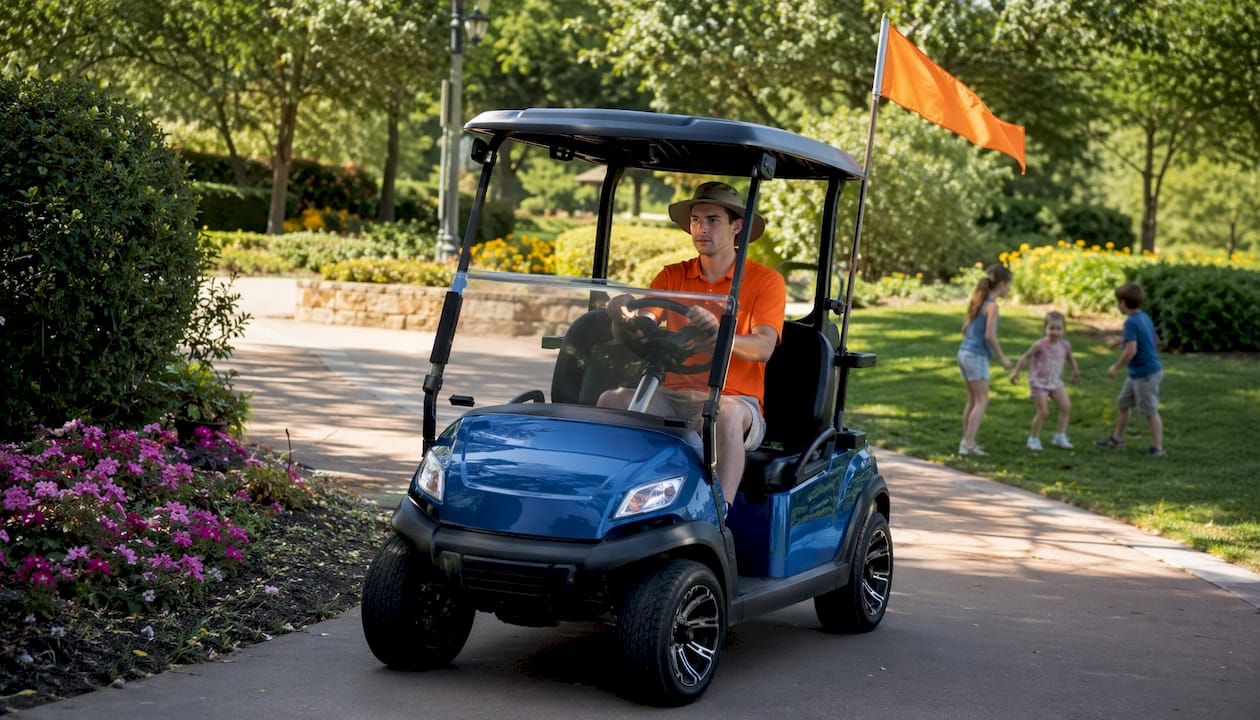
Safe golf cart driving depends on obeying hard limits and building consistent habits. Church Mutual’s safety guidance makes the point plainly: because golf carts lack advanced safety systems, the driver’s behavior is the primary safety system. There is no ABS, no stability control, and no crumple zone.
| Rule |
Threshold / Guidance |
| Maximum speed |
Never exceed 15 mph; keep speeds comparable to a well-paced walk and reduce further in pedestrian areas |
| Minimum driver age |
Drivers should be adults with a valid license |
| Minimum passenger age |
Children should be old enough to use appropriate restraints |
| Passenger limit |
Seated occupants only; no standing riders |
| Alcohol / drugs |
Zero tolerance |
Behavioral rules for mixed-traffic areas:
- Signal every turn, even when no other vehicles are visible
- Reduce speed before entering parking lots, crosswalks, or resort pathways
- Never assume pedestrians or other drivers can hear or see the cart
- Check blind spots before reversing; mirrors help but do not replace a physical look
- Avoid sharp turns at speed, especially on inclines or uneven terrain
New driver orientation checklist:
- Walk the driver through all controls before the first move
- Practice braking from low speed in an open area
- Demonstrate turn radius and the cart’s tendency to tip on sharp turns
- Confirm the driver knows the passenger limit and the no-DUI rule
- One supervised lap in a low-traffic area before solo operation
4. Maintenance schedule and safety equipment worth prioritizing
Consistent maintenance is what keeps a pre-ride checklist from turning into a repair bill. The cadence below applies to both owners and dealers managing a fleet.
Maintenance timeline:
-
Every use (pre-ride): Tires, brakes, lights, battery terminals, steering feel, seat/belt condition
-
Weekly: Battery charge state with a multimeter; tire PSI check
-
Monthly: Clean battery terminals; inspect brake pads for wear; check all lights
-
Annually (or after heavy use): Professional brake service; suspension bushing inspection; leaf spring and A-arm check. Rubber bushings harden during cold storage and can fail silently when the cart returns to service in spring.
Any item that fails inspection removes the cart from service until repaired. No exceptions.
Safety equipment and upgrades to prioritize:
-
Seat belts: Install only where factory or aftermarket mounting points exist. Improper mounting creates new hazards.
-
LED headlights and taillights: Brighter output, lower draw on the battery pack, longer service life.
-
Mirrors: Side mirrors add meaningful blind-spot coverage with minimal installation effort.
-
Slow-moving vehicle (SMV) emblem: Required in many states for street-legal operation; high-visibility triangle mounts to the rear.
-
Horn or audible alert: Useful in pedestrian-heavy areas where the cart’s quiet operation is a hazard.
-
Battery meter or charge monitor: Gives the driver a real-time state-of-charge reading and prevents deep discharge damage.
Dealer parts inventory to keep stocked:
- OEM brake pads (by make/model)
- Battery terminal kits and anti-corrosion spray
- Replacement tires and inner tubes
- Battery meters
- Multimeters
For motors, controllers, and brake components, OEM parts are the right call. Generic parts can cause premature failure in integrated electronic systems, particularly on modern EZGO, Club Car, and Yamaha controllers.
5. What to do after a breakdown, collision, or safety incident
Medical aid comes first. Property comes second. That order never changes.
Incident response steps:
- Stop the cart and secure it (parking brake, key out)
- Check every passenger for injuries before touching the cart
- Call emergency services if anyone is hurt or if the cart is blocking a hazard
- Move the cart only if it is safe and doing so removes a danger
- Photograph the scene, damage, and any relevant road or path conditions
- Exchange contact information with any other parties involved
- Complete an internal incident report before the end of the day
Dealer documentation checklist:
- Record the cart’s last inspection date and outcome
- Note any parts recently replaced and the part numbers used
- Collect names and brief statements from witnesses
- Attach photos to the cart’s service record
Repair vs. remove from service:
-
Require professional repair before return to service: Brake failure, bent steering components, battery fire risk, frame damage
-
Acceptable field repair or part swap: Burned-out bulb, flat tire with no rim damage, corroded terminal with no cable damage
When in doubt, keep it out of service. A cart that fails under a passenger is far more expensive than a repair delay. The golf cart troubleshooting guide covers common failure diagnostics in detail.
6. How to choose safety upgrades and parts for your specific model
Fix failures first. That is the only rule that matters when budgeting for upgrades. Brakes, steering, and lighting address real safety gaps. Cosmetic or performance upgrades come after those are solid.
Decision criteria:
-
Compatibility: Always verify the part fits your exact make, model, and year. EZGO, Club Car, and Yamaha use different specs even across similar model years.
-
OEM vs. aftermarket: Use OEM for motors, controllers, and brakes. Aftermarket is acceptable for lighting, mirrors, and accessories where fit tolerances are less critical.
-
Cost vs. safety impact: LED lights and an SMV emblem deliver high visibility gains at low cost. Seat belts require proper mounting points but are worth the investment where those exist.
-
Installation complexity: Some upgrades (brake pads, terminals) are straightforward DIY. Steering components and controller work benefit from a professional install.
-
Warranty implications: Confirm that aftermarket parts do not void any remaining manufacturer warranty on the cart.
Dealer buying workflow:
- Diagnose the failure or identify the upgrade need
- Confirm the OEM part number or compatible aftermarket spec for the specific make/model/year
- Order with a fast-shipping option to minimize cart downtime
- Test the repair or upgrade before returning the cart to service
Pro Tip: When ordering for a fleet, pull the make/model/year for every unit before placing a single order. One wrong part number on a brake kit means a cart stays grounded. The golf cart upgrade checklist is a useful reference for prioritizing mods by safety impact.
Key Takeaways
Treat the golf cart as a motor vehicle, run a pre-ride inspection every time, and fix any mechanical failure before the cart carries another passenger.
| Point |
Details |
| Pre-ride inspection every use |
Check tires, brakes, lights, battery terminals, and steering before every ride. |
| Speed and age thresholds |
Texas Department of Insurance guidance advises never exceeding 15 mph, recommends drivers be at least 16 with a valid license, and suggests young children should not ride without proper restraints. |
| Maintenance cadence |
Weekly battery and tire checks; monthly brake and terminal inspection; annual suspension service. |
| Prioritize safety upgrades |
Fix brakes and steering first; then add LED lights, mirrors, seat belts, and an SMV emblem. |
| Golfcartstuff for parts |
OEM-compatible parts for EZGO, Club Car, and Yamaha, including batteries, lights, tires, and seat belts. |
The maintenance-first case for golf cart safety
Most golf cart incidents trace back to deferred maintenance, not bad luck. A cart with worn brake pads, a low battery pack, or cracked suspension bushings is not a safe vehicle regardless of how carefully the driver behaves. The pre-ride checklist and the maintenance schedule in this article are not bureaucratic overhead. They are the actual safety system on a vehicle that has no airbags, no stability control, and no crumple zones.
Dealers carry a particular responsibility here. A cart that leaves a lot with a known mechanical issue is a liability, not a sale. Stocking OEM brake pads, terminal kits, and battery meters is not just good inventory practice. It is the difference between a cart that passes inspection and one that fails in the field.
The upgrade priority order matters too. Owners often want to add lift kits or custom wheels before they have confirmed the brakes are in spec. Visibility and restraint upgrades, LED lighting, mirrors, and seat belts where mounting points exist, return more safety value per dollar than almost any performance modification. Get those right first.
Where to find OEM-compatible safety parts for your cart
Golfcartstuff stocks the parts that matter most for keeping EZGO, Club Car, and Yamaha carts safe and road-ready. From golf cart batteries and battery meters to LED lighting, mirrors, seat belts, and tire kits, the catalog is organized by make and model so you can confirm compatibility before you order.
Dealers and owners ordering replacement parts should always have the cart’s make, model, and year on hand before placing an order. One wrong part number on a brake kit or controller means downtime. Browse Club Car DS parts or Yamaha golf cart parts by model to match exactly what your cart needs, and check out the golf cart accessories collection for visibility and restraint upgrades. Every order ships with the compatibility details you need to get it right the first time.
Authoritative U.S. sources and further reading
External references:
-
Texas Department of Insurance: Operating thresholds, speed limits, driver age guidance, and passenger rules for golf cart use
-
Nationwide Children’s Hospital: Child passenger safety, age recommendations, and restraint limitations
-
Church Mutual: Defensive driving, visibility, and signaling guidance for mixed-traffic environments
Golfcartstuff how-to resources:
- Pre-ride inspection guide: Step-by-step inspection procedures for owners and dealers
-
Electrical system basics: Battery care, voltage checks, and component overview
-
Maintenance checklist: Full service schedule with frequencies and task descriptions
Recommended



Leave a comment