



Your Cart Is Our Priority
Explore our store to see what our products and resources can do for you.

Five areas eat most of a golf-cart dealer’s margin: inventory sitting too long, procurement costs hidden in shipping and paperwork, shop hours that go unbilled, blind spots from disconnected systems, and marketing dollars spent without tracking results. Fix them in this order for the fastest payoff.
Priority order:
The first two items can show measurable results within one to three weeks. The others take longer to compound but pay off bigger over a full quarter.
Cutting dealership costs works best when you fix billable-hours tracking and inventory turnover first, then layer in procurement and DMS reporting.
| Point | Details |
|---|---|
| Start with billable hours | Track billed versus paid hours weekly; a low ratio signals real leakage. |
| Fix inventory before procurement | Run ABC analysis and bundle aging stock before renegotiating supplier terms. |
| Calculate true landed cost | Add freight, duties, brokerage, and fees to unit cost, not just the invoice price. |
| Centralize data in one DMS | Weekly reports on turnover, labor, and promotion ROI replace guesswork with decisions. |
| Time-box the rollout | Use a 30-60-90 day plan with daily, weekly, and monthly KPIs, not an open-ended overhaul. |
Some of the best cost-saving tips for dealers cost nothing to implement. They just require enforcement.
None of these stick without a habit behind them.
Pro Tip: Post the billable-hours ratio on a whiteboard in the shop, updated weekly. Techs who see their own number tend to close the gap faster than any memo ever will.
Watch one metric closely during this phase: billed hours as a percentage of paid hours. A low ratio indicates leakage worth chasing.
Carrying too much of the wrong parts is the single biggest silent cost for most golf-cart dealers. Cash sits on a shelf instead of in the bank, and slow-moving SKUs quietly depreciate.
Four numbers matter more than any others:
Once you have those numbers, the fixes are mechanical:
Forecasting with historical sales data and seasonality cuts both overstock and stockouts, which is the real goal, not just moving boxes for the sake of it.
One bundle that works well: pair a slow-moving windshield with a fast-moving light kit at a combined price that protects blended margin even though the windshield alone might need a discount to move. A complete inventory checklist makes this audit repeatable every quarter instead of a one-time scramble.
Pro Tip: Never discount a slow SKU in isolation. Bundle it with something that already sells, and set a floor margin for the bundle before your team starts pricing it.
Most dealers price parts off the invoice total and never see what actually inflated the cost to get there. Landed cost is bigger than freight, and it’s where a lot of margin quietly disappears.
Components that typically get missed:
Before committing to an order, run this checklist:
Consolidating multiple supplier shipments into one container eliminates duplicated documentation and drayage fees that stack up fast when orders ship separately. Aligning factory completion windows before the consolidation deadline avoids the delays that come from one supplier running late while everyone else waits. Standardize packaging specs across vendors, and score suppliers on a simple scorecard: quality, lead-time reliability, and paperwork completeness.
The billable-hours ratio, billed hours divided by paid hours, is the single number that tells you whether your shop is actually profitable or just busy. Tracking job time from check-in to completion exposes non-billable drift that’s invisible on a casual walk-through.
Three moves fix most of it:
Weekly audit checklist:
Small gaps compound weekly if nobody’s watching them.
Marketing spend that isn’t tracked at the campaign or SKU level is a cost, not an investment. Calculate whether a promotion is margin-accretive with one quick check: incremental margin generated minus discount cost and ad spend. If that number is negative, kill the promotion.
High-margin upsell categories for golf-cart dealers include:
A service advisor script that works: “While it’s on the lift, want us to check the suspension bushings? Most carts this age need them, and we can do it same visit.” Bundling accessories with installation at point of service consistently beats standalone parts sales when staff are trained to offer it, not just ring it up if asked.
Pro Tip: Track every promotion by channel. A discount that performs well on a local Facebook post might lose money the moment it runs on a broader paid campaign with a lower close rate.
A Dealer Management System is the difference between guessing and knowing. Integrating sales, parts, and service data in one system gives you visibility that spreadsheets can’t match, because the data updates itself instead of waiting for someone to enter it after the fact.
Look for these features specifically:
Pull these reports weekly, not monthly:
Predictable weekly reporting on parts turnover and billed hours is what separates dealers who catch a margin problem in week two from ones who find it in the annual review, three months after it started costing them money.
Cost-cutting ideas for auto sales operations fail when they’re not time-boxed. Here’s a sequence that works for most dealer operations:
Days 1-30: Roll out job timers, spot price audits, and the billable-hours whiteboard. Start the ABC inventory analysis.
Days 31-60: Consolidate supplier orders, set automated reorder points, and launch the first bundle promotion on aging stock.
Days 61-90: Roll out DMS reporting cadence, cross-train technicians, and formalize the procurement scorecard.
KPIs to watch by cadence:
Loop in the general manager, the parts buyer, and the head technician from day one, and document weekly numbers in a shared sheet so nobody’s relying on memory come month three.
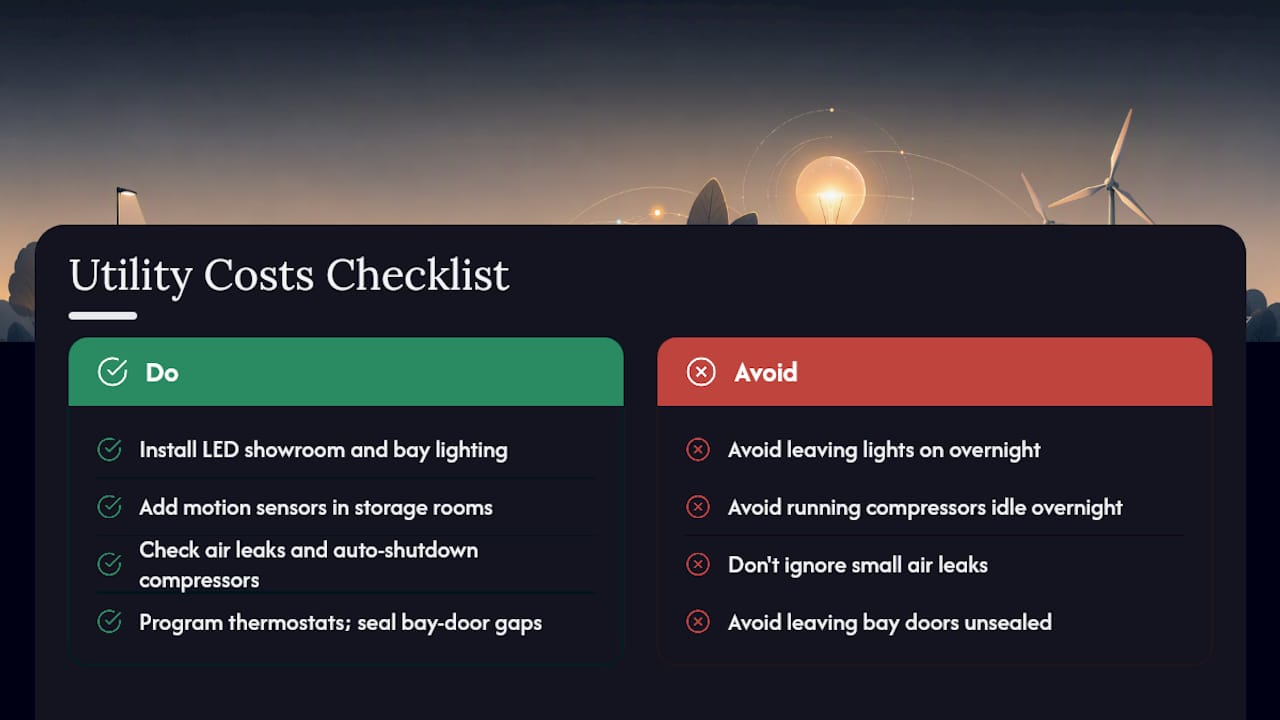
Utility bills creep up quietly in a shop full of lifts, compressors, and lighting that runs longer than it needs to. LED retrofits in showroom and bay lighting typically pay for themselves within a year through reduced electricity draw and far less bulb replacement labor. Motion-sensor lighting in storage and back rooms cuts waste from lights left on overnight.
Compressed air is the most overlooked expense in most repair shops. A single quarter-inch leak in a shop air line can waste a meaningful chunk of compressor output every month, so a monthly leak-check with soap water on fittings pays for itself fast. Set compressors to shut off automatically after hours instead of running idle overnight.
Water use matters more for shops that pressure-wash carts before delivery or detailing. A simple flow restrictor or a rinse-recovery bucket for pre-clean rinsing cuts water bills without changing the wash quality customers see.
HVAC scheduling matters just as much as equipment choice. A programmable thermostat that drops heating and cooling during closed hours, paired with sealing gaps around bay doors, reduces the biggest line item on most utility bills: climate control in a building that’s often half-empty overnight. None of this requires new equipment purchases in most cases, just a walk-through with a checklist and a willingness to fix small leaks before they become a $400-a-month problem.
A tech who doesn’t know the torque spec on a lift-kit bolt costs you twice: once in comeback labor, once in a customer who doesn’t trust the shop again. Structured onboarding that walks new hires through your specific parts catalog and common repair procedures reduces error rates far more than “shadow the senior tech for a week.”
Short, recurring training sessions work better than annual seminars. A 20-minute Friday morning walkthrough on one recurring issue (torque specs, wiring harness routing, battery terminal corrosion) keeps the whole team sharp without pulling anyone off the floor for a full day.
Incentive structures should reward accuracy, not just speed. A tech who blows through jobs fast but generates comebacks is more expensive than one who’s slightly slower and gets it right the first time. Consider a small bonus pool tied to comeback rate staying under a set threshold, split among the team monthly. On the sales side, tie a portion of commission to attach-rate on accessories and installs rather than gross unit count alone, since pairing accessory sales with installation is where the real margin lives, not in the base cart price.
Cross-training pays for itself the first time your best specialist calls in sick during a busy Saturday and the shop doesn’t stall.
A lift that fails mid-repair doesn’t just cost a repair bill. It costs the bay’s entire day, plus every job scheduled behind it. Preventative maintenance on shop equipment, not just the carts you’re servicing, is one of the more overlooked ways to reduce dealership costs.
Build a simple maintenance calendar for the equipment that keeps the shop running:
The same logic that applies to keeping customer carts running longer applies to your own shop tools. Reactive repairs on shop equipment run higher than scheduled maintenance because they almost always happen at the worst possible time, mid-job, with a customer waiting. Track equipment downtime hours monthly. If a piece of equipment is down more than once a quarter, it’s likely cheaper to replace than keep patching.
Batteries, tires, and packaging materials pile up fast in a golf-cart shop, and disposal fees for hazardous materials like lead-acid batteries add up quietly over a year. Most battery distributors offer core-return credit, so a shop that isn’t returning old batteries for credit is leaving money on the table with every swap.
Cardboard and plastic packaging from parts shipments is the next biggest waste stream. A baler for cardboard, even a small manual one, cuts hauling costs and can sometimes generate a small revenue stream through recycling brokers depending on local market rates. Sort scrap metal from lift kits, brackets, and hardware separately since scrap yards typically pay more for clean, sorted metal than mixed loads.
Used oil and coolant from cart maintenance need proper disposal tracking, both for cost control and for compliance with local waste regulations. Partnering with a local recycler for a scheduled pickup, instead of ad hoc drop-offs, usually costs less over a year and keeps your shop audit-ready if regulators ever ask for disposal records.
Cash flow problems on the dealer side often trace back to loose payment terms extended to customers without a clear policy. Offering in-house financing or working with a third-party lender for larger cart purchases can move inventory faster, but only if the terms are structured to protect your cash position, not just close the sale.
Shorter payment windows on service work reduce the receivables float that ties up working capital. A shop that invoices net-30 on all service work is effectively lending money to customers for a month at no interest. Moving standard service payment to due-at-pickup, with financing offered only for larger repair or upgrade jobs, tightens this considerably.
For cart sales, a down payment tied to a percentage of total price, rather than a flat fee, scales protection with deal size and reduces exposure on higher-ticket customizations like lift kits or body kits. Running a basic credit check before extending in-house financing on larger purchases catches risk before it becomes a write-off. None of this requires a finance department. It requires a written policy that staff actually follow instead of making exceptions deal by deal.
Most dealers chase the wrong fix first. They cut marketing spend or delay restocking when the real leak is sitting in the service bay, unbilled and untracked. The gap between billed and paid hours is usually where the first real dollars show up, and it’s the cheapest problem to fix because it doesn’t require new inventory systems or supplier renegotiations, just enforcement of what should already be tracked.
The dealers who improve fastest treat this as a measurement problem before it’s a cost problem. Start the 30-day checklist, put the billable-hours ratio somewhere visible, and resist the urge to fix five things simultaneously. GolfCartStuff’s dealer resources exist because the operational gap between “we know we’re losing money somewhere” and “here’s exactly where” is usually smaller than owners think, once someone actually measures it.
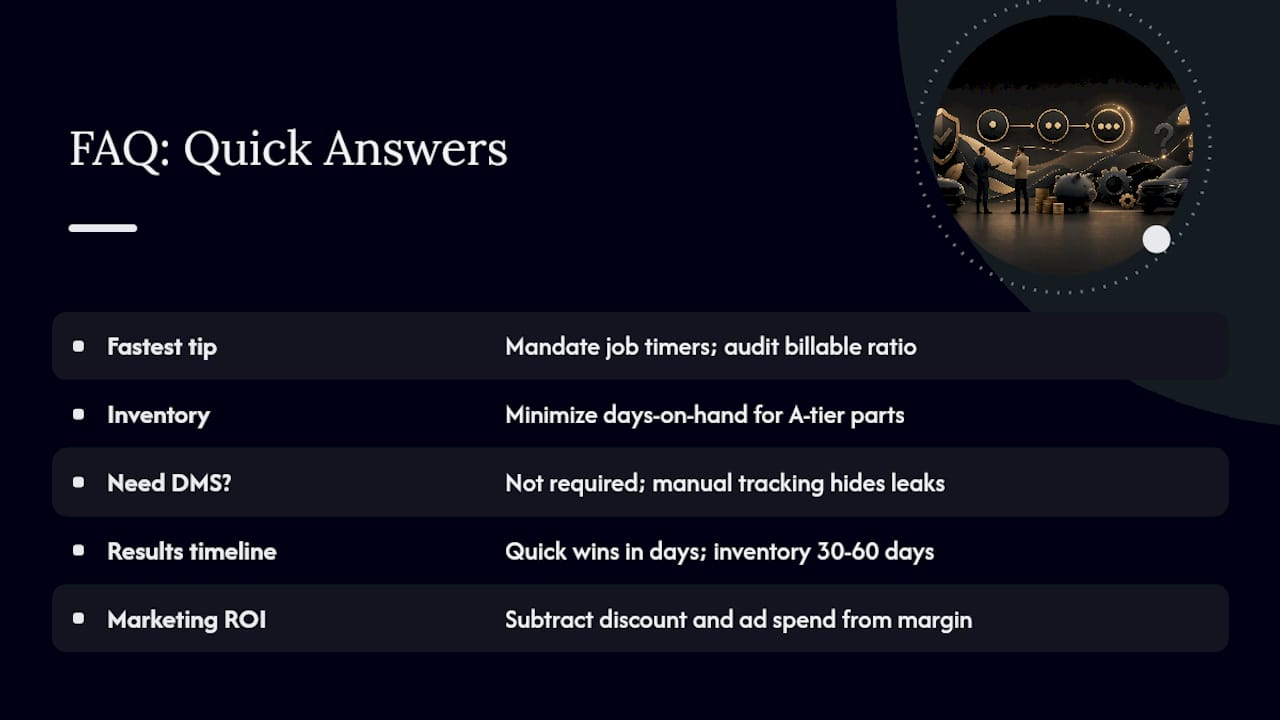
What’s the fastest cost-saving tip for a golf-cart dealer to implement? Mandating job timers and auditing the billable-hours ratio. Both can start the same day and typically show measurable change within one to two weeks.
How much inventory should a golf-cart dealer keep on hand? It depends on sell-through velocity, but the goal is minimizing days-on-hand for A-tier parts while keeping buffer stock only on high-demand seasonal items like batteries and tires.
Do golf-cart dealers really need a DMS to cut costs? Not strictly, but manually tracking sales, parts, and service separately makes it far harder to catch margin leaks before they compound over a quarter.
What’s a realistic timeline for seeing results from these cost-saving strategies? Quick wins like price audits and job timers show results in days. Inventory and procurement changes typically take 30 to 60 days to show up clearly in the numbers.
How do I know if my marketing spend is actually margin-accretive? Subtract discount cost and ad spend from the incremental margin a promotion generates. If the result is negative, the promotion is losing money even if sales volume looks good.
Ready to put these changes into action? Restock the parts your bundles and upsells depend on through Club Car DS parts or the full golf cart accessories catalog, and build your next promotion around inventory you already need to move.
Explore our store to see what our products and resources can do for you.

Leave a comment