
Your Cart Is Our Priority
Explore our store to see what our products and resources can do for you.

A full 48V battery replacement typically runs $700 to $1,700 installed for a flooded lead-acid set, or $1,800 to $4,500 for a LiFePO4 lithium pack, according to pricing data from Nick’s Golf Carts. If you want the lowest bill today, lead-acid wins. If you’re keeping the cart for the long haul and want to stop replacing batteries every few years, lithium usually pencils out better over time.
A few things swing the total fast:
The numbers above are before those extras. Keep reading for the breakdown by chemistry, voltage, and installation type.
Golf cart battery cost depends less on brand and more on chemistry, voltage, and how long you plan to keep the cart before the next replacement.
| Point | Details |
|---|---|
| Lead-acid costs less upfront | Installed totals run $500 to $1,850 for flooded lead-acid or $900 to $3,000 for AGM. |
| Lithium costs more but lasts longer | LiFePO4 packs run $1,800 to $4,500 installed but last 8 to 12 years versus 4 to 6 for lead-acid. |
| Charger compatibility adds cost | Converting to lithium often requires a new charger, adding $150 to $400 to the project. |
| Labor varies by job type | Simple swaps take 1 to 2 hours; lithium conversions take 2 to 6 hours depending on wiring needs. |
| Golfcartstuff supplies matched kits | Golfcartstuff sells battery kits and model-specific trays and wiring for EZGO, Club Car, and Yamaha carts. |
Golf cart battery cost breaks down cleanly once you know your voltage and chemistry. Most carts run either 36V or 48V systems, and the per-battery price scales with how many cells you need to hit that voltage.
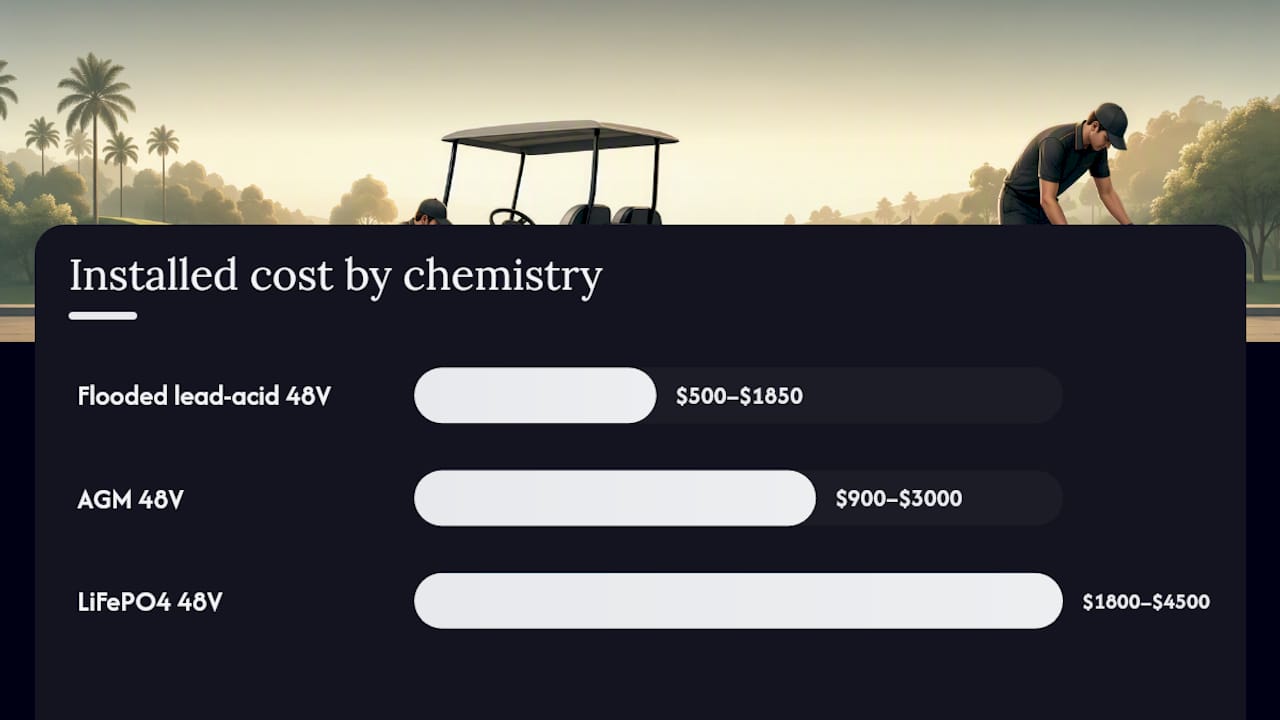
Flooded lead-acid batteries remain the cheapest entry point. A single 6V unit typically runs $140 to $260, while 8V units land around $190 to $350, based on Cost Insider’s battery price guide. A 48V system built from six 8V batteries can land anywhere from $500 to $1,850 installed, per Vatrerpower’s cost breakdown. AGM batteries sit a tier above flooded lead-acid, with installed totals more commonly falling between $900 and $3,000 for the same voltage, thanks to sealed construction and lower maintenance needs.
LiFePO4 lithium packs cost the most upfront. A 48V lithium pack alone can run $1,500 to $4,000 or more depending on amp-hour capacity, and installed totals climb to $1,800 to $4,500 once you factor labor and any charger work, according to Golf-Energy’s pricing guide.
Here’s how three real-world scenarios shake out:
Quick online quotes often leave out three line items that show up on the final invoice anyway: battery disposal or core fees (often $10 to $20 per battery), shipping on heavy lead-acid units (batteries are dense and freight isn’t free), and a charger swap if your existing unit doesn’t support the new chemistry. Ask for those three items by name before you agree to a number. For a deeper look at how voltage and battery count interact, the 36V vs 48V setup guide walks through configuration options in more detail.
A quote isn’t just “battery price times battery count.” Several variables stack on top of each other, and understanding them helps you catch a lowball quote or an inflated one before you sign off.
Chemistry sets the floor. Flooded lead-acid is cheapest per unit, AGM costs more for reduced maintenance, and LiFePO4 lithium commands the highest sticker price but changes the ownership math entirely (more on that below).
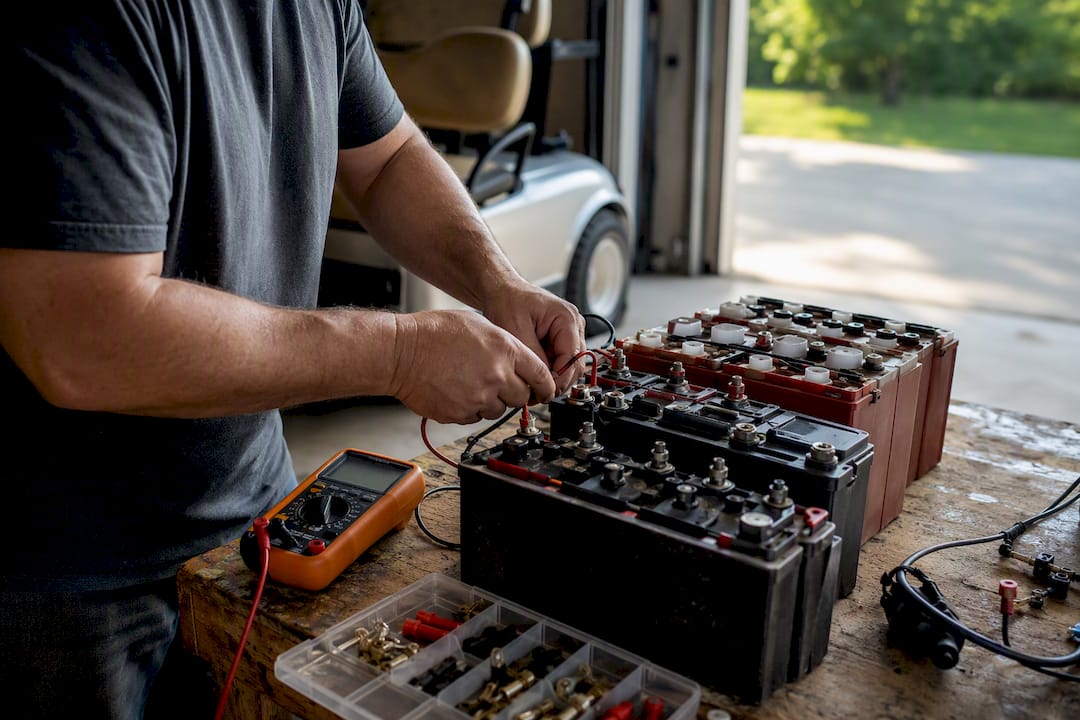
Amp-hour (Ah) capacity matters as much as voltage. Two 48V lithium packs can differ by $1,000 or more based purely on capacity, since higher Ah means longer range per charge and a bigger, more expensive battery bank.
Battery count multiplies everything. A 36V system needs six 6V batteries or three 12V batteries; a 48V system typically needs six 8V, four 12V, or eight 6V batteries depending on your cart’s design. Miscounting here is the single most common estimating mistake DIYers make.
Charger compatibility is the line item most people forget. A like-for-like lead-acid replacement rarely needs a new charger, but converting to lithium frequently does, according to Golf-Energy, adding $200 to $400 to the project.
Wiring and tray work adds another $200 to $500 when the new battery pack doesn’t physically match the old one’s dimensions or terminal layout.
Labor and disposal round out the invoice, and both vary by shop and region.
Pro Tip: Before calling a shop for a quote, take photos of your current battery bank, note the voltage stamped on your controller or existing batteries, and measure the battery tray dimensions. A shop can quote accurately in one call instead of three when you hand them that information upfront.
The upfront price gap between lead-acid and lithium is real, but it tells only half the story. Lifespan closes that gap faster than most owners expect.
Lithium packs also weigh less (often less than half the weight of an equivalent lead-acid bank), which improves range and acceleration, and they accept a full charge faster without the sulfation issues that shorten lead-acid life when a cart sits unused.
Run the ownership math over ten years and the picture shifts. A flooded lead-acid owner replacing batteries every 5 years pays for two full battery sets across a decade, roughly $1,000 to $3,700 total at typical pricing. A lithium owner buying one pack for $1,800 to $4,500 up front often never needs a second purchase in that same window. Ownership economics tend to favor lithium specifically when you plan to keep the cart for many years, since fewer replacements and near-zero maintenance narrow or erase the lifetime cost gap, as Cost Insider’s analysis notes.
If you’re trading carts every 2 to 3 years, lead-acid’s lower entry price is hard to beat. If you’re planning to keep the same cart for a decade, the full lead-acid versus lithium comparison breaks down the maintenance differences that factor into that decision too.
Labor is where a “simple” battery job can turn into a bigger invoice than expected, especially if you’re converting chemistries rather than swapping like for like.
What typically adds to the invoice beyond the base labor rate: charger replacement, new wiring runs, BMS (battery management system) setup and calibration on lithium conversions, disposal fees for old lead-acid cores, and a post-install test drive to confirm range and charge acceptance.
DIY makes sense for a like-for-like lead-acid or AGM swap if you’re comfortable with basic hand tools and know how to disconnect a battery bank safely (negative terminal first, always). A lithium conversion is a different animal. Mismatched wiring gauge, an incompatible charger, or a poorly configured BMS can damage an expensive pack fast, so this is one job where hiring a pro usually costs less than a mistake.
Converting an existing lead-acid cart to lithium isn’t just buying a pack and dropping it in. Three add-ons show up on almost every conversion invoice:
Stack those onto the pack price itself and you get three realistic totals: a low-end conversion around $2,000 (smaller Ah pack, minimal wiring work), an average conversion around $3,000 to $3,500 (mid-capacity pack, new charger, minor wiring), and a high-end conversion near $4,500 to $5,000 (large-capacity pack, full charger and BMS integration).
The breakeven point generally falls between 4 and 6 years of ownership, since that’s roughly when a lead-acid owner would be buying their second battery set. If you’re planning to keep the cart past that window, conversion costs tend to pay for themselves.
Getting the numbers right on a battery job starts with knowing your setup, and that’s easier with the right reference points on hand.
Before ordering anything, measure your system voltage, count your existing batteries, and photograph the tray and wiring. Bringing that information to a supplier or installer turns a vague estimate into an accurate one on the first try.
One more thing worth checking before you buy: warranty terms differ meaningfully between suppliers, and reading the fine print on coverage exclusions, as outlined in typical vendor warranty documentation, can save you a costly surprise if a battery underperforms in year two.
The conventional advice on this topic treats the upfront price gap as the whole decision. It isn’t. The real question is how many more years you plan to own the cart, and most buyers never run that math before choosing.
A lead-acid set costing $1,200 that needs replacing every 5 years costs more over a decade than a $3,000 lithium pack that lasts 10. Yet most shoppers default to the cheaper sticker price because it’s the number in front of them at checkout. That’s backwards for anyone keeping a cart long term.
What the data actually supports: budget replacements make sense for carts you’ll sell or trade within a few years, mid-range AGM upgrades suit owners who want less maintenance without the lithium premium, and full lithium conversions make sense once you’ve confirmed you’re past that 4 to 6 year breakeven window. Prioritize figuring out your ownership horizon before you compare a single price. Everything else, chemistry, capacity, charger, follows from that one decision.
Once you know your voltage, chemistry, and battery count, the harder part is finding parts that actually fit your model instead of guessing from a generic listing. Golfcartstuff stocks battery kits alongside model-specific trays, wiring, and mounting hardware for EZGO, Club Car, and Yamaha carts, so you’re not stuck adapting a universal part to fit a cart it wasn’t designed for.
Browse the lithium and lead-acid battery collection to compare kit specs side by side, or head straight to your model’s parts page, whether that’s Club Car DS parts, EZGO TXT parts, or Yamaha G1-G22 parts, to find tray and wiring components that match without modification. If you’re unsure whether your cart needs a charger swap for a lithium conversion, reach out before you order. Getting that answer up front beats returning a $2,000 pack because the charger wasn’t compatible.
How much does it cost to replace golf cart batteries? Most owners pay $700 to $1,700 installed for a 48V lead-acid set, or $1,800 to $4,500 for a LiFePO4 lithium pack, depending on capacity and labor.
Why are golf cart batteries so expensive? Cost reflects the number of cells needed to reach 36V or 48V, the raw materials in each battery, and labor for wiring and testing. Lithium costs more upfront because of the battery management system and higher-grade cells, but lasts two to three times longer.
How long do golf cart batteries last? Flooded lead-acid and AGM batteries typically last 4 to 6 years or 300 to 500 charge cycles. LiFePO4 lithium packs typically last 8 to 12 years or 2,000 to 3,500 cycles.
Can a dead golf cart battery be recharged? A fully discharged lead-acid battery can often be recharged if caught early, but repeated deep discharges shorten its lifespan significantly. A lithium battery’s BMS usually protects against damage from over-discharge, making it more forgiving of accidental drain.
Does location affect golf cart battery pricing? Yes.
Is it cheaper to buy golf cart batteries online or from a local dealer? Online retailers often beat local dealer pricing on the battery itself, especially for lithium packs, but local shops save you on freight for heavy lead-acid units and can handle installation same day. Comparing both for your specific voltage and chemistry before committing is worth the extra ten minutes.
How do I avoid counterfeit or low-quality batteries? Buy from retailers who list amp-hour capacity, cycle life, and warranty terms clearly, and be wary of prices dramatically below the ranges listed here. A legitimate LiFePO4 pack won’t sell for lead-acid pricing, and a listing that can’t specify cell brand or BMS details is a red flag.
Explore our store to see what our products and resources can do for you.

Leave a comment