
Your Cart Is Our Priority
Explore our store to see what our products and resources can do for you.

TL;DR:
- Golf cart reconditioning costs include parts, labor, and diagnostics, with battery expenses being the largest variable. Proper inspection and diagnosis before repairs prevent overspending and help determine if refurbishment is financially viable. Replacing batteries with lithium-ion offers long-term savings, especially for carts expected to last several years.
Golf cart reconditioning cost estimation is the process of calculating parts, labor, and upgrade expenses needed to restore your cart’s performance and resale value. Typical shop labor runs $60–$100 per hour, diagnostic fees land between $50 and $75, and battery replacements alone can range from $800 to over $2,500 depending on the technology you choose. Getting these numbers right before you commit to repairs prevents budget surprises and helps you decide whether a full refurbishment makes financial sense. This guide breaks down every major cost category so you can build a realistic budget from the start.
Reconditioning costs fall into three buckets: parts, labor, and diagnostics. Each category carries its own price range, and the totals shift significantly depending on whether you own an electric or gas cart.
Standard repairs like solenoid replacement, charger port work, and brake adjustments typically run $75–$300 installed. More involved work costs considerably more. A full parts breakdown looks like this:
Labor at $60–$100 per hour stacks on top of every parts cost. A brake job that takes two hours at $80 per hour adds $160 in labor alone. That math changes your total fast.
| Repair Type | Parts Cost | Estimated Labor | Total Range |
|---|---|---|---|
| Solenoid replacement | $35–$90 | $60–$120 | $95–$210 |
| Charger replacement | $100–$300 | $60–$120 | $160–$420 |
| Brake adjustment | $75–$150 | $60–$160 | $135–$310 |
| Controller replacement | $300–$700 | $120–$300 | $420–$1,000 |
| Motor replacement | $400–$900 | $160–$300 | $560–$1,200 |
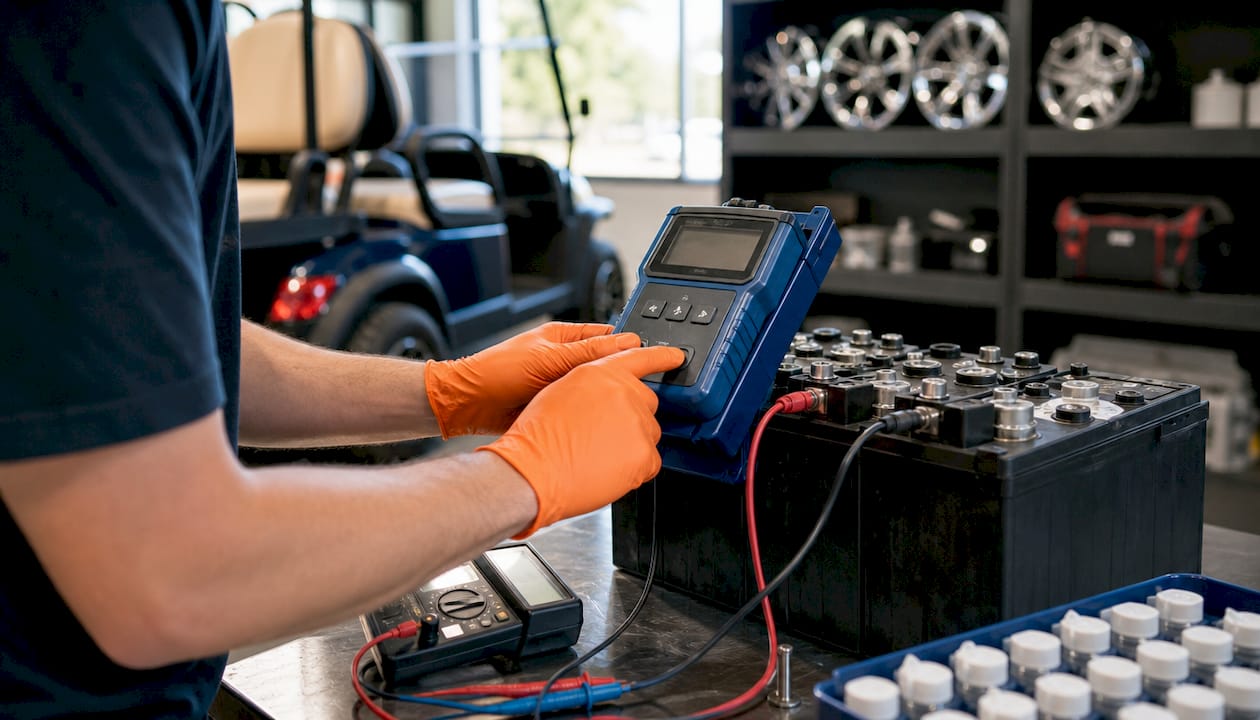
Pro Tip: Always ask for an itemized estimate before approving any repair. Shops that bundle parts and labor into one number make it harder to spot overcharges.
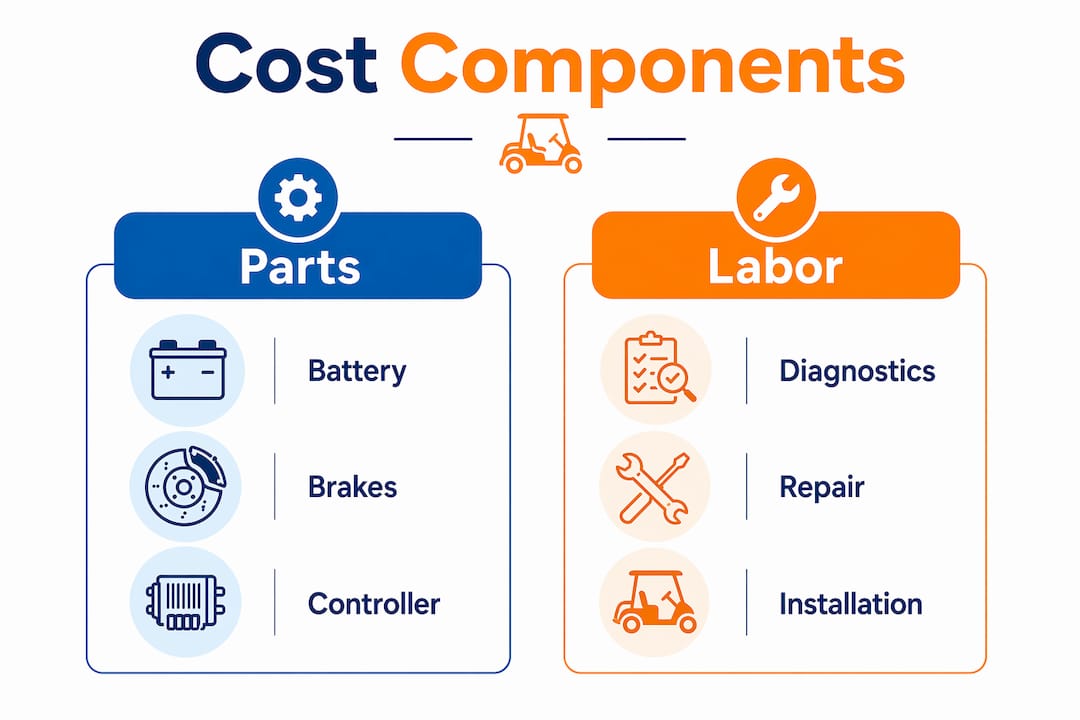
Electric carts carry higher battery costs but lower engine maintenance fees. Gas carts require oil changes, fuel system cleaning, and carburetor work, which adds $100–$400 per service cycle. Electric carts skip those costs but face larger single expenses when the battery pack fails. Knowing your cart type shapes the entire cost to refurbish a golf cart before you call a single shop.
Diagnostic fees deserve special attention. Proper diagnosis prevents replacing expensive components unnecessarily. Misdiagnosing a controller or motor can turn a $100 fix into a $1,000+ expense. Most shops credit the diagnostic fee toward your repair bill if you proceed, making it a low-risk upfront investment.
Battery work is the single largest variable in any golf cart restoration pricing calculation. Your choice between reconditioning existing lead-acid batteries and upgrading to lithium-ion changes both your upfront spend and your long-term maintenance fees.
Lead-acid batteries last 3–5 years under normal use. Reconditioning can extend that lifespan by 1–2 years and recover 60–80% of lost performance. The process involves four main steps:
The process requires multiple charge cycles and rest periods. Results vary by battery age and condition. Reconditioning costs run $50–$150 in materials if you do it yourself, or $100–$250 at a shop.
Pro Tip: Request a load test before committing to reconditioning. A battery that fails a load test is past the point where reconditioning will deliver meaningful results.
Lithium-ion batteries last 8–15 years and eliminate watering, equalization, and sulfation tasks entirely. That longevity changes the math on total ownership cost. The top benefits of lithium battery upgrades include lighter weight, faster charging, and consistent power output across the full charge cycle.
| Battery Type | Upfront Cost | Lifespan | Maintenance |
|---|---|---|---|
| Lead-acid (replacement) | $800–$1,800 | 3–5 years | Watering, equalization |
| Lead-acid (reconditioned) | $50–$250 | +1–2 years | Ongoing monitoring |
| Lithium-ion (upgrade) | $1,500–$2,500+ | 8–15 years | Minimal |
Repeated lead-acid reconditioning yields diminishing returns and risks sudden failure. Owners who recondition the same pack two or three times often spend more over five years than they would have by switching to lithium from the start. The long-term cost savings from lithium make the higher purchase price rational for most owners planning to keep their cart for more than three years.
Accurate golf cart repair costs start with a structured inspection, not a guess. Skipping this step is the most common reason owners end up with repair bills that double their original estimate.
Run through these checks before requesting any quote:
Battery age is the single largest indicator of remaining lifespan. Always request load-tested batteries when buying refurbished carts. That one check can save you from inheriting a $1,500 battery replacement within six months of purchase.
Owners consistently underestimate labor time on electrical repairs. A wiring fault that looks simple can take three hours to trace and fix. Reviewing a golf cart wiring guide before your shop visit helps you ask better questions and spot inflated labor estimates. Professional diagnostic fees of $50–$100 serve as a safeguard against costly misdiagnosis. Many shops credit this fee toward your repair when you proceed, so the net cost is often zero.
Reconditioning makes financial sense when the total repair cost stays below the cart’s post-repair market value. Spending $3,000 to recondition a cart worth $4,000 in good condition is rational. Spending $3,000 on a cart that sells for $2,500 fully restored is not.
Used golf carts in fair condition sell for $2,000–$5,000 depending on brand, age, and model. A full refurbishment including battery replacement, brake work, and cosmetic repairs can run $1,500–$4,000. The math works when:
Factors that push resale value up include fresh batteries, new tires, and clean bodywork. Factors that drag it down include outdated controllers, worn seats, and non-standard wiring.
A cart needing motor replacement, controller replacement, and a full battery pack simultaneously is a financial trap. Those three items alone can reach $3,500–$5,000 installed. At that price, a newer used cart with a warranty is the better choice. Partial repairs, such as fixing the charger and adjusting brakes while deferring battery replacement, can extend a cart’s useful life by one to two seasons without overcommitting your budget.
| Upgrade Type | Cost Range | Resale Value Impact |
|---|---|---|
| Battery replacement (lead-acid) | $800–$1,800 | High |
| Lithium-ion upgrade | $1,500–$2,500 | Very high |
| Brake and tire refresh | $300–$700 | Moderate |
| Cosmetic repairs (seats, body) | $200–$600 | Moderate |
| Motor/controller replacement | $700–$2,200 | Low to moderate |
Pro Tip: Before committing to a full refurbishment, get a written appraisal of the cart’s current value and its estimated post-repair value from a dealer. That number is your ceiling for total repair spend.
Accurate golf cart reconditioning cost estimation requires knowing your battery type, labor rates, and repair priorities before committing to any work.
| Point | Details |
|---|---|
| Diagnostics first | A $50–$100 diagnostic fee prevents misdiagnosis and is often credited toward repair costs. |
| Battery type drives total cost | Lead-acid reconditioning costs $50–$250 short-term; lithium-ion upgrades cost more but last 8–15 years. |
| Labor adds up fast | Shop rates of $60–$100 per hour can double the cost of parts-only estimates. |
| Know your break-even point | Total repair spend should stay below the cart’s post-repair resale value to make financial sense. |
| Inspect before you estimate | Battery age, brake response, and controller behavior are the three most predictive cost indicators. |
Most owners I’ve seen get burned on reconditioning costs make the same mistake: they skip the diagnostic step and go straight to replacing the most obvious part. A cart that won’t hold a charge usually gets a new charger. But the charger is often fine. The real culprit is a single bad battery cell dragging down the whole pack, and a motor diagnostic check or battery load test would have caught it in 20 minutes.
The second pattern I see is owners reconditioning the same lead-acid pack twice. The first round buys them a season. The second round buys them three months. By the time they’re ready for a third round, they’ve spent $400 on reconditioning and still need a $1,500 battery replacement. Switching to lithium after the first recondition would have cost more upfront and saved money within two years.
My honest recommendation: treat the diagnostic fee as the most important line item in your budget. Get the full picture before spending a dollar on parts. Then prioritize the battery system above everything else, because it determines range, reliability, and resale value more than any other component. Cosmetic work is the last thing to spend money on, not the first.
— Roshan
Golfcartstuff stocks the parts and accessories you need to move from estimate to finished project without hunting across multiple suppliers.
Whether you’re working on a Club Car DS and need Club Car DS parts for a brake or controller job, or you own a Yamaha and need Yamaha G1-G22 parts for a drivetrain refresh, Golfcartstuff carries model-specific components with clear fitment information. The full golf cart accessories catalog covers seat covers, wheels, and lighting upgrades that add resale value after mechanical work is complete. Every order comes backed by a team that knows golf carts, not just parts numbers.
A basic reconditioning covering brakes, charger, and battery work typically runs $1,000–$3,500 depending on battery type and labor rates. Full refurbishments with lithium-ion upgrades can reach $4,000 or more.
Reconditioning extends battery life by 1–2 years and recovers 60–80% of lost performance, but the results are temporary. Lithium-ion replacement is the better long-term investment for carts you plan to keep.
Most repair shops charge $60–$100 per hour for labor. Rates vary by region and shop type, with dealership service centers typically at the higher end.
The battery pack is the highest single cost, ranging from $800–$1,800 for lead-acid and $1,500–$2,500 for lithium-ion. Controller and motor replacements follow at $300–$1,200 installed.
Reconditioning makes sense when total repair costs stay below the cart’s post-repair resale value. If the cart needs a motor, controller, and battery pack simultaneously, buying a newer used cart is usually the better financial decision.
Explore our store to see what our products and resources can do for you.

Leave a comment