




Your Cart Is Our Priority
Explore our store to see what our products and resources can do for you.

TL;DR:
- A golf cart charger algorithm controls the multi-stage process of delivering voltage and current tailored to the battery’s chemistry. Using the wrong algorithm can cause battery damage, reduced lifespan, and safety risks, especially if it does not match the battery type or capacity. Proper updates and verification of the charge profile are essential when upgrading batteries to ensure safe and efficient operation.
A golf cart charger algorithm is the programmed multi-stage logic that controls how a smart charger delivers voltage and current to a battery pack, matching every phase of charging to the battery’s chemistry and capacity. Without the correct algorithm, even an expensive charger can destroy a battery pack in a matter of months. Understanding this technology is the difference between a battery that lasts years and one that fails a season early. The industry standard for modern electric golf cart chargers now centers on multi-stage profiles covering bulk, absorption, and float stages, each calibrated to specific battery chemistry requirements.
A golf cart battery charger algorithm is the programmed charge profile that tells the charger exactly how much voltage and current to deliver at each stage of the charging process. It replaces the old fixed-output approach, where a charger simply pushed power until the timer stopped. Smart algorithms read battery feedback in real time and adjust output dynamically.

The algorithm works in stages. Each stage serves a specific purpose, and the transition between stages is triggered by voltage and current thresholds, not guesswork. This is why two chargers with identical wattage ratings can produce very different results on the same battery pack.
Charger manufacturers like Delta-Q Technologies maintain dedicated battery testing labs to develop and refine these profiles, simulating temperature and use scenarios to confirm safety and lifespan before releasing a profile. That level of engineering is what separates a true smart charger from a basic unit with a marketing label.
Pro Tip: A charger labeled “smart” is only as effective as the algorithm loaded into it. Always verify that the charge profile matches your battery’s chemistry and amp-hour rating before plugging in.
The three core stages in lead-acid charging are bulk, absorption, and float. Each stage has a distinct role in restoring and protecting battery capacity.
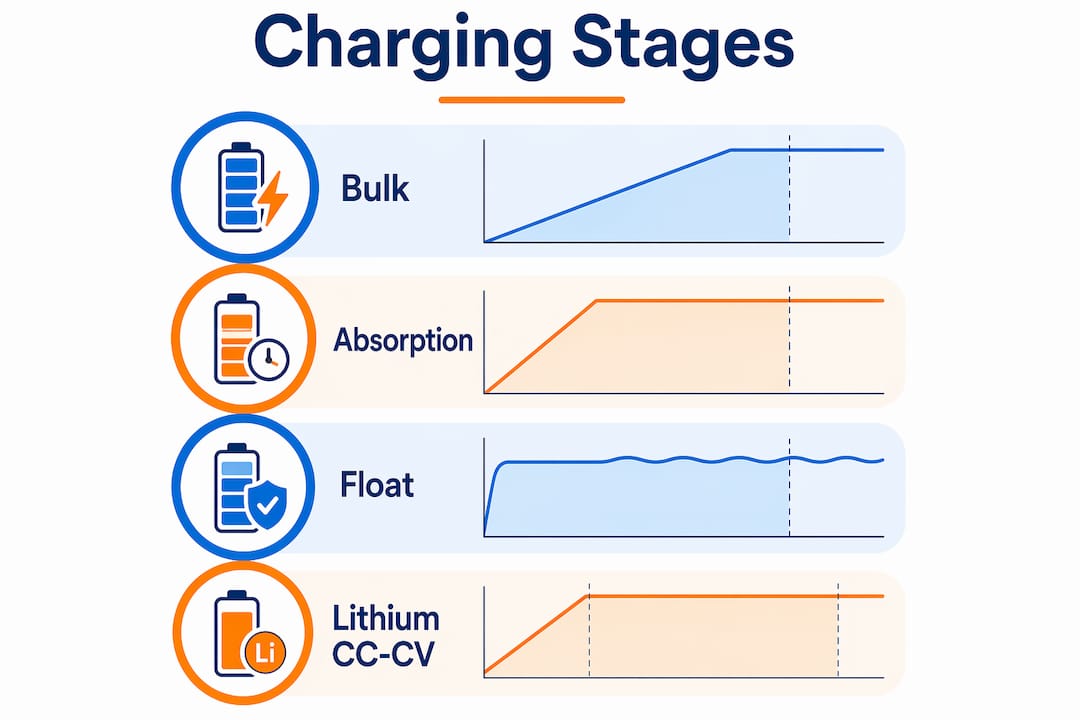
The bulk stage delivers the highest current the charger can safely output, pushing the battery from its depleted state to roughly 80% capacity. Speed is the priority here, and the charger holds current constant while voltage rises. Once voltage hits the absorption threshold, the algorithm shifts automatically.
The absorption stage locks voltage at a fixed level and allows current to taper naturally as the battery fills. This is the most critical stage for lead-acid batteries because it prevents overcharge while completing the final 20% of capacity. Rushing this stage causes sulfation and long-term capacity loss.
The float stage applies a small maintenance current after the battery reaches full charge, counteracting self-discharge without overcharging. This stage is specific to lead-acid chemistry. Lithium batteries do not use a float stage.
Lithium charging follows a constant current, constant voltage (CC-CV) profile. The charger delivers steady current until voltage peaks, then holds voltage constant while current drops. Lithium charging cuts off when current falls to roughly 2–5% of rated capacity, preventing the overcharge conditions that degrade lithium cells.
| Stage | Lead-Acid | Lithium (LiFePO4) |
|---|---|---|
| Bulk / Constant Current | High current, rising voltage to ~80% | High current, rising voltage |
| Absorption / Constant Voltage | Fixed voltage, tapering current | Fixed voltage, tapering current |
| Float / Maintenance | Low current to offset self-discharge | Not used. Charger cuts off |
| Termination trigger | Time or current threshold | Current drops to 2–5% of rated capacity |
Some advanced lead-acid algorithms also incorporate temperature compensation and variable finish phases, adjusting the absorption endpoint based on ambient temperature to balance sulfation prevention against water loss.
Using the wrong algorithm is one of the most common and costly mistakes golf cart owners make. The consequences range from reduced range to permanent battery failure.
The specific risks include:
The damage rarely shows up immediately. A mismatched algorithm typically degrades battery health over 10–20 cycles before the owner notices reduced range or longer charge times. By then, the damage is done.
Pro Tip: After any algorithm change, monitor the battery closely during the first 3 charge cycles. Check for unusual heat, swelling, or a charger that terminates earlier than expected. These are early warning signs of a mismatch.
A Battery Management System (BMS) is the safety gatekeeper inside every lithium golf cart battery pack. The charger algorithm and the BMS work together, but they serve different functions. Understanding the division of responsibility between them prevents dangerous assumptions.
The charger algorithm controls power delivery from the outside. It determines how much voltage and current the charger sends to the pack at each stage. The BMS operates from inside the pack, monitoring cell voltages and temperatures and cutting off power if any cell exceeds safe limits.
Key BMS functions include:
High-quality lithium BMS units maintain cell voltage balance within ±0.01V using active balancing and thermal sensors, enabling faster charge cycles and longer overall pack life. The BMS and charger algorithm form a two-way safety system. Neither one alone is sufficient.
Pro Tip: Always confirm that your charger’s output voltage ceiling is compatible with your BMS’s overvoltage threshold before connecting a new charger to a lithium pack. A mismatch here can trigger repeated BMS shutdowns that look like charger failure but are actually a compatibility problem.
Upgrading your battery pack without updating the charger algorithm is one of the most reliable ways to kill a new battery quickly. The algorithm must match the pack’s amp-hour rating and chemistry, not just its voltage.
When you increase pack capacity, say from 200Ah to 300Ah, the charger needs more time in the bulk and absorption stages to fully charge the larger pack. An algorithm calibrated for 200Ah will terminate the charge cycle early, leaving the 300Ah pack chronically undercharged. Over time, this creates a condition called chronic undercharge, which accelerates sulfation in lead-acid batteries and reduces usable capacity in lithium packs.
Parallel battery configurations add another layer of complexity. When you connect two packs in parallel, total amp-hour capacity increases while voltage stays the same. The algorithm must account for the combined capacity, or it will terminate the charge cycle before either pack reaches full charge.
Follow these steps when changing or updating a charger algorithm:
Manufacturers continuously update charging algorithms as battery technology evolves. Using an outdated profile on a new pack carries the same risks as using the wrong profile entirely.
A golf cart charger algorithm is the single most important factor in determining whether your battery pack reaches its rated lifespan or fails years early.
| Point | Details |
|---|---|
| Algorithm defines charging stages | Bulk, absorption, and float stages are controlled by the algorithm, not the charger hardware. |
| Chemistry determines the profile | Lead-acid and lithium require fundamentally different charge profiles. Never use one for the other. |
| Wrong algorithm causes real damage | Overheating, boil-over, and chronic undercharge all result from mismatched charge profiles. |
| BMS and algorithm work together | The charger algorithm delivers power; the BMS protects the pack. Both must be compatible. |
| Upgrades require algorithm updates | Increasing pack capacity or switching chemistry requires a new or recalibrated charge profile. |
I have watched golf cart owners spend serious money on new lithium packs and then plug them into a charger running a five-year-old lead-acid profile. The charger looks like it works. The battery appears to charge. But inside the pack, the BMS is fighting the charger on every cycle, and the cells are degrading faster than they should.
The biggest misconception I see is that “smart charger” means the charger figures everything out on its own. It does not. A smart charger’s effectiveness depends entirely on loading the correct profile for your specific battery. The hardware is just the delivery mechanism. The algorithm is the actual intelligence.
The second mistake is ignoring algorithm updates. Battery manufacturers refine their recommended profiles as they gather real-world data. A profile released two years ago may not reflect the current recommendation for the same battery model. Checking for updated profiles when you install a new pack takes five minutes and can add years to your battery’s life. For owners who want to go deeper on charger maintenance practices, the technical details of keeping your charger performing correctly are worth understanding before problems appear.
The owners who get the most out of their batteries treat the algorithm as a living setting, not a one-time configuration. They verify it when they buy a new pack, check for updates annually, and monitor the first few cycles after any change. That habit alone separates the owners who replace batteries on schedule from the ones replacing them two years early.
— Roshan
Choosing the right charger algorithm starts with having the right charger and battery combination. Golfcartstuff carries a wide selection of golf cart batteries designed for compatibility with current multi-stage charging profiles, including lithium packs with integrated BMS technology.

Whether you drive a Club Car, Yamaha, or another model, Golfcartstuff stocks the parts that match your cart’s electrical system. The Club Car DS parts catalog includes chargers, batteries, and accessories built for the charging standards your cart was designed around. You can also find battery meters to monitor charge status and catch algorithm mismatches before they cause damage. Shop by model, voltage, or battery type to find exactly what your setup requires.
A golf cart charger algorithm is the programmed charge profile that controls how a smart charger delivers voltage and current through multiple stages, including bulk, absorption, and float, to safely restore battery capacity based on chemistry and pack size.
No. Lead-acid and lithium batteries require completely different charge profiles. Using a lead-acid algorithm on a lithium pack causes overvoltage events that trigger BMS shutdowns and permanently damage cells.
Yes. Increasing pack capacity or switching battery chemistry requires a new or recalibrated charge profile. Failing to update the algorithm causes premature charge termination and chronic undercharge, which degrades the new pack rapidly.
The BMS monitors individual cell voltages and temperatures inside a lithium pack, disconnecting the pack if any cell exceeds safe limits. It works alongside the charger algorithm, which controls power delivery from the outside.
Signs of a mismatched algorithm include the charger terminating earlier than expected, the battery running warm during charging, reduced range after a full charge, or visible swelling in the pack. Monitor the first 3 charge cycles after any algorithm change to catch these issues early.
Explore our store to see what our products and resources can do for you.

Leave a comment