
Your Cart Is Our Priority
Explore our store to see what our products and resources can do for you.

Choosing the right lift height for your golf cart often sparks debate among owners across North America. Whether you tackle rocky Texas ranch roads or steep Appalachian hills, getting more ground clearance goes far beyond looks. The actual performance on rugged trails depends on matching lift height to tire size and manufacturer recommendations rather than chasing maximum inches. This guide clears up common myths, explains how lift kits impact off-road ability, and helps you pick the safest, most reliable option for your terrain.
| Point | Details |
|---|---|
| Lift Height Selection Matters | Matching lift height to tire size and intended terrain is crucial for optimal performance and stability. Avoid choosing height purely for aesthetics. |
| Understanding Lift Types | Evaluate lift kit types based on installation ease, suspension geometry, and terrain requirements to maximize your cart’s off-road capability. |
| Ground Clearance vs. Lift Height | Recognize that ground clearance is different from lift height; ensure your lift choice translates into actual clearance when measuring. |
| Avoid Over-Lifting | Installing a lift that exceeds what your cart needs compromises safety and performance; choose a height based on functional requirements rather than trends. |
Golf cart lift height refers to the vertical distance the chassis is raised above its original position, typically measured in inches from the ground to the bottom of the frame. When you install a lift kit, you’re not just adding height for appearance. The primary purpose is to create adequate ground clearance that accommodates larger tires and allows your cart to traverse rough, uneven terrain without the undercarriage dragging or getting stuck.
Here’s where most owners stumble: they assume that simply adding the biggest possible lift will automatically translate to superior off-road capability. That’s not how it works in real life. The reality is far more nuanced. Lift height should match tire size and manufacturer recommendations rather than being chosen based on aesthetics or neighbor envy. When you exceed the manufacturer’s specified lift height for your cart model, you actually compromise suspension geometry. Your suspension components may no longer function within their designed parameters, leading to poor handling characteristics, reduced stability on slopes, and premature wear on bushings and ball joints.
Another persistent myth claims that a 6-inch lift is universally better than a 4-inch lift. Wrong. A 4-inch lift paired with 23-inch all-terrain tires might give you everything you need for rocky trails and sandy creek beds, while a 6-inch lift could create stability issues if you’re navigating tight turns or side slopes. The sweet spot depends on three factors: the terrain you’ll actually be driving, the tire size you want to run, and your cart’s specific suspension design. Additionally, excessive lift height raises your center of gravity, which increases the risk of tip-overs on inclined terrain. Proper suspension geometry preservation matters more than raw height when building a reliable off-road machine.
Some owners also believe that all lift kits are created equal. Not true. A cheap kit with insufficient bracing might provide height but offer minimal structural support. Quality matters here. You want a kit designed specifically for your cart model, with proper control arm angles and chassis reinforcement. The difference between a solid installation and a sketchy one becomes painfully obvious when you’re navigating rough terrain at speed.
Pro tip: Before purchasing any lift kit, identify the exact tire size you want to run, then work backward to determine the minimum lift height needed. This approach prevents over-lifting and keeps your suspension working as designed.
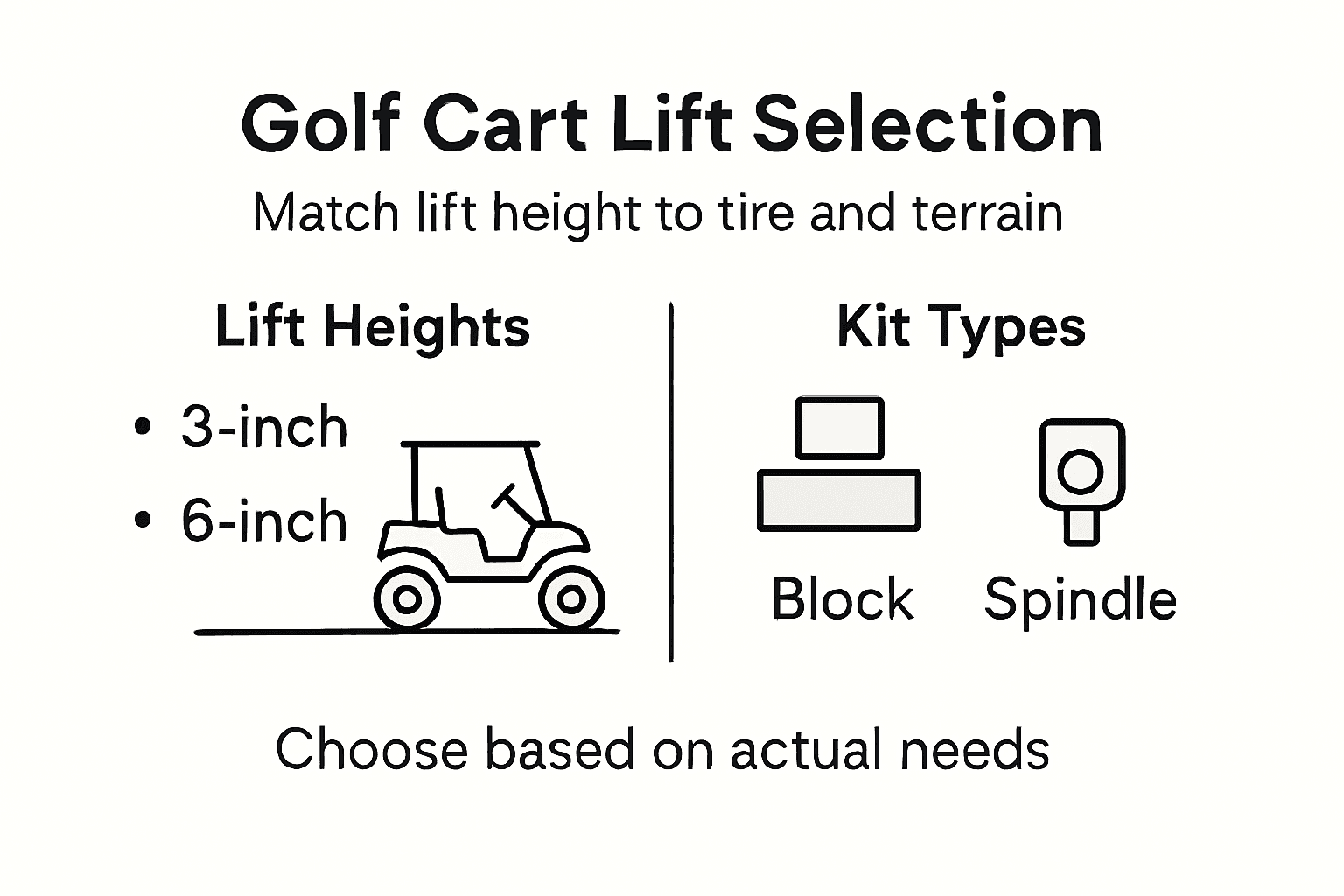
Lift kits aren’t one-size-fits-all solutions. The golf cart aftermarket offers multiple height options and mechanical designs, each suited to different terrain challenges and performance goals. Understanding the distinctions between them helps you select the right combination for your specific off-road adventures.
Common lift heights range from 3 inches up to 8 inches, with most owners choosing somewhere in the middle. A 3-inch lift works well for mild terrain upgrades and accommodates tires around 20 inches in diameter. This height suits owners who want slightly better clearance without dramatically altering their cart’s handling characteristics. Moving up to a 5-inch or 6-inch lift opens the door to genuine all-terrain capability. A 6-inch lift pairs effectively with 23-inch tires for rough, rocky terrain, offering solid ground clearance for creek crossings, sandy washes, and uneven hillside trails. Beyond 6 inches, most owners venture into 8-inch territory, which sits at the extreme end of the spectrum. Eight-inch lifts are typically reserved for serious off-road enthusiasts tackling severe terrain or those seeking maximum visual presence.
Here is a comparison of common golf cart lift heights and their main use cases:
| Lift Height | Typical Tire Size | Primary Use Case |
|---|---|---|
| 3 inches | Up to 20 inches | Mild terrain, light upgrades |
| 4 inches | Up to 23 inches | Moderate trails, mixed terrain |
| 5-6 inches | 23 inches | Rough terrain, improved clearance |
| 8 inches | 25 inches+ | Extreme off-road, visual impact |
The mechanical approach matters just as much as the height itself. Block lifts represent the most straightforward option. These spacers sit between the frame and axle, raising your cart quickly and affordably. Installation takes a few hours with basic tools, making them popular among budget-conscious owners. The trade-off: block lifts don’t modify suspension geometry, so they work best with modest 2 to 4-inch lifts.
Spindle lifts replace your front spindle assembly to gain additional height while maintaining better suspension function than blocks alone. This approach allows for greater lift heights with improved ride quality on uneven ground. A-arm lifts modify the suspension itself by replacing or extending control arms. Different lift kit types impact wheel alignment and ride quality depending on your chosen height, with A-arm designs offering superior control when going higher. Drop axle lifts lower the rear axle to raise the chassis, providing balanced lifting while preserving suspension geometry.
Below is a summary of lift kit types and their main advantages:
| Lift Kit Type | Best For | Key Benefit |
|---|---|---|
| Block Lift | Budget upgrades, light trails | Simple install, low cost |
| Spindle Lift | Medium lifts, better comfort | Retains ride quality |
| A-arm Lift | High lifts, rough terrain | Superior geometry, control |
| Drop Axle | Balanced lift, stability | Preserves suspension angles |
Your terrain and comfort preferences should guide your decision. If you’re mostly dealing with light trails and want easy installation, a block lift in the 3 to 4-inch range makes sense. If you’re tackling rougher ground regularly and want your cart to handle smoothly at higher heights, invest in an A-arm lift system that maintains proper suspension geometry throughout its range.
Pro tip: Match your lift height to your tire choice first, then choose your kit type based on terrain severity and desired ride quality, rather than starting with a preferred height and forcing incompatible tires onto your cart.
Lift height doesn’t just change how your golf cart looks. It fundamentally alters how your cart interacts with terrain, obstacles, and the forces acting on it during off-road driving. Understanding these impacts helps you make informed decisions about how much lift actually benefits your specific needs.
The most obvious benefit of increased lift height is improved ground clearance. When you raise your cart higher, you create more space between the chassis and the ground below. This extra clearance becomes invaluable when navigating rocky trails, deep ruts, or terrain littered with stumps and fallen branches. A cart with modest lift might scrape its undercarriage on a large rock that a lifted cart clears easily. On steep hillsides with washboard terrain, that additional clearance prevents damage to your fuel tank, battery compartments, and suspension components. Higher lift heights enable larger tire installations that significantly enhance traction off-road, especially when paired with aggressive tread patterns designed for loose surfaces.
Here’s where lift height gets complicated. Raising your cart also raises its center of gravity, which is the invisible point around which your cart naturally balances. The higher this point sits, the more unstable your cart becomes on uneven terrain. Think of it like balancing a water glass on its base versus balancing it on a pencil. This increased instability becomes particularly dangerous when driving on side slopes, navigating sharp turns, or encountering sudden obstacles that require quick directional changes.
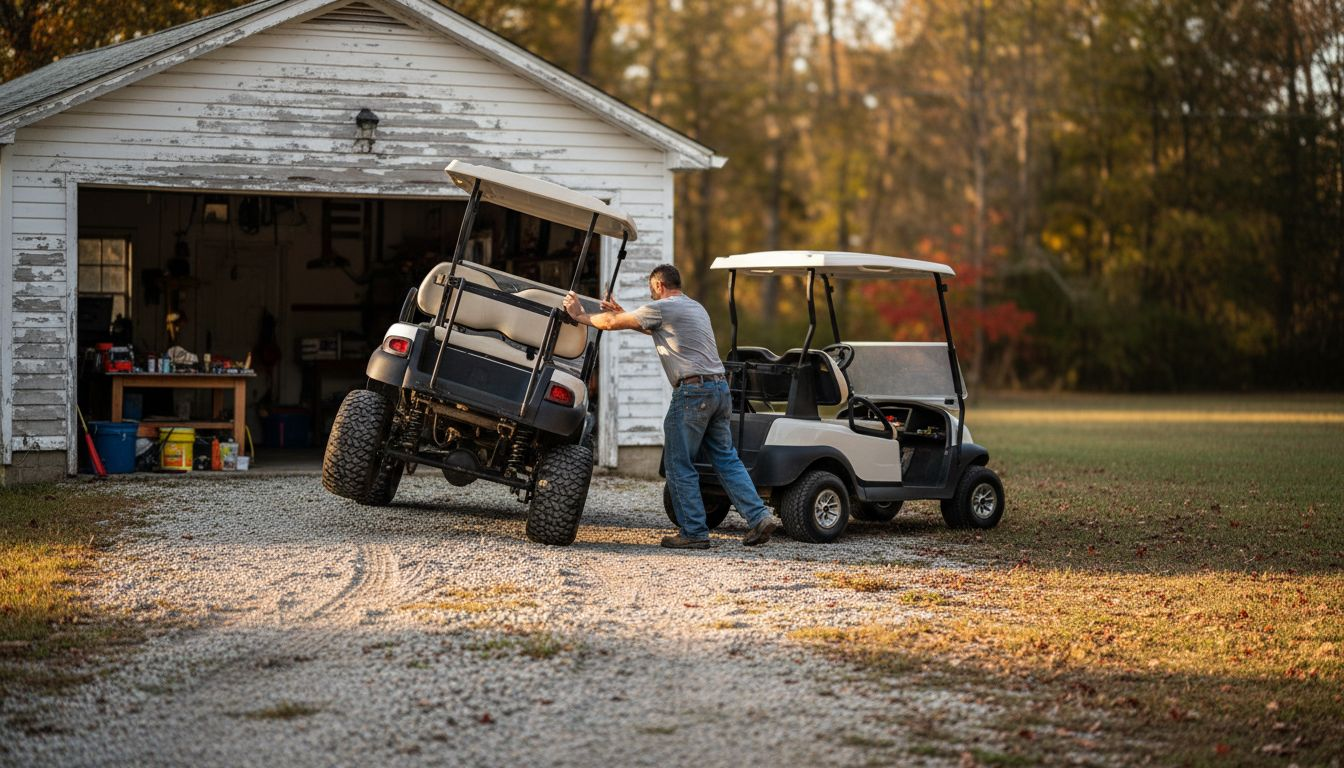
Excessive lift height reduces stability and increases rollover risk during sharp maneuvers or uneven ground, making this a genuine safety concern rather than a minor inconvenience. A 3-inch lift with proper suspension geometry maintains predictable handling. A 6-inch lift demands more cautious driving techniques and heightened awareness of terrain conditions. An 8-inch lift requires experienced drivers who understand weight distribution and slope angles.
The sweet spot depends on your actual terrain. If you’re mostly navigating rocky trails and creek crossings at moderate speeds, a 4 to 5-inch lift provides excellent clearance without creating problematic instability. If you’re driving faster across rougher terrain or tackling steeper slopes, invest in quality suspension components like A-arm lifts that maintain geometry better than simple block lifts. Never choose lift height based solely on aesthetics or what your neighbor installed. Your specific terrain, driving style, and comfort with dynamic balance determine what height works for your cart.
Pro tip: Start with a 4-inch lift on proven terrain, then evaluate how your cart handles before committing to additional height. This conservative approach lets you experience the stability trade-offs firsthand before investing in more extreme lifts.
Accurate measurement of your golf cart’s lift height matters more than most owners realize. When you’re comparing your setup to manufacturer specifications or planning tire upgrades, sloppy measurements lead to purchasing wrong components or misunderstanding your cart’s actual capability. The good news is that measuring lift height requires only basic tools and a methodical approach.
Start with your cart on completely level ground. Uneven surfaces throw off measurements immediately, so find a flat driveway or parking lot. Your cart should be parked in a natural resting position with all weight distributed normally. Don’t bounce the suspension or apply brake pressure that might compress or extend components artificially.
Measure from a fixed point on the cart’s frame to the ground. The most reliable location is the lowest point of the frame rails that runs the length of your chassis. Use a tape measure and take the measurement straight down to the ground surface directly below that point. Record this number as your baseline. Next, measure the distance from the same frame point to the center of your wheel hub or the lowest point of the tire contact patch. This measurement helps you understand ground clearance separate from frame height.
The most meaningful measurement compares your cart’s height before and after lift installation. Take your baseline measurements before any work begins. After installation, repeat the exact same measurements from identical frame locations. The difference between these two sets of numbers is your actual lift height. This approach eliminates confusion about whether you’re measuring from the frame, axle, or suspension components.
If you’re shopping for a lift kit and want to understand what a 4-inch or 6-inch lift truly means, remember that manufacturers measure from the stock position to the new position. However, different manufacturers may measure from slightly different reference points, so always verify the exact measurement location in their documentation. A quality lift kit manufacturer provides clear diagrams showing precisely where measurements are taken.
Understood that ground clearance and lift height are different measurements. Lift height refers to how much higher the frame sits. Ground clearance measures the space between your lowest undercarriage component and the ground. A 4-inch lift doesn’t automatically give you 4 inches of additional ground clearance if your suspension compresses under load or if your tires sit lower than expected. Real-world ground clearance depends on tire diameter, suspension compression, and the lowest hanging parts of your cart, whether that’s a skid plate, differential, or fuel tank mounting bracket.
Pro tip: Measure your cart’s height at multiple points along the frame, not just one location, to verify even lift and identify any installation problems that might have tilted your frame slightly.
Choosing the wrong lift height for your golf cart can create problems that cost you money, compromise safety, and leave you frustrated on the trail. Most mistakes stem from either chasing aesthetics or failing to think through the practical implications of lift selection.
The most common mistake is installing a lift height that exceeds what your cart actually needs. Owners see their friend’s 6-inch lift and immediately assume bigger is better. They order an 8-inch kit without considering their terrain, tire plans, or suspension capabilities. Over-lifting compromises ride quality, increases rollover risk, and places excessive stress on suspension components that weren’t designed for extreme heights. Your suspension bushings wear out faster, your braking system works harder to control the higher center of gravity, and your steering geometry gets thrown off in ways that affect handling predictability.
The problem gets worse when you pair excessive lift with tire mismatches. Installing a 6-inch lift but only running 20-inch tires wastes the lift’s ground clearance benefit. Conversely, installing a 3-inch lift with 28-inch tires creates tire rub issues and forces your suspension into geometries it doesn’t handle well. Height and tire size must work together, not against each other.
The flip side is under-lifting for your intended use. If you’re planning to regularly navigate rocky terrain with a lifted suspension setup, a 2-inch lift paired with stock-sized tires leaves you vulnerable to undercarriage damage. You’ll be replacing skid plates and suspension components regularly because you chose lift height based on budget rather than function. Additionally, failing to match lift height to your specific golf cart model creates compatibility problems where components don’t fit properly or suspension geometry gets compromised unexpectedly.
Many owners focus only on lift kit cost and ignore the necessary supporting modifications. A proper lift installation often requires brake system adjustments, steering tie-rod extensions, or driveline modifications depending on height and lift type. Skipping these upgrades leaves you with a lifted cart that doesn’t handle as designed. Your brakes might not respond predictably when lifted. Your steering might feel loose. These aren’t minor annoyances. They’re safety issues that compound over time.
Another hidden mistake is choosing lift height without considering your actual terrain. If you mostly drive flat, groomed trails but install an aggressive 6-inch setup, you’re paying extra money and sacrificing ride comfort for capability you don’t use. Match your lift to your environment, not to what looks impressive in a parking lot.
Pro tip: Visit a local golf cart community or forum to see what lift heights work best with your specific cart model and terrain type before making a purchase decision.
Understanding the right golf cart lift height is crucial to maximize off-road performance while maintaining safe handling and suspension integrity. If you have been struggling to find a balance between clearance, stability, and terrain capability, know that choosing the correct lift kit and tire combination directly impacts your cart’s ride quality and safety. Avoid the common pitfalls of over-lifting or under-lifting by accessing high-quality parts designed to preserve your golf cart’s suspension geometry and durability.
Shop reliable and precisely engineered golf cart parts and accessories at GolfCartStuff.com to customize your ride with confidence. Whether you need block lifts for mild upgrades or A-arm lift kits for serious off-road adventures, our selection supports your goal to enhance clearance without compromising stability. Don’t wait until poor lift choices cause costly damage or unsafe handling—visit Golf Cart Parts and Accessories now to find the ideal components that fit your terrain and driving style perfectly.
Golf cart lift height refers to the vertical distance the chassis is raised above its original position. It is typically measured in inches from the ground to the bottom of the frame, allowing for increased ground clearance and larger tire accommodation.
Lift height improves ground clearance, enabling a golf cart to navigate rough terrain without the undercarriage dragging. However, excessively raising the cart’s height can also increase the risk of rollover due to a higher center of gravity, impacting stability during sharp maneuvers.
When choosing a lift height, consider the terrain you will be driving on, the tire size you intend to use, and your cart’s suspension design. It’s essential to balance the lift height with these factors to maintain handling stability and performance.
No, lift kits vary significantly in design and quality. It is crucial to select a kit specifically designed for your cart model, as quality lifts provide proper support and maintain suspension geometry, enhancing overall performance and safety.
Explore our store to see what our products and resources can do for you.

Leave a comment