

Your Cart Is Our Priority
Explore our store to see what our products and resources can do for you.

Compatibility comes down to three exact matches: battery chemistry, pack voltage, and BMS or charging algorithm. If any one of those is wrong, you risk a charger that trips out, undercharges, or damages a lithium pack outright. The safe move is verifying chemistry and voltage first, then defaulting to either the charger your battery maker shipped with the pack or a properly programmed multi-profile smart charger.
TL;DR:
- Using a charger with the wrong chemistry, voltage, or connector can cause incomplete charging, damage, or safety hazards in lithium golf cart batteries.
- It is essential to verify the battery’s chemistry, voltage, and connector before purchasing or connecting a charger to avoid compatibility issues.
- Brand-matched chargers are safest because they come pre-programmed for the specific battery BMS, while multi-profile smart chargers require technical flashing for correct operation.
- Overpowered chargers or those with mismatched voltage can overcharge or damage cells and BMS, making amperage rating just as critical as voltage.
- Avoid generic universal chargers without explicit lithium profiles, as they’re likely to run incompatible charging curves that jeopardize battery longevity.
Before you plug in anything new or place an order, run through this sequence. Skipping a step here is how owners end up with a charger that “sort of” works, cycling on and off or shutting down mid-charge.
Pro Tip: Take a photo of your charger’s data plate and your battery’s spec label before calling any parts supplier. Voltage, amperage, and part numbers on those two labels answer 90 percent of compatibility questions in one phone call.
A detailed guide to golf cart charger algorithms breaks down how these profiles talk to a lithium BMS in more technical detail, worth a read if you want to understand the handshake between charger and battery before you buy.
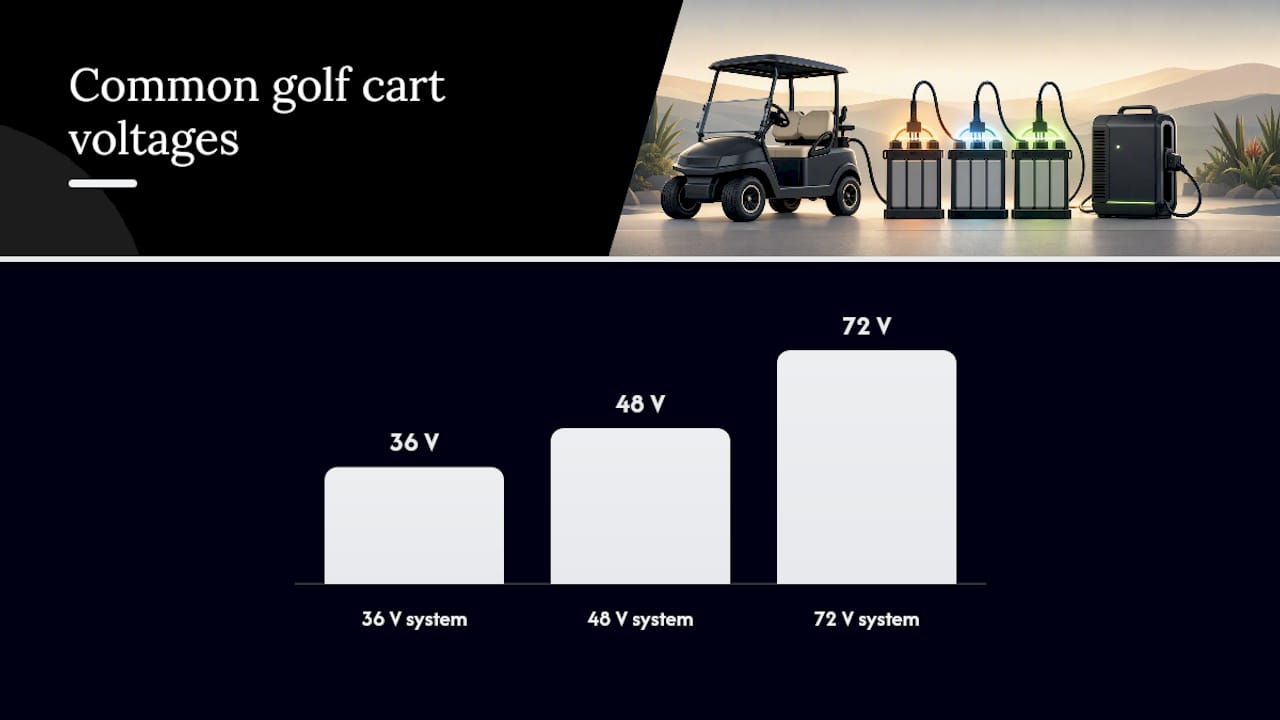
Three charger categories cover almost every lithium conversion, and they are not interchangeable in terms of risk.
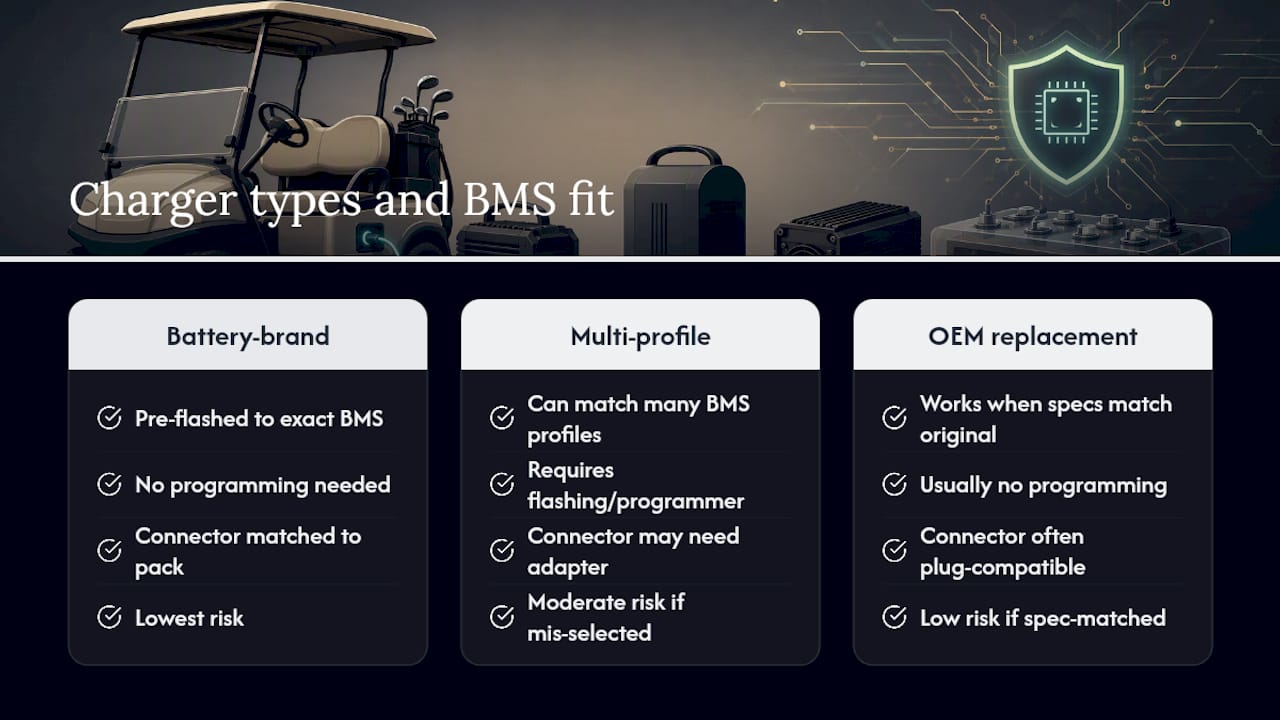
Battery-brand matched chargers are the safest starting point. These ship with the LiFePO4 pack itself, pre-flashed for that exact BMS, with bulk and absorption voltages already set correctly and float charging disabled or managed the way lithium needs it, not the way lead-acid does. The Epoch 36V 105Ah kit is a good example: it includes a 36V 15A LiFePO4-specific charger with published bulk and absorption figures rather than leaving you to guess.
Multi-profile smart chargers are the flexible option. Units in this category can store hundreds of stored algorithms covering different chemistries and voltages, which matters if you plan to switch battery brands down the road or you’re not fully sure which profile your current pack needs. The catch is access: selecting or flashing the right profile usually requires a technician with the manufacturer’s programming cable and algorithm library.
OEM-style drop-in replacements work when the connector and internal profile already match your cart’s original charger. This is the closest thing to a plug-and-play swap, but it only holds true when the replacement genuinely mirrors the original unit’s specs, not just its shape.
What to avoid: generic “universal” chargers sold without an explicit lithium profile listed. A charger that doesn’t specify BMS compatibility is either running a generic lead-acid curve or an unverified lithium approximation, and neither is worth the risk to a pack that often costs more than the charger many times over. Delta-Q’s own guidance on golf applications notes that a technician can typically flash the correct lithium algorithm onto a compatible smart charger in under five minutes with the right cable and library access, which tells you how quick the fix is once you have the right tool, and how stuck you are without it.
Amp output matters as much as voltage. A charger rated well above what your battery’s BMS accepts, or above what your existing charge cable is rated for, creates heat and stress even when the voltage and chemistry line up. Match amperage to the lower of the two limits, not the charger’s maximum output.
Work through this list before ordering anything or touching your existing wiring.
Pro Tip: A fused DC disconnect near the charger makes future servicing and swaps dramatically easier, and it’s a small add during install versus a headache later if you ever need to isolate the pack quickly.
Red flags during that first monitored charge: a charger that cycles on and off rapidly, one that shows a full charge in a fraction of the expected time, or a BMS that trips and won’t reset. Any of those means stop, disconnect, and recheck your voltage and profile match before trying again. GolfCartLab’s fitment notes point out that a controlled first charge with a knowledgeable tech nearby catches these mismatches before they become a warranty claim.
Most golf cart owners treat a charger as a dumb power brick. It isn’t. A lithium pack is an integrated electronic system, and the charger is half of a conversation happening with the BMS every time you plug in. Get that conversation wrong and you don’t just get a slow charge, you get a battery that ages faster or a BMS that locks itself out as a protective measure.
The industry’s push toward field-programmable smart chargers is the right direction, but it quietly shifts the burden onto owners to know what profile their pack actually needs. Specialized support exists to help pair the right charger to the right pack, with fitment guides and support that go beyond “here’s a charger, good luck.”
— Roshan
Getting the wrong charger for a lithium pack costs more than a bad review. It costs a battery. A full range of golf cart battery chargers is available alongside detailed breakdowns like a types of golf cart chargers guide, built specifically to help you avoid the chemistry, voltage, and connector mismatches covered above.
If you’re converting a Club Car, Yamaha, or EZGO to lithium, gather your cart’s make, model, year, current pack voltage, and a photo of your charge port, then reach out to a support team for a direct fitment match. Parts are available for Club Car DS and Yamaha G1 through G22 carts specifically. With specs provided, guidance can be given to the appropriate charger for your pack.
Delta-Q Technologies on golf applications, GolfCartLab’s charger fitment guide, Canyon Lake Mobile’s charger comparison, and Epoch Batteries’ LiFePO4 kit specs informed the voltage and BMS guidance above. For accessory power needs, All Star Truck Parts carries golf cart-compatible lighting.
No. A lead-acid charger applies the wrong voltage curve for LiFePO4 chemistry and can trip the BMS or degrade the pack over time.
Usually yes, unless your existing charger is a field-programmable smart charger that can be reflashed with the correct lithium profile by a technician.
Mismatched voltage, like a 48V charger on a 36V pack, will overcharge the battery and can cause permanent damage to both the cells and the BMS.
Charging below freezing risks damaging LiFePO4 cells, so keep the charger and battery above roughly 32°F, per most manufacturer specifications.
Watch for rapid on/off cycling, a charge that finishes far too quickly, or a BMS that trips and refuses to reset, all signs the charger and battery are not communicating correctly.
Explore our store to see what our products and resources can do for you.

Leave a comment