
Your Cart Is Our Priority
Explore our store to see what our products and resources can do for you.

TL;DR:
- Golf cart chargers must match the cart’s voltage, plug type, battery chemistry, and amperage to prevent damage. Properly matching these specifications ensures reliable operation and extends battery life. Using the wrong charger, especially with incompatible plug types or chemistry profiles, can cause costly battery failure or safety hazards.
Golf cart chargers are defined by four non-negotiable match points: voltage, plug type, battery chemistry, and amperage. Get any one of these wrong, and you risk damaging your battery pack or triggering a charger failure. Understanding the types of golf cart chargers available today means knowing exactly how these four factors interact, so you can buy with confidence and protect your investment for the long haul.
Voltage is the first and most critical filter when choosing a charger. Your charger must match your cart’s total system voltage, which is the sum of all batteries wired in series. Using a charger that matches an individual battery voltage instead of the full pack voltage causes failure or creates a safety hazard.
The three main voltage categories are:
Verifying your cart’s system voltage before buying is straightforward. Check the owner’s manual, count the batteries and multiply by their individual voltage, or look for a label on the battery compartment. Never assume based on cart age or brand alone.
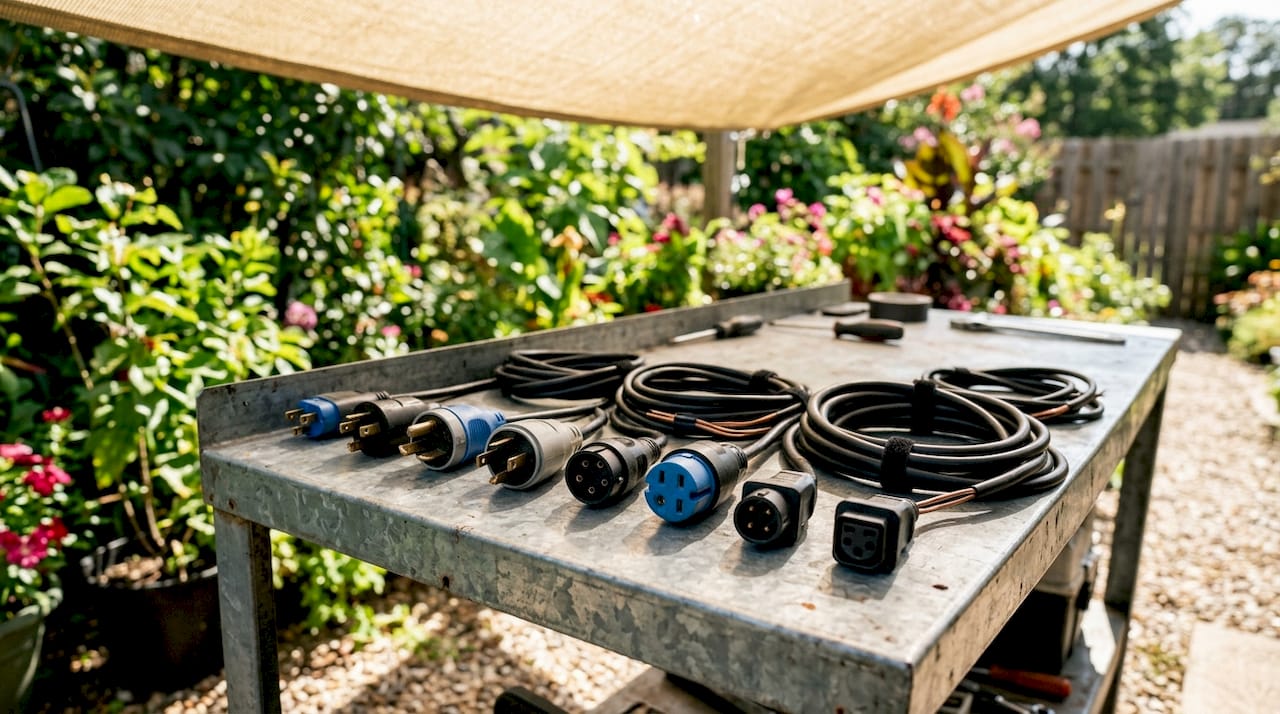
Plug compatibility is the most frequently overlooked factor in charger selection. Many owners assume voltage compatibility guarantees a fit, but plug type varies widely across manufacturers and model years, causing common compatibility problems even when voltage is correct.
The most common plug types you will encounter include:
Manufacturers have changed plug designs across model years, so the brand name alone does not confirm plug type. A 2005 Club Car may use a different connector than a 2015 Club Car.
Pro Tip: Photograph your cart’s charging receptacle and your old charger’s plug before shopping. This single step eliminates the most common ordering mistake and saves you a return shipment.
Battery chemistry dictates the charger profile your cart needs. Lead-acid chargers are not compatible with lithium batteries, and lithium chargers are not safe for lead-acid packs. Using the wrong charger risks permanent battery damage or undercharging that shortens pack life.
Lead-acid batteries come in three main types, each with slightly different charging needs:
Lithium batteries, specifically LiFePO4 chemistry, operate on a completely different profile. A lithium charger for a 48V system outputs approximately 58.4V at peak, while a lead-acid charger for the same system peaks at around 51–52V. That voltage gap means a lead-acid charger will chronically undercharge a lithium pack, and a lithium charger risks overcharging a lead-acid pack.
Modern multi-chemistry smart chargers with selectable profiles solve this problem directly. The Lester Summit II, for example, lets you switch between lead-acid and lithium profiles, which means you can upgrade to lithium batteries later without buying a new charger.
Amperage controls how fast your charger refills the battery pack. Higher amperage means faster charging, but the relationship between speed and battery health requires careful management. Experts recommend matching or exceeding the original factory amperage rating for the best balance of speed and longevity.
The three main amperage tiers are:
Charging time also depends on battery capacity measured in amp-hours. A larger pack takes longer to refill at any given amperage. Running a 13A charger on a large-capacity lithium pack, for instance, can result in charge times that exceed 12 hours, which is impractical for daily commercial use.
Pro Tip: Never drop below your cart’s factory amperage rating when replacing a charger. Going lower slows charging and can leave batteries in a partial state of charge, which accelerates sulfation in lead-acid packs.
The physical format of your charger affects how and where you charge your cart. On-board chargers are integrated into the cart itself, while off-board chargers are portable units that connect externally.
| Feature | On-board charger | Off-board charger |
|---|---|---|
| Location | Mounted inside the cart | External, portable unit |
| Convenience | Plug in anywhere with an outlet | Requires carrying the unit to the cart |
| Typical amperage | 13–18A | 13–25A |
| Best for | Frequent users, fleets, daily drivers | Occasional users, multi-cart owners |
| Replacement | Requires installation | Simple plug-and-play swap |
| Weather protection | Needs IP67 rating minimum | Stored indoors when not in use |
On-board chargers suit fleet operators and daily drivers because they eliminate the need to manage a separate unit. Chargers with an IP67 waterproof rating are recommended for on-board use, while IP65 is the minimum for basic weather protection. Off-board chargers give occasional users more flexibility and are easier to replace without tools. A single high-amperage off-board unit can also serve multiple carts in a small private collection.
Smart chargers are the current standard for golf cart charging, and manual chargers are a liability. Older manual chargers caused electrolyte boiling and shortened battery life because they relied on the owner to disconnect at the right time. Modern automatic 3-stage smart chargers prevent overcharging by adjusting current and shutting off when the pack is full.
The three stages in a smart charger are bulk, absorption, and float. Bulk delivers maximum current to refill the pack quickly. Absorption tapers the current as voltage rises to avoid overcharging. Float holds the battery at full charge without continuing to push current through it. This sequence protects battery chemistry regardless of how long the cart sits plugged in.
Charger algorithms in high-quality smart chargers also monitor temperature and adjust output accordingly. Cheap generic chargers often lack adequate cooling and quality control, leading to premature failure and potential battery damage. The cost difference between a quality smart charger and a generic unit is small compared to the cost of replacing a battery pack early.
Matching all four charger specifications, including voltage, plug type, battery chemistry, and amperage, is the only way to protect your battery pack and get reliable performance from your charger.
| Point | Details |
|---|---|
| Voltage must match the full pack | Charge a 48V system with a 48V charger, not a charger sized to one battery. |
| Plug type is brand and year specific | Photograph your receptacle before buying to avoid incompatible connectors. |
| Chemistry dictates the charge profile | Lead-acid and lithium chargers are not interchangeable and cause damage when swapped. |
| Amperage affects speed and longevity | Match or exceed factory amperage; never drop below it for regular use. |
| Smart chargers prevent overcharging | Automatic 3-stage chargers protect batteries that manual units routinely damaged. |
Roshan’s take on charger selection is blunter than most guides will tell you. The voltage section of any charger guide gets the most attention, but plug type is where the real money gets wasted. I have seen owners buy the right voltage charger for their cart, receive it, and discover it will not physically connect because they did not verify the connector style. That is a preventable mistake every single time.
The second thing I would push back on is the instinct to buy cheap. Generic chargers without proper thermal management fail faster and can cook a battery pack in the process. A quality smart charger with selectable chemistry profiles costs more upfront but pays for itself by extending battery life. If you are planning to upgrade from lead-acid to lithium at any point, buy a multi-chemistry charger now and avoid replacing it again later.
Routine charger maintenance matters too. Inspect connectors for corrosion, check the cord for wear, and store off-board units indoors. A charger that sits in a wet environment without an adequate IP rating will fail before its time. Charger maintenance is not complicated, but most owners skip it entirely until something stops working.
— Roshan
Golfcartstuff carries golf cart parts and accessories for Club Car, Yamaha, and a wide range of other makes, so you can find the right charger without guessing. Whether you need a replacement for a Club Car DS or a Yamaha G-series, the catalog is organized by model to make compatibility straightforward.

Browse Club Car DS parts or the full Yamaha G-series catalog to find chargers, plugs, and accessories matched to your specific cart. If you have questions about plug type or chemistry compatibility, the Golfcartstuff team can help you confirm the right fit before you buy. Getting the right charger the first time is faster and cheaper than returning the wrong one.
Your charger must match your cart’s total system voltage, not the voltage of a single battery. Count your batteries, multiply by their individual voltage, and buy a charger rated for that total.
No. Lead-acid chargers peak at a lower voltage than lithium packs require, resulting in chronic undercharging and reduced battery life. Use a charger designed specifically for your battery chemistry.
Plug type depends on your cart’s brand and model year. Photograph the charging receptacle on your cart before purchasing a replacement charger to confirm the connector style.
Higher amperage charges faster but is not always better for battery health. Match or exceed your factory amperage rating, and choose a smart charger with automatic shutoff to prevent overcharging at any amperage level.
On-board chargers are mounted inside the cart and are best for daily drivers and fleets. Off-board chargers are portable external units that suit occasional users or owners who charge multiple carts with one unit.
Explore our store to see what our products and resources can do for you.

Leave a comment