



Your Cart Is Our Priority
Explore our store to see what our products and resources can do for you.

Most Club Car and E-Z-GO carts use 1/2"-20 threaded studs with a 3/4" hex, while Yamaha runs metric M12 x 1.25 studs that need metric lug nuts, not SAE. Gem Car and Star EV mostly follow metric patterns too, though a few models drift to M12 x 1.5. Whatever brand you own, keep a 3/4" socket and a 19mm or 22mm socket in your kit, and check for a stamped size on the nut itself before you assume anything.
TL;DR:
- Most golf cart brands use a standard four-lug pattern spaced 4 inches apart, but thread size and hex dimensions vary significantly by manufacturer.
- Club Car and E-Z-GO typically use 1/2 inch-20 SAE threads with a 3/4 inch hex, while Yamaha, Gem Car, and Star EV generally use M12 x 1.25 metric threads requiring 19mm or 22mm sockets.
- Correct identification involves measuring bolt pattern center to center, checking stamped sizes, and using a thread pitch gauge to avoid damaging studs or cross-threading.
- A comprehensive toolkit should include both 3/4 inch SAE and 19mm/22mm metric sockets, a torque wrench, and a thread gauge for accurate installation.
- Proper torque ranges usually fall between 45 and 60 foot-pounds, and tightening should be done in a star pattern, with re-torque after initial driving to ensure safety.
Every major golf cart brand builds around the same bolt pattern: four lugs arranged in a square, spaced 4 inches (or 101.6mm) apart. That part’s universal. What changes from brand to brand is the thread spec on the stud and the hex size of the nut that goes over it, and mixing those up is how people strip threads or snap studs in a parking lot.
Here’s the quick-reference breakdown for the six brands you’ll run into most:
| Brand | Common Thread Spec | Recommended Socket | Notes |
|---|---|---|---|
| Club Car | 1/2"-20 (SAE) | 3/4" | Consistent across most DS and Precedent models |
| E-Z-GO | 1/2"-20 (SAE) | 3/4" | Matches Club Car’s SAE standard on most model years |
| Yamaha | M12 x 1.25 (metric) | 19mm or 22mm | SAE nuts will not thread correctly, even if they seem to start |
| Gem Car | M12 x 1.25 or M12 x 1.5 (metric) | 19mm or 22mm | Pitch varies by model year; measure before ordering |
| Star EV | M12 x 1.25 (metric) | 19mm or 22mm | Follows common golf cart metric convention |
| Verify before buying | Check stamped marking | Test-fit recommended | Look for “1/2-20” or “M12x1.25” stamped on the nut or stud |
The thread spec tells you the diameter and pitch of the stud, essentially how fine or coarse the threads are cut. The socket size is a completely separate measurement: it’s the distance across the flat sides of the nut’s hex head, which determines what wrench or socket physically grips it. A nut can share the same hex size across two different thread specs, which is exactly why relying on “it fit the socket” instead of checking the thread is a common mistake.
A few exceptions are worth flagging. Some older or aftermarket wheel setups use acorn-style lug nuts with a taller, tapered profile, and those often demand a deep socket to seat properly. Vendor part listings for Club Car lug hardware consistently list the 1/2" x 20 spec, which is a useful cross-check if your cart’s stamped markings have worn smooth from years of use.
Guessing costs you a stripped stud or a wasted trip to the parts counter. Measuring takes about five minutes and settles the question permanently.
Pro Tip: Never force a lug nut onto a stud that feels “almost right.” If it binds or cross-threads after a turn or two, back it out immediately. Forcing a metric nut onto an SAE stud (or the reverse) will damage the threads on both parts, and now you’re replacing the stud too.
Skip the socket-fit-only method. A nut can slide onto the wrong socket size and still turn a few threads before binding, which is exactly how people end up rounding off a stud in their driveway.
Here’s where brand history actually matters, because Club Car, E-Z-GO, Yamaha, Gem Car, and Star EV didn’t all standardize the same way.
If you’re unsure which family your cart falls into, check three places: the stamped numbers on the lug nut or stud itself, your owner’s manual (if you still have it), and part listing pages for your model. Vendor guides for lug nut specifications often list exact thread and hex dimensions by model year, which is faster than disassembling anything.
A basic golf cart toolkit doesn’t need to be complicated, but it does need coverage on both measurement systems.
Having both socket systems on hand covers nearly every situation you’ll run into, whether you’re swapping a tire roadside or doing a full wheel upgrade at home.
Pro Tip: If you’re using an impact wrench, back off the final tightening and finish with a torque wrench by hand. Impact wrenches are fast but imprecise, and over-torquing an aluminum wheel can crack the mounting surface around the stud hole.
Manufacturers give a torque range instead of one fixed number because bolt lubrication, wheel material, and temperature all shift the ideal tightness slightly. As a general reference point, many golf cart lug nuts fall somewhere between 45 and 60 foot-pounds, but you should always check your cart’s manual since Club Car, E-Z-GO, and Yamaha don’t all publish identical ranges.
A few symptoms tell you almost immediately whether you’re dealing with the wrong thread or the wrong hex size.
If none of your on-hand sockets or nuts solve it, bring the old nut and stud measurements (or clear photos with a ruler in frame) to a parts counter rather than guessing from memory.
The thread and socket figures here were cross-checked against GolfCartStuff’s own bolt pattern guide, which walks through the same measurement process used to confirm brand specs for this piece. Where brand data varied across sources, thread specs were confirmed against multiple vendor part listings, and Yamaha’s metric standard was noted for its incompatibility with SAE hardware. GolfCartStuff’s wheel and tire collections also serve as a practical reference point for anyone matching new wheels to existing lug hardware.
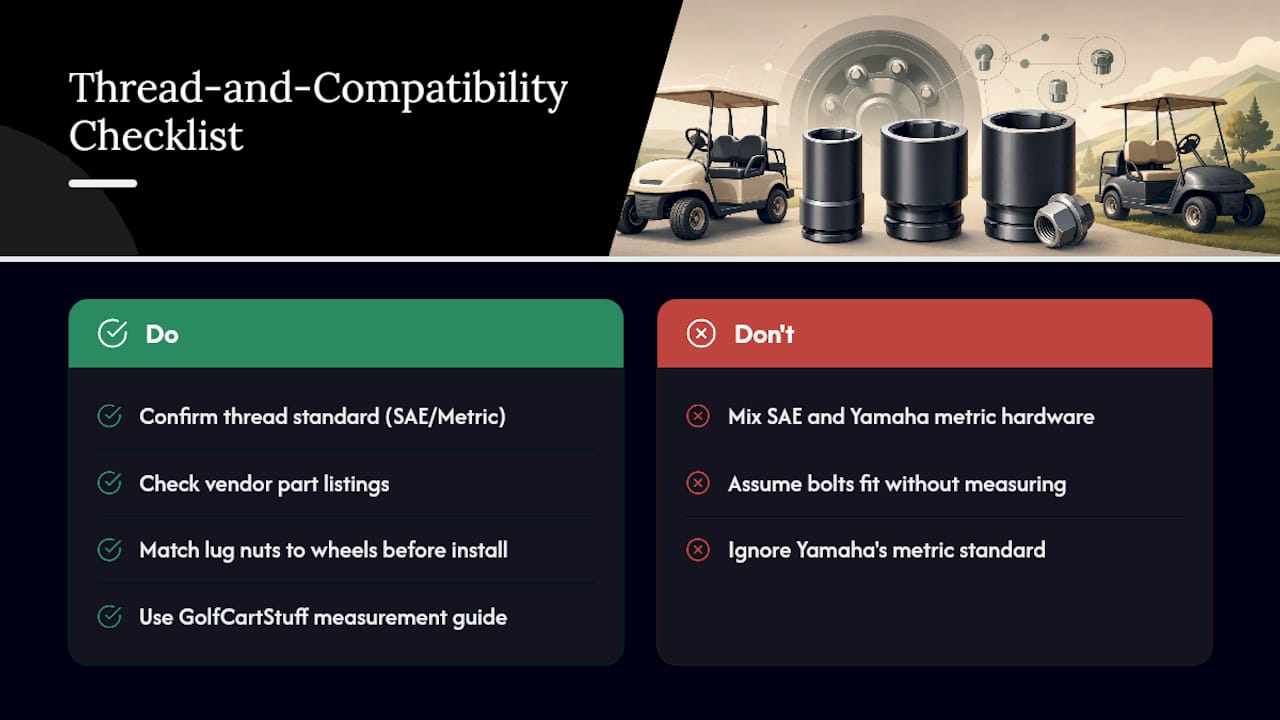
Most golf cart content treats lug nuts as an afterthought, a quick mention buried inside a broader maintenance article. That’s backwards. Getting the thread spec wrong is one of the few golf cart mistakes that can actually strand you or damage a stud beyond a quick fix, and it happens because owners trust memory or a “close enough” socket fit instead of five minutes with a caliper.
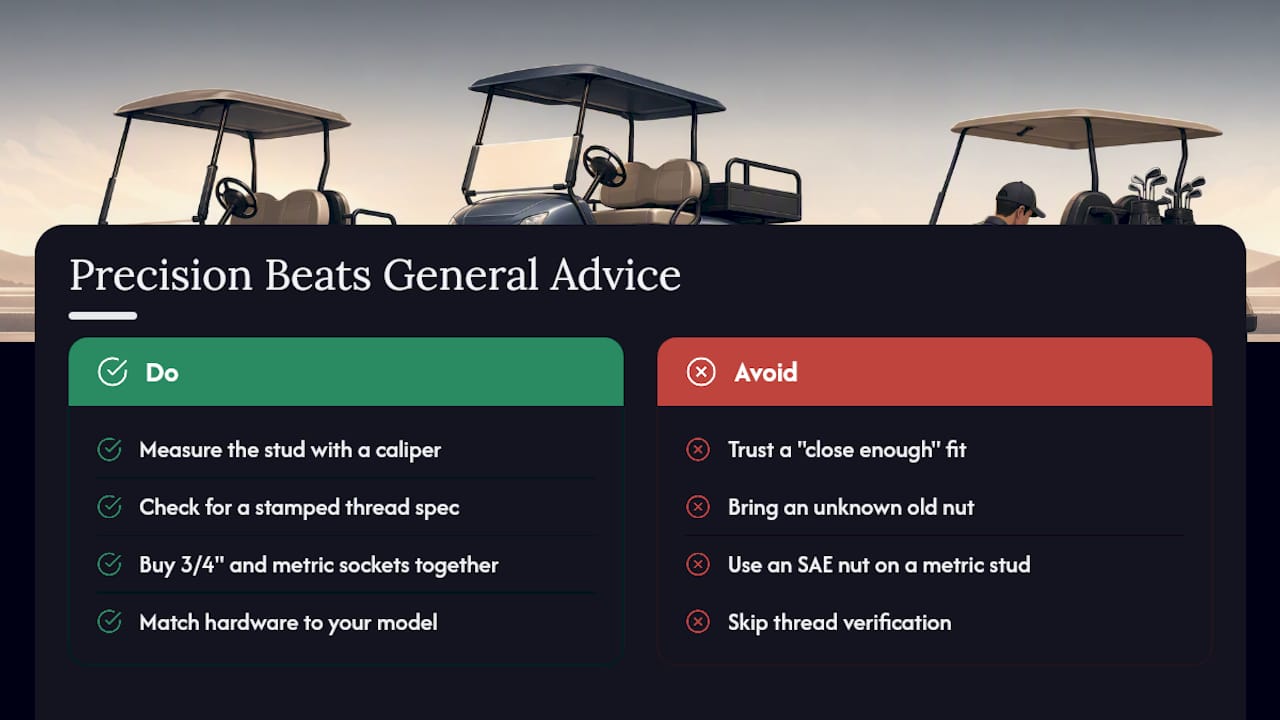
The conventional advice, “just bring the old nut to the store,” works until the old nut is the wrong one someone installed years ago. I’d rather see owners measure the stud directly and check for a stamped spec before they even think about buying. Yamaha owners especially underestimate how easily a metric stud gets damaged by a well-meaning SAE nut that almost fits.
If you take one thing from this: buy the 3/4" and metric sockets together, regardless of your brand. Carts get sold, wheels get swapped, and the next owner’s toolkit shouldn’t depend on guesswork.
— Roshan
Ready to match the right hardware to your cart? Browse Club Car parts for SAE-spec lug nuts and wheels, or check the Yamaha G1-G22 parts collection for correctly sized M12 x 1.25 metric hardware built for your model.
Explore our store to see what our products and resources can do for you.

Leave a comment