
Your Cart Is Our Priority
Explore our store to see what our products and resources can do for you.

A roof rack is worth adding if you regularly haul coolers, camping gear, or bulky tools and your cart has usable roof supports to bolt into. Before you buy anything, measure your roof, check what’s rated to hold weight, and confirm total height so the rack won’t clip a garage door or low branch.
TL;DR:
- Choose a roof rack with a weight capacity rated above your typical cargo load to ensure safety, especially on uneven terrain.
- Measure your cart’s roof length, width, and total height with accessories before selecting a rack to avoid fit and clearance issues.
- Use factory reinforced support points for mounting whenever possible and torque hardware to manufacturer specifications for safety and stability.
- Be aware that lifted carts and those with additional accessories can increase height by a foot or more, affecting garage clearance and route passages.
- Regularly inspect and re-torque mounting hardware, and avoid overloads or loose straps that can compromise cargo security and rack longevity.
A golf cart roof rack is a mounted frame that turns unused space above the cab into cargo capacity, usually secured to the roof supports or the factory roof struts rather than the fiberglass or aluminum roof panel itself. Most fall into three rough categories: basket-style racks with raised side rails for loose gear, flat platform racks built for coolers or flat boxes, and ladder-style racks designed to carry long, narrow items like fishing rods or lumber.
The appeal is obvious once you’ve tried to cram a 48-quart cooler and a folding table into a cart that already seats four people. Roof space solves that without eating into legroom or the rear basket.
Common uses owners report:
If your main cargo is heavy and dense, like a full-size generator or a case of bottled water, a rear cargo basket or a small trailer usually makes more sense than putting that weight up high. Roof racks work best for bulky but lighter items.
Fit comes down to three numbers: roof length, roof width, and total installed height. Skip this step and you either buy a rack that doesn’t bolt up to your supports or end up with a cart that won’t clear your garage door.
Here’s the sequence to follow before you order anything:
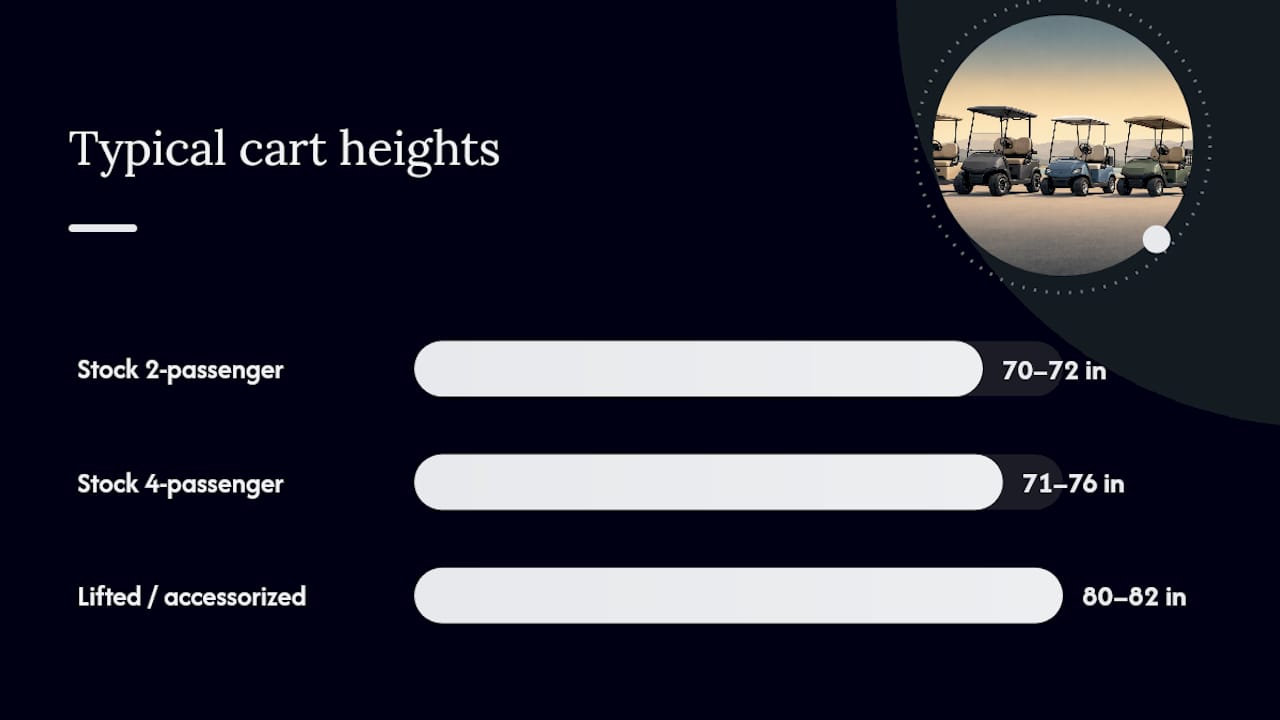
Cart height varies more than most owners expect. Stock two-passenger carts commonly run 70 to 72 inches tall, while four-passenger stock models measure closer to 71 to 76 inches. Lifted carts, or carts already carrying roof accessories, can climb to 80 or 82 inches. That’s a full foot of variation between a stock two-seater and a lifted four-seater with a rack loaded up, which is exactly why “just eyeball it” measuring causes so many returns.
Clearance checklist:
A rough rule some installers use is keeping at least 90 percent of your garage door’s rated height as your working ceiling, leaving a margin for uneven pavement or a slightly soft tire changing your ride height. Cart models also differ in where their roof supports sit and how much they can take, so check a model-specific roof support guide before assuming your EZGO, Club Car, or Yamaha matches a generic diagram.
Weight capacity is the number that matters most, and it’s also the one owners most often ignore. A rack rated for 100 pounds static doesn’t mean 100 pounds while bouncing down a cart path at 15 mph. Match the rating to your actual habit, not your best-case load, and leave real margin if you’ll be driving on uneven terrain.
Material affects both weight and longevity. Steel racks are strong and cheap but heavier, and they’ll rust if the powder coating chips. Aluminum racks weigh less, which matters since everything up top raises your center of gravity, and they resist corrosion naturally, though they typically cost more per pound of capacity. Powder-coated finishes on either material add a real layer of protection against sun and moisture, but a scratched coating on steel needs prompt touch-up or rust starts underneath it within a season.
Mount type determines how invasive installation gets:
Pro Tip: Buy the mounting hardware kit rated for your exact rack model rather than substituting generic hardware store bolts. Roof supports flex slightly at speed, and undersized bolts back out over time in a way that’s easy to miss until the rack shifts.
Once the rack’s mounted, a cargo net, ratchet straps, and a dedicated cooler or rod mount turn it from a flat platform into something you’ll actually trust with gear.
Installation is straightforward mechanically, but it rewards patience more than speed. Rushing the bracket alignment is the single most common reason racks end up crooked or loose within the first month.
Before you start, run through this checklist:
The install sequence, at a high level:
Some models complicate this. Certain EZGO and Club Car roof supports have reinforced mounting points designed for factory accessories, while others require aftermarket drilling that can weaken the support if done in the wrong spot. Yamaha carts vary by generation in how their roof struts attach. If your model isn’t covered by an install guide with clear photos and torque specs, or you’re not confident drilling into a structural roof support, that’s the point to call a technician and ask specifically whether your roof uses reinforced supports or standard factory holes.
A loaded roof rack changes how your cart handles, and that’s worth taking seriously rather than treating as a footnote. Weight sitting high above the cart’s center of gravity makes it lean more in turns and reduces your margin on uneven terrain, so a lot of owners cut their turning speed noticeably once the rack’s loaded.
Routine maintenance to stay on top of:
Real trade-offs to weigh:
For cargo securement, a cargo net or two ratchet straps beats bungee cords every time. Bungees stretch under vibration and let loads shift, which is how coolers end up sliding off mid-drive. Keeping the cart itself dry between uses also matters. Tarps alone tend to trap moisture against the roof and accelerate corrosion at those same bracket points, which is one reason clamshell shelters and metal carports are a better long-term bet than a plain cover if the cart sits outside.
Guessing at roof support strength is how racks end up loose or, worse, pulling a support loose from the roof panel entirely. Golfcartstuff publishes owner guides that walk through exactly where roof supports sit on common models and what torque specs to use, which matters more than any generic installation video because support placement genuinely differs between an EZGO, a Club Car, and a Yamaha.
The roof support owner’s guide covers the details that determine whether a bolt-on bracket will actually hold.
Before you drill anything, run through this short checklist pulled from that guidance:
Consulting a model-specific page before modifying roof supports saves you from the two most common and expensive mistakes: drilling in the wrong spot, and buying a rack your roof simply isn’t built to hold.
The instinct with roof racks is to shop by brand reputation first and fit second. That’s backwards. A well-reviewed rack bolted to the wrong point on a roof support does nothing for you, and a mid-tier rack correctly matched to your model’s reinforced points will outlast it.
Where conventional advice falls short is treating installation as an afterthought, a five-minute footnote after the “which rack should I buy” decision. In practice, the install determines whether the purchase decision even mattered. A rack rated for 75 pounds is a different product entirely depending on whether it’s clamped to a factory reinforced point or drilled into a thin aftermarket spot that was never meant to bear load.
If you take one thing from this guide, prioritize the boring stuff first: measure with accessories on, confirm your model’s actual roof support type, and torque hardware to spec rather than “tight enough.” Capacity ratings and material choice matter, but they only matter after fit is settled. Skip that order and you’re troubleshooting a wobbly rack in six months instead of hauling gear.
— Roshan
Model-specific brackets and roof-mount hardware sorted by chassis are available to avoid reverse-engineering a universal kit to fit an EZGO, Club Car, or Yamaha frame. That’s the real advantage over generic racks sold with one-size-fits-most hardware: you order parts already matched to your cart’s roof supports instead of gambling on adapters.
Start by measuring your roof and total height with accessories installed, then decide on capacity and mount type based on what you actually carry. From there, browse the golf cart accessories collection for roof-mount parts and hardware, or head straight to the Club Car DS parts collection or Yamaha G1-G22 parts collection if you know your chassis. Once parts are in hand, follow the model-specific install guide before you torque a single bolt.
For deeper technical detail, check ShelterLogic’s storage guide, Golf Cart Search’s garage sizing guide, and Plastnet’s garage floor protection guide for flooring beneath a stored cart.
Explore our store to see what our products and resources can do for you.

Leave a comment