
Your Cart Is Our Priority
Explore our store to see what our products and resources can do for you.

TL;DR:
- The golf cart rear differential allows the rear wheels to spin at different speeds during turns, improving handling. Proper maintenance, including regular fluid checks and replacements, extends its lifespan and prevents costly repairs. Identifying the differential type helps determine correct fluids and maintenance practices for optimal performance.
The golf cart rear differential is the gear assembly that allows the rear wheels to rotate at different speeds during turns while distributing motor torque to both sides of the axle. Without it, both rear wheels would spin at the same rate, causing the inside tire to scrub against the pavement on every corner. Understanding how this component works, how to maintain it, and when to repair or replace it saves you money and keeps your cart running reliably for years.
The rear differential splits engine torque between the two rear output shafts while allowing each wheel to rotate at its own speed. That function is what makes smooth cornering possible. When your cart turns right, the left rear wheel travels a longer arc than the right. The differential lets the outside wheel spin faster to cover that extra distance without binding the drivetrain.
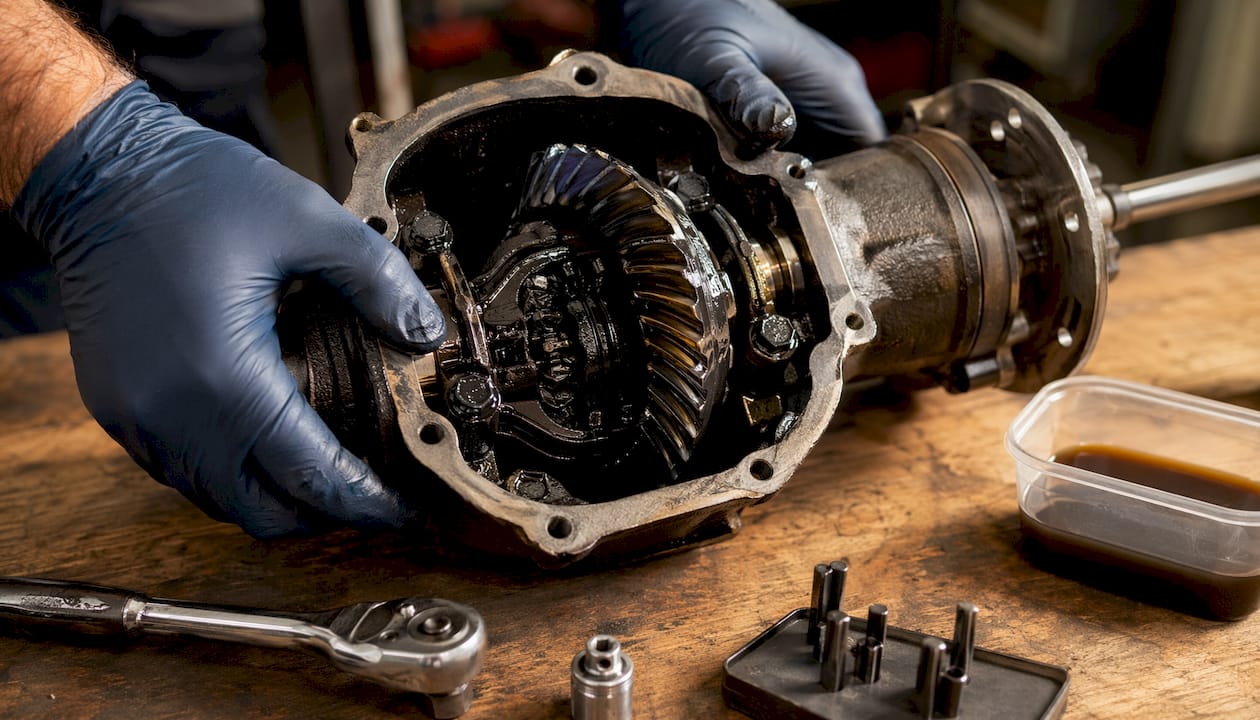
The gear set inside the housing makes this happen. Four main parts do the work: the ring gear, the pinion gear, the spider gears, and the carrier. The pinion gear connects to the driveshaft and meshes with the ring gear to transfer power into the differential housing. The carrier holds the spider gears, which are small bevel gears mounted on a cross shaft inside the carrier. When both wheels meet equal resistance, the spider gears do not rotate on their own axis. They simply carry torque to both axle shafts equally. When one wheel meets less resistance during a turn, the spider gears begin to rotate, allowing that wheel to speed up while the other slows down.
| Component | Function |
|---|---|
| Ring gear | Receives torque from the pinion and drives the carrier |
| Pinion gear | Transfers driveshaft power into the differential housing |
| Spider gears | Allow each axle shaft to rotate at a different speed |
| Carrier | Houses the spider gears and rotates with the ring gear |
| Axle shafts | Carry torque from the spider gears out to each wheel |
Pro Tip: Not every gear noise signals a problem. Some whining sounds are normal results of gear tooth geometry and do not indicate failure. Check the fluid for metallic debris first. If the fluid is clean, the noise is likely harmless.
Golf carts use two main differential types: open and limited slip. Knowing which one your cart has changes how you maintain it and what fluids you use.
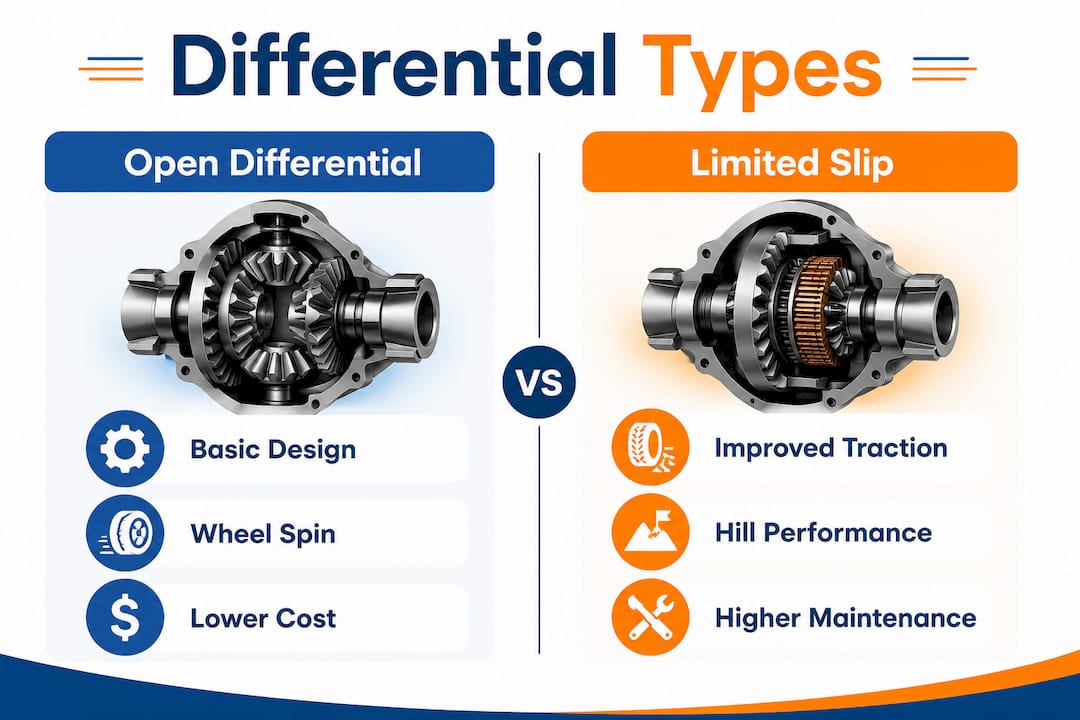
An open differential sends torque to whichever wheel has the least resistance. That works well on flat, paved courses but becomes a liability on loose terrain. If one wheel lifts off the ground or sits on a slick surface, all the torque goes to that wheel and the cart loses traction. A limited slip differential (LSD) uses clutch packs or friction plates to bias torque toward the wheel with more grip. LSDs are less common on standard golf carts but appear on some off-road and utility models.
To identify your differential type, follow these steps:
Understanding your differential type also guides performance upgrades for carts used on hills or rough terrain, where traction management matters most.
Consistent fluid maintenance is the single most effective way to extend differential life. Industry standards recommend checking fluid every 6 months and replacing it every 2 years under normal use. That schedule keeps gear surfaces lubricated and prevents the metal-on-metal contact that destroys ring and pinion sets.
Follow this maintenance sequence for a DIY fluid service:
Heavy loads or steep terrain break down friction modifiers in gear oil faster than normal use. If you regularly haul cargo or drive on hills, cut your fluid replacement interval to once a year rather than every two years. The cost of a quart of gear oil is a fraction of what a new ring and pinion set costs.
Pro Tip: Before you drain the fluid, run the cart for five minutes to warm the oil. Warm fluid flows out faster and carries more suspended wear particles with it, giving you a cleaner fill.
A full golf cart maintenance checklist should include the differential alongside battery checks, brake inspections, and tire pressure. Treating it as a standalone task means it gets skipped.
Most differential problems announce themselves through sound or handling changes before they cause complete failure. Catching them early keeps repair costs low.
Typical warning signs include:
Once you identify a problem, you face a choice: rebuild the gear set or swap in a complete rear axle assembly. Each path has real trade-offs.
| Factor | Gear set rebuild | Full assembly replacement |
|---|---|---|
| Cost | Lower parts cost | Higher upfront cost |
| Time | Several hours, high skill | Faster swap, moderate skill |
| Tools needed | Dial indicator, bearing press | Basic hand tools |
| Risk | High if done without proper tools | Low, known-good assembly |
| Best for | Minor wear, correct tools on hand | Severe damage, no specialty tools |
Rebuilding without a dial indicator and bearing press leads to incorrect backlash and preload settings. That causes early gear failure and the exact whining noise you were trying to fix. For most DIY owners, a complete rear axle assembly replacement is the safer and often faster path when damage is significant.
Ignoring differential problems does not make them cheaper. A worn bearing that costs $30 to replace becomes a destroyed ring gear that costs ten times more if you keep driving on it. Use the golf cart noise guide from Golfcartstuff to match sounds to specific causes before ordering parts.
The rear differential is the most maintenance-neglected component on most golf carts, yet it is the one that controls traction, cornering, and drivetrain longevity.
| Point | Details |
|---|---|
| Core function | The differential lets rear wheels spin at different speeds, preventing tire scrub and axle stress during turns. |
| Fluid schedule | Check gear oil every 6 months and replace it every 2 years, or annually under heavy use. |
| Know your type | Identify open vs. limited slip before buying fluid, since LSDs require a friction modifier additive. |
| Noise diagnosis | Whining alone is not always failure. Check for metallic debris in the fluid before assuming gear damage. |
| Repair decision | Choose full assembly replacement over a DIY rebuild unless you have a dial indicator and bearing press. |
Most golf cart owners I talk to have never touched their differential fluid. They service the batteries, check the tires, and clean the body, but the rear axle housing gets ignored until something starts grinding. By then, the repair bill is three to five times what a fluid change would have cost.
The rebuild question trips people up the most. I understand the appeal of saving money by doing it yourself, but setting backlash and preload without a dial indicator is guesswork. I have seen carts come back with worse noise than before the rebuild because the gear mesh was off by a few thousandths of an inch. That is not a beginner task.
What actually works is simple: set a calendar reminder every six months to pull the fill plug and check the fluid color and level. Dark, metallic fluid means you change it now, not at the two-year mark. Clear or amber fluid with no debris means you are fine. That five-minute check has saved more differentials than any rebuild kit ever will.
If you drive on hills or carry passengers and cargo regularly, treat your differential like a truck differential, not a golf cart one. The loads are different, and the fluid breaks down faster. Adjust your schedule accordingly and you will likely never need to open that housing at all.
— Roshan
Golfcartstuff stocks rear differential components, axle parts, and drivetrain hardware for the most popular golf cart models on the market.
Whether you drive a Club Car DS or a Yamaha G-series, Golfcartstuff carries the parts you need to complete a fluid service or a full axle replacement. The Club Car DS parts catalog includes differential seals, axle shafts, and gear oil suited to Club Car drivetrains. Yamaha owners can find model-specific components in the Yamaha golf cart parts section. Every part ships with clear fitment details so you order with confidence and avoid returns.
The rear differential splits motor torque between the two rear wheels and allows each wheel to rotate at a different speed during turns. This prevents tire scrubbing and reduces stress on the axle shafts.
Check fluid every 6 months and replace it every 2 years under normal use. Carts used on hills or with heavy loads need fluid changes every year.
Whining often comes from normal gear tooth geometry and does not always signal failure. Check the drained fluid for metallic particles. If the fluid is clean, the noise is likely not a sign of immediate damage.
A rebuild is possible but requires a dial indicator and bearing press to set backlash and preload correctly. Without those tools, improper gear setup causes early failure. Most DIY owners get better results from a complete axle assembly swap.
An open differential sends torque to the wheel with the least resistance, which reduces traction on loose or uneven ground. A limited slip differential biases torque toward the wheel with more grip and requires a friction modifier additive in the gear oil.
Explore our store to see what our products and resources can do for you.

Leave a comment