
Your Cart Is Our Priority
Explore our store to see what our products and resources can do for you.

TL;DR:
- Golf cart relays control high-power circuits and protect wiring from damage.
- They operate by using low-current signals to switch larger currents for components.
- Regular inspection and proper replacement prevent costly electrical failures and extend system lifespan.
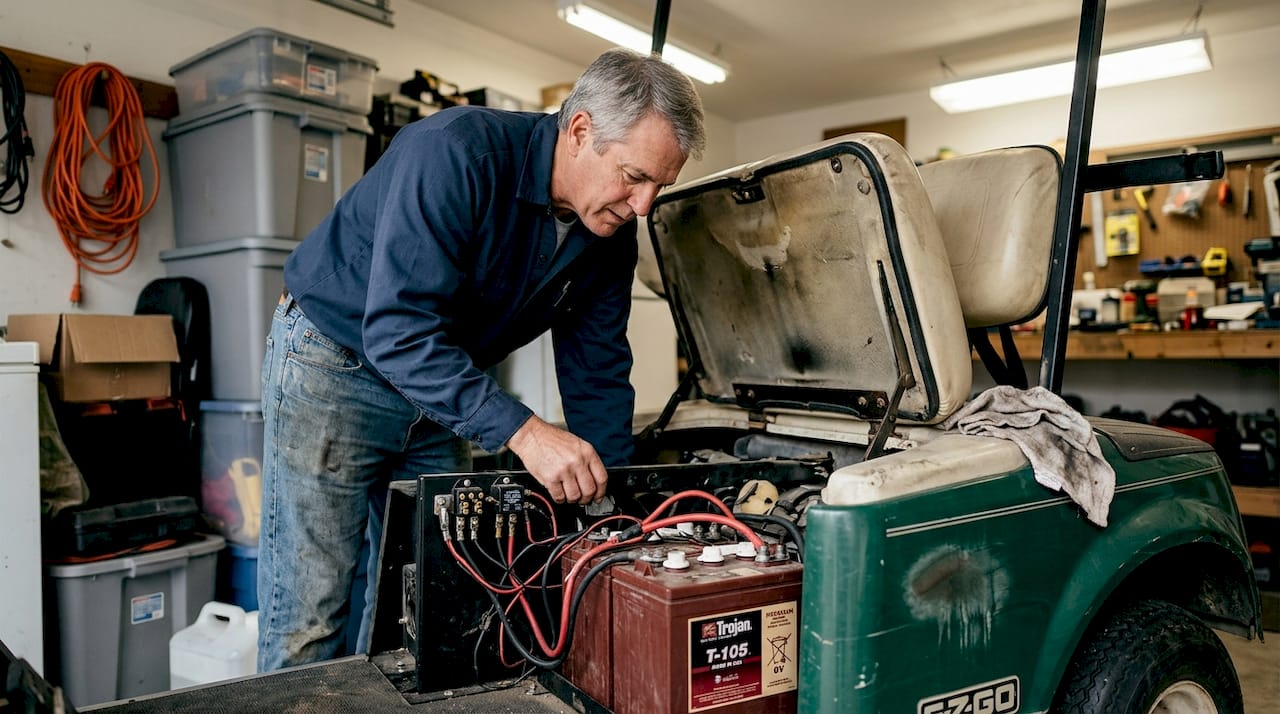
Golf carts look simple from the outside. Four wheels, a motor, a battery pack, and a seat. But underneath that clean exterior sits a surprisingly sophisticated electrical system, and one of its most critical components is something most owners have never thought about: the relay. Relays quietly manage the flow of electricity every time you press the gas, flip on your lights, or start your cart. Ignore them, and you risk unexpected breakdowns, damaged wiring, and expensive repairs. This guide walks you through what a relay does, how it works, the different types you’ll find, and how to keep them in good shape.
| Point | Details |
|---|---|
| Relays control main circuits | Golf cart relays safely link low-power switches to high-power components for reliable operation. |
| Multiple relay types exist | Solenoids, accessory relays, and solid-state relays each serve specific purposes in your golf cart. |
| Regular checks prevent failures | Inspecting and maintaining relays can help avoid sudden breakdowns and costly repairs. |
| Easy DIY replacement | Most owners can diagnose and change faulty relays with basic tools and safety precautions. |
A relay might sound like an advanced electrical term, but the concept is straightforward. Think of it like a remote-controlled light switch. You flip a small switch in one room, and it controls a much more powerful circuit somewhere else. In your golf cart, a relay does exactly that. As explained in golf cart relay basics, “a relay is an electrically operated switch that helps control high-power circuits with a low-power signal.”
This matters because the motor, headlights, and other components in your golf cart require far more electrical current than your small control switches can safely handle. Without a relay sitting in between, you’d need thick, heavy wiring running directly to every switch, and those switches would burn out fast.
Relays show up in several places across your cart:
Each of these locations benefits from the relay’s ability to separate a low-power control signal from a high-power output circuit. That separation is what keeps your wiring from overheating and your switches from failing prematurely.
Key insight: A relay doesn’t just switch things on and off. It acts as a safety buffer between delicate control components and the raw electrical power flowing through your cart’s main circuits.
Direct-wired circuits without relays are simpler to install, but they’re far less safe and less efficient. Every time current flows through a switch directly, that switch absorbs heat and wear. A relay shifts that burden away from the switch, extending the life of your entire electrical system. For golf cart owners who rely on their carts daily, whether on the course, around a community, or on a job site, this kind of protection is not optional. It’s essential.
Understanding the mechanics behind a relay makes it much easier to diagnose problems and appreciate why your cart behaves the way it does. The process happens in a fraction of a second, but there are clear steps involved.
As noted in motor relay troubleshooting, “when you press a switch on your golf cart, a small current activates the relay and allows a larger current to flow to the component.” That separation between the control side and the power side is called signal isolation, and it’s one of the smartest features of relay-based circuits.
Signal isolation means that even if your high-power circuit experiences a surge or fault, the damage stays contained. Your control wiring and switches remain protected. This is especially important in golf cart controller relays, where the speed controller sends precise signals that must not be disrupted by electrical noise from the motor circuit.
Pro Tip: If your cart’s lights flicker or your motor hesitates, don’t immediately blame the battery. A relay with a worn contact arm can cause exactly these symptoms, and it’s a much cheaper fix.
In popular models like Club Car, EZGO, and Yamaha, relays are typically located near the battery pack, under the seat, or mounted on the motor controller bracket. Knowing where to look saves you time when something goes wrong.
Not all relays are built the same, and knowing which type handles which job helps you make smarter repair decisions. There are three main types you’ll encounter.
Solenoid relay: This is the heavy-duty workhorse of your golf cart. It handles the main drive circuit, connecting the battery to the motor when you press the accelerator. Solenoids are larger than standard relays and built to handle high amperage. You’ll usually hear a distinct click when the solenoid engages.
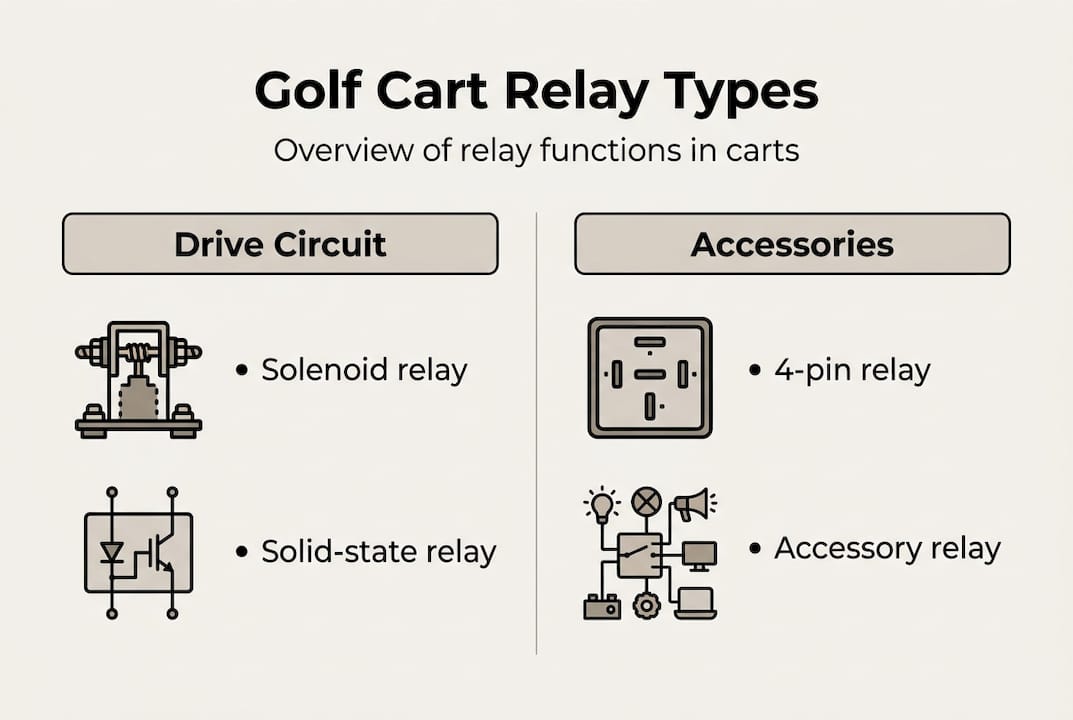
Standard 4-pin relay: These smaller relays manage accessories like lights, horns, and fans. They’re compact, inexpensive, and easy to swap out. Most light relay wiring setups use this type.
Solid-state relay: Found in newer and more technologically advanced carts, solid-state relays use semiconductor components instead of mechanical contacts. They’re quieter, faster, and more durable over time, but they’re also more expensive and harder to test with basic tools.
As confirmed in controller relay roles, “solenoid relays are commonly used for powering the main drive circuit, while standard 4-pin relays handle accessories.”
| Relay type | Primary use | Current capacity | Replaceability |
|---|---|---|---|
| Solenoid | Drive motor circuit | High (100A+) | Moderate |
| Standard 4-pin | Lights, accessories | Low to medium | Easy |
| Solid-state | Modern controllers | Variable | Difficult |
Signs that a relay may be failing vary by type:
Knowing these symptoms by relay type helps you zero in on the right component quickly instead of guessing.
Relay problems are more common than most owners realize. In fact, 85% of golf cart first-time fixes involve diagnosing issues with electronic components like relays. That’s a striking number, and it tells you that knowing how to test and replace a relay is one of the most valuable skills you can have as a cart owner.
The most common symptoms of a bad relay include:
Here’s how to test and replace a relay step by step:
For complete relay fault troubleshooting guidance, including motor-specific issues, it helps to cross-reference your cart’s wiring diagram. Also keep up with charger maintenance to avoid voltage irregularities that can stress relays over time.
Pro Tip: Always source OEM-quality or manufacturer-spec replacement relays. Cheap generic substitutes may fit physically but fail to handle the correct amperage, which can cause repeated failures and even wiring damage.
Here’s something we’ve seen time and again: an owner replaces their battery, then their motor, then their controller, and the cart still acts up. The real culprit? A $15 relay that nobody thought to check.
Relay problems are sneaky because their symptoms mimic bigger failures. A cart that won’t move feels like a dead motor. Lights that cut out feel like a battery issue. Most owners reach for the most expensive explanation first, when the relay sitting quietly in the circuit is the actual problem.
The uncomfortable truth is that relays are often the last thing inspected, not because they’re hard to check, but because they’re easy to forget. As regular maintenance for relays shows, “routine relay maintenance can extend your golf cart’s electrical system life by years.” That’s not a minor benefit. That’s real money saved.
Our approach is simple: make relays part of every routine inspection. Check for corrosion, listen for weak clicks, and test continuity once a season. Catching a failing relay early costs almost nothing. Catching it after it takes out your controller costs a lot more.
Once you understand how relays work and what to look for, the next step is making sure you have the right replacement parts on hand before something fails.
At GolfCartStuff.com, we carry a wide selection of electrical components, including relays, solenoids, and wiring accessories that are compatible with the most popular cart brands and models. Whether you drive a Club Car, Yamaha, or EZGO, you can browse golf cart accessories to find exactly what your cart needs. Looking for model-specific components? Check out our Club Car DS parts or Yamaha G1-G22 parts collections for precise fitment and OEM-quality reliability.
Common signs include no response when activating components, repeated clicking sounds, or intermittent function. These symptoms of relay failure are often mistaken for larger electrical problems, so checking the relay first saves time and money.
Yes, with basic tools and careful attention to safety, most owners can handle this repair at home. Golf cart relays can be changed by following step-by-step procedures and matching the correct relay spec to your cart model.
The most common types are solenoid relays for the drive motor, standard 4-pin relays for accessories like lights and horns, and solid-state relays in some modern carts.
Relays protect your electrical system from overload by separating low-power control signals from high-power output circuits. This separation means safe control of high currents and protection for sensitive components like your controller and switches.
Relays should be checked during every major service interval or any time you notice electrical issues. Routine relay inspection is a standard part of recommended golf cart maintenance and takes only a few minutes with a multimeter.
Explore our store to see what our products and resources can do for you.

Leave a comment