
Your Cart Is Our Priority
Explore our store to see what our products and resources can do for you.

A shocks upgrade earns its keep on lifted carts, loaded rear seats, and off-road terrain, but does little for a stock cart cruising smooth pavement. If your cart fits one of those first three categories, your next move is simple: measure the eye-to-eye length and mount style on your current shocks, then pick a tier below. Fitment charts from golf cart parts retailers can confirm the match before you order.
TL;DR:
- Upgrading shocks for lifted carts or off-road use requires measuring current shocks and matching the correct type, with long-travel kits costing over $1,000 installed.
- Heavy-duty, gas-charged shocks improve load support and trail performance but are unnecessary for smooth pavement cruising, which only requires OEM-style replacements.
- Proper diagnosis of suspension issues involves checking springs first, as sagging often stems from spring failure rather than shock wear.
- Confirming mounting style, bushing size, and ride height changes before purchase prevents costly mismatches, especially on lifted or model-specific carts.
- Regular suspension checks, including bounce tests and tire pressure, help maintain shock performance and prevent unnecessary replacements.
Not every cart needs the same fix, and matching the tier to the job matters more than chasing the priciest option on the shelf. Here’s how the three main upgrade paths break down.
OEM-style replacement works for value-focused owners who just want their factory ride restored. These are hydraulic units built to the same spec as what came on the cart, and they’re the right call for neighborhood cruisers and light course duty. A full set for common EZGO or Club Car models typically runs $60 to $80, with Yamaha pairs landing closer to $175 to $195 because of different mount hardware. Trade-off: you get back to stock, not beyond it.
Heavy-duty, gas-charged shocks step up damping consistency for carts hauling rear seats, coolers, or utility loads, and they hold up better on washboard trails than basic hydraulics. Hands-on testing on a 10L0L unit installed on an EZGO TXT showed a meaningful reduction in rear sag under payload, though the same test noted a firmer front-end feel on an unlifted cart. That firmness isn’t a flaw. It’s the trade you make for load support, and it’s worth knowing before you order a set for a cart that rarely carries weight.
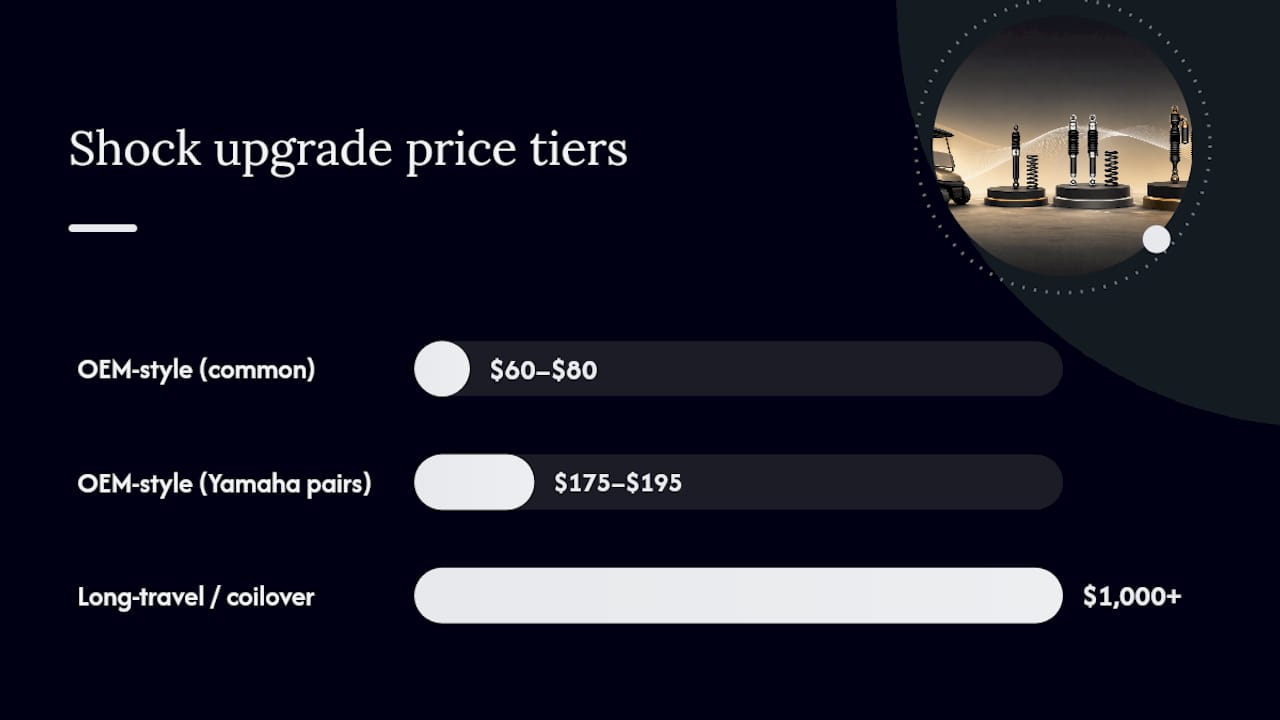
Long-travel or coilover kits exist for lifted builds and genuine off-road use, where stock geometry runs out of usable stroke. Expect $1,000 or more installed, and expect it to be overkill on a cart that never leaves pavement.
Before buying anything, confirm these details:
Start by naming your use case honestly. A neighborhood cruiser, a loaded utility cart, and a lifted off-road build each want a different shock, and guessing wrong here is the single most common return reason in this category.
Owners frequently confuse sagging with worn shocks, and buying new dampers to fix a spring problem is a wasted purchase. Diagnose before you buy, not after.
Pro Tip: Push down hard on one corner of the cart and release. If it bounces more than once or twice before settling, the shock on that corner is worn. If it barely moves at all, check the spring rate instead, since an overly stiff spring can mask shock wear.
The differences between shock types come down to how consistently they control motion, not just how firm they feel in the driveway.
If your cart runs washboard trails or gravel paths regularly, gas-charged is the baseline you want. If you’ve already lifted the cart and are still riding on stock-length shocks with an extension rod, that’s a temporary fix, not a real one.
Getting the measurements wrong is the number one reason DIY shock swaps go sideways, and it’s an easy mistake to avoid with five minutes of checking before you buy.
Record these three numbers off your current shocks:
Model-specific quirks matter here too. EZGO TXT shocks often interchange across several EZGO model years, which makes sourcing easier, but always confirm against your specific year rather than assuming. Club Car DS and Precedent models use different mount geometry despite both being Club Cars, so a shock built for one won’t drop into the other without adapting hardware. Yamaha carts frequently pair a coil-spring rear setup that behaves differently from EZGO and Club Car’s rear suspension, which changes both the shock length and the spring rate you’ll want.
Lift kits complicate all of this further. Once you’ve installed a lift, the spindle geometry and shock operating angle both change, which is exactly why a stock-length shock runs out of stroke on a lifted cart and why extension rods are a stopgap at best.
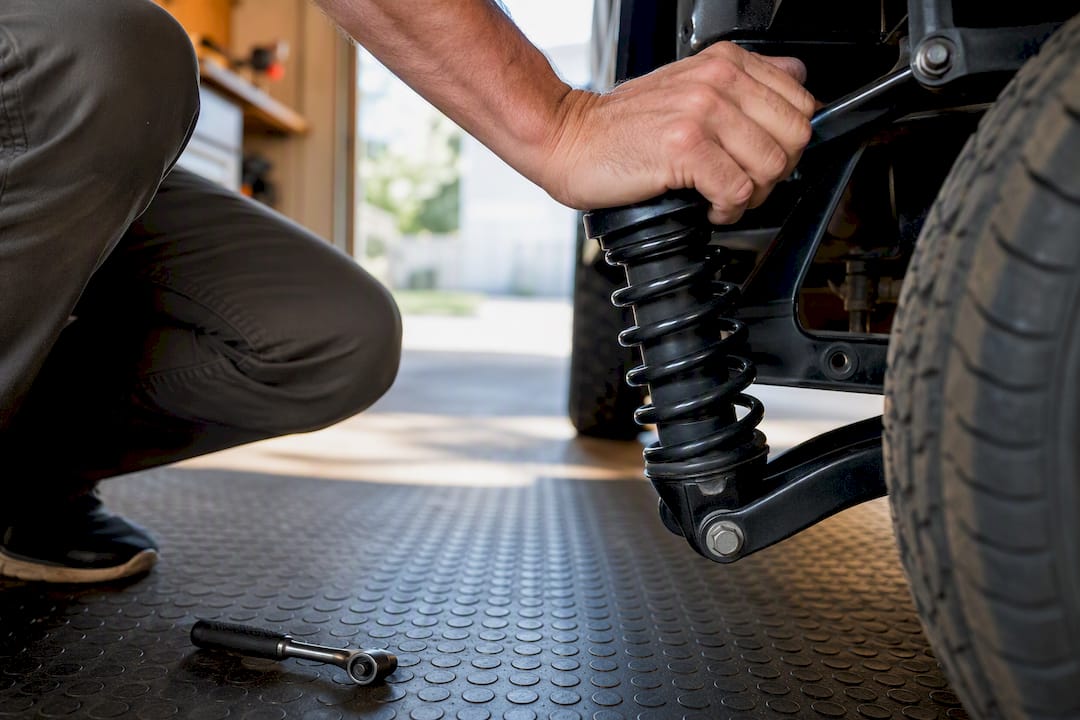
Swapping front shocks on a common EZGO TXT is a genuinely approachable weekend job. The full process runs 1 to 2 hours with basic hand tools, and most owners with a socket set and a little patience can handle it without a shop visit.
Tools you’ll want on hand:
The basic sequence:
Pro Tip: Don’t crank the mount bolts past spec thinking tighter is safer. Over-tightening compresses the bushing and restricts the pivot movement the shock needs to work, which defeats the upgrade before you’ve even driven it.
Spring replacement, full coilover installs, and long-travel kits involve more disassembly and sometimes specialty tools like a spring compressor. If you’re not confident with those, a shop visit running $85 to $250 is money well spent.
A quick monthly look at your suspension catches most problems before they turn into a bad ride or a bigger repair. Check for fluid leaks around the shock body, any visible damage to the rod, and worn bushings or loose mount hardware.
Pro Tip: If the ride feels harsh right after a shock swap, check tire pressure first. A stiffer shock paired with over-inflated tires amplifies every bump, and it’s the most common complaint after a heavy-duty upgrade.
Golfcartstuff has built out detailed suspension explainer guides and shock-specific fitment resources covering EZGO, Club Car, and Yamaha models, built from real fitment questions customers bring to us. This guide was written by Roshan. Use the measurement checklist above before ordering, and if you’re unsure about a fit, send us photos of your current shock and mount so we can confirm the match before it ships.
If I had to give one piece of contrarian advice here, it’s this: most owners reach for shocks when the real problem is sitting in the springs or the tires. A shock upgrade fixes damping. It does nothing for ride height, and it won’t fix a cart that’s sagging because the springs gave out years ago.
For a city cruiser on smooth streets, I wouldn’t spend a dollar on shocks. Check tire pressure and call it done. For a rear-seat utility cart hauling passengers or gear most days, heavy-duty gas-charged shocks matched to your spring rate are worth the money, and you’ll feel the difference on the first loaded trip. For a serious off-road build, don’t cheap out with an extension rod on stock shocks. A proper long-travel kit is the only setup that actually uses your lift correctly.
— Roshan
Suspension parts sorted by model are sold online, which can help avoid decoding generic listings hoping the mount pattern matches. That’s the real advantage over piecing a fitment together from mixed marketplace listings: you shop by your actual cart, not by guesswork.
If you drive a Club Car, start with the Club Car DS parts collection or the broader Club Car parts catalog for DS and Precedent-specific hardware. EZGO owners can go straight to the EZGO TXT parts page, and Yamaha owners will find coil-spring-compatible options on the Yamaha G1-G22 parts page. Building or finishing a lift? The off-road and street-legal accessories page covers the hardware that pairs with long-travel setups, and partners like XTR Offroad Products round out the accessory side for serious builds. Not sure your measurements match what’s listed? Send us a photo of your current shock and mount, and we’ll confirm fitment before you check out.
For hands-on diagnosis, see Golfcartstuff’s guide on spotting suspension problems early and the breakdown of why carts ride rough. For deeper buyer research, the suspension buyer’s guide and the 10L0L shock review offer real installed results worth reading before you order.
Explore our store to see what our products and resources can do for you.

Leave a comment