
Your Cart Is Our Priority
Explore our store to see what our products and resources can do for you.

TL;DR:
- Golf cart shocks regulate spring rebound, preventing uncontrolled bouncing and improving ride comfort on various terrains.
- Choosing the correct type and size of shocks based on brand, model, and lift height is essential for optimal performance and safety.
Golf cart shocks are damping devices that control spring rebound, preventing your cart from bouncing repeatedly after hitting a bump. The industry term is shock absorber, and understanding how they work is the fastest way to fix a rough ride on any Yamaha, EZGO, or Club Car. Springs carry the weight of the cart. Shocks regulate what happens after the spring compresses and releases. Without working shocks, every small bump turns into a series of uncontrolled bounces that wear out your suspension and make every ride uncomfortable.
A shock absorber works by forcing hydraulic fluid through a calibrated piston. When your cart hits a bump, the spring compresses and then tries to rebound. The shock slows that rebound by converting motion into heat through fluid resistance. The result is a controlled, single return to ride height instead of a bouncing sequence.
A healthy shock absorber suppresses spring oscillations within 1–2 cycles. That number matters because it defines the difference between a cart that feels planted and one that wallows over rough ground. Damping force is directly proportional to piston velocity, meaning the faster the spring tries to rebound, the harder the shock resists.
Wheel contact with the ground also depends on shock performance. A shock that lets the wheel bounce loses traction and steering control. On a golf course or a neighborhood path, that translates to a cart that drifts and feels unpredictable. On a lifted cart running off-road terrain, failing shocks become a safety issue.
Pro Tip: Push down firmly on the front corner of your cart and release. If the cart bounces more than once before settling, your shocks are losing their damping ability and need inspection.
Two types cover nearly every golf cart on the market: oil shocks and gas-charged shocks. Each uses a different internal design, and the right choice depends on how and where you ride.
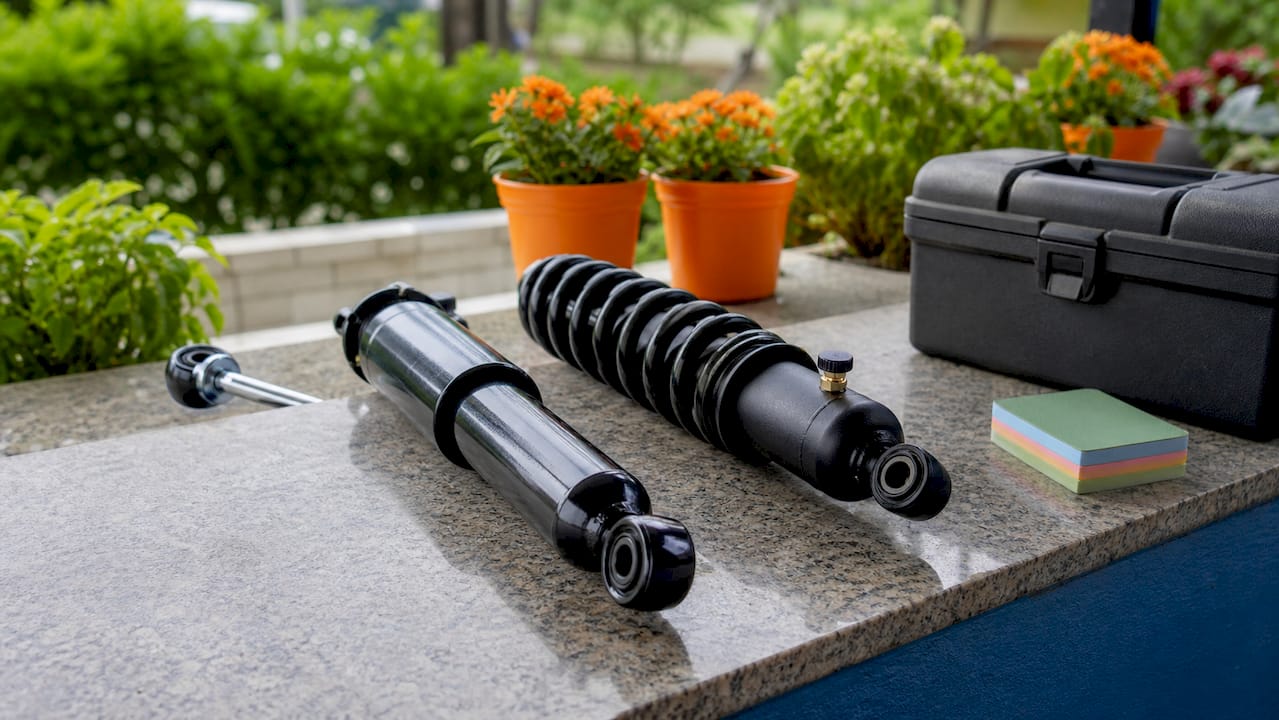
Oil shocks use hydraulic fluid only, with no pressurized gas. They deliver a softer, more compliant ride, which works well on flat golf courses and paved paths. The trade-off is fade. Under repeated heavy use, the fluid heats up and loses viscosity, reducing damping performance. Oil shocks typically cost $15–$30 and last 4–6 years under normal use. That price point makes them a practical choice for carts that stay on smooth terrain.
Gas-charged shocks add nitrogen pressure to the hydraulic fluid. That pressure prevents the fluid from foaming under heat, which is what causes fade in oil-only designs. The ride is firmer, but the damping stays consistent even after repeated bumps. Gas-charged shocks cost $20–$50 and last 5–7 years. For carts running on rough terrain, carrying heavy loads, or fitted with lift kits, gas-charged shocks are the better investment.
| Feature | Oil Shocks | Gas-Charged Shocks |
|---|---|---|
| Price range | $15–$30 | $20–$50 |
| Typical lifespan | 4–6 years | 5–7 years |
| Ride feel | Softer, more compliant | Firmer, more controlled |
| Fade resistance | Lower | Higher |
| Best terrain | Flat, paved, golf course | Rough, hilly, off-road |
| Load performance | Standard | Heavy loads and lifts |
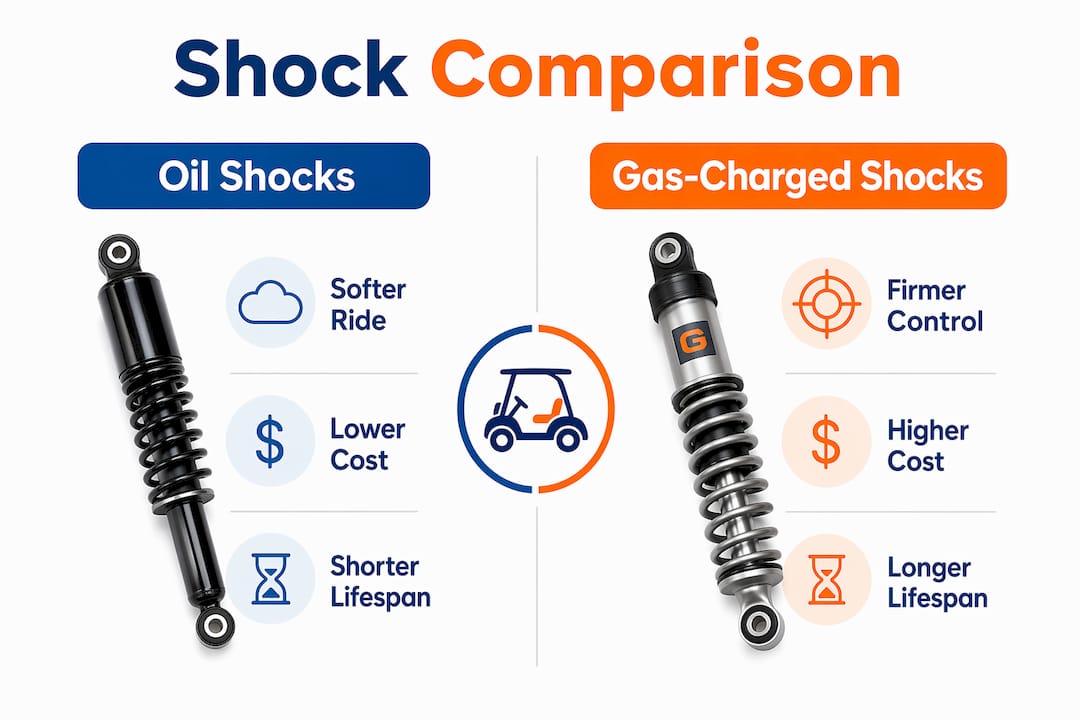
The table shows that gas-charged shocks cost roughly 50% more but deliver meaningfully longer life and better performance under stress. For most owners who use their cart beyond a flat fairway, that difference is worth the extra cost.
Compatibility is where most owners make expensive mistakes. Suspension designs differ by brand, and a shock that fits a Club Car DS will not fit a Yamaha Drive2. Getting this wrong means returning parts, waiting on shipping, and potentially damaging your suspension geometry.
Yamaha’s newer models, including the Drive2, use independent rear suspension with coil-over shocks. Most EZGO and Club Car models use a leaf spring setup with separate shock absorbers. That design difference changes both the shock length and the mounting hardware required. Front and rear shocks differ in size and design and are not interchangeable, even on the same cart.
Lifted carts add another layer of complexity. Lifted carts require longer shocks or kits with linkage extenders because stock-length shocks cannot accommodate the increased suspension travel. Installing the wrong length compresses the shock beyond its designed range and accelerates wear.
Steps to verify shock compatibility before ordering:
Pro Tip: Measuring both compressed and extended shock lengths before ordering is the single most effective way to avoid a costly return. Write both numbers down and keep them with your cart’s service records.
Shocks are the last thing to address, not the first. Replacing springs first is recommended if your cart sags or bottoms out, because new shocks cannot fix a ride problem caused by weak or broken springs. Springs carry the load. Shocks control the rebound. Both need to be functional for either to work correctly.
Knowing which component is failing saves you money. Excess bounce after bumps points to worn shocks. Sagging ride height, bottoming out on small bumps, or a nose-down stance points to spring failure. Confusing the two leads to replacing the wrong part.
Maintenance checklist for golf cart shocks and suspension:
For owners upgrading golf cart shocks on a lifted cart, aftermarket gas-charged shocks designed for the specific lift height deliver the best results. Generic shocks installed on a lifted cart without matching the extended length will bind or bottom out, creating worse ride quality than the worn shocks they replaced. Brands like Monroe and KYB make shocks that fit common golf cart applications, and OEM-equivalent options are available for Yamaha, EZGO, and Club Car through specialty retailers.
A full golf cart maintenance checklist should include suspension inspection at least once per season. Catching a leaking shock early costs far less than repairing suspension geometry damaged by a shock that failed completely.
Golf cart shock absorbers control spring rebound, and choosing the right type for your terrain, brand, and lift configuration is what separates a smooth ride from a rough one.
| Point | Details |
|---|---|
| Shocks control rebound, not weight | Springs carry load; shocks dampen bounce cycles to 1–2 after each bump. |
| Gas-charged shocks last longer | At $20–$50, gas shocks outperform oil shocks on rough terrain and under heavy loads. |
| Compatibility requires measurement | Measure compressed and extended lengths before ordering to avoid fitment errors. |
| Fix springs before shocks | Sagging or broken springs must be replaced first; shocks cannot correct spring failure. |
| Lifted carts need longer shocks | Stock-length shocks will not fit lifted carts and can damage suspension geometry. |
Most golf cart owners I talk to replace shocks when they should be replacing springs, or they order the wrong size because they skipped the measurement step. Both mistakes are easy to avoid and expensive to repeat.
The bounce test is the most underused diagnostic tool in golf cart maintenance. Two bounces and settle means your shocks are working. Three or more means they are not. That test takes ten seconds and costs nothing. Skipping it and ordering shocks based on a rough ride alone is how owners end up replacing parts that did not need replacing.
I also see owners install gas-charged shocks on a flat-course cart because they read that gas shocks are “better.” Better depends on context. On a smooth golf course, a gas-charged shock delivers a firmer ride that some owners find uncomfortable. Oil shocks are genuinely the right call for that application. Matching the shock to the terrain is more important than chasing the higher-spec option.
The Yamaha Drive2 coil-over setup trips up a lot of owners who are used to EZGO or Club Car leaf spring designs. The parts look different, the measurements are different, and the installation process is different. If you are switching brands or buying a used cart from a different manufacturer, treat it as a completely new fitment exercise. Do not assume anything carries over.
For DIY installs, always torque the mounting bolts to spec and check them again after the first 25 miles of use. Shocks work under constant load and vibration. A bolt that felt tight on the bench will loosen faster than you expect on a cart that sees daily use.
— Roshan
Golfcartstuff carries front and rear shocks compatible with the most popular golf cart brands, including Club Car and Yamaha, along with the suspension hardware needed for lifted and off-road builds.
Whether you are doing a direct OEM replacement or upgrading to gas-charged shocks for a lifted cart, Golfcartstuff stocks parts matched to specific models and years. Browse Club Car DS parts for shocks, springs, and suspension components built to fit your model. For Yamaha owners, the Yamaha parts catalog covers Drive, Drive2, and G-series models with OEM-equivalent options. Every order ships with the fitment confidence that comes from parts sourced specifically for golf cart applications.
Golf cart shocks dampen spring rebound by forcing hydraulic fluid through a piston, converting bounce energy into heat. A working shock limits spring oscillation to 1–2 cycles after a bump, keeping the ride stable and the wheels in contact with the ground.
Push down on each corner of the cart and release. If the cart bounces more than once before settling, the shock at that corner is losing its damping ability and should be replaced.
Gas-charged shocks last longer and resist fade better, making them the right choice for rough terrain and heavy loads. Oil shocks deliver a softer ride at a lower price point and work well on flat, paved surfaces like golf courses.
No. Front and rear shocks differ in size and mounting design and are not interchangeable. Always order shocks specified for the correct axle position on your cart’s brand and model.
Yes. Lifted carts require longer shocks to match the increased suspension travel. Installing stock-length shocks on a lifted cart causes binding and accelerates wear, so always measure your existing shock lengths and match them to your lift height before ordering.
Explore our store to see what our products and resources can do for you.

Leave a comment