
Your Cart Is Our Priority
Explore our store to see what our products and resources can do for you.

TL;DR:
- Golf carts pose a rollover risk, and installing speed controls significantly reduces accidents and injuries.
- Regulations require speed limiting devices for street-legal Low-Speed Vehicles and impact liability; proper calibration is essential.
- Adjustable controllers enhance safety and performance, but unauthorized modifications increase crash risk, void warranties, and create legal issues.
Golf carts feel harmless. They move slowly enough that most riders never think twice about speed. But rollovers cause 72% of serious golf cart injuries, and speeding over 15 mph plays a role in 40% of golf cart crashes. The importance of golf cart speed controls becomes impossible to ignore once you see those numbers. Whether you own a single cart for weekend use or manage a fleet of 50 units, speed controls are the single most impactful safety feature you can install, maintain, or upgrade. This guide breaks down exactly why they matter.
Understanding how speed contributes to golf cart accidents highlights why installing and maintaining speed controls is essential. Golf carts have a high center of gravity, narrow wheelbase, and minimal structural protection. At higher speeds, that combination becomes dangerous fast.
The numbers are stark. Carts with 15 mph governors experience 50% fewer rollovers than unregulated carts. That is not a minor improvement. That is half the serious incidents eliminated by one well-calibrated setting.
Speed-related crashes rarely happen in isolation. They tend to cluster with other risk factors:
“The moment a golf cart tips, there is almost nothing a passenger can do. At 20 mph without a seatbelt, even a minor slope change becomes a serious threat.”
Speed controls act as a first line of defense before any of those other factors have a chance to compound. Installing golf cart speed chips that limit top-end output keeps the cart in a speed range where its stock suspension and brakes can actually function as designed. Pairing speed controls with golf cart safety seatbelts stacks two of the highest-impact safety upgrades together.
The biggest misconception among owners is that golf carts are inherently safe because they look slow. They are not. They are small vehicles with large blind spots, no airbags, and frames that were never designed for high-speed impacts. Speed controls do not slow down the fun. They define the safe ceiling where fun stays fun.
Knowing the safety benefits of speed controls naturally leads to exploring how regulations enforce these controls and define legal operation. If you want to take your cart on public roads, speed controls are not optional. They are federal law.
FMVSS 500 defines Low-Speed Vehicles (LSVs) as vehicles with top speeds between 20 and 25 mph, requiring speed controls as part of mandatory safety equipment for public road use. A cart without a properly calibrated speed control cannot legally be classified as an LSV. No LSV classification means no registration, no license plate, and no legal road use.
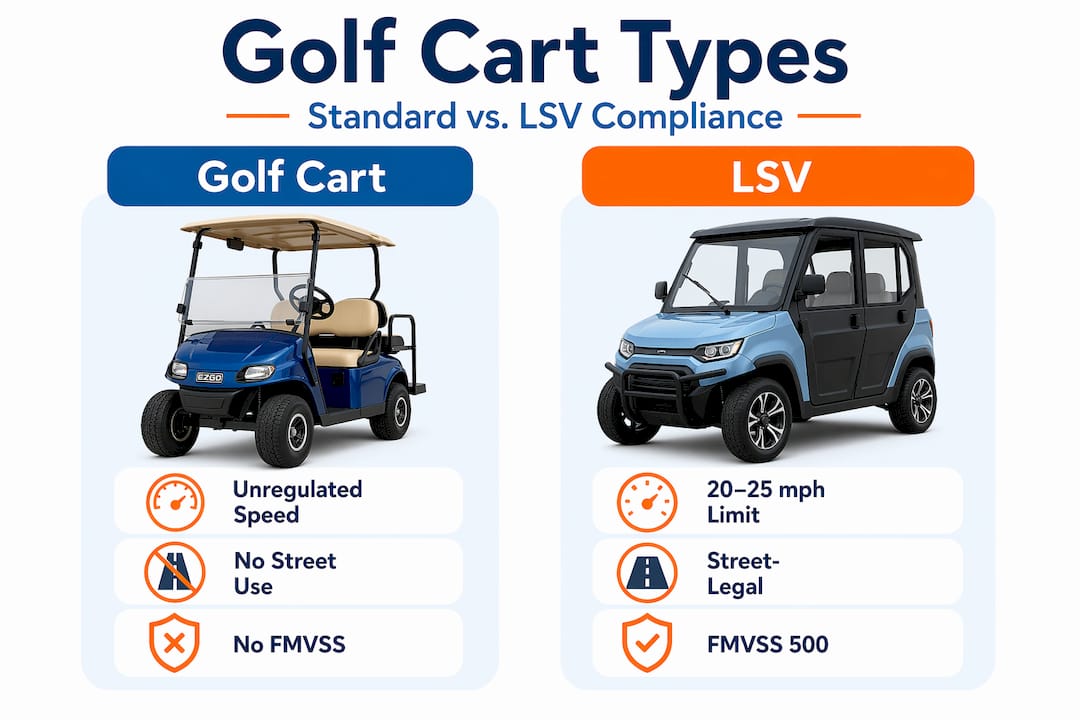
Here is how standard golf carts and LSVs compare across the key compliance categories:
| Feature | Standard golf cart | Street-legal LSV |
|---|---|---|
| Top speed | Up to 25 mph (unregulated) | 20 to 25 mph (regulated) |
| Speed control required | Recommended | Federally required |
| Seatbelts | Optional | Required |
| Headlights and taillights | Optional | Required |
| Turn signals | Optional | Required |
| Road use | Private property only | Public roads (varies by state) |
| Registration | Not required | Required |
Beyond the federal baseline, state and local laws add another layer. Many municipalities cap golf cart speeds on designated paths or roads at 15 mph or lower. The golf cart speed limits guide covers how those local rules vary and where owners commonly get caught off guard.
Dealers especially need to communicate this clearly. A customer who modifies their cart after purchase and then gets cited or involved in an accident can create liability exposure for the selling dealer if the sale did not include proper documentation of compliance requirements. Understanding golf cart legal requirements is not just the buyer’s responsibility. It is part of responsible retail.
The compliance essentials every owner should know:
Beyond regulations, programmable speed control offers practical benefits for performance and tailored safety in varied golf cart uses. A fixed governor set to one speed for every situation is not the ideal approach. The best setups let you fine-tune speed to match the environment.
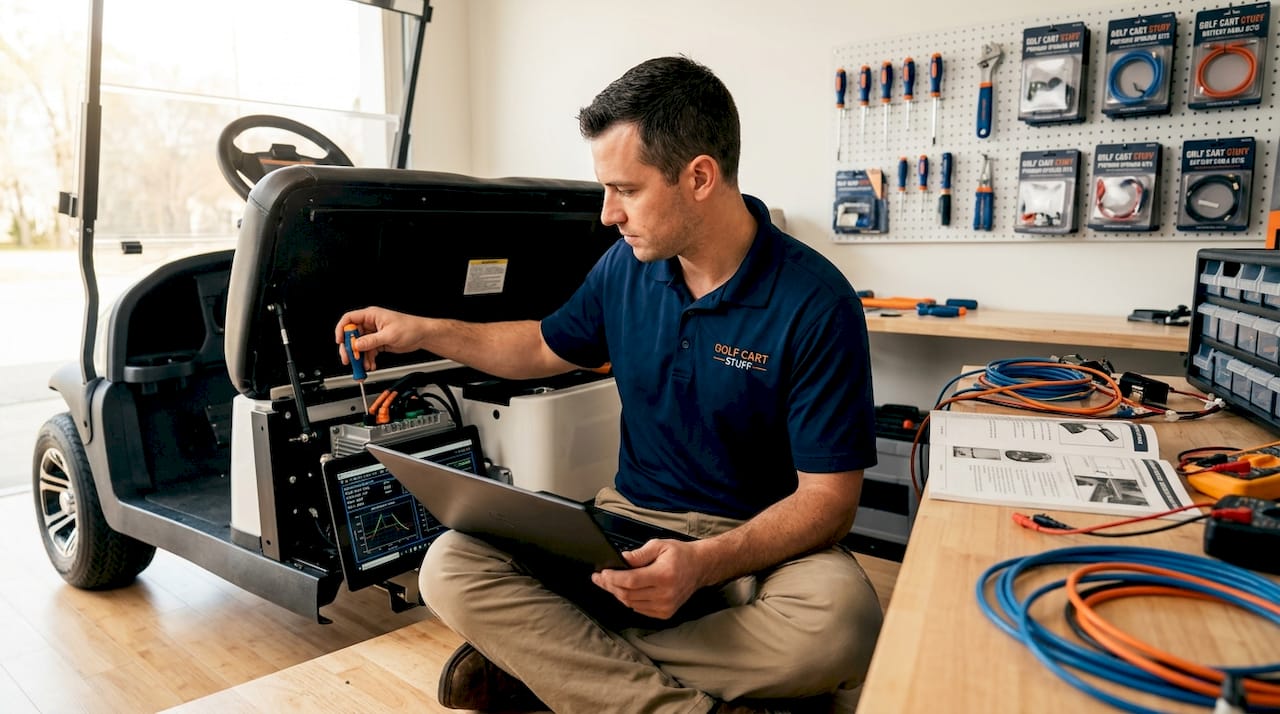
Programmable controllers allow site-specific speed limits that reduce liability and match performance to terrain and regulations. That flexibility is where adjustable controls go from a compliance checkbox to a genuine performance tool.
Here is how a thoughtful approach to adjusting golf cart speed plays out in practice:
Pro Tip: If you manage a fleet, standardize speed settings across all carts to the same maximum. Inconsistent top speeds across a fleet create confusion for drivers and make accident investigations much more complicated.
The golf cart controller guide explains how controllers regulate motor output and why controller quality directly affects how accurately your speed limits hold under load. A cheap controller can drift from its programmed settings, especially under thermal stress. That drift matters when legal compliance depends on a precise speed ceiling.
Fleet operators and resort managers who have worked through resolving golf cart speed issues consistently report that the biggest performance gains come not from higher speeds, but from consistent, well-calibrated speed management that extends equipment life and reduces downtime.
While adjusting speed controls offers benefits, unsafe modifications reveal the critical balance between speed and safety. The temptation to push a cart faster is real. But the consequences of doing it wrong are serious.
Modified carts that bypass governors show 25 to 30% higher crash risk because stock brakes and suspension cannot handle the additional speed loads they were never engineered for.
“Stock brakes on a standard golf cart are designed for a maximum speed of around 19 mph. Push it to 25 or 30 mph without brake upgrades, and you are driving a vehicle that physically cannot stop in time.”
The risks go beyond the mechanical:
Pro Tip: Before making any speed-related modification, consult the manufacturer’s documentation or an authorized dealer. What reads as a “simple governor removal” online often has cascading effects on braking distance, battery stress, and frame fatigue.
Understanding the risks that come with golf cart modifications helps owners make informed decisions. Not all modifications are dangerous. Performance upgrades done correctly, with matching safety components, can be safe and legal. The problem is modification without a full picture of the downstream effects.
High-output charger safety follows the same principle. Pushing more power into a system not rated for it creates failure points. Speed modification without brake, suspension, and structural upgrades is the same logic applied to a moving vehicle.
Most golf cart owners do not think of themselves as drivers of a vehicle that requires active safety management. They think of a golf cart as a slow-moving convenience. That mental framing is exactly where the danger starts.
The golf cart industry has done an unintentional disservice by allowing the “toy vehicle” perception to persist. Carts capable of 20 mph carry the same rollover physics as a small car. The difference is that a small car has a roll cage, crumple zones, and airbags. A golf cart has a canvas top and a grab bar.
We see this play out in how dealers approach speed controls in the sales conversation. Most treat it as a technical spec buried in the brochure. The dealers who lead with it, who explain the golf cart speed best practices to every buyer before the sale closes, build a fundamentally different customer relationship. Their customers come back for maintenance. They refer friends. They do not end up in accidents that become legal problems.
There is also a liability dimension that many private owners miss entirely. If you own property where guests operate your golf cart and someone gets hurt because the speed was not controlled, you carry liability. That is not a hypothetical. It happens every summer across resorts, farms, and private communities.
The cultural shift worth pushing for is treating speed controls the way we treat seatbelts: not as a restriction, but as a baseline standard of responsible use. The benefits of speed controls are not just mechanical or legal. They are the foundation of a culture where people actually enjoy golf carts without someone getting hurt.
With a full understanding of why speed controls matter, here are trusted resources to upgrade or maintain your golf cart’s safety and performance.
At Golf Cart Stuff, we stock the parts and components you need to keep speed controls functioning correctly, whether you are maintaining a single cart or standardizing a fleet. From controllers and governors to brand-specific components, our catalog covers the major platforms.
Browse Club Car DS golf cart parts and Yamaha G1-G22 golf cart parts for model-specific speed control components built to manufacturer specifications. For owners looking to expand safety across the whole cart, our full range of golf cart accessories includes everything from seatbelts to lighting upgrades. Every product we carry is selected with compliance and long-term reliability in mind, because speed controls only protect you when they actually work.
Setting golf cart speed controls to 15 mph significantly reduces rollovers and accidents. Carts with 15 mph governors experience 50% fewer rollovers than unregulated carts, making it the most defensible standard for most operating environments.
Yes, for street-legal golf carts classified as Low-Speed Vehicles. FMVSS 500 requires speed controls for LSVs with top speeds between 20 and 25 mph as a condition of federal compliance and legal road use.
Unauthorized modifications to speed controllers can void your warranty and increase crash risk. Unauthorized controller changes may void warranty coverage and increase liability, so any adjustments should follow manufacturer guidelines or be handled by an authorized dealer.
Modified carts that bypass governors exceed speeds their stock brakes and suspension can safely manage. Modified carts bypassing governors show 25 to 30% higher crash risk because the mechanical systems were never designed for those speeds.
Programmable controllers let fleet owners set different speed limits for different locations and terrain types. Programmable controllers enable site-specific limits that reduce liability and match cart performance to the actual conditions where each unit operates.
Explore our store to see what our products and resources can do for you.

Leave a comment