
Your Cart Is Our Priority
Explore our store to see what our products and resources can do for you.

TL;DR:
- A golf cart speed sensor provides essential feedback by measuring rotational speed and transmitting data to the controller for safe operation. Faulty sensors often cause limp mode, jerky acceleration, and loss of regenerative braking, which can be diagnosed by inspecting magnets, wiring, and signal output. Replacing sensors costs $40 to $180, but proper diagnosis and maintenance of magnets and wiring can prevent unnecessary repairs.
A golf cart speed sensor is defined as a feedback device that measures the rotational speed of your cart’s drivetrain and transmits that data to the controller to regulate speed, acceleration, and braking. Without it, the controller operates blind. Systems like the Club Car IQ, EZGO RXV, and Yamaha G-series all depend on speed sensor signals to manage motor output safely. When the sensor fails, the cart does not just slow down. It loses the feedback loop that keeps every drive predictable and safe.
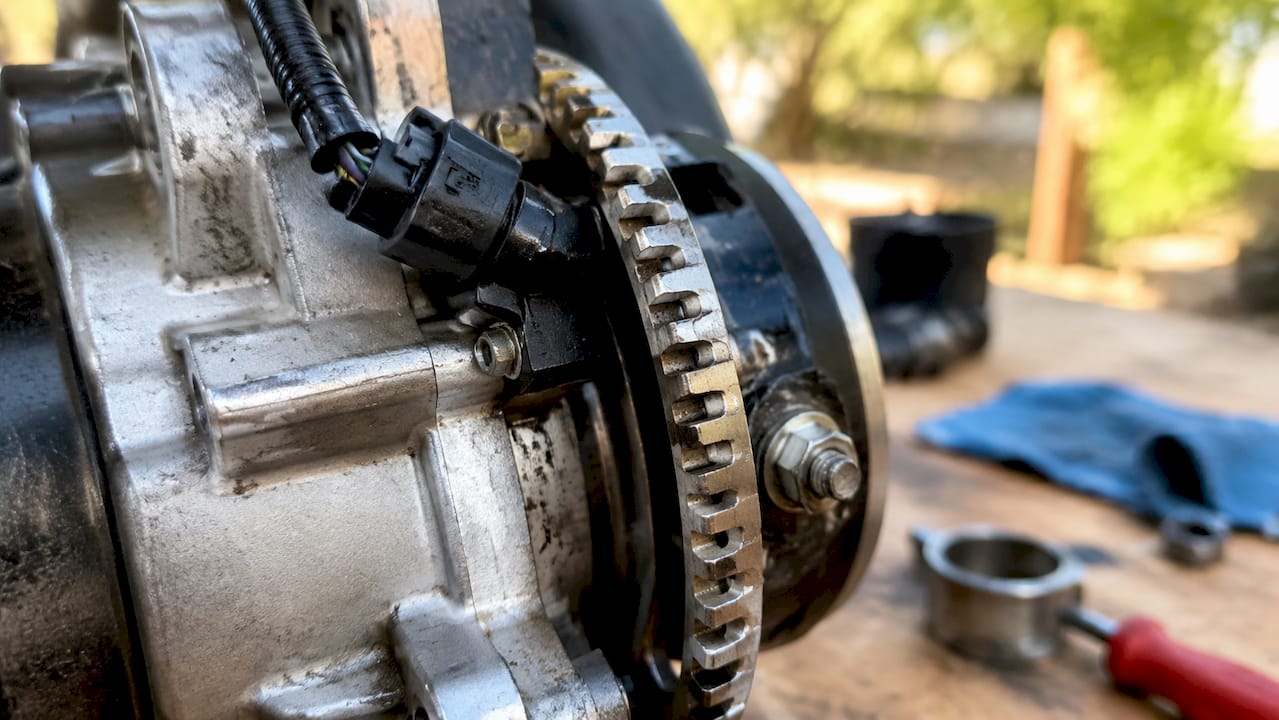
A golf cart speed sensor works by detecting rotational movement and converting it into electrical pulses that the controller reads as speed data. The controller uses this data to match motor output to throttle input, apply regenerative braking, and trigger safety features like hill protection. This is a closed-loop feedback system, meaning the controller constantly compares actual speed against expected speed and adjusts accordingly.
The industry term for this type of device is a rotational speed sensor or encoder, depending on the system. Most golf cart owners call it a speed sensor, and both terms are accurate in context.
Two main sensor types appear across popular golf cart platforms:
Yamaha G-series carts use magnetic pickup sensors reading a tone ring, which functions similarly to the Club Car hall-effect setup but with different mounting configurations.
Pro Tip: If you own an EZGO RXV, note that the encoder is built into the motor bearing assembly. Replacing just the sensor is not an option. The entire encoder bearing service kit is the correct fix.
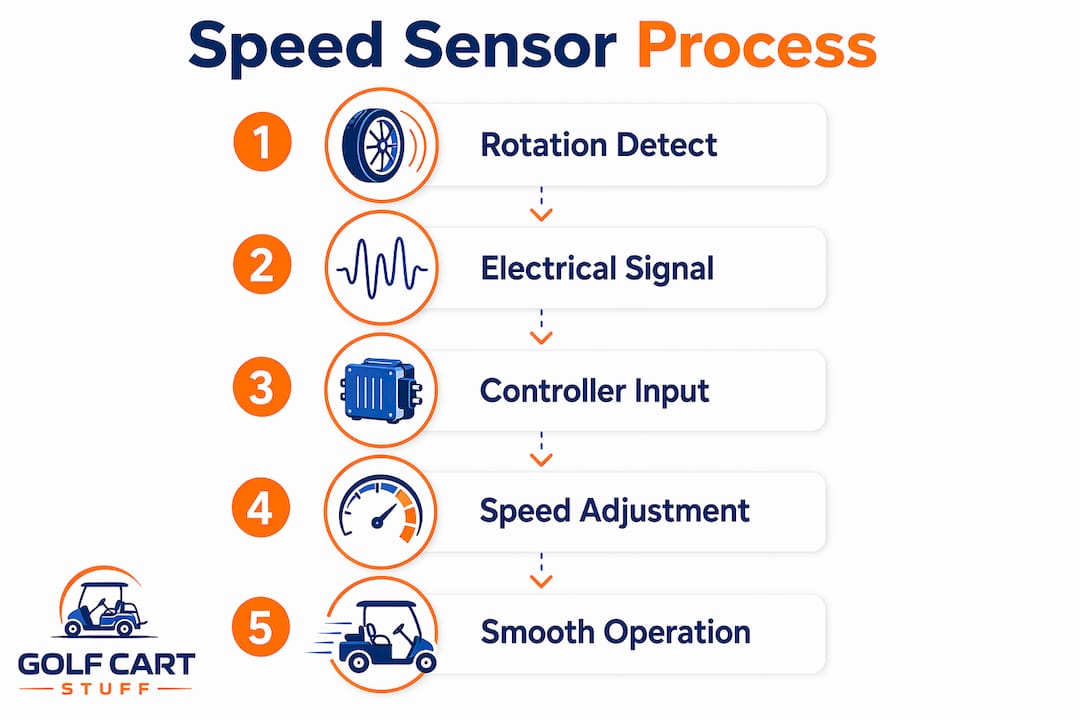
Speed sensor problems produce a specific set of symptoms that owners often misread as controller or motor failures. Recognizing the pattern early saves you from expensive misdiagnoses.
The most common signs of a faulty speed sensor include:
Many owners blame the controller first. Checking the speed sensor circuit before ordering a controller replacement is the correct first step and can save hundreds of dollars.
Diagnosing a speed sensor correctly takes about 30 minutes with basic tools. Follow this sequence to avoid replacing parts that do not need replacing.
Pro Tip: Before you order a new sensor, replace the speed magnet if it shows any wear. Installing a new sensor against a damaged magnet causes immediate failure and wastes the part entirely.
Replacement costs vary by cart model and whether you replace the sensor alone or the full encoder assembly. Here is a realistic breakdown:
| Component | Parts Cost | Installed Cost |
|---|---|---|
| Hall-effect speed sensor (Club Car, Yamaha) | $40–$180 | $150–$350 |
| Speed magnet or tone ring | $15–$60 | $60–$120 |
| EZGO RXV encoder bearing kit | $80–$150 | $200–$400 |
| Controller (if misdiagnosed) | $300–$800 | $500–$1,200 |
These cost ranges for sensor replacement show why diagnosing the sensor first matters so much. A controller replacement costs three to five times more and solves nothing if the sensor was the actual problem.
A few things to keep in mind before ordering parts:
For wiring-related sensor issues, a proper golf cart wiring inspection should accompany the sensor replacement to prevent repeat faults.
A golf cart speed sensor is the critical feedback link between your motor and controller, and diagnosing it correctly before replacing other components saves time and money.
| Point | Details |
|---|---|
| Core function | The speed sensor sends rotational data to the controller to manage speed, braking, and safety. |
| Limp mode trigger | Missing or irregular speed pulses cause the controller to drop the cart to roughly 8 MPH as a safety response. |
| Inspect magnet first | A cracked or loose speed magnet causes the same symptoms as a failed sensor and must be checked before replacement. |
| Replacement cost range | Sensor parts cost $40–$180; full installed repair runs $150–$350 depending on model and complexity. |
| OEM parts outperform budget options | High-quality sensors handle heat and vibration better, reducing the chance of repeat failure. |
By Roshan
Most owners who come to me with limp mode problems have already convinced themselves the controller is shot. That assumption costs them money every time. The speed sensor circuit is almost always the right place to start, and within that circuit, the speed magnet is the first thing I look at.
Here is what I have learned from working through dozens of these repairs: the magnet takes the physical abuse. It spins at motor speed, sits close to a stationary sensor face, and absorbs every vibration the drivetrain produces. Sensors fail too, but they fail far less often than magnets crack or shift out of position.
The other thing owners miss is wiring quality. A sensor can test perfectly on the bench and still produce intermittent faults in the cart because a corroded connector or a wire routed too close to a high-current cable is injecting noise into the signal. The controller sees garbage data and responds with limp mode. Replacing the sensor fixes nothing. Cleaning the connector or rerouting the wire fixes everything.
My honest recommendation: follow OEM specs for sensor air gap, replace the magnet whenever you replace the sensor, and run a wiring check before you assume any component is dead. The motor troubleshooting guide at Golfcartstuff covers this sequence in detail and is worth reading before you order any parts.
— Roshan
When you know what needs replacing, getting the right part matters as much as the repair itself. Golfcartstuff carries genuine replacement parts for the most popular golf cart platforms, so you are not guessing on fitment or quality.
For Club Car owners, the Club Car DS parts catalog includes speed sensors, magnets, and related electrical components matched to your specific model year. Yamaha owners can find compatible sensors and drivetrain parts in the Yamaha G1-G22 parts section. Every part listed is selected for durability and correct fitment, which means fewer repeat repairs and more time on the course.
A golf cart speed sensor measures the rotational speed of the drivetrain and sends pulse signals to the controller, which uses that data to regulate motor output, acceleration, and regenerative braking.
Limp mode is triggered when the controller stops receiving valid speed feedback, typically due to a failed sensor, cracked speed magnet, or damaged wiring. The cart defaults to roughly 8 MPH as a safety response.
The clearest signs are sudden limp mode, jerky acceleration, loss of motor braking, and controller fault codes tied to speed feedback errors. Always inspect the speed magnet before replacing the sensor itself.
Parts cost between $40 and $180 for most hall-effect sensors, with installed repair running $150–$350. EZGO RXV encoder bearing kits cost more due to the motor disassembly required.
Hall-effect sensor replacement on Club Car and Yamaha models is straightforward for owners comfortable with basic electrical work. EZGO RXV encoder bearing replacement requires motor disassembly and is better handled by a qualified technician.
Explore our store to see what our products and resources can do for you.

Leave a comment