
Your Cart Is Our Priority
Explore our store to see what our products and resources can do for you.

You check your golf cart’s batteries, but the voltage reading confuses you. Is 38 volts good or bad for a 36V system? Should you be worried about that 50V spike after charging your 48V cart? Many owners struggle to interpret voltage numbers, leading to premature battery failure and poor performance. Understanding voltage isn’t just technical knowledge, it’s the key to extending battery life, maintaining consistent power, and avoiding costly repairs.
| Point | Details | |-------|---------|| | Golf carts run on 36V or 48V systems | Your cart’s voltage determines speed, power output, and component compatibility. | | Regular voltage checks extend battery life | Proper maintenance boosts lifespan by 25% through early problem detection. | | Voltage affects motor performance directly | Inconsistent voltage causes overheating, weak acceleration, and premature component failure. | | The right charger prevents voltage damage | Using incompatible chargers leads to overcharging and voltage health deterioration. |
Voltage measures the electric potential difference that drives current through your golf cart’s system. Think of it as electrical pressure pushing power from your batteries to the motor. Golf carts typically use either 36V or 48V battery systems depending on model and performance needs.
Your cart’s voltage directly impacts three critical performance factors:
Higher voltage systems deliver more power, but they also place greater demands on controllers, wiring, and motors. A 48V system typically provides 30% more speed than a comparable 36V setup, but requires heavier gauge wiring and more robust components.
Voltage compatibility matters immensely. Your batteries, charger, and motor must all match. Installing 48V batteries in a 36V system will fry your controller within minutes. Conversely, using a 36V charger on 48V batteries leaves them perpetually undercharged, dramatically reducing range and lifespan.
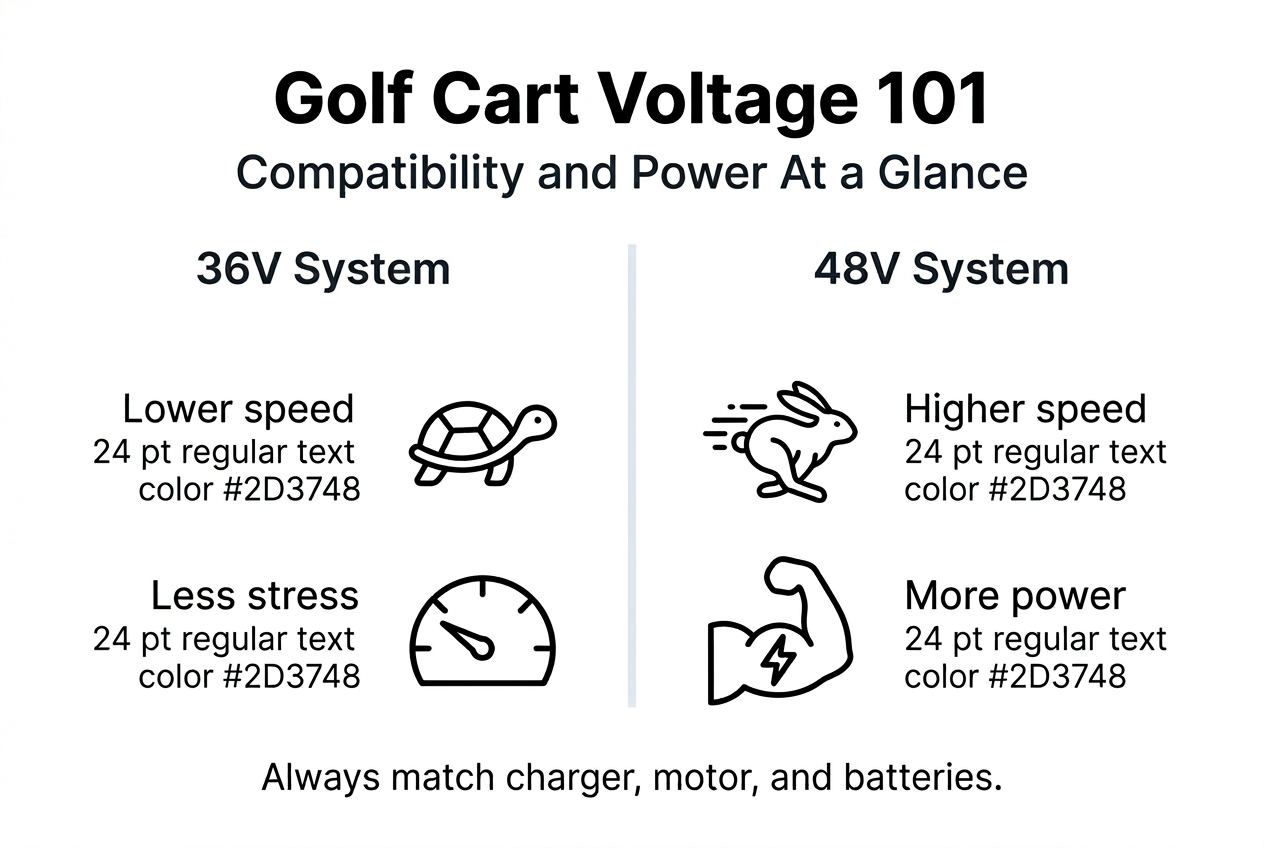
Pro Tip: Your cart’s voltage isn’t constant. A fully charged 36V system reads around 38 to 39 volts, while a depleted one drops to 32 volts. These fluctuations are normal, understanding them helps you gauge battery health.
Measuring voltage accurately requires the right tool and technique. A digital multimeter or voltmeter gives you precise readings that reveal battery condition.
Follow these steps for accurate voltage measurement:
Your voltage readings tell a story. A fully charged 48V system should read 50 to 52 volts. Anything below 48 volts indicates weak or failing batteries. Regular maintenance and accurate voltage measurement can extend golf cart battery life by up to 25% when you catch problems early.
Terminal connections significantly impact voltage readings. Corrosion creates resistance that drops voltage by several volts before it reaches your motor. Clean terminals monthly with a wire brush and apply terminal protectant spray. Check that cable connections are tight, a loose connection can mimic a dead battery.
Using the right charger and avoiding overcharging are essential to preserving voltage health. Automatic chargers designed for your specific voltage prevent overcharging, which boils battery fluid and warps internal plates. Set a charging schedule rather than leaving your cart plugged in continuously.
Pro Tip: Test individual battery voltages, not just the total pack. In a 48V system with eight 6V batteries, one weak battery drags down the entire pack. Each 6V battery should read 6.3 to 6.4 volts when fully charged.
Your motor’s performance ties directly to the voltage it receives. Lower voltage systems offer reliability and longer component life, while higher voltage setups prioritize speed and power.
A 36V system typically reaches 12 to 14 mph and handles moderate terrain efficiently. The lower electrical stress means controllers and motors last longer with less maintenance. Battery packs in 36V configurations often survive 800 to 1,000 charge cycles when properly maintained.

Compare that to 48V systems, which achieve 18 to 22 mph and climb steep grades with heavy loads. The upgrade from 36V to 48V systems can improve speed and torque but requires compatible motor components. Higher voltage generates more heat, demanding better cooling and more frequent inspections.
| Feature | 36V System | 48V System |
|---|---|---|
| Top Speed | 12 to 14 mph | 18 to 22 mph |
| Hill Climbing | Moderate grades | Steep terrain capable |
| Battery Cycle Life | 800 to 1,000 cycles | 600 to 800 cycles |
| Component Stress | Lower wear rates | Higher heat generation |
| Upgrade Cost | N/A | $800 to $1,500 |
Voltage inconsistencies can cause motor heat buildup and premature failure. A motor designed for 48V will struggle and overheat if voltage drops to 42V under load. This happens when batteries age unevenly or connections corrode.
Upgrading voltage isn’t as simple as swapping batteries. Your controller must handle the increased voltage, or it will fail instantly. Wiring gauge matters too, 48V systems need heavier cables to handle higher current safely. Some motors work across voltage ranges, but most require replacement when upgrading.
Pro Tip: Speed controllers rated for higher voltage than your system provide a safety margin. A controller rated for 52V works perfectly in a 48V system and tolerates voltage spikes during regenerative braking.
Voltage problems manifest in predictable ways. Recognizing symptoms early saves you from expensive repairs and dangerous breakdowns.
Low voltage creates multiple issues simultaneously:
High voltage damages electrical components through excessive current. You might notice your controller running hot, lights burning out frequently, or sudden motor cutouts as safety features engage.
Erratic gauge readings signal voltage instability. Your battery meter swings wildly between full and empty, or shows full charge but the cart dies after five minutes. Voltage problems are a leading cause of golf cart motor and battery failures, making diagnosis critical.
| Symptom | Likely Cause | Solution |
|---|---|---|
| Voltage drops under load | Weak battery cells | Test individual batteries, replace failures |
| Voltage exceeds 52V on 48V system | Charger malfunction | Replace charger immediately |
| Inconsistent voltage readings | Loose or corroded connections | Clean terminals, tighten all connections |
| Voltage reads normal but cart lacks power | Voltage sag from internal resistance | Load test batteries, replace weak units |
| One battery much lower than others | Single battery failure | Replace the weak battery |
Voltage reducer devices stabilize voltage in modified carts. Use of a voltage reducer can prevent damage from excess voltage in some setups. If you’ve added accessories like sound systems or upgraded lighting, a reducer protects sensitive electronics from voltage spikes.
Solving voltage issues starts with systematic testing. Check resting voltage, then test under load by driving the cart while monitoring voltage. A healthy battery pack shows minimal voltage drop during normal use. Drops exceeding 10% indicate failing batteries or poor connections.
Ready to maximize your golf cart’s performance and longevity? GolfCartStuff.com offers the parts and expertise you need for reliable voltage system maintenance.
Upgrade your ride with premium wheels and tires that enhance both style and performance. Our selection includes voltage system components, battery accessories, and maintenance tools designed specifically for golf cart electrical systems. Whether you’re troubleshooting voltage problems or planning a system upgrade, GolfCartStuff.com provides expert guidance and quality parts backed by knowledgeable customer support. Browse our catalog for chargers, voltage testers, terminal cleaners, and upgrade components that keep your cart running at peak voltage efficiency.
Most golf carts operate on 36V or 48V battery systems created by connecting multiple batteries in series. Older models typically use 36V configurations with six 6-volt batteries, while newer performance carts favor 48V setups with eight 6-volt batteries or six 8-volt batteries. The voltage you choose affects your cart’s speed, range, and power output significantly.
Use a digital voltmeter or multimeter set to DC voltage mode. Place the red probe on the positive terminal and black probe on negative, testing before and after charging for accurate baseline and full charge readings. Always turn off the cart and wait five minutes for voltage to stabilize before testing. Wear safety glasses when working near batteries.
Loose connections, corroded terminals, worn batteries, or faulty chargers create voltage inconsistencies. One weak battery in your series pack drags down total voltage significantly. Voltage problems often precede motor performance issues, so address fluctuations immediately. Test individual battery voltages to isolate the problem component.
Upgrading delivers better speed and hill climbing ability but requires compatible motors, controllers, and wiring. The conversion from 36V to 48V typically costs $800 to $1,500 in parts and labor. Consider whether the performance gains justify the expense based on how you use your cart. Flatter terrain and shorter trips make 36V perfectly adequate.
Explore our store to see what our products and resources can do for you.

Leave a comment