
Your Cart Is Our Priority
Explore our store to see what our products and resources can do for you.

TL;DR:
- A golf cart brush guard provides essential protection against trail debris, branches, and minor impacts, preventing damage to the grille, headlights, and bumper during off-road use.
- Most are made from durable steel with powder coat finishes and are specifically designed for each cart model, ensuring proper fit and ease of installation.
- They are most valuable for trail riding, rural work, or heavy-duty use, while being less necessary for carts used solely on paved courses or smooth paths.
If you’ve ever returned from a trail ride to find scratches across your golf cart’s front end, you already understand the problem a golf cart brush guard is designed to solve. A brush guard is a protective front-end accessory that shields your grille, headlights, and bumper from trail debris, low-hanging branches, and minor contact during everyday use. Many owners assume their factory bumper is enough. It rarely is. This guide covers what brush guards do, the types available, how to install and maintain them, and how to pick the right one for your specific cart.
| Point | Details |
|---|---|
| Protection from trail damage | Brush guards shield your front end from debris, branches, and minor impacts during off-road and rural use. |
| Material matters | Steel with powder coat finish offers the best durability and corrosion resistance for outdoor environments. |
| Model-specific fit is critical | A brush guard built for one cart model often won’t fit another, so always verify compatibility before buying. |
| Installation is DIY-friendly | Most brush guards bolt on with basic tools, but model-specific hardware and bracket kits are required. |
| Style and function together | Brush guards add a rugged look while protecting your investment, and many support LED light bar mounting. |
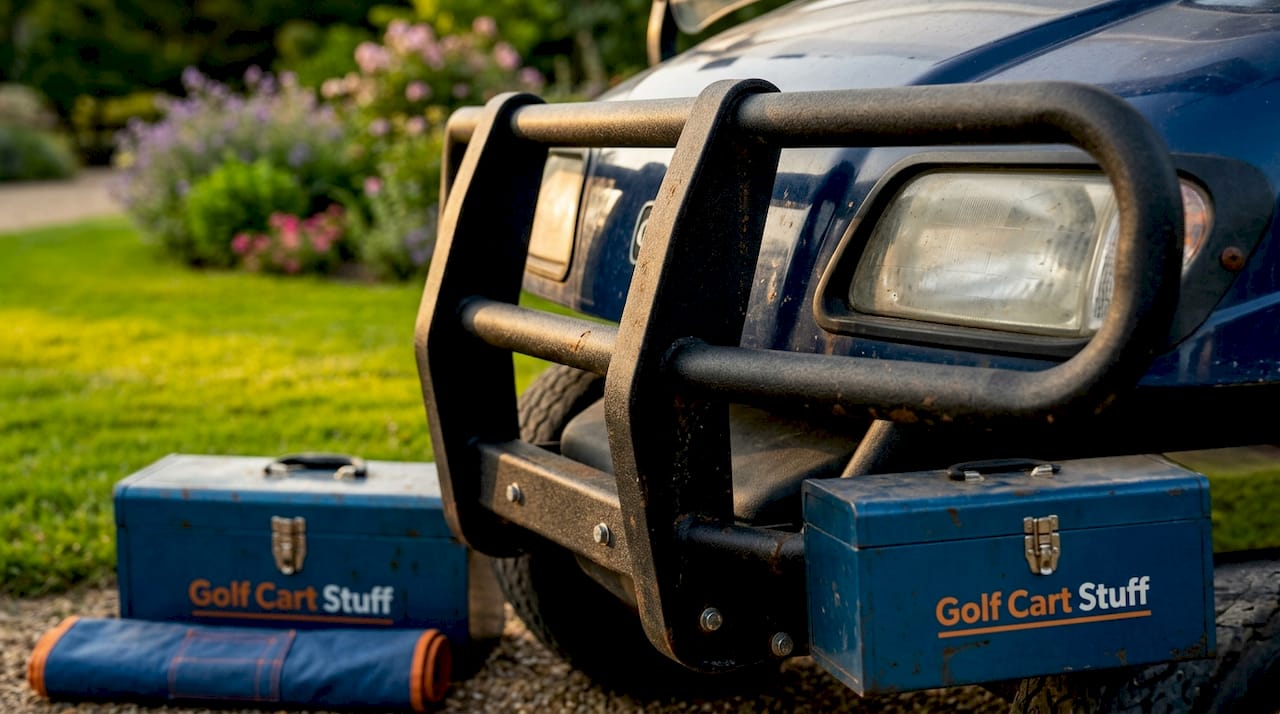
A lot of owners think a brush guard is a cosmetic upgrade. That’s only part of the story. At its core, a brush guard is a front-end protective accessory designed to deflect branches, tall grass, trail debris, and light vegetation before they reach your cart’s grille, headlights, or bodywork.
Here’s what brush guards actually protect against in real-world use:
The economic argument is real. Fleet operators use brush guards specifically to reduce repair costs and operational downtime, and the same logic applies to personal carts used in demanding environments.
That said, there is one thing to get straight before buying. Brush guards deflect light vegetation but are not engineered for high-speed collisions or large, solid obstacles. Hitting a concrete barrier or a large stump at speed will overwhelm any brush guard. Think of it as a shield for everyday hazards, not a crash cage.
Pro Tip: If you use your golf cart for hunting or ranch work, a brush guard can prevent costly front-end repairs from everyday trail riding and vegetation contact. The investment typically pays for itself after just one avoided repair.
Most brush guards are built from heavy-duty steel with powder coat finishes, which resist UV exposure, rust, and corrosion. This matters if your cart lives outside or gets used in wet conditions. Aluminum versions exist too, trading some strength for lighter weight.
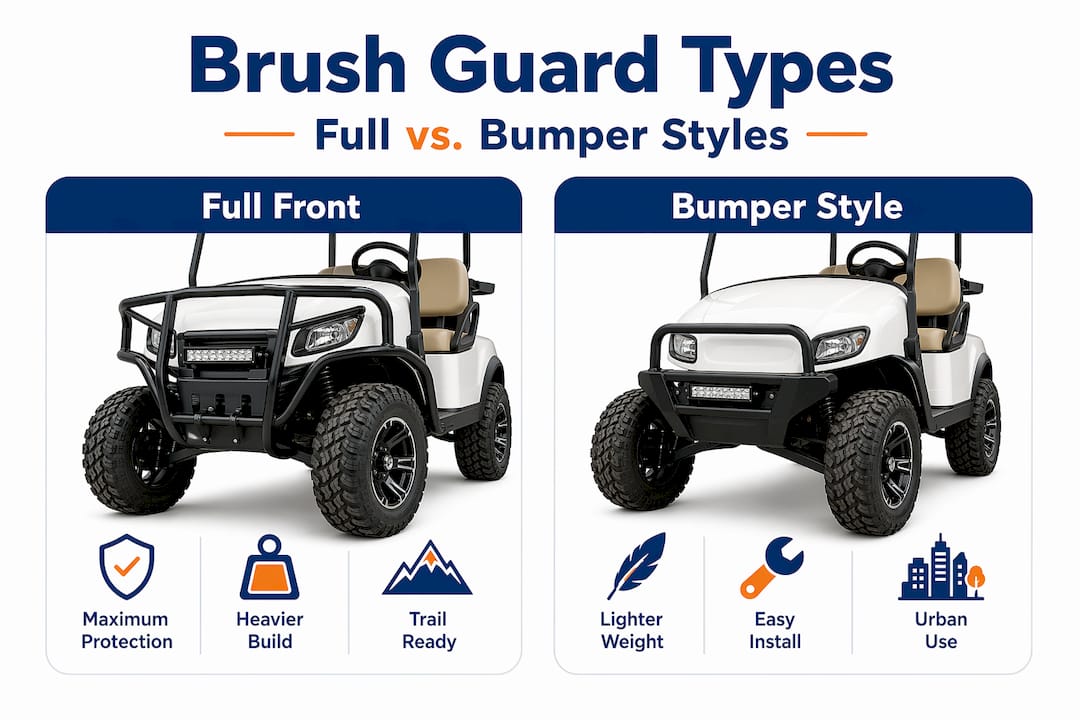
Not all brush guards are built the same, and the differences matter more than most buyers realize before their first purchase.
Steel is the standard for strength. It handles repeated brush contact, resists bending, and holds up in rough terrain. Powder coat finishes go beyond rust prevention. They can be color matched or customized, giving you styling flexibility alongside protection. Aluminum guards are lighter and won’t rust at all, making them a solid choice for carts used near water or in humid climates.
Many guards also include pre-drilled mounting holes for LED light bars or spot lights, which is a significant feature if you ride at dawn, dusk, or in low-visibility conditions.
| Type | Material | Best For | Pros | Cons |
|---|---|---|---|---|
| Full front guard | Steel | Trail riding, hunting, ranch use | Maximum coverage, light mount ready | Heavier, more aggressive look |
| Half/grille guard | Steel or aluminum | Light trail use, aesthetic upgrade | Lighter, less bulk | Less headlight protection |
| Integrated bumper | Steel | Daily use, clean install | Seamless fit, sturdy | Higher cost, model-specific |
| Aluminum guard | Aluminum | Coastal or humid environments | Rust-proof, lightweight | Less impact resistance |
Brush guards are model and year specific. A guard built for a Club Car Onward will not bolt onto an EZGO RXV without modification. Lift kits also change the geometry of your front end, which can affect fitment. Always confirm the exact make, model, and year of your cart before ordering. Many manufacturers list compatibility by trim level too, so check that as well.
Pair a brush guard with other golf cart protection features like skid plates and nerf bars for a more complete coverage package if you spend significant time off pavement.
Installation difficulty varies, but most brush guards are designed for DIY installation with basic hand tools. The process is straightforward when you have the right hardware.
Here’s a typical installation sequence:
Pro Tip: If your cart has a lift kit installed, bring measurements of your front-end geometry when consulting a dealer or searching for compatible guards. A 4-inch lift changes mounting angles enough to make some guards incompatible without adapter brackets.
For maintenance, the work is minimal but consistent care extends the life of your guard significantly. Wash it with the rest of the cart using mild soap, and dry it afterward to prevent moisture from sitting in joints and welds. Inspect the powder coat finish twice a year. Small chips or scratches in the coating are entry points for rust. Touch those up with a matching rust-resistant paint immediately. Tighten mounting hardware every few months if you ride on rough terrain. Vibration loosens bolts gradually.
Brush guards deliver the most value in specific situations. Knowing where they shine helps you decide whether one belongs on your cart.
Scenarios where a brush guard earns its keep:
A brush guard does less for you if your cart only travels on paved golf courses or smooth community paths. That doesn’t mean it looks out of place there. It just means the protective benefit is lower.
Brush guards also complement other golf cart upgrades and accessories well. Pair one with a windshield, rooftop light bar, and lifted suspension and you have a cart that’s genuinely ready for off-road use. There are no specific legal restrictions on brush guards in most states, but always check local regulations if your cart is street legal or operated on public roads.
Here’s how to think through the decision quickly and clearly.
I’ve seen a lot of golf cart owners skip the brush guard entirely because they figure their factory bumper is tough enough. In my experience, that assumption holds up right up until the first time they push through a tightly wooded trail or park too close to a steel fence post. The repair bills from those moments are almost always more than the cost of a decent brush guard.
What I’ve also noticed is that owners often buy the wrong type. A full front guard on a cart used exclusively on a manicured golf course is overkill and adds weight you don’t need. But a half guard on a cart used for deer hunting on 40 acres of hardwood forest is a mistake in the other direction. Match the guard to what you actually do with the cart.
The other mistake I see is skipping model verification. I can’t count how many times someone orders a guard that “looks like it should fit” and ends up with mounting holes that don’t line up or clearance issues with their steering. Spend five minutes confirming compatibility and you save hours of frustration.
Brush guard designs have gotten better in recent years too. The pre-drilled light mounting options are genuinely useful, and the powder coat quality on current production guards holds up well in wet and UV-heavy environments. If you haven’t looked at what’s available lately, the options are much stronger than they were even a few years ago.
— Roshan
At Golfcartstuff, we carry brush guards and front-end protection accessories across the most popular cart brands and models. Whether you ride an EZGO, Club Car, or Yamaha, you can find model-specific guards built to fit without modification. Browse the full EZGO parts and accessories collection to find guards, light mounting kits, and compatible hardware for your cart. Club Car owners can explore the complete Club Car DS parts lineup for front-end protection options that bolt right on. Every product listing includes compatibility information so you know exactly what fits before you order. Shop the full golf cart accessories collection to find brush guards alongside windshields, body kits, and everything else your cart needs.
A golf cart brush guard protects the front end of your cart from trail debris, branches, and minor impacts. It shields the grille, headlights, and bumper from cosmetic and structural damage during off-road and rural use.
Heavy-duty steel with a powder coat finish is the most durable option for most environments. Aluminum guards are a strong alternative for coastal or high-humidity areas where rust resistance is the priority.
If you ride trails, use your cart on ranch or hunting property, or park in tight spaces with collision risk, a brush guard makes practical sense. Carts used only on paved or groomed surfaces benefit less from one.
Yes. Brush guards are designed for specific makes, models, and years. A guard built for one cart model typically won’t fit another without modification, and lifted carts may require additional adapter hardware for proper installation.
Many brush guards include pre-drilled holes specifically for mounting LED light bars or spot pods. This is a major advantage for owners who ride in low-light conditions or need better trail visibility.
Explore our store to see what our products and resources can do for you.

Leave a comment