
Your Cart Is Our Priority
Explore our store to see what our products and resources can do for you.

TL;DR:
- Upgrading golf cart cables from stock 6 AWG to 4 or 2 AWG reduces resistance, heat, and power loss, improving performance and lifespan. Proper installation with high-quality materials and correct routing ensures maximum efficiency and avoids common pitfalls that diminish benefits. Most owners notice faster acceleration, longer range, and cooler components after a proper upgrade, making it a worthwhile investment.
Most golf cart owners never think twice about their cables. The cart runs, the batteries charge, and life goes on. But here’s the problem: your stock cables may be quietly stealing power every single time you press the throttle. Original equipment cables are built to minimum specs, not maximum performance, and the result is wasted energy, extra heat, and batteries that wear out faster than they should. This guide breaks down exactly how cable upgrades work, what they actually deliver in measurable terms, and how you can make smart choices that improve both performance and lifespan.
| Point | Details |
|---|---|
| Thicker cables boost power | Upgrading to lower gauge cables improves efficiency and reduces lost power from heat. |
| Better cables extend battery life | Efficient cables lower heat stress, making your batteries last longer and run cooler. |
| Match cable to your cart’s needs | Choose cable size based on your controller and how you use your cart—not just the largest possible. |
| Quality install is crucial | The gains depend on quality parts and careful, professional installation. |
Having set the stage for why cables matter, let’s see exactly how the numbers play out in your cart’s wiring.
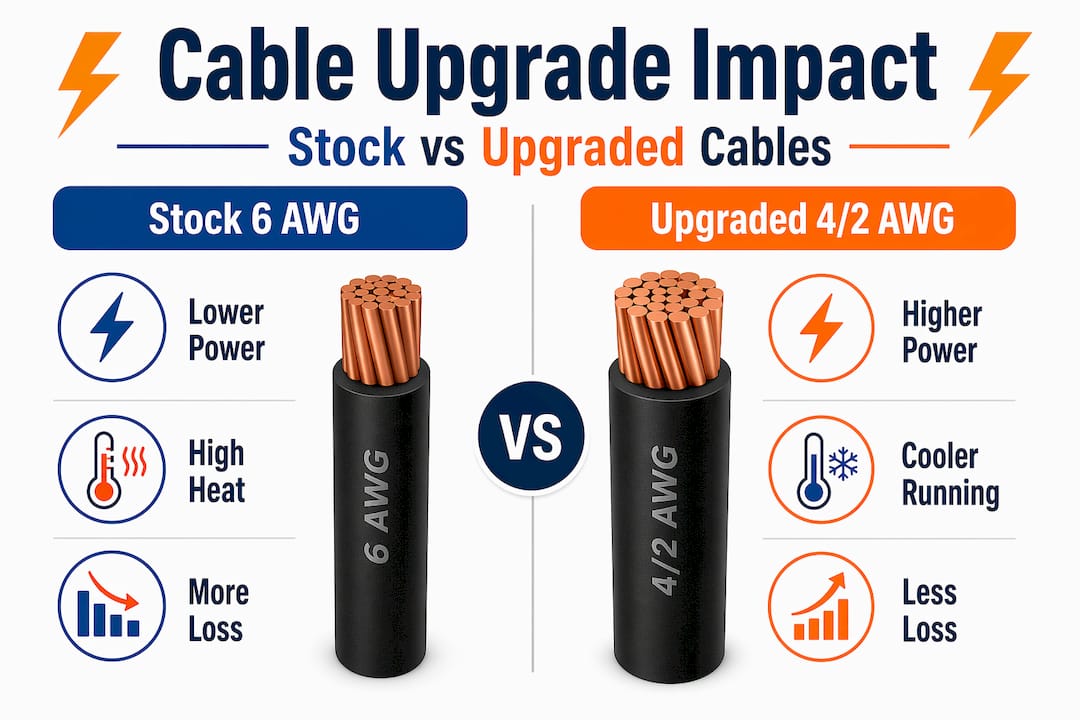
AWG stands for American Wire Gauge. It’s the standard system used to measure wire thickness, and the numbers work backward from what you’d expect. A lower AWG number means a thicker wire. So 2 AWG is thicker than 4 AWG, which is thicker than 6 AWG. That thicker wire has a larger copper cross-section, which means electricity has more room to flow through it.
Think of it like a garden hose. A narrow hose restricts water flow and builds up pressure. A wider hose lets water move freely with less resistance. Electrical cables work the same way. Upgrading golf cart battery cables reduces electrical resistance, minimizing voltage drop and heat generation.
Every foot of wire creates a small amount of resistance. Resistance causes something called voltage drop, meaning the voltage available at your motor is lower than what the batteries supply. The formula behind this is straightforward: voltage drop equals current multiplied by resistance (V = I × R). With high current loads like golf cart motors drawing 100 amps or more, even tiny resistance differences add up fast. Lower gauge cables have more copper cross-section, reducing resistance per foot and preventing power loss as heat.
Here’s a quick look at how gauge affects voltage drop over a 10-foot run at 100 amps:
| Cable gauge | Resistance (ohms/ft) | Voltage drop (10ft, 100A) | Approximate power loss |
|---|---|---|---|
| 6 AWG | 0.00095 | 0.95V | 95 watts |
| 4 AWG | 0.00060 | 0.60V | 60 watts |
| 2 AWG | 0.00048 | 0.48V | 48 watts |
That 47-watt difference between 6 AWG and 2 AWG is real power that your motor never receives. Instead, it becomes heat inside your wiring. For a full guide on how voltage ties into everything else your cart does, the golf cart voltage guide is worth reading alongside this article.
Heat is the silent killer in golf cart electrical systems. When resistance is high, energy that should move the cart instead heats up your cables, battery terminals, and connections. Over time, this thermal stress degrades insulation, accelerates corrosion at terminals, and causes battery cells to age faster. Understanding golf cart voltage basics helps you see how heat at any point in the circuit can drag down the whole system.
Here’s a simple breakdown of what undersized cables quietly cost you every ride:
Now that you know why gauge matters, let’s explore the real-world impact of upgrading those cables on your daily drive.
Undersized 6 AWG cables in 48V systems can lose 10 to 15% efficiency, or up to 12% of usable power through heat. That’s not a small margin. On a 48-volt cart, losing nearly 6 volts across your wiring before the motor even sees it is a real handicap. Here are the voltage drop numbers for a 10-foot run at 100 amps: 6 AWG drops 0.92 to 1.2 volts (1.9 to 2.5% of 48V), 4 AWG drops 0.58 to 0.76 volts, and 2 AWG drops just 0.48 volts.
Those fractions of a volt compound across every cable in the circuit. A cart with six battery-to-battery connections and a main run to the controller could be losing several volts total on stock wiring.
| Setup | Efficiency | Heat output | Best for |
|---|---|---|---|
| Stock 6 AWG | Lowest | Highest | Light duty, level terrain |
| 4 AWG upgrade | Moderate improvement | Noticeably lower | Hills, regular use, most carts |
| 2 AWG upgrade | Best efficiency | Lowest | High-performance, lithium setups |
Most owners report a clear difference after switching from stock wiring to a proper upgrade. Here’s what to expect in order of what you’ll likely feel first:
Pairing a cable upgrade with the right battery chemistry makes an even bigger difference. The lithium golf cart battery benefits article explains why low-resistance wiring matters especially for lithium setups. And if you want to maximize what you get from any battery type, these golf cart battery care tips will help you protect your investment.
Up to 12% power recovered: Proper cable upgrades can return up to 12% of previously lost power back to your motor, improving performance without touching the controller or batteries.
Pro Tip: Choose cable gauge based on your cart’s controller amperage and how you actually use the cart. A 4 AWG set covers most real-world needs. Jumping to 2 AWG on a lightly used cart isn’t always necessary, and it can make installation harder without delivering proportional gains.
After seeing the performance benefits, the logical next step is choosing the best possible cables and installing them correctly.
Before buying anything, think through these factors carefully:
4 AWG is recommended for most upgrades covering 300 to 400A controllers, hilly terrain, and moderate loads. 2 AWG is for high-performance setups running 500A or more, lithium conversions, or heavy-duty applications. Unnecessarily oversizing to 2 AWG can make cable routing harder and stress battery posts.
Your battery setup also plays a role. The 36V vs 48V battery setups guide covers how voltage configuration affects your wiring needs, and the golf cart wiring basics resource is a solid starting point for understanding your cart’s full electrical layout before you start pulling wires.
Not all cables are created equal, even at the same gauge. Here’s what separates a good cable from one that underperforms:
Pure copper vs tinned copper: Tinned copper adds a thin tin coating over the copper strands, which resists oxidation better over time. Both work well, but tinned is the smarter choice in humid or coastal environments.
Fine strand vs solid or coarse strand: Fine-strand copper is flexible, vibration-resistant, and seats better in crimp terminals. Solid or coarse-strand wire is rigid, cracks under vibration, and doesn’t compress properly in crimps.
Prioritizing fine-strand pure or tinned copper, hydraulic crimps, and heat shrink is the single most important installation guidance available. A good cable installed poorly performs worse than a mediocre cable installed well.
Pro Tip: Always use a hydraulic crimp tool rather than a hammer-style or ratchet crimp. Hydraulic crimps create a cold weld between wire and terminal, giving you the lowest possible resistance at every connection point. Finish every terminal with adhesive-lined heat shrink to seal out moisture.
Even a quality cable won’t help if it’s installed poorly. Let’s cover how to sidestep common pitfalls.
Here are the most frequent errors owners make during cable upgrades:
Even high-performance upgrades can backfire with poor installations.
Efficient power transfer from upgraded cables extends battery lifespan by reducing heat stress. That benefit only holds when the installation itself is clean. A sloppy crimp on a 2 AWG cable creates a bottleneck that eliminates the advantage of the larger wire entirely.
If you run into electrical issues after an upgrade, the troubleshooting golf cart wiring guide walks through common problems step by step. And if you suspect the motor is involved, the motor troubleshooting guide covers that territory thoroughly.
Here’s a candid perspective based on firsthand experience in the field.
The most common thing we hear from owners who’ve done cable upgrades is some version of “I can’t believe I waited this long.” And honestly, that tracks. Most owners spend time chasing battery brands, controller specs, or tire upgrades before they ever look at the wiring connecting everything together.
The thing most articles won’t tell you is that the gains from a basic 4 AWG upgrade are not subtle. In stock systems running 6 AWG wiring, you can expect real, measurable improvements of 8 to 12% in available power with a simple cable step-up. That’s not a performance mod for enthusiasts. That’s fixing an inefficiency that was baked in from the factory.
What we’ve seen in the field tells a clear story. Far more failures come from poor routing and cheap connectors than from choosing the wrong gauge. Cables rubbing against a chassis edge for two seasons fail. Plier-crimped terminals corrode and arc. Skipped heat shrink lets moisture wick up into the terminal and eat it from the inside. These are unglamorous problems, but they cause more trouble than wire thickness ever does.
We’ve also seen owners fix months of mysterious battery drain, stuttering acceleration, and heat complaints with nothing more than a proper cable replacement. Not a new battery pack. Not a controller swap. Just clean wiring with solid crimps and good routing. The improvement is real because the problem was real.
If you’re chasing reliability, our honest recommendation is to prioritize cable quality and installation craftsmanship over maxing out wire thickness. Doing the basics right, good copper, clean crimps, correct routing, and heat shrink on every terminal, gives you more return than oversizing ever will. The thickest cable in the world still fails if it’s pinched under a body panel.
The same discipline applies to other upgrades too. Well-chosen golf cart tire upgrades compound the gains you get from better wiring by reducing rolling resistance and improving handling, giving you more out of every improvement across the board.
Ready to take action? Here’s where to find the best components for a stress-free, reliable upgrade.
You’ve got the knowledge. Now you need the right parts. At Golf Cart Stuff, we carry cable kits, terminals, heat shrink, and all the accessories you need to do this job correctly the first time. Browse our full selection of golf cart accessories to find cable upgrades, connectors, and install hardware suited to your specific setup.

Whether you drive a Club Car, Yamaha, or EZGO, we stock brand-specific parts to make sure everything fits and performs as expected. If you own a Club Car DS, check out our dedicated Club Car DS parts collection for cables and electrical components built to spec. Our team is here to help you match the right gauge and materials to your cart, so you get the performance gains without the guesswork.
If your cart feels sluggish, batteries run hotter than usual, or cables show corrosion or cracking, a cable upgrade is likely overdue. Upgrading from stock 6 AWG to thicker 4 AWG or 2 AWG reduces electrical resistance, minimizing voltage drop and heat generation.
4 AWG fits most needs and balances performance with straightforward installation. 4 AWG is recommended for 300 to 400A controllers and moderate loads, while 2 AWG suits high-performance setups with 500A controllers or lithium batteries.
Most manufacturers allow cable upgrades when done correctly, but always check your owner’s manual or contact your dealer to confirm before starting.
Yes, many owners handle these upgrades at home. Use quality copper cables, a hydraulic crimp tool, and adhesive-lined heat shrink to ensure safe, durable results.
Absolutely. Fine-strand pure or tinned copper provides the best combination of conductivity, flexibility, and long-term resistance to corrosion compared to cheaper alternatives.
Explore our store to see what our products and resources can do for you.

Leave a comment