
Your Cart Is Our Priority
Explore our store to see what our products and resources can do for you.

TL;DR:
- Many golf cart owners mistakenly believe seat belts are optional and mainly for comfort, risking legal issues. When golf carts are modified for road use or classified as low-speed vehicles, federal, state, and local laws mandate seat belt installations and usage. Ensuring proper seat belt compliance and understanding local regulations are essential for safety and legal protection.
Most golf cart owners assume seat belts are optional equipment, something you add for comfort rather than compliance. That assumption can lead to real legal and financial trouble. Whether you ride on a resort path, cross a public street in a retirement community, or haul passengers at a large event, your seat belt obligations depend on a combination of federal standards, state laws, and local ordinances. This article breaks down exactly when seat belts are required, which vehicle classifications trigger those rules, and how you can bring your cart into full compliance without guesswork.
| Point | Details |
|---|---|
| Know your vehicle category | Whether your golf cart is classified as a recreational cart or an LSV directly affects seat belt requirements. |
| Public road use triggers rules | Seat belts are federally required for LSVs and many state/local rules apply when operating on public streets. |
| States add their own laws | States like South Carolina require seat belts for children and can impose further restrictions. |
| Right installation is key | Using compliant seat belts and proper installation ensures legal and physical safety for all riders. |
To understand when seat belts are required, let’s clarify how golf carts and LSVs differ. This distinction is not just technical, it is the single most important factor that determines your legal obligations.
A golf cart is generally defined as a small, motorized vehicle designed to carry golfers and equipment around a course. Most golf carts have a top speed under 20 mph and are intended for off-road or private property use. They are not factory-built to meet federal motor vehicle safety standards, which means they are not street-legal by default.
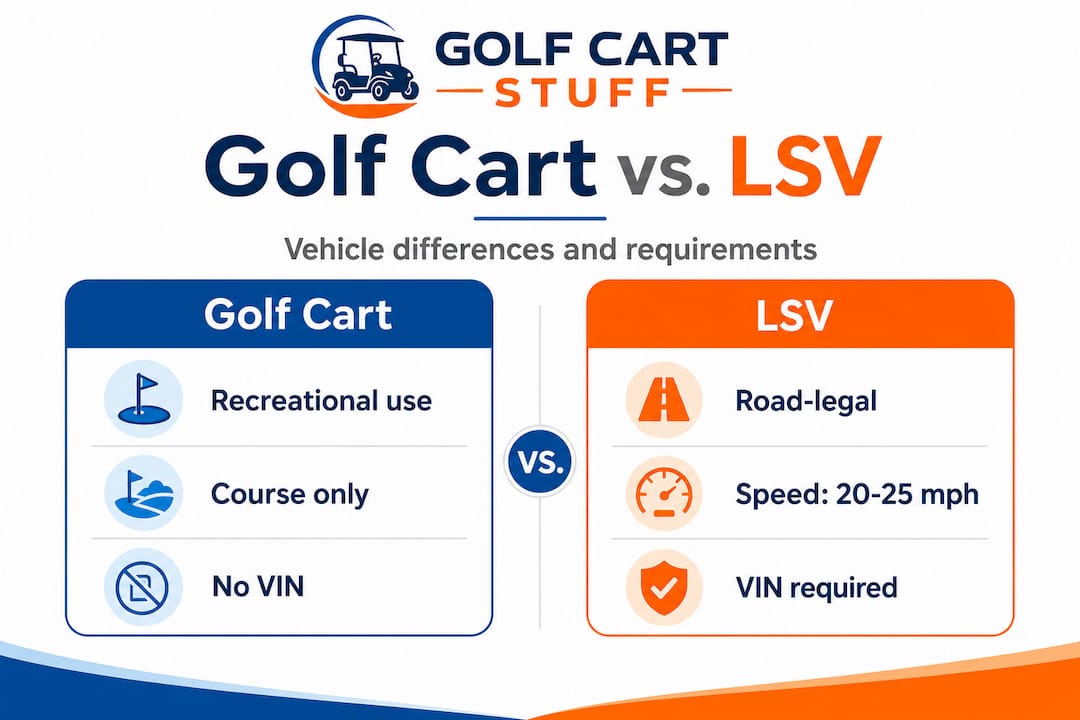
A low-speed vehicle (LSV), by contrast, is a four-wheeled motor vehicle designed to operate on roads with speed limits of 35 mph or less. LSVs have a minimum top speed of 20 mph and a maximum of 25 mph. They must comply with federal safety requirements, and that includes seat belts at every designated seating position under FMVSS No. 500 (Federal Motor Vehicle Safety Standard No. 500, which covers low-speed vehicles).
Here is a quick comparison of the two vehicle types:
| Feature | Golf cart | Low-speed vehicle (LSV) |
|---|---|---|
| Top speed | Under 20 mph | 20 to 25 mph |
| Federal safety standard | Not required | FMVSS No. 500 required |
| Seat belts required (federal) | No | Yes |
| Street legal by default | No | Yes (on roads up to 35 mph) |
| Registration required | Typically no | Yes |
| VIN and lighting required | No | Yes |
The key compliance point most owners miss is this: the moment a golf cart is modified or sold as a street-legal vehicle, it crosses into LSV territory and picks up a full set of federal requirements.
“If your vehicle can legally operate on a public road, it is almost certainly subject to federal and state rules that include seat belt requirements. The vehicle’s title and registration status tell the story.”
A few things that commonly shift a cart from “golf cart” to “LSV” include adding headlights, turn signals, mirrors, a VIN plate, and registering the vehicle with your state DMV. Many owners do this to gain access to public roads without realizing they have just opted into a stricter regulatory framework. Understanding golf cart seat belt safety before you make modifications can save you from a compliance surprise later.
With definitions clear, next comes understanding how laws vary by situation and jurisdiction. The short answer is that seat belts become legally required at the federal level once your vehicle is classified as an LSV and used on public roads. But the longer answer involves layers of state and local rules that apply even to traditional golf carts.
Federal requirements are straightforward: LSVs on public roads must meet FMVSS No. 500, which mandates a seat belt at each designated seating position. This is a manufacturer-level standard, meaning any LSV sold new must ship with compliant restraints already installed.
State-level requirements go further. States like South Carolina have passed laws that impose seat belt obligations specifically on golf carts, even those not classified as LSVs, when operating on public streets. South Carolina requires children under 12 to wear fastened seat belts on golf carts operated on public streets and highways. That is a state rule, separate from federal LSV standards, and it applies to the cart your neighbor drives to the mailbox.
Local jurisdictions can pile on additional requirements. A city, county, or planned community can restrict golf cart hours, routes, passenger limits, and yes, seat belt use. Gated communities and resort towns with established golf cart corridors often adopt their own codes, some of which are stricter than the state baseline.
Here is a practical checklist to determine your compliance level:
The statistic that should grab your attention: according to the National Highway Traffic Safety Administration, occupant ejection is a leading cause of fatal injuries in low-speed vehicle crashes. Seat belts directly address that risk, which is why the regulatory pressure on them is only increasing over time.
One often overlooked scenario involves adding rear seat kits to a golf cart. When you expand seating capacity, you also expand your liability. If those new seats lack belts and someone gets hurt, your exposure in a lawsuit or insurance claim increases significantly.
Let’s look closer at how these laws play out in a specific state, South Carolina. The state provides one of the clearest examples of how seat belt law for golf carts is evolving rapidly and how local governments layer rules on top of state requirements.
South Carolina’s 2025 update mandated that children under 12 must wear seat belts in golf carts on public roads, and additional restrictions may apply depending on your local jurisdiction. This came after years of reported injuries involving young passengers who were ejected from carts during low-speed accidents or sharp turns. The law reflects a growing recognition that golf carts carry real injury risk, particularly for children.
Beyond the seat belt mandate, South Carolina law includes several other requirements for golf carts operated on public roads:
“Local governments in South Carolina can be more restrictive than the state, so check what your specific county or municipality requires before assuming the state baseline is enough.”
The key takeaway is that laws change. South Carolina’s 2025 legislation is proof that what was acceptable last year may not meet the current standard. Golf cart operators who stay current with regulatory updates protect themselves from being caught off guard during a traffic stop or after an accident.
Pro Tip: Set a calendar reminder once a year to check your state DMV’s website and your local ordinance database for any updates to golf cart laws. A fifteen-minute search can prevent a costly compliance violation.
Understanding the law is one thing. Here is how to ensure your golf cart actually meets seat belt requirements on the ground.
Step 1: Identify your vehicle type and use case. If your cart is classified as an LSV, you need seat belts that meet Type 1 or Type 2 restraint assembly standards under FMVSS 209. FMVSS 209-compliant restraints are not the same as basic lap straps. They must meet specific load-bearing and release-mechanism standards. If your cart is not an LSV but you operate on public roads in a state with seat belt requirements, check whether your state specifies a standard for those belts.
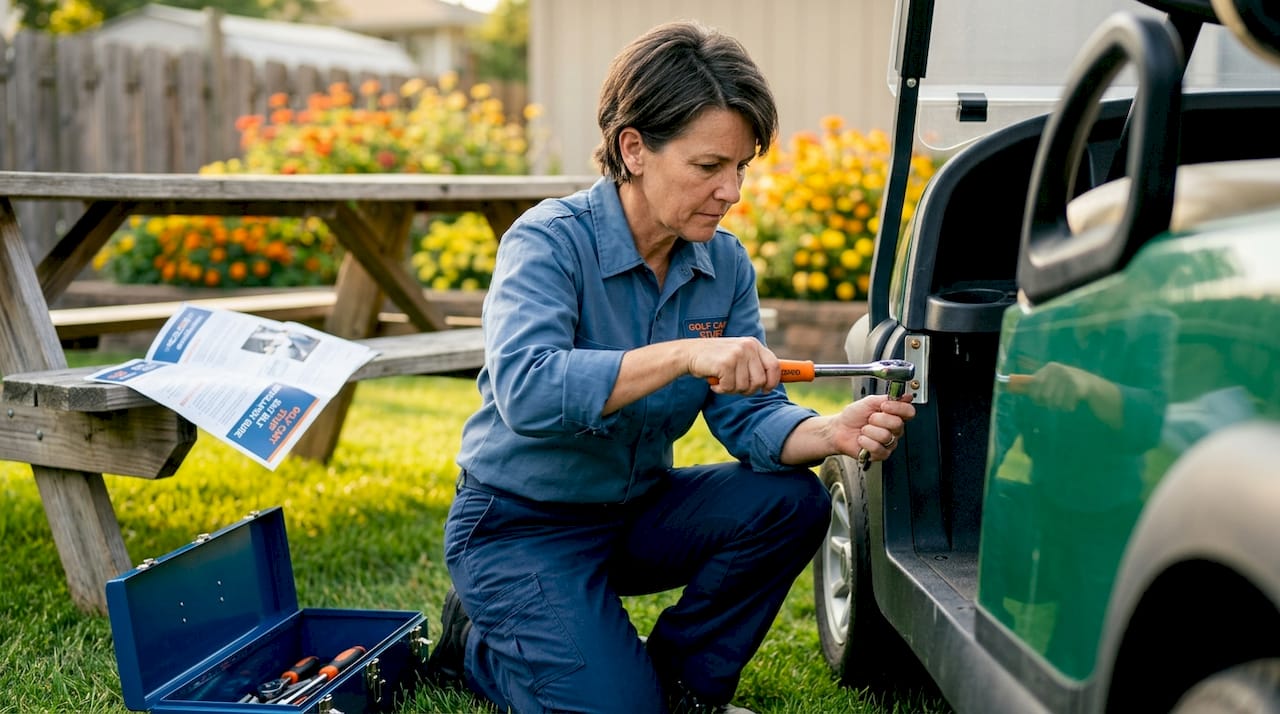
Step 2: Measure your seating layout. Different carts have different seat configurations, and not all aftermarket seat belts fit every model. Measure the width of your seats, note the material and structure of your frame where mounting hardware will attach, and identify any existing bolt holes that might accept a bracket.
Step 3: Choose the right belt type.
Step 4: Anchor the belts correctly. This is where many DIY installs go wrong. The anchor points must be attached to structural frame members, not to seat frames, plastic panels, or floor decking that lacks the strength to hold under load. Use grade-5 or grade-8 hardware, and torque bolts to manufacturer specifications. If you are unsure about your frame’s structural integrity at a mounting point, consult a professional.
Step 5: Test before you ride. After installation, simulate a hard pull on each belt at the buckle and at the anchor points. The belt should not slide, pull free, or show signs of movement at the mounting hardware. Buckles should click, latch, and release smoothly every time.
Step 6: Document your installation. Keep the product documentation, receipts, and photos of the installation. If you are ever stopped by law enforcement or involved in an insurance claim, documentation that you used compliant hardware and followed proper installation procedures can make a meaningful difference.
Pro Tip: When choosing seat belt kits for your cart, always verify the product lists FMVSS 209 compliance on the packaging or product description. This is your fastest way to confirm the belt meets federal standards without reading through the full regulatory text.
If your seats are worn or damaged, it also makes sense to address that before installing new belts. A belt anchored to a structurally sound seat is far safer than one bolted onto compromised upholstery. A good seat repair guide can walk you through assessing and restoring your seat condition before the upgrade.
Now that you know the rules, let’s zoom out and consider the real-world compliance pitfalls most people miss.
The most dangerous assumption in golf cart ownership is this: “I only use it in my neighborhood, so the rules don’t apply to me.” That assumption breaks down the second your wheels touch a public road, and in most suburban and resort communities, that happens constantly.
Crossing a public street to get to the next section of a community path counts as public road operation in most states. Driving two blocks to a neighbor’s house counts. Using a cart at a large event venue that shares access with a public road counts. Owners who don’t verify their operating context before driving are taking a risk they may not even recognize as a risk.
Beyond legal exposure, there is a practical safety reality. Seat belts are not just compliance items. They are the primary mechanism that keeps passengers in their seats during sudden stops, sharp turns, and low-speed impacts. Golf carts have a high center of gravity relative to their wheelbase, which makes them more prone to tipping than most people expect. A 15 mph rollover with unbelted passengers is a serious injury event, not a minor inconvenience.
The second blind spot is inconsistent use. Many operators install seat belts, check the compliance box, and then never remind passengers to buckle up. The belt does nothing if it is not being worn. Creating a habit of consistent use, especially for children and elderly passengers, is just as important as having the correct hardware installed.
Understanding the importance of seat belt safety goes beyond avoiding fines. It is about protecting the people in your cart every time you move.
Equipped with a clear understanding of the law and practical steps, here is where to get compliant seat belts and other upgrade essentials.
Meeting seat belt requirements does not have to be complicated or expensive. The right products, installed correctly, put you on the right side of the law and significantly improve passenger safety.
At Golf Cart Stuff, we carry a full range of golf cart seat belts that meet federal restraint standards, fit a wide variety of cart models, and come with everything you need for a clean, secure installation. Beyond seat belts, our golf cart accessories collection includes lighting kits, mirrors, and safety upgrades that support full LSV compliance. Browse our catalog, check compatibility with your cart model, and get everything you need to drive with confidence.
Generally, no federal law requires seat belts for carts operated exclusively on private property, but local rules may differ. Private property use typically does not trigger federal LSV seat belt standards, which apply to vehicles used on public roads.
Penalties vary by state and locality, ranging from fines to restrictions on cart use, especially if children are unrestrained. In some jurisdictions, an accident involving an unbelted child can also expose the operator to civil liability beyond any traffic fine.
If your cart is street-legal, registered with a VIN, and capable of speeds between 20 and 25 mph, it almost certainly qualifies as an LSV. FMVSS No. 500 applies to LSVs on public roads, so check your vehicle’s title and registration to confirm its classification.
Many states impose stricter requirements for child passengers in golf carts, particularly on public roads. South Carolina requires children under 12 to wear seat belts when riding in a golf cart on public streets and highways, and other states are moving toward similar protections.
Explore our store to see what our products and resources can do for you.

Leave a comment