
Your Cart Is Our Priority
Explore our store to see what our products and resources can do for you.

TL;DR:
- Proper indoor storage with ventilation reduces moisture buildup and prevents rust and mold more effectively than outdoor tarp covers.
- Selecting breathable, vented covers suited to your climate ensures better moisture escape and protects your golf cart from environmental damage.
Weather does not care how much you paid for your golf cart. A single wet season without proper preparation can corrode battery terminals, warp seat cushions, crack plastic panels, and leave you facing repair bills that dwarf the cost of a good cover or a few hours of maintenance. The difference between a cart that lasts a decade and one that limps through its third winter is almost never about luck. It comes down to a handful of specific, repeatable habits that most owners skip because they seem minor at the time.
| Point | Details |
|---|---|
| Indoor storage is best | Keeping your golf cart in a ventilated garage or shed minimizes rust, rot, and mold. |
| Use ventilated covers | Choose breathable covers with air vents to prevent trapped moisture and corrosion. |
| Keep batteries fully charged | Charge your batteries fully before storage to reduce freezing risk in winter. |
| Inspect regularly | Check terminals, wiring, and covers before bad weather hits for early problem prevention. |
| Match protection to weather | Adapt your strategy based on rain, wind, humidity, or cold climate for best long-term results. |
Where you store your cart is the single biggest factor in how long it survives harsh weather. Full stop. A cart parked in a well-ventilated garage through a brutal winter will outperform a cart wrapped in a cheap tarp in the driveway every single time. The reason comes down to moisture. Metal components rust, wiring corrodes, and mold grows when moisture has nowhere to escape.
Indoor storage wins because it shields the cart from wind-driven rain, temperature swings, and UV exposure all at once. But the word “indoor” does not mean “airtight.” A sealed garage with no air movement can still trap condensation, especially when temperatures rise and fall overnight. That condensation settles on metal frames, battery terminals, and electrical plugs. Over weeks, it does real damage.
Here is what smart indoor storage looks like:
The good news is that storing your cart indoors with adequate airflow dramatically cuts condensation risk compared to outdoor plastic tarp storage.
Plastic tarps are one of the most common weather protection mistakes we see. They feel like protection, but sealed plastic traps moisture underneath and creates a humid microenvironment that accelerates rust and mold far faster than leaving the cart uncovered in dry conditions.
If outdoor storage is your only option, elevate the tires slightly off the ground using wooden boards or tire ramps to prevent prolonged contact with wet concrete or soil. Always use a vented cart-specific cover rather than a hardware store tarp. And take the time to winterize your golf cart before you button it up for the season. Pairing proper technique with safe winter storage habits will dramatically reduce the odds of a nasty surprise when spring arrives.
Pro Tip: Before storing your cart for more than two weeks, give the entire frame and undercarriage a quick spray of corrosion-inhibiting fluid. It takes five minutes and adds meaningful protection to metal surfaces that contact moisture from below.
Once you have considered where to park your cart, the next layer of protection is the cover you choose. And this is where a lot of owners get it wrong by assuming that “more waterproof” automatically means “better.”
The reality is that breathable, ventilated covers outperform sealed, ultra-waterproof designs in most climates because they allow trapped moisture to escape rather than pooling underneath. A sealed cover on a cart with any residual moisture is essentially a sauna: warm, wet, and perfect for rust and mildew.
Here is a quick comparison of cover types to help you choose:
| Cover type | Best use | Breathability | Weather resistance |
|---|---|---|---|
| Standard storage cover | Parked/stored cart | Medium to high | Rain, dust, UV |
| Full enclosure (riding) | Use during rain or cold | Low to medium | Rain, wind, cold |
| Plastic tarp | Emergency short-term only | None | Rain only |
| Vented waterproof cover | Outdoor storage, humid climates | High | Rain, humidity, UV |
Before purchasing, check these features:
Browse golf cart cover examples from our resource library to see real-world applications across popular models and climate types.
Maintenance matters too. A dirty or damp cover stored folded in your shed is a mold factory waiting to happen. Air dry your cover completely before folding it. Shake out debris after each use. Inspect it seasonally for tears, worn seams, or clogged vents that reduce breathability. A cover in poor condition can actually create worse outcomes than using no cover at all.
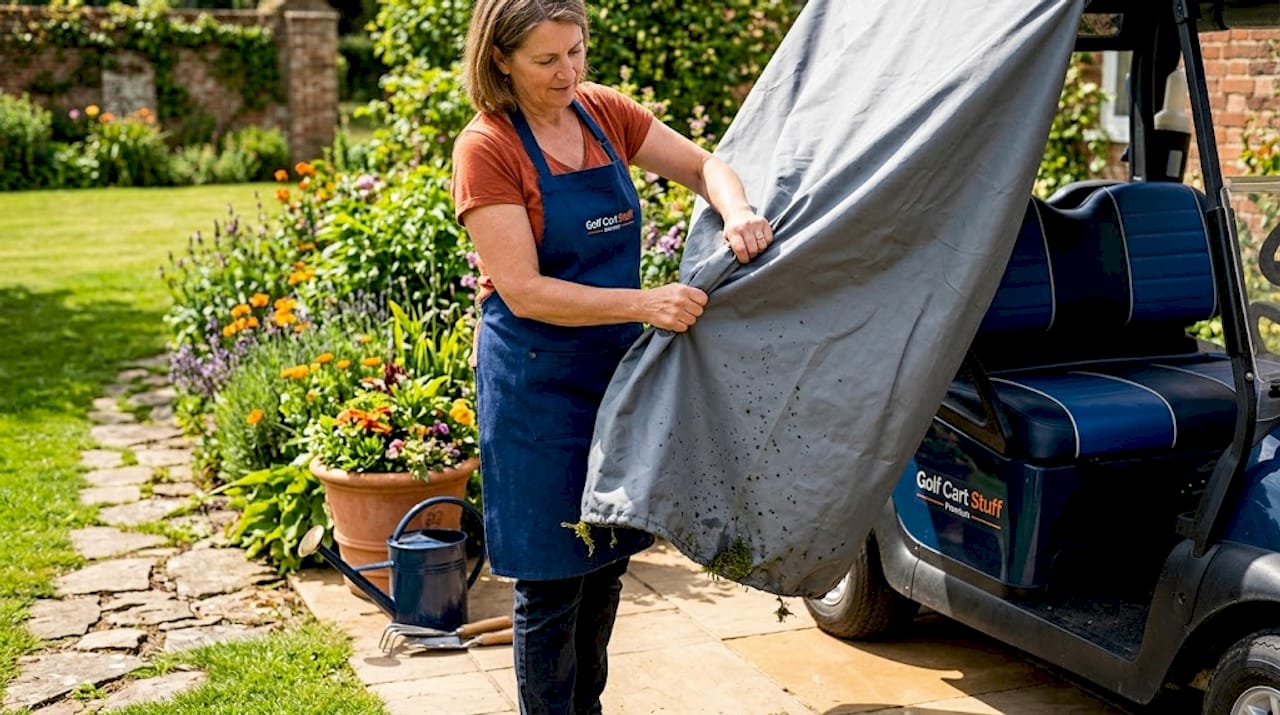
Pro Tip: In very humid regions, consider leaving the cover slightly lifted at one bottom corner while the cart is in storage. This simple step creates a passive air exchange that dramatically reduces interior humidity without exposing the cart to rain.
Besides keeping the outside protected, safeguarding your electrical system and batteries is just as critical. This is the area where owners most often discover expensive problems after the fact, usually when a cart that “looked fine” refuses to start after a wet winter.
Here is a step-by-step electrical prep routine for weather protection:
Battery charge state in cold weather is a topic that catches many owners off guard. The freezing point of a lead-acid battery is not fixed. It shifts dramatically based on how charged the battery is. A fully charged lead-acid battery has a freezing point near minus 75 degrees Fahrenheit. A half-discharged battery freezes at around 10 degrees Fahrenheit. That is a staggering difference, and it explains why so many owners lose batteries in their first serious cold snap.
| Battery charge level | Approximate freezing point |
|---|---|
| 100% (fully charged) | Around minus 75°F |
| 75% charged | Around minus 16°F |
| 50% charged | Around 10°F |
| 25% charged | Around 17°F |
| Discharged (0%) | Around 27°F |
The takeaway is simple: never store your cart for the season with a low or partially discharged battery. Charge it fully before temperatures drop, and if you are storing for more than a month, reconnect periodically to top it off using a smart trickle charger. For more detailed guidance, read up on golf cart battery care tips and review the electrical basics that govern how your system handles environmental stress. If you suspect a wiring issue after a wet season, our guide on troubleshooting golf cart wiring walks you through common fault points.
With your batteries and wiring prepped, you also need to match your cover choice to your actual climate risks. A cover that works perfectly in Phoenix is not necessarily the right tool for coastal South Carolina or Minnesota winters.
Matching your cover type to climate is about understanding what your specific environment throws at a parked cart most often. Sealed waterproofing stops rain but traps humidity. Vented designs handle moisture better but may allow wind-driven rain to enter at the edges in storm-prone regions. There is no single best cover. There is only the best cover for your conditions.
Here is how to think through it by climate category:
| Climate type | Primary threat | Cover priority |
|---|---|---|
| Hot and humid (Gulf Coast, Southeast) | Mold, corrosion, UV | Ventilated, UV-resistant cover |
| Cold and dry (Mountain West, Midwest) | Battery freeze, cracking plastic | Insulated or snug-fit storage cover |
| Wet and windy (Pacific Northwest, Northeast) | Water ingress, wind lift | Secure tie-down straps, vented waterproof design |
| Desert/dry (Southwest) | UV degradation, heat | UV-resistant material, light color to reflect heat |
| Coastal | Salt corrosion, humidity | Corrosion-resistant cover, frequent rinsing |
A few real-world scenarios worth knowing:
Take a look at our guidance on how to extend golf cart life through smart, seasonal maintenance paired with the right protection gear.
Here is something we have noticed after years of serving golf cart owners: the people who suffer the most expensive weather-related damage are rarely careless owners. They are usually owners who made one or two reasonable-sounding assumptions that turned out to be wrong.
The most common assumption is that a heavy-duty tarp equals real protection. It feels logical. Tarps are thick, waterproof, and inexpensive. But they are designed for cargo, not for a vehicle with battery terminals, wiring harnesses, and fabric surfaces that need to breathe. Tarp users often discover rust, mold, and corrosion damage that would not have happened with a simple vented cover and indoor storage.
The second big mistake is the “set it and forget it” approach to winter storage. Owners charge the battery once in November and check in again in March. What actually happens in between is that the battery slowly self-discharges, reaches a dangerous charge level, and either freezes during a cold snap or sulfates so badly that it will not accept a full charge again. A 20-minute checkup every three to four weeks during storage would prevent most of these losses.
The owners whose carts consistently outlive average expectations share a few simple habits. They do a five-minute visual check whenever the cart comes out of storage or sits through a heavy rain. They keep terminals clean and greased as a routine rather than a reaction to problems. They invest in a proper cover that fits their specific cart and climate rather than grabbing whatever is available.
The importance of ongoing maintenance cannot be overstated. The gap between a cart that lasts 15 years and one that needs major work in year five is almost entirely explained by small, consistent attention over time.
Our honest advice: build a two-minute weather prep checklist and tape it inside your storage space. Check connections. Confirm charge level. Verify the cover is seated properly. That routine, done consistently, is worth more than the most expensive cover on the market.
Ready to put these tips to work? We carry a wide range of golf cart accessories specifically selected for year-round weather protection, including breathable covers, battery maintainers, corrosion inhibitors, and more.
Whether you drive a Club Car, EZGO, or Yamaha, we stock model-specific solutions that actually fit. Browse our selection of Club Car DS parts or explore EZGO accessories to find covers, enclosures, and protection products matched to your exact cart. Every product we carry is vetted for real-world performance, not just spec sheets. Our team is here to help you match the right gear to your climate, your cart, and your storage situation so you get protection that actually works season after season.
Waterproof covers without ventilation can trap moisture and increase corrosion risk, making breathable, vented covers a much safer choice for long-term outdoor storage.
Inspect electrical connections before and after heavy rain or humidity spikes. Inspect and protect battery lugs and harness plugs regularly to prevent corrosion from building up undetected.
Fully charge your lead-acid batteries before winter storage. Fully charged batteries have a freezing point near minus 75°F, compared to around 10°F for a half-discharged pack.
Use a standard storage cover when the cart is parked, and choose a riding enclosure only if you plan to operate it in rain or cold. Storage covers are not built to withstand motion and wind load during rides.
Rinse off mud or salt gently, towel dry the canopy, seats, and floor wells, then inspect plugs and lugs before using the cart again to catch any moisture-related issues early.
Explore our store to see what our products and resources can do for you.

Leave a comment