

Your Cart Is Our Priority
Explore our store to see what our products and resources can do for you.

TL;DR:
- Most golf cart backfires stem from simple, fixable issues like misadjusted carburetors, worn spark plugs, or faulty governors. Addressing symptoms promptly with basic maintenance prevents small problems from causing engine damage and reduces long-term repair costs. Proper troubleshooting, routine upkeep, and quality parts ensure smooth operation and minimize backfire occurrences.
That loud bang from your golf cart’s engine isn’t necessarily the sign of disaster most people assume it is. In reality, the vast majority of golf cart backfires trace back to a short list of fixable, affordable problems — things like a slightly out-of-tune carburetor, a worn spark plug, or a governor that isn’t closing completely. Backfiring is a combustion event happening outside the engine’s normal cycle, and while it sounds alarming, understanding exactly what triggers it puts you back in control. This guide walks you through what causes backfires, how to diagnose them systematically, and what you can do to stop them from coming back.
| Point | Details |
|---|---|
| Backfire basics | Golf cart backfiring usually means combustion happens at the wrong time or place. |
| Most common causes | Air-fuel mix, ignition timing, and throttle issues are the main culprits behind most backfires. |
| Effective troubleshooting | Addressing simple issues first solves most backfiring problems quickly and easily. |
| Preventive care | Regular maintenance is the best way to avoid backfire-related trouble in the future. |
| When to seek help | Persistent or unclear backfires may require diagnosis from a golf cart professional. |
Before we dive into causes, let’s clarify what backfiring means for a golf cart owner.
Backfiring is an explosion of fuel that happens either in the intake manifold (a “backfire” in the traditional sense) or in the exhaust system (sometimes called an “afterfire”). In plain terms, fuel is igniting somewhere it shouldn’t, or at the wrong time in the engine cycle. The result is that sharp crack or bang you hear, sometimes accompanied by a puff of smoke, a stumble in power delivery, or even a small flame from the exhaust.
In gas-powered golf carts, backfiring typically shows up in a few specific ways:
As poor combustion develops from an incorrect air-fuel mixture, the unburned fuel finds its way into the exhaust or back into the intake, where it eventually ignites on contact with heat. That explosion is the bang you hear.
“Backfiring doesn’t automatically mean your engine is failing. More often, it’s a signal that something small is out of adjustment and needs attention before it becomes a bigger problem.”
Understanding the exact nature of the backfire — when it happens, what it sounds like, and how often it occurs — is the first step toward a proper fix. Getting familiar with golf cart motor troubleshooting basics will help you read these symptoms accurately and avoid paying for repairs you don’t actually need.
Now that you know what backfiring is, let’s look at the actual reasons it happens in your golf cart.
The good news is that most backfires come from one of just three root areas: air-fuel mixture problems, ignition timing issues, or throttle and governor faults. Each one has distinct symptoms, so you can often narrow down the cause before you even open the engine cover.
This is the single most common culprit. An incorrect air-fuel mixture — whether too lean (too much air, not enough fuel) or too rich (too much fuel) — creates combustion that is incomplete or poorly timed. A lean mixture burns slowly and may still be burning when the exhaust valve opens, creating a backfire in the exhaust. A rich mixture dumps excess fuel into the system, which can ignite explosively when it finally meets heat.
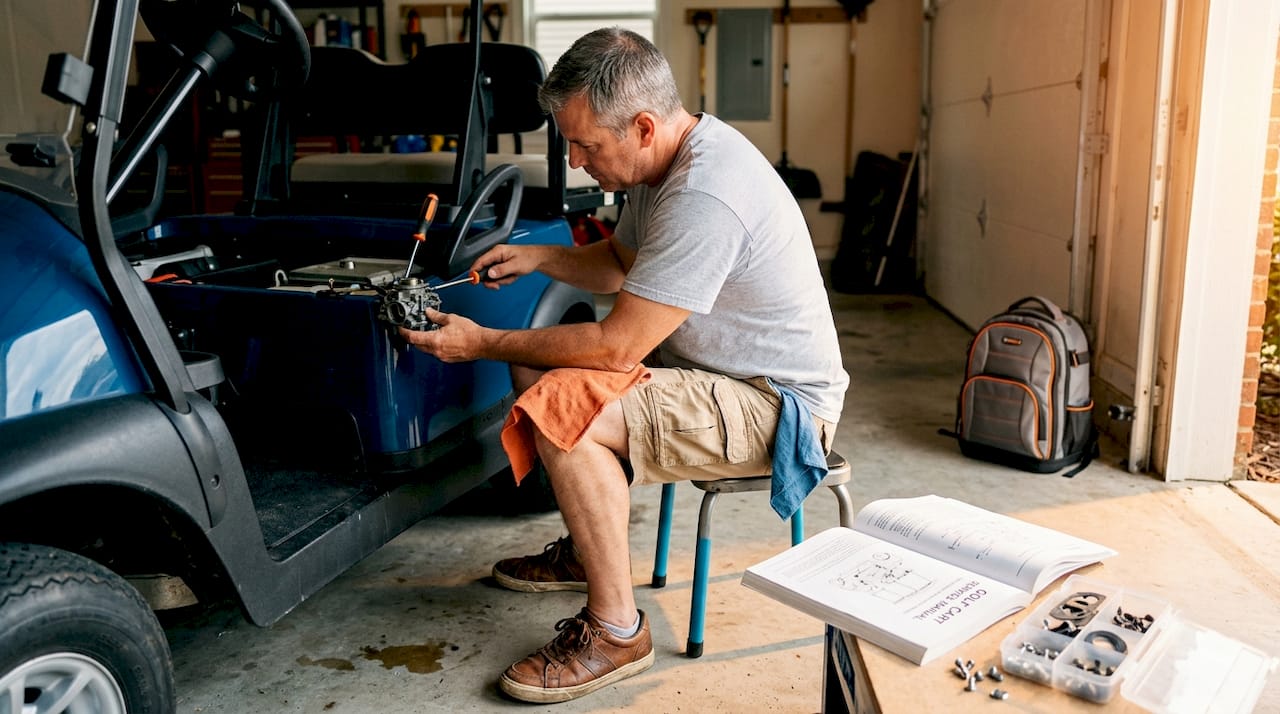
Fuel igniting at the wrong time is another major cause. If your spark plug fires too early or too late in the piston’s stroke, the combustion event doesn’t line up with the engine’s mechanical cycle. Early ignition can force combustion gases back through the intake; late ignition sends unburned fuel into the exhaust, where it pops or bangs on contact with heat.
This is the most likely cause when your cart backfires specifically during deceleration. A governor or throttle that doesn’t close completely keeps feeding fuel into the engine even as the engine slows. That excess fuel moves into the exhaust system, ignites from residual heat, and produces the characteristic deceleration pop.
Here’s a quick comparison to help you connect what you’re experiencing to the most likely cause:
| Symptom | Most likely cause | Typical fix |
|---|---|---|
| Backfire on cold startup | Rich mixture or choke issue | Adjust carburetor, clean choke |
| Backfire on deceleration | Throttle/governor not closing | Adjust linkage, clean governor |
| Backfire at high speed | Lean mixture or timing off | Rejet carburetor, check timing |
| Constant rough running with pops | Spark plug fouled or failing | Replace spark plug, check wires |
| Backfire even after new parts | Faulty coil or governor | Test ignition coil, readjust |
Follow these steps to start identifying your specific situation:
Pro Tip: Persistent backfiring after you’ve replaced the spark plug, air filter, and carburetor jets almost always points to an ignition coil that’s breaking down under heat, or a governor adjustment that’s slightly off. Don’t overlook these before spending more money on parts.
Following a solid set of golf cart maintenance steps as part of your routine will catch many of these issues before they develop into full-blown backfiring problems. If your cart is also struggling with speed alongside the backfire, reviewing golf cart speed solutions can help you address both problems at the same time.
Once you’ve identified possible causes, here’s how you can work through them methodically.
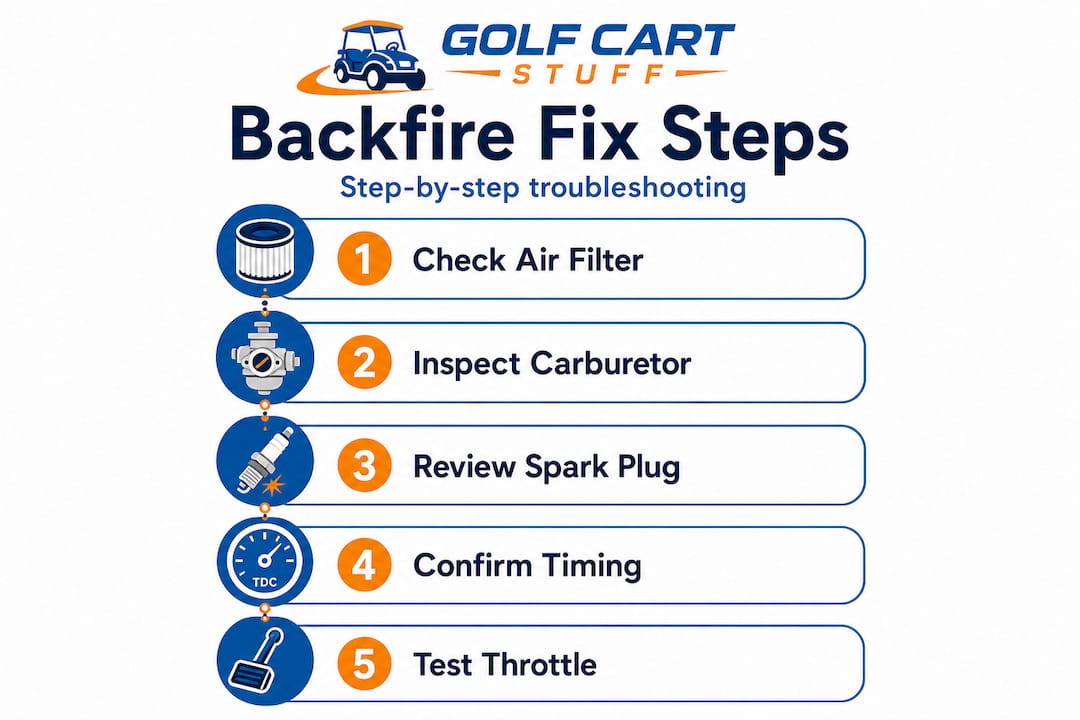
The key to effective troubleshooting is ruling out simple, inexpensive problems before you move on to more complex ones. Most backfire issues are resolved within the first three or four steps below — so patience and a systematic approach will save you both time and money.
Step-by-step diagnosis checklist:
Here’s a quick-reference troubleshooting table to match your observations to likely fixes:
| When does it backfire? | Check first | Secondary check |
|---|---|---|
| Cold startup only | Choke function | Carburetor enrichment circuit |
| After lifting throttle | Governor linkage | Throttle plate return spring |
| Under load/acceleration | Air filter, fuel flow | Jet size, fuel pump output |
| Randomly and frequently | Spark plug, coil | Timing, fuel mixture screws |
| Only at high speed | Lean mixture, jetting | Ignition timing advance |
Pro Tip: Always start troubleshooting at the least expensive and most accessible components. Fixing a $3 air filter before chasing an ignition coil problem is just smart mechanics. Work from simple to complex, and document what you’ve already checked so you don’t repeat steps.
Developing a solid understanding of your cart’s golf cart electrical basics is especially useful when the backfire seems linked to ignition components rather than fuel delivery — the two systems interact closely in small gas engines.
Diagnosing and fixing a backfire is one thing, but prevention makes owning a golf cart much easier.
The reality is that most backfires are preventable with consistent, basic maintenance. The engines in gas golf carts are small and relatively simple, which means they respond quickly to neglect — but they also respond quickly to proper care. A few focused habits throughout the year will keep combustion running clean and quiet.
Key prevention habits every owner should follow:
Pro Tip: Keep a simple maintenance log in your cart’s storage compartment. Write down when you changed the plug, cleaned the carb, and last checked the linkage. That record makes it easy to spot what’s overdue and gives any mechanic a head start if the cart needs professional service.
Staying ahead of routine cart maintenance isn’t just about preventing backfires — it extends the life of the engine, keeps fuel economy stable, and maintains the resale value of your cart over the long run.
Here’s an insider view that every long-time golf cart owner should hear: the real danger isn’t the backfire itself — it’s the assumption that the cart needs a major repair when it doesn’t.
We see this pattern constantly. An owner hears a loud bang, panics, and either ignores the cart entirely or jumps straight to expensive diagnostics and part replacements. Both responses usually miss the actual fix. The truth is that the overwhelming majority of backfires resolve with something as basic as a new spark plug, a carburetor cleaning, or a governor linkage adjustment. None of those jobs require a professional shop or serious investment.
What does create real engine trouble is the second pattern: ignoring a backfire and driving through it for weeks. Persistent combustion problems put extra stress on exhaust valves, can erode head gaskets over time, and lead to carbon buildup that compounds every other running issue the cart has. A backfire that starts as a $15 carburetor cleaning job can become a $400 valve job if it’s left alone long enough.
The other thing most owners miss is context. As persistent backfire situations show, sometimes you replace everything that seems logical — the plug, the filter, the carburetor — and the backfire continues. In those cases, the ignition coil is almost always the overlooked variable. Coils can test fine when cold but break down intermittently under heat, which makes them hard to diagnose without a proper spark test under load. If you’ve replaced all the obvious parts and still hear that bang, test the coil before you go any further.
The bottom line is this: a backfiring golf cart is telling you something specific, and it’s almost always speaking a fixable language. Treat it as an early warning system rather than a death sentence, and you’ll spend far less time and money keeping your cart on the course. Check out our motor troubleshooting resources for a deeper look at how gas and electric cart engines behave differently under stress.
If you’re ready to put these fixes and habits into action, quality parts make all the difference.
Working through a backfire diagnosis is satisfying — but only when you have the right parts on hand to actually make the repair. Generic or incompatible components can introduce new problems, especially with carburetors, ignition coils, and governor linkage where precise fit matters.

At Golf Cart Stuff, we stock a wide selection of genuine and compatible replacement parts across all major cart brands. Whether you’re rebuilding a carburetor, replacing a spark plug, or hunting down a governor spring, you’ll find what you need without guesswork. Browse our Club Car DS parts collection or check out our Yamaha G1 through G22 parts catalog for model-specific components that actually fit. We also carry a full range of golf cart accessories to keep your ride running and looking its best all season long.
Occasional backfiring generally doesn’t cause serious engine damage, but repeated backfires put stress on exhaust valves and other components, so it’s worth addressing the root cause promptly rather than riding it out.
Deceleration backfiring almost always means the throttle or governor isn’t returning fully to the closed position, so unburned fuel enters the hot exhaust and ignites — a throttle not closing fully is the textbook cause.
Driving short distances while you gather information for a diagnosis is usually fine, but continuing to use the cart without addressing the problem can worsen the underlying issue, especially if the cause is coil or governor related.
No — backfiring is a combustion event, so it only applies to gas-powered carts. Electric carts have their own set of performance issues, such as battery or controller faults, but they don’t produce the combustion-based bang that gas engines do.
Explore our store to see what our products and resources can do for you.

Leave a comment