
Your Cart Is Our Priority
Explore our store to see what our products and resources can do for you.

TL;DR:
- A golf cart solenoid is an electromagnetic switch that manages high-current power flow from the battery to the motor. It acts as a relay, closing contacts to send voltage to the motor or starter circuit when the accelerator is pressed. Testing involves checking battery voltage, control signal, and contact continuity, with replacement needed when contacts are pitted or burnt.
A golf cart solenoid is an electromagnetic switch that controls high-current power flow from the battery to the motor, making it one of the most critical golf cart electrical components in your entire drivetrain. Explaining golf cart solenoid function comes down to one core idea: without a working solenoid, pressing the accelerator does nothing. The solenoid acts as the gatekeeper between your battery pack and your motor. Understanding how it works, how it fails, and how to test it will save you time, money, and unnecessary part replacements.
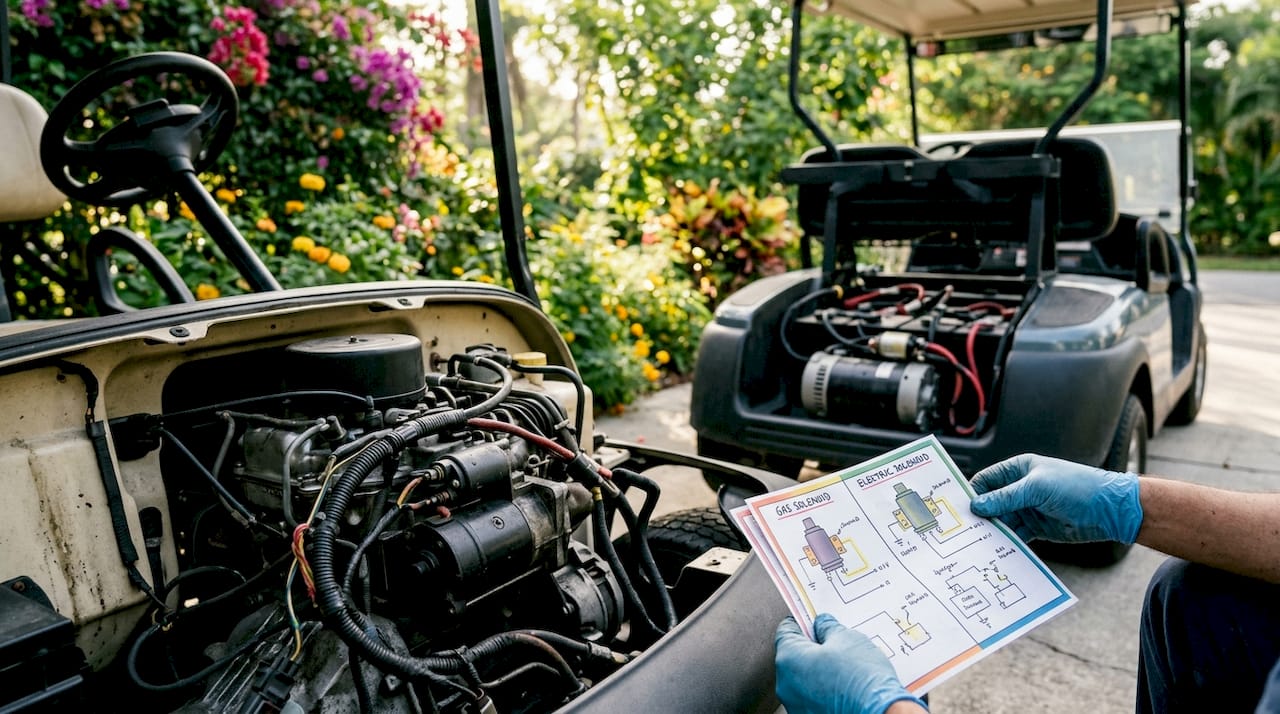
The solenoid operates as a relay. When you press the accelerator, a small control signal energizes the solenoid’s internal electromagnetic coil. That coil pulls a plunger inward, which physically closes a set of heavy copper contacts. Those contacts complete the high-current circuit between the battery and the motor.
The key distinction between electric and gas carts is what that circuit powers. In an electric golf cart, the solenoid controls the drive motor directly. Closing the contacts sends full battery voltage to the motor controller or motor, and the cart moves. In a gas golf cart, the solenoid activates the starter generator circuit instead. Gas cart solenoids produce a “click but no crank” fault when they fail, not a “click but no movement” fault like electric models. That difference matters when you are diagnosing a problem.
Most electric golf carts run on 36V or 48V battery systems. The solenoid’s control coil typically operates on a much lower signal voltage, often drawn from the key switch or a microswitch on the accelerator pedal. The main contacts, however, carry the full pack voltage at high amperage every time you accelerate.
Upgrading to a high-torque motor or a lithium battery pack increases amperage draw significantly. That added load accelerates contact wear inside the solenoid and shortens its service life. If you have upgraded your cart’s power system, a standard OEM solenoid may not be rated for the new load.
Pro Tip: If your cart has a lithium battery upgrade, verify that your solenoid’s continuous amperage rating matches or exceeds the motor’s peak draw. A mismatch is one of the most overlooked causes of premature solenoid failure.
Solenoid failure follows predictable patterns once you know what to listen and look for. The three most common symptoms each point to a different root cause.
Single click, no movement. A single click with no cart movement means the coil is energizing and pulling the plunger, but the internal copper contacts are pitted or corroded and cannot pass current. The mechanical side works. The electrical side does not.
Rapid, repetitive clicking. Rapid clicking signals that battery voltage is too low to hold the solenoid engaged. The coil pulls the plunger in, voltage drops, the plunger releases, voltage recovers slightly, and the cycle repeats. This is a battery or charging problem masquerading as a solenoid fault.
No click at all. Silence when you press the accelerator points to coil failure, a broken wire, a failed key switch, or a faulty microswitch on the accelerator pedal. The solenoid never receives its trigger signal.
The root cause of most true solenoid failures is contact wear from arcing and thermal stress. Solenoids switch full battery voltage thousands of times over their service life. Each switching event creates a small arc across the contacts. Over time, those arcs pit and burn the copper surfaces until they can no longer carry current reliably.
One important nuance: a click only confirms mechanical engagement. It does not confirm that the contacts are conducting. Many cart owners hear a click and assume the solenoid is fine. That assumption leads to chasing motor or controller faults that do not exist. Always verify actual current flow, not just the sound.
Corrosion, physical damage, and heat discoloration are also reliable visual indicators. Burnt or pitted terminals visible on the solenoid body are a strong sign that internal contacts have failed and replacement is needed.
Safe testing starts with a multimeter and a clear sequence. Skipping steps wastes time and leads to replacing parts that are not broken.
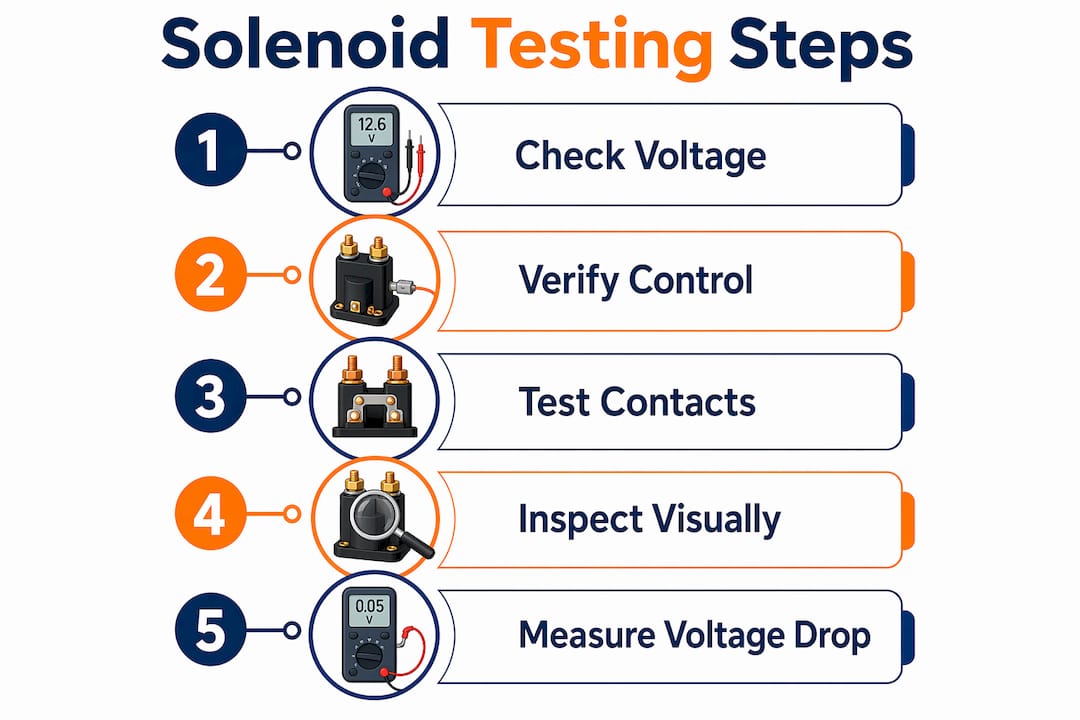
Step 1: Check battery voltage first. A fully charged 48V pack should read 50–52V at rest. A 36V pack should read 37–38V. Low voltage causes rapid clicking and mimics solenoid failure. Fix the battery before testing anything else.
Step 2: Verify the control circuit. With the key on and the accelerator pressed, use your multimeter to confirm that the solenoid’s small coil terminals are receiving the correct control voltage. No voltage here means the fault is upstream: key switch, microswitch, or wiring.
Step 3: Test the main contacts under load. Measuring voltage and continuity across the solenoid’s large terminals while the accelerator is pressed confirms whether the contacts are closing and conducting. A voltage drop greater than 0.5V across a closed solenoid indicates degraded contacts.
Step 4: Inspect visually. Look for heat discoloration, burnt terminals, and swollen or cracked solenoid bodies. Physical damage is a definitive sign of failure.
| Test | Tool | Pass Result | Fail Result |
|---|---|---|---|
| Battery voltage | Multimeter | At or above rated pack voltage | Below rated voltage |
| Control coil voltage | Multimeter | Signal voltage present at coil terminals | No voltage at coil terminals |
| Main contact continuity | Multimeter | Near-zero resistance when engaged | High resistance or open circuit |
| Voltage drop under load | Multimeter | Less than 0.5V drop across contacts | Greater than 0.5V drop |
| Visual inspection | Eyes | No burns, no swelling, clean terminals | Burnt terminals, heat marks, corrosion |
Many electrical faults blamed on solenoids are actually caused by loose battery cables, corroded connectors, or failing switches. Always inspect the full wiring and cable path before condemning the solenoid.
Pro Tip: Measure voltage drop across the solenoid’s main terminals while the cart is under load, not just at rest. A solenoid can pass a static continuity test and still fail under the current demands of actual operation.
Preventive maintenance is far cheaper than emergency replacement. A few simple habits protect the solenoid and the rest of your electrical system.
Not all replacement solenoids are equal. Choosing the right one depends on your cart model, battery voltage, and any performance upgrades you have installed.
OEM solenoids from Club Car, EZGO, and Yamaha are engineered to match the exact voltage and amperage specifications of their respective carts. They are the safest choice for a stock cart with no modifications. Aftermarket solenoids are widely available at lower price points, but quality varies. A reputable aftermarket unit from a known supplier will perform reliably. A cheap, unbranded unit may fail within a season.
Heavy-duty solenoids are designed for carts running upgraded motors or lithium battery packs. They feature larger contact surfaces and higher continuous amperage ratings, which reduces arcing and extends service life under elevated loads. If your cart has any performance modifications, a heavy-duty solenoid is the correct replacement, not an OEM-spec unit.
Pre-charge resistors are worth understanding if your cart uses a motor controller. When a solenoid closes on a discharged controller capacitor, the inrush current creates a large arc across the contacts. A pre-charge resistor limits that inrush, protecting both the solenoid and the controller. Some aftermarket solenoid kits include a resistor; many OEM setups do not. Adding one is a low-cost upgrade that meaningfully extends contact life.
Flyback diodes protect the solenoid coil from voltage spikes when the coil de-energizes. Most modern solenoids include an internal diode, but older or budget units may not. Verify this before installing a replacement on a cart with solid-state components.
The golf cart solenoid is a high-current electromagnetic switch that controls power delivery from the battery to the motor, and testing it correctly requires checking the full electrical path, not just listening for a click.
| Point | Details |
|---|---|
| Core function | The solenoid closes a high-current circuit between the battery and motor when the accelerator is pressed. |
| Electric vs. gas carts | Electric solenoids control drive power; gas solenoids control the starter circuit only. |
| Failure symptoms | A single click signals contact failure; rapid clicking signals low battery voltage; silence signals coil or wiring failure. |
| Testing sequence | Check battery voltage, control signal, main contact continuity, and voltage drop before replacing the solenoid. |
| Upgrade compatibility | High-torque motors and lithium batteries require a heavy-duty solenoid rated for the increased amperage. |
The single biggest mistake I see from cart owners is replacing the solenoid the moment they hear a click. A click is not a diagnosis. It is a starting point. I have seen carts come in with a brand-new solenoid installed and the same fault still present, because the real problem was a corroded battery cable or a worn microswitch that nobody bothered to check.
The second mistake is ignoring upgrades. When someone installs a high-torque motor and keeps the original solenoid, they are setting themselves up for a failure within months. The math is simple: more current through the same contacts means faster wear.
What actually works is a systematic approach. Start at the battery, work forward through the cables and switches, and only condemn the solenoid after you have ruled out everything upstream. That process takes maybe 20 minutes with a multimeter and saves you from a part replacement that solves nothing. For a deeper look at distinguishing solenoid faults from motor faults, the golf cart motor troubleshooting guide at Golfcartstuff is worth reading before you start pulling parts.
Brand-specific tendencies are real. Club Car solenoids tend to be durable but are sensitive to voltage drops from aging battery packs. EZGO units are straightforward to test and replace. Yamaha solenoids on older G-series carts are known to develop coil failures before contact wear becomes an issue. Knowing your platform helps you know where to look first.
— Roshan
Golfcartstuff carries a wide selection of OEM-compatible and heavy-duty solenoids for the most popular cart platforms on the market.
Whether you drive a Club Car DS, a Yamaha G-series, or an EZGO, you will find the right replacement solenoid matched to your model’s voltage and amperage specs. Golfcartstuff also stocks related electrical components including battery cables, contactors, and motor controllers to support a complete repair or upgrade. Browse Club Car DS parts or the full Yamaha G1-G22 parts catalog to find the exact solenoid your cart needs. When you are ready to do the swap yourself, the solenoid replacement guide at Golfcartstuff walks you through the process safely.
A golf cart solenoid is an electromagnetic switch that closes a high-current circuit between the battery and the motor when you press the accelerator. Without it, no power reaches the motor and the cart will not move.
A single click with no movement means the solenoid coil is engaging but the internal copper contacts are pitted or corroded and cannot pass current. The solenoid needs replacement.
Rapid, repetitive clicking almost always points to low battery voltage rather than a failed solenoid. Charge your batteries fully and retest before replacing any parts.
No. Gas cart solenoids control the starter circuit, while electric cart solenoids control drive motor power. They require different testing methods and are not interchangeable.
Solenoids are wear components with no fixed replacement interval. On a heavily used cart, inspect the solenoid annually and replace it proactively if you see burnt terminals, heat discoloration, or intermittent faults.
Explore our store to see what our products and resources can do for you.

Leave a comment